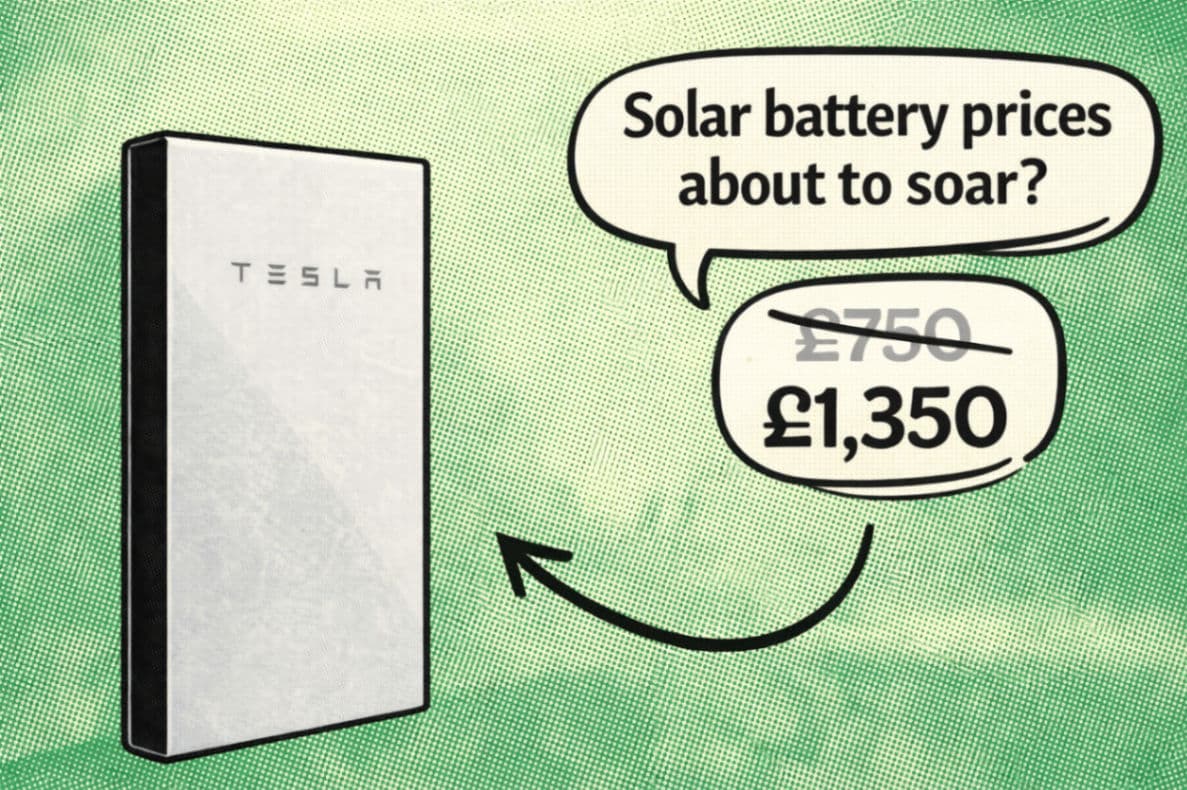

Solar battery prices are about to get noticeably more expensive - and no, it’s not because installers have suddenly turned greedy.
- Why have solar battery prices been falling for years?
- The China export VAT rebate explained (without the boring bits)
- Panels already got hit - batteries are next
- What’s actually happening to battery rebates?
- Why UK buyers will feel this fast
- What this means in actual UK prices (proper pounds & pence)
- Will manufacturers use this as an excuse to jack prices up?
- What about Tesla - will Powerwall buyers be safe?
- Who gets squeezed first? The budget battery market
- Will Sigenergy prices increase?
It’s not because the UK has had a surprise battery-buying frenzy either.
This price shift is coming from somewhere else entirely: China is pulling back a policy that’s been quietly keeping battery costs low for years.
And because China supplies most of the world’s battery hardware, what happens there doesn’t stay there.
In this guide, we’ll explain what’s changing, when you’ll feel it in the UK, and what it could mean in real terms for your install cost.
PS We offer MCS-certified battery installation nationwide. Simply answer these questions, get your fixed price and arrange your free design.
The short version
For years, solar batteries have been quietly “helped along” by China through a system called an export VAT rebate.
In simple terms, it meant manufacturers could export batteries at lower prices, because part of the VAT cost was effectively refunded.
That’s a big reason battery hardware has stayed cheaper than the true cost of production would normally allow.
But that support is now being switched off.
The rebate is being phased down across 2026, then removed completely from January 2027 - and once that happens, the price floor rises.
Not just in China… but everywhere that buys Chinese-made battery kit (so yes, the UK too).
Why have solar battery prices been falling for years?
If you’ve been keeping an eye on solar and battery pricing lately, you’ll know the direction has been pretty consistent:
downwards.
That’s mainly because the market exploded.
More manufacturers moved in, supply chains scaled up, competition got fierce, and prices started dropping as brands fought for market share.
But the real secret sauce behind those bargain-level prices?
China’s industrial and financial firepower.
For years, China pumped serious support into manufacturing to keep its exports globally competitive - especially across solar panels and batteries.
And now that support is being pulled back…which is why battery prices are about to start climbing.
The China export VAT rebate explained (without the boring bits)
China uses something called an export VAT rebate system - and it’s basically one of the reasons batteries have been so aggressively priced for the last few years.
Here’s the simple version.
A manufacturer buys all the bits needed to build a battery inside China - cells, components, materials, the lot. Like any business, they pay VAT when they buy those parts.
But when that finished battery is exported overseas, the Chinese government refunds some of that VAT back to the manufacturer through a rebate scheme.
So what does that actually mean?
It means Chinese brands can sell batteries abroad for less than you’d expect, because they’re getting part of their costs returned behind the scenes.
So the price looks cheaper… but their profit margin stays protected.
And that is the support that’s now being scaled back - which is exactly why battery prices are about to start creeping up.
🎥 Watch the full video to see what this change really means for UK battery prices - and whether installers will pass it on:
Panels already got hit - batteries are next
Solar panels were on the same kind of deal too. Their export rebate has already been cut from 13% down to 9%, and from April 2026, it gets removed entirely.
So… why haven’t panel prices shot up already?
Because the panel market is basically swimming in cheap stock right now.
Manufacturers and distributors have been sitting on piles of low-priced inventory, and the UK supply chain is still working its way through it.
So even though the rebate is shrinking, prices won’t properly move until the “old cheap stuff” has been sold off.
Once that stock clears after April 2026, panel prices are much more likely to rise across the board.
Batteries won’t behave the same way.
Battery units don’t sit around in warehouses in the same quantities as panels. Installers and suppliers generally hold far fewer batteries in reserve, so when the cost structure changes, the effect shows up faster.
Meaning when battery prices move… it probably won’t be slow and gentle.
It’ll feel more like a sudden step-up.
What’s actually happening to battery rebates?
This is the key bit.
China isn’t removing the battery export rebate overnight - it’s doing it in stages.
First, the rebate is being phased down from 9% to 6% through most of 2026.
Then from January 2027, it’s gone completely.
And the reason they’re doing it is pretty straightforward: they’re trying to stop batteries turning into the same mess we’ve already seen with solar panels - overproduction, constant price undercutting, and manufacturers racing each other to the bottom until nobody’s making any money.
The logic from China’s side goes like this:
take away the subsidy → prices rise → demand cools off → production levels out → profit margins recover.
That’s the theory, anyway.
“Is this just speculation?” Nope.
This isn’t solar WhatsApp gossip or installer rumour.
It’s already being reported by major outlets - Reuters described the policy shift as a move to curb what they called “excessive involution-style competition.”
That phrase sounds like it belongs in a thesis…
…but in normal human language it basically means:
too many companies cutting prices so hard they’re wrecking their own profits, just to keep volume moving.
So China’s stepping in and raising the floor.
Why UK buyers will feel this fast
China isn’t some small player we can ignore.
It basically is the supply chain.
They control over 28% of the global solar panel manufacturing chain, and they produce more than three quarters of the batteries sold worldwide.
So when China tweaks pricing, it doesn’t stay inside China. It ripples straight through manufacturers, distributors, installers…and eventually lands on UK quotes.
You could even see the market reacting almost immediately after the announcement - lithium prices reportedly jumped, and some of the big producers took a hit in share price as investors priced in lower demand and tighter margins.
In other words: this isn’t just a theory. The industry is already moving.
This is the classic “low price → lock-in → price rise” play
If this feels familiar, it’s because you’ve seen it before.
Uber did it. Netflix did it.
Launch cheap. Get everyone used to it. Build market share.
Then once people are properly bought in…
the price slowly creeps up.
China’s been holding the price floor low for years through rebates.
Now that floor is moving - and once it lifts, the rest of the market tends to lift with it.
What this means in actual UK prices (proper pounds & pence)
Alright, enough theory - let’s talk real numbers.
Right now on the Heatable website, a typical Sigenergy battery install comes in at roughly £6,700 fully installed.
(And if you want to see your own price, you can grab a quote online in about 60 seconds.)
Now here’s the bit that matters:
On a job like that, around 65% of the total cost is the battery hardware itself.
So if the current export rebate has been helping keep that hardware price low - and it gets pulled back - the maths is pretty simple:
You’re potentially looking at around £400–£450 extra for the same kind of install once the change filters through.
That would push a £6,700 job closer to:
£7,100–£7,150 installed
(depending on the system size, layout, and how the manufacturer handles pricing)
Will every brand pass that on instantly? Probably not.
Some premium players might absorb part of it, at least short-term, because they’ve got more margin to play with.
But either way - the pressure is real. And the direction of travel is pretty obvious.
Will manufacturers use this as an excuse to jack prices up?
This is where it gets a bit spicy.
Because once the market expects prices to rise, it creates the perfect opportunity for the supply chain to do what supply chains love doing…
…quietly rebuild margins under the cover of “well, costs have gone up”.
So the big questions now are:
Will some brands take the chance to claw back profit after years of price wars?
Will the ultra-budget end of the market get squeezed out?
Does the industry consolidate into fewer big players with more control over pricing?
And does this accelerate cheaper future tech like sodium or solid-state batteries?
Because this change doesn’t just nudge the numbers up a bit.
It could reshape who survives in the battery market - and what “good value” even looks like going forward.
What about Tesla - will Powerwall buyers be safe?
If China controls roughly 80% of the global battery supply, it raises the obvious question:
who’s got the other 20%… and do they suddenly become the winner here?
Because if Chinese-made hardware gets more expensive, you’d expect “non-Chinese” brands to either:
swoop in and fill the gap, or
quietly enjoy the fact the whole market just got more expensive around them.
And the big name everyone jumps to is obviously Tesla Powerwall 3.
There’s been a lot of debate around where Tesla’s cells come from (because supply chains are never as simple as the marketing makes them sound)… but in the video we literally ring Tesla to clear it up.
Tesla confirmed their Powerwall production is done in Nevada, which means they’re not directly impacted by China’s export VAT rebate changes in the same way the wider market is.
And Tesla were already pushing hard on price before this news even landed…
They’ve been running a £350 Powerwall 3 rebate for customers purchasing before March 31st, via approved installers (including Heatable).
So now the real question becomes:
If Chinese battery pricing rises… does Tesla follow?
Our take: probably not (at least not immediately)
Tesla are already gaining momentum with the rebate scheme, and if the rest of the market lifts its prices, Tesla doesn’t need to do anything dramatic - their value proposition improves automatically.
When the price floor rises around you, “holding steady” becomes a competitive advantage.
Who gets squeezed first? The budget battery market
This is where things start getting uncomfortable.
If you’re shopping at the cheaper end of the market, those products often work on razor-thin margins already. So when costs rise, they don’t have much wiggle room.
Which usually means one of two outcomes:
prices go up quickly
or brands disappear altogether
Either way, the gap between entry-level, feature-light batteries and premium, feature-packed systems starts shrinking fast.
And weirdly… that’s where the premium brands can actually benefit.
Will Sigenergy prices increase?
Sigenergy is a good example of a premium player - and honestly, they might not raise prices at all.
They’ve got strong traction, a healthy market share, and (most likely) more margin headroom than the budget brands. So there’s less urgency to hike pricing just because the market got noisy.
If anything, what’s more likely is the lower end of the market moves first…
…and Sigenergy starts looking even better value at today’s price point without changing a thing.
Next Steps For Your Battery Journey:
When planning to install battery storage for your home, there are several important factors to consider. Make sure to refer to the following guides to help you make informed decisions:
To dive deeper into these topics, head over to our advice section, check out our YouTube channel for informative videos, or read a customer case study to see how others have benefited from their battery installation.
Get a Quote for a Battery Today
Without boasting, you should get your battery storage installed with us, here's why:
Thousands of Happy Customers: We boast an average score of 4.9 on Trustpilot, outperforming the market leader.
Which? Trusted Trader: Heatable is proudly recognised as a Which? Trusted Trader.
Tesla Certified Installer: Heatable is proudly certified and approved by Tesla to install the Powerwall.
MCS Accredited: Our accreditation by the Microgeneration Certification Scheme (MCS) ensures high-quality standards.
Consumer Protection: As members of the HIES consumer code, we provide 2-year deposit protection.
Flexible Payment Options: Choose from multiple payment methods, including finance options.
Fixed Price Guarantee: Enjoy transparency with no hidden costs.
Save Your Quote: You can save your quote and decide later.
Bespoke Battery Quote Tool: Find out which battery is ideal for your home, here.
![What size solar battery do I need? [UK, 2026]](/_next/image?url=https%3A%2F%2Fassets.heatable.co.uk%2F1720791617113_Fc5oG64OI.png&w=3840&q=75)