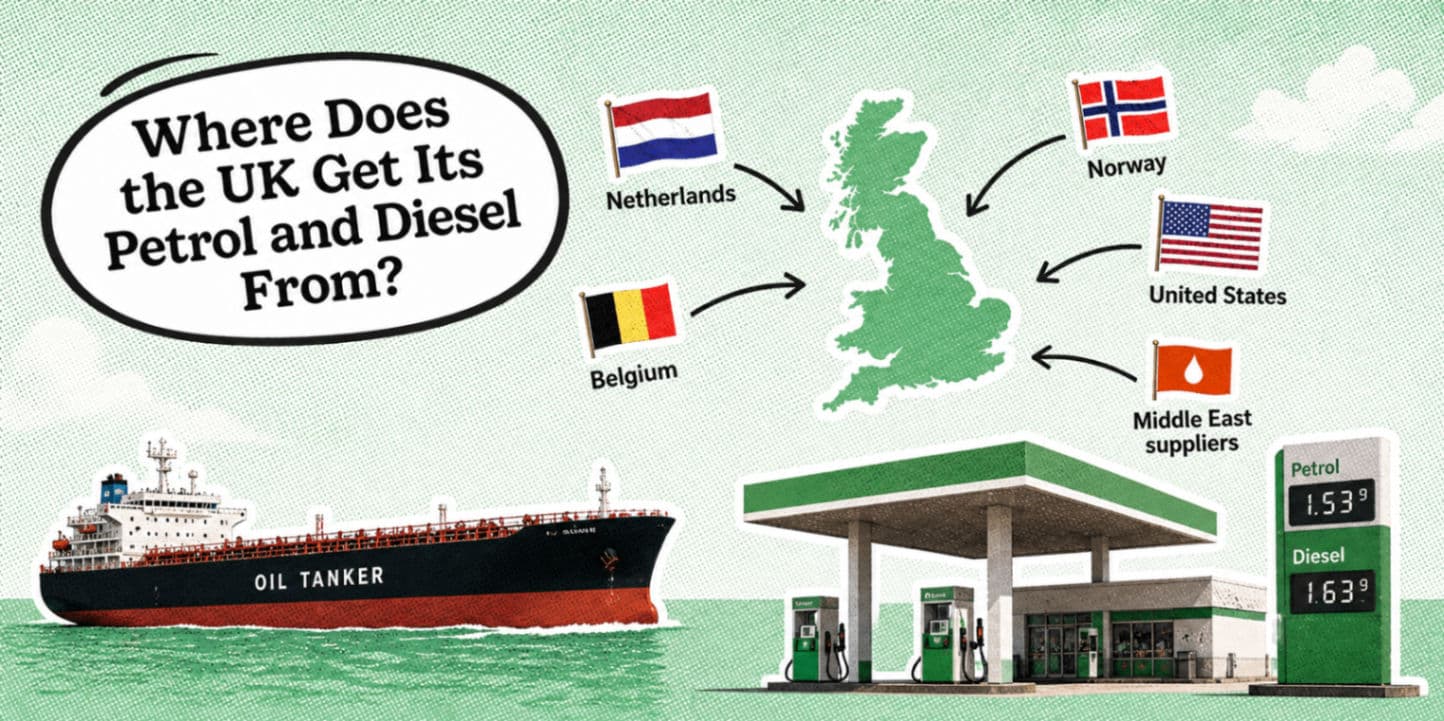

The UK gets its petrol and diesel from a mix of home-grown refining and imported fuel. So, no, it doesn’t all just bubble up from the North Sea and magically appear at your local forecourt.
- What are petrol and diesel made from?
- Does the UK produce its own petrol?
- Does the UK produce its own diesel?
- Which countries does the UK import petrol and diesel from?
- Why does the UK import diesel but export petrol?
- Is UK petrol and diesel from the North Sea?
- So, is the fuel at your local petrol station “from the North Sea”?
- Does fuel supply affect prices at the pump?
- Is the UK running out of petrol or diesel?
- What happens as the UK moves to electric cars?
Some crude oil is still produced from the UK Continental Shelf, while some is imported.
UK refineries then turn it into petrol, diesel, jet fuel, heating oil and other useful stuff.
But road fuel is part of a much bigger international supply chain. According to DESNZ’s DUKES 2025 petroleum data, the UK remains more than self-sufficient in petrol, but relies more heavily on imports for diesel.
In 2024, petroleum product imports rose by 5.9%, with diesel making up just under 40% of those imports.
Quick answer: where does UK fuel come from?
Put simply - from a bit of here, a bit of there, and a lot of behind-the-scenes logistics.
Some crude oil is produced in the UK, mainly offshore, including from the North Sea.
Some crude oil is imported from overseas. UK refineries then process that crude into petrol, diesel and other useful fuels.
The UK generally produces plenty of petrol and often exports the surplus. Diesel is the trickier one. Because demand has historically been higher than what UK refineries produce, Britain relies more heavily on imported diesel.
So, the short version: UK petrol and diesel come from a mix of North Sea production, imported crude oil, UK refining and imported finished fuels.
Not quite “straight from the North Sea to your tank”, sadly.
What are petrol and diesel made from?
Petrol and diesel are both made from crude oil.
Crude oil is the thick, dark liquid extracted from underground reservoirs or offshore fields.
On its own, it is not especially useful for your car. You cannot pour crude oil into a Ford Focus and hope for the best. Please do not try.
First, it has to go to a refinery.
At a refinery, crude oil is heated and separated into different products, including:
petrol
diesel
jet fuel
heating oil
LPG
fuel oil
bitumen
petrochemical feedstocks, which are used to make plastics and other materials
This is important because refineries do not just make one product at a time. They produce a whole mix of fuels and materials from the same crude oil.
The awkward bit is that this mix does not always match what the UK actually wants to use.
And that is where the petrol-versus-diesel problem begins.
Does the UK produce its own petrol?
Yes. The UK does produce its own petrol.
It still has domestic refining capacity, although there are fewer refineries than there used to be.
As of 2026, the UK government lists four major UK refineries: Fawley, Pembroke, Stanlow and Humber.
These refineries take crude oil and turn it into finished fuels, including petrol.
And petrol is one area where the UK is pretty comfortable. That is partly because petrol demand is lower than diesel demand.
Petrol is mainly used by cars and some light vans. Diesel, meanwhile, has to do a lot more heavy lifting.
As well as diesel cars, it is used by:
vans
lorries
buses
logistics fleets
agriculture
construction
industry
backup generators
some heating and off-road uses
That wider diesel demand helps explain why the UK can be well stocked on petrol while still importing a lot of diesel.
According to DUKES 2025, the UK is “more than self-sufficient” in petrol, with petrol typically making up around half of petroleum product exports.
In 2024, UK petrol exports went to countries including the Netherlands, the United States and Belgium.
Does the UK produce its own diesel?
Yes, the UK produces diesel too.
But, slightly annoyingly, it does not usually produce enough to cover everything the country uses.
UK refineries make diesel as part of their normal output. The problem is that Britain’s demand for diesel has historically been higher than domestic refinery production.
So the extra has to be brought in from overseas, along with other similar fuels known as middle distillates.
That is why two things can be true at once:
the UK exports petrol
the UK imports diesel
Which sounds a bit daft, until you remember that oil markets are not built around neat national shopping baskets. Countries export the products they have too much of and import the ones they need more of.
So it is not really “Britain is running out of diesel”. It is more “our refineries do not perfectly match what we actually use”.
Which countries does the UK import petrol and diesel from?
The exact mix changes from year to year, depending on prices, refinery maintenance, shipping routes, demand, sanctions and the usual global energy market chaos.
But official UK data shows that Britain imports petroleum products from a range of countries, especially nearby European refining and trading hubs.
Common sources include:
the Netherlands
Belgium
Norway
the United States
Middle East suppliers, depending on the product and year
The Netherlands is a big one, because it is one of Europe’s major oil refining and trading hubs.
According to DESNZ’s DUKES 2025 data, Dutch petroleum product imports made up about a fifth of UK petroleum product imports in 2024, while the United States accounted for 16%.
Belgium also matters because of its refining, storage and trading links with the wider European fuels market.
But this does not always mean the original crude oil came from the Netherlands or Belgium.
Often, these countries are part of the journey rather than the starting point. Fuel may be refined, blended, stored or shipped through them before reaching the UK.
Think of it like buying bread from a supermarket. The supermarket sold it to you, but the wheat, flour, bakery and distribution centre may all have been somewhere else.
Oil is similar. Just with bigger ships, more paperwork and fewer meal deals.
Why does the UK import diesel but export petrol?
Because what UK refineries produce and what the UK actually uses do not line up perfectly. Annoying, but very normal.
When a refinery processes crude oil, it does not get to say, “Today we’ll make diesel and absolutely nothing else, thanks.”
Crude oil is turned into a mix of products, and that mix depends on things like the type of crude, the refinery equipment, market demand and how the refinery is set up.
The UK has historically used a lot of diesel. Not just in cars, but across the parts of the economy that do the heavy lifting: vans, lorries, buses, freight, farming, construction and industry.
Diesel cars were also encouraged for years because they often produced lower CO2 emissions per mile than petrol cars.
Later, concerns about nitrogen oxides and particulates made that look a lot less tidy.
So you end up with a mismatch:
UK refineries produce a lot of petrol
UK petrol demand is lower than diesel demand
UK refineries produce diesel too
but UK diesel demand often exceeds domestic diesel output
That is why the UK can export petrol while importing diesel. It sounds odd, but it is basically the fuel market version of having too much pasta and not enough sauce.
In 2024, official data showed the UK remained more than self-sufficient in petrol, while petroleum product imports rose and diesel made up a large share of those imports.
Is UK petrol and diesel from the North Sea?
Some of it might start there, yes. But sadly, it is not as simple as “North Sea oil goes in, petrol station fuel comes out”.
The UK still produces crude oil, mainly from offshore fields including the North Sea. But North Sea production has declined over time.
The government’s 2025 security of supply report says the UK’s net primary oil imports increased in 2024, reflecting higher demand and falling domestic production.
Also, important bit: crude oil is not petrol or diesel.
North Sea crude has to be refined before it becomes road fuel. Some UK-produced crude is exported, while UK refineries also use imported crude.
DUKES 2025 notes that UK crude exports mainly go to the Netherlands and other European countries, where it can be processed into products such as road diesel, gas oil and heating fuels.
So, is the fuel at your local petrol station “from the North Sea”?
Sometimes. Partly. Possibly. Annoyingly, not in a neat, single-origin, farm-shop-for-fuel kind of way.
A litre of petrol or diesel at the pump is usually part of a blended international supply chain. It may involve:
crude oil produced in the UK or overseas
refining in the UK or abroad
fuel imported through ports and terminals
storage and blending
distribution by pipeline, tanker, rail or coastal shipping
delivery to forecourts
So the honest answer is - some UK road fuel may be linked to North Sea crude, but Britain’s petrol and diesel supply is really part of a much bigger global oil and refining market.
Does fuel supply affect prices at the pump?
Yes, but it is only one piece of the “why is this so expensive?” puzzle.
UK petrol and diesel prices are shaped by a whole mix of things, including:
crude oil prices
wholesale petrol and diesel prices
refining margins
exchange rates, especially sterling against the US dollar
fuel duty
VAT
retailer margins
shipping costs
supply disruption
seasonal demand
Diesel can sometimes be more expensive than petrol because it does so much of the economy’s heavy lifting.
It is used in freight, farming, construction, industry, buses, vans and logistics. So when global diesel supply gets tight, wholesale diesel prices can rise faster than petrol prices.
Exchange rates matter too. Oil is generally traded in US dollars, so if sterling weakens against the dollar, UK buyers can end up paying more even if the oil price itself has not moved much. Helpful? Not especially. True? Unfortunately.
And then there is tax.
Fuel duty is charged per litre, and VAT is added on top. So a chunky part of the pump price is not the fuel itself, but tax.
Retailers also need to cover their costs and make a margin, although how much competition you have nearby can affect what you pay locally.
So, in short: pump prices are not decided only by “where the fuel comes from”. They are shaped by global oil markets, refining capacity, taxes, exchange rates and the cost of getting fuel from refinery or port to pump.
Is the UK running out of petrol or diesel?
No. There is no need to start panic-buying fuel like it is toilet roll in 2020. That usually creates the exact problem everyone is trying to avoid.
The UK has a diversified fuel supply chain. It produces some crude oil, imports more, refines fuel domestically and brings in finished petroleum products from several countries.
But that does not mean the UK is immune to global energy chaos.
If shipping routes are disrupted, refineries go offline, wholesale prices jump, or a major supplier changes output, that can affect UK prices and availability. Diesel is usually more exposed than petrol because the UK relies more heavily on diesel imports.
So the sensible answer is: the UK is not simply “running out” of petrol or diesel. But it does depend on a complicated international supply chain, which means global problems can still show up at your local pump.
What happens as the UK moves to electric cars?
The shift away from petrol and diesel is partly about climate change. But it is also about energy security, price stability and giving households a bit more control.
The more the UK relies on imported fossil fuels, the more exposed households and businesses are to global price swings.
Electric vehicles, heat pumps, solar panels and smarter home energy systems will not magically solve every energy problem, because obviously nothing is ever that simple.
But over time, they can reduce the UK’s dependence on petrol, diesel and gas.
For households, that shift could mean:
installing an EV charger
looking at solar panels
improving home energy efficiency
considering a heat pump
planning a boiler replacement
thinking about wider home electrification
Of course, not everyone can switch to an EV or heat pump overnight. Upfront costs, property type, charging access and personal circumstances all matter. Very real life, sadly, has a habit of interfering with neat policy ideas.
But the direction of travel is clear: the UK is gradually moving from a fuel system based on imported and refined oil products towards one based more on electricity, renewables and smarter home energy use.
Less “where did this diesel come from?” and more “how can I power my home and car with cleaner, more predictable energy?”