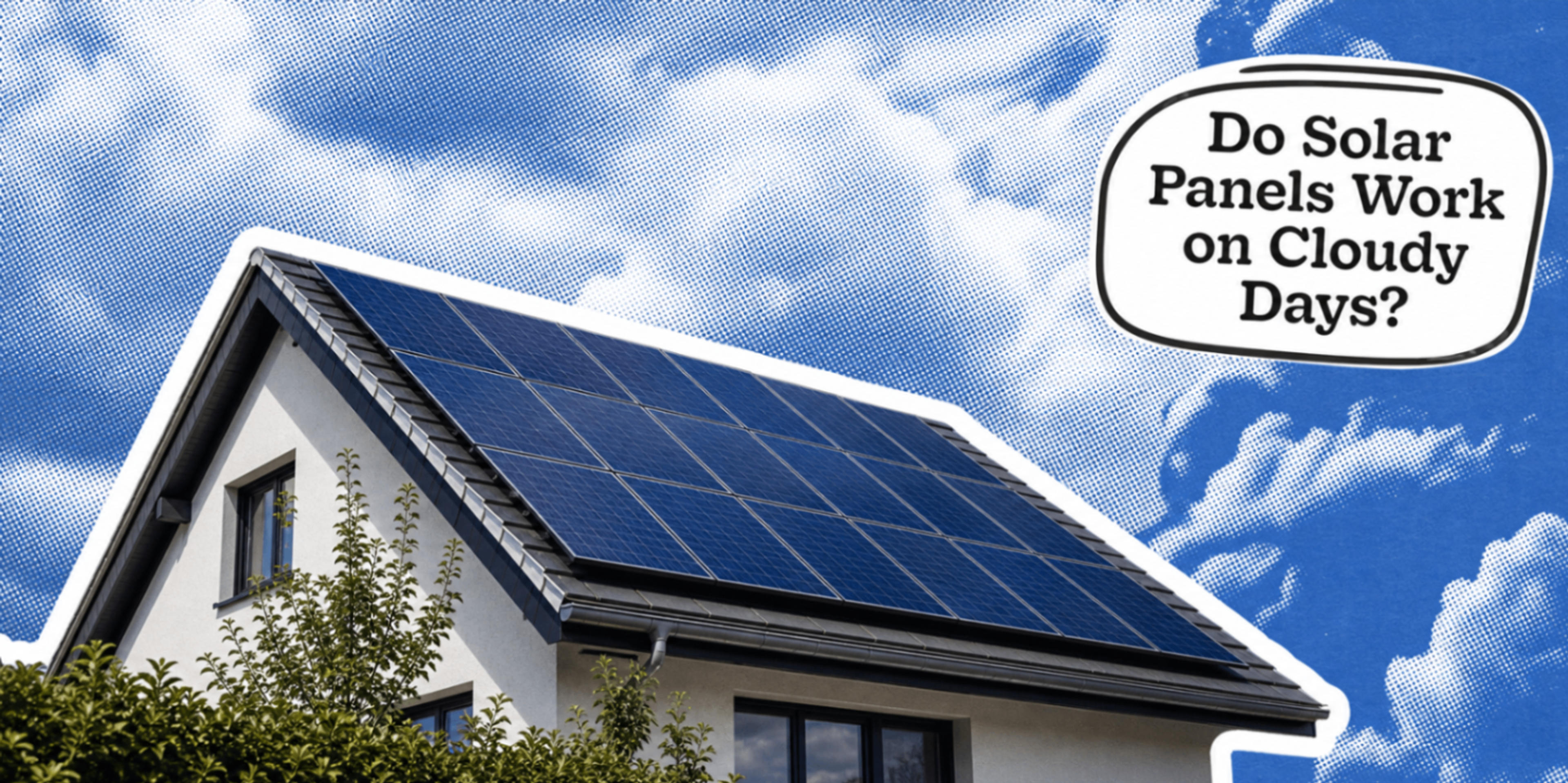

Yes, solar panels work on cloudy days. They generate less electricity than they would in strong sunshine, but a grey sky does not flick the big solar off-switch.
If solar panels only worked beneath a flawless blue sky, selling them in the UK would be a fairly bold business model.
Luckily, they do not.
Solar panels generate electricity from daylight, which means they continue working when the sun disappears behind a cloud at 9:07am and is not seen again until Thursday.
They will not produce as much electricity as they would in strong sunshine. But photovoltaic panels can use direct sunlight and the softer, scattered light that makes its way through cloud.
So, no - your solar system does not take the day off whenever the weather app displays a little grey symbol. It simply generates less.
PS We offer MCS-certified solar panel installation nationwide. Simply answer these questions, get your fixed price and arrange your free design.
Key points:
Yes, they work - solar panels generate electricity on cloudy and overcast days.
Output will be lower - thicker cloud means less light reaches the panels.
There is no magic percentage - every cloud, roof and solar system is different.
Cold is not the enemy - dull light reduces generation; cool temperatures can actually suit solar cells.
A battery cannot improve the weather - it stores electricity but does not make the panels generate more.
The full year matters - judge a solar system by realistic annual generation, not one glorious afternoon in July.
How do solar panels work when it is cloudy?
Yes.
Solar photovoltaic cells generate electricity when particles of light, called photons, reach the semiconductor material inside the panel. That process does not depend entirely on direct sunshine.
Some light travels straight from the sun to the panel. This is called direct radiation.
Other light bounces and scatters through the atmosphere and cloud before reaching the roof. This is known as diffuse radiation. It is essentially sunlight taking the scenic route.
Clouds reduce the amount of light available, particularly the direct portion, but diffuse daylight can still reach the panels and produce an electrical current.
The important bit is not whether they work, but how much electricity they generate under the conditions at that moment.
Clouds turn down the available light. They do not normally turn the panels off.
Once the panels produce direct-current electricity, the system’s inverter converts it into alternating current that can be used around the home.
At night, there is no useful daylight, so the panels stop generating. Cloud and darkness are not the same thing, despite what a November afternoon in Warrington may occasionally suggest.
How much power do solar panels produce on a cloudy day?
Here comes the annoying-but-honest answer: it depends.
They produce less than they would in strong sunshine, but the exact reduction can vary enormously.
A bright day with thin or broken cloud can still produce a healthy amount of electricity. A dark sky beneath thick storm cloud may reduce output much more sharply. Passing clouds can also make generation rise and fall within minutes.
Here is the useful, non-made-up version:
Clear, bright sky - strong generation, subject to the time of day, roof direction, temperature and system design.
Bright or broken cloud - panels continue generating, with output changing as clouds pass.
Uniform overcast sky - continued generation from diffuse daylight, usually at a noticeably reduced level.
Dark storm cloud - output may fall substantially because much less light reaches the panels.
Night - no solar generation.
A panel’s wattage is its rated peak power under standard test conditions. A 4kWp system is therefore not promising to produce 4kW all day, every day. It describes the array’s peak rating under a specific laboratory light level and cell temperature.
Real roofs have weather, seasons, chimneys, pigeons and other objections to laboratory conditions.
What percentage do solar panels produce on cloudy days?
You may have seen suspiciously confident claims that solar panels always produce a fixed percentage of their normal output on cloudy days.
Lovely and simple. Also not especially useful.
“Cloudy” is not one measurable condition. It can mean a thin milky layer, fast-moving patches or a sky that looks like wet cement.
Output can change according to:
how thick and dark the cloud is;
whether the cloud is broken or covers the whole sky;
the time of day;
the time of year;
the sun’s position;
roof direction and pitch;
local shading;
panel temperature;
panel and inverter specifications; and
the size and design of the system.
There is another problem with the percentage question: what exactly counts as “normal” output?
Comparing a grey January morning with a clear June lunchtime mixes cloud cover with shorter winter days, a lower sun angle and a different time of day. That does not tell you how much of the reduction was caused by cloud alone.
A trustworthy installer should model expected annual energy yield using the property, system design and long-term solar data for the location.
That annual figure is far more useful than a random online percentage wearing a hi-vis jacket and pretending to be an engineer.
Cloud, shade and winter: three different nuisances
These three factors can all reduce solar generation, but they do it in different ways. Bundling them together is how perfectly good panels end up being blamed for the Earth’s axial tilt.
Cloud cover
Cloud affects the light arriving across the sky and can change quickly. Panels can still use diffuse daylight, although output is reduced.
Shading
Shade is a local obstruction caused by something such as a tree, chimney or nearby building. It may affect one panel, one part of a panel or the whole array.
System design can sometimes reduce the effect of partial shade using panel-level electronics or a different layout. It cannot persuade a roof that spends all day behind a large building to become sunny.
Winter
Winter brings shorter days and a lower sun angle as well as a greater chance of poor weather. Panels still work, but there are fewer daylight hours in which to generate.
This is why winter production is normally lower even when the panels themselves are perfectly healthy.
For the full seasonal breakdown, read our guide to how solar panels work in winter.
What about rain? Because this is Britain
Yes. If there is daylight, solar panels can generate electricity while it is raining.
Rain usually turns up with cloud - apparently the two have a group booking - so output is likely to be below its clear-sky level. The rain itself does not stop the photovoltaic process.
It can also wash away some loose dust and pollen from tilted panels, although rain is not a complete maintenance strategy. Bird droppings, leaves and stubborn dirt may remain, and nobody should climb onto a wet roof to investigate.
If system output looks unexpectedly low for an extended period, check the monitoring app and contact the installer rather than blaming one gloomy afternoon.
Do solar panels prefer hot weather?
Not particularly. Solar panels need light, not heat.
In fact, photovoltaic cells generally convert light more efficiently at lower temperatures. Very hot panels can lose some conversion efficiency.
This does not mean a cold, dark day will outperform a bright summer day. The small benefit of cooler cells cannot compensate for a major reduction in available light.
Put simply:
bright and cool: potentially excellent solar conditions;
bright and hot: strong generation, with some temperature-related loss;
cold and cloudy: the panels still work, but limited light means lower output.
The weather likes nuance. Marketing leaflets are sometimes less enthusiastic.
Can a solar battery save the day?
A battery can help you use solar electricity at a different time. It cannot summon extra sunshine or create generation that the panels did not produce.
On brighter days, a battery can store surplus solar electricity for use in the evening or overnight. During a run of dull weather, some suitable systems and tariffs may also allow the battery to charge from the grid at a cheaper time.
Whether battery storage makes financial sense depends on:
the battery’s installed cost and usable capacity;
how much electricity the household uses;
when that electricity is used;
expected solar generation;
import and export tariffs; and
whether backup power is part of the goal.
A battery should be sized around the home rather than added simply because there is an empty rectangle on the garage wall and the brochure made it look futuristic.
How to squeeze more from the available daylight
You cannot order better weather. If you could, every British bank holiday would look very different.
What you can do is make sure the system is designed to use the available light properly.
1. Start with a roof-specific design
Roof direction, pitch, usable space and shade all affect annual generation. South-facing roofs usually offer the highest annual yield, but east- and west-facing roofs can also be worthwhile.
The aim is not to play rooftop Tetris until every tile disappears. It is to build a system that makes sense for the property and its electricity use.
2. Choose panels for energy yield, not one headline number
Panel wattage and efficiency matter, particularly where roof space is limited, but they are not the whole system.
Look at product quality, low-light behaviour, degradation, temperature coefficient, warranties and how the panels work with the chosen inverter.
Heatable’s current solar system uses LONGi Hi-MO X10 485W panels with N-type back-contact cells, selected with strong low-light performance and long-term yield in mind.
In other words, panels chosen for the weather we actually have, not the weather depicted on a stock photo of California.
3. Use the right inverter setup
The inverter must operate effectively across the system’s expected range of conditions.
Microinverters or power optimisers can be useful where panels face different directions or experience uneven shading, because the panels can operate more independently.
They are not a magical cure for a uniformly dark sky, but good system design can prevent one compromised panel from unnecessarily dragging down the others.
4. Keep genuine obstructions under control
Trim back overhanging vegetation where practical and have persistent dirt or debris dealt with safely.
Clouds move on their own. The conifer planted six feet from the house in 1984 may require a conversation.
5. Match electricity use to generation
Run flexible appliances during the brighter part of the day where practical. A dishwasher, washing machine, immersion diverter or smart EV charger can use more solar electricity directly when scheduled sensibly.
This will not increase the panels’ output, but it may increase the financial value of the electricity they already produce.
Are solar panels worth it in Britain, then?
For many suitable homes, yes.
The UK is not cloudless, which will surprise nobody who has ever bought disposable barbecue food in advance.
It does, however, receive enough daylight for well-designed solar PV systems to generate useful electricity across the year.
Whether solar is worthwhile for a particular home depends on:
expected annual generation;
roof direction, pitch and shading;
installation price;
household electricity use;
how much generation is used in the home;
export payments;
system quality; and
how long the homeowner expects to keep benefiting from it.
Cloudy weather should already be reflected in a sensible annual generation estimate. A forecast based only on perfect summer conditions would not be a forecast. It would be fan fiction.
The better question is not “Will the panels work when it is cloudy?”
They will.
The better question is “What will a properly designed system generate on my roof over a full year?”
So, do solar panels work on cloudy days?
Yes. Solar panels work on cloudy days because diffuse daylight still reaches the photovoltaic cells.
Output falls as cloud becomes thicker and less light reaches the roof, but the system does not down tools because the sky turns grey.
There is no universal cloudy-day output percentage worth trusting. Performance depends on the weather, season, roof and system design.
Judge solar by a realistic annual forecast for your property, not by one damp Tuesday or the sunniest day since records began.
Get a Quote for Solar Today
Without boasting you should get your solar installed with us, here's why:
Thousands of Happy Customers: We boast an average score of 4.9 on Trustpilot, outperforming the market leader.
Which? Trusted Trader: Heatable is proudly recognised as a Which? Trusted Trader.
MCS Accredited: Our accreditation by the Microgeneration Certification Scheme (MCS) ensures high-quality standards.
Exclusive Panels: We offer REA Fusion solar panels, available only through Heatable.
Consumer Protection: As members of the HIES consumer code, we provide 2-year deposit protection.
Flexible Payment Options: Choose from multiple payment methods, including finance options.
Fixed Price Guarantee: Enjoy transparency with no hidden costs.
Save Your Quote: You can save your quote and decide later.
Bespoke Design Tool: Draw your own conclusion (literally) on whether solar is worth it for you, here.