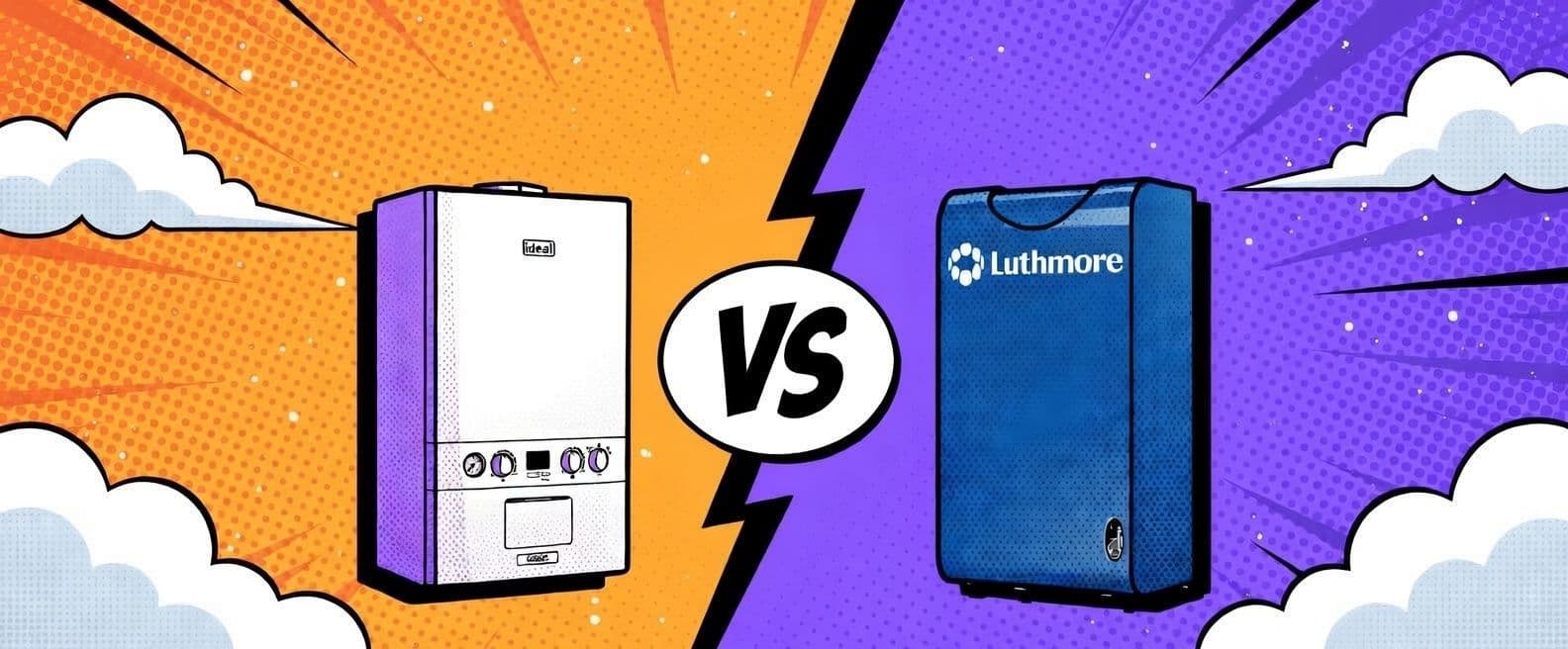

For years, the UK heating industry has been chasing one big question: what actually replaces the gas combi boiler?
- Who are Luthmore?
- What is a battery-enabled electric combi boiler?
- How does the Luthmore boiler work?
- Is it cheap to run?
- Could dynamic tariffs make it more viable?
- How much does the Luthmore electric battery boiler cost?
- Could it qualify for a Boiler Upgrade Scheme grant?
- What are the advantages of the Luthmore boiler?
- What are the drawbacks?
- Is Luthmore better than an air source heat pump?
- Is the Luthmore battery boiler the future of home heating?
Air source heat pumps have become the main answer - and for many homes, rightly so. But they are not perfect for every property. Some homes do not have the right layout, enough outside space, or the right conditions to make a heat pump practical or affordable.
That is where Luthmore enters the conversation.
This British-made battery-enabled electric boiler is trying to solve one of the biggest problems in home heating: how to deliver combi-boiler-style hot water and heating without burning gas.
It is compact, clever and packed with technology - but is it genuinely a game-changing alternative, or just an interesting niche product?
After seeing the system up close and hearing directly from the team behind it, here is what homeowners need to know.
🎥 Prefer video? Watch our Youtube video on the Luthmore:
Who are Luthmore?
Luthmore is a British heating technology company based in Swindon, founded by a team of former Dyson engineers.
That background matters. This is not a brand taking a small step away from traditional heating - it is a technology-first business trying to rethink how electric home heating can work in a country still heavily dependent on gas boilers.
The company’s aim is ambitious: create a product that delivers the convenience and familiarity of a combi boiler, but without the gas connection and emissions.
At first glance, that sounds like a direct challenger to air source heat pumps. But after speaking to the team, that is not quite how they see it.
Instead, Luthmore appears to be positioning its boiler as a solution for homes where a heat pump is not suitable, practical or physically possible to install.
That is a far more interesting position.
Rather than trying to replace heat pumps across the board, Luthmore is targeting the awkward gap in the market - homes that still need an alternative to gas, but cannot easily adopt a conventional low-carbon system.
What is a battery-enabled electric combi boiler?
The simplest way to describe the Luthmore system is this: it is a wall-hung unit around the size of a combi boiler, but instead of a gas burner inside, it uses battery storage.
That battery stores electricity when energy is cheapest, then releases it later to produce hot water for showers, taps and baths - and in some cases to support heating too.
The battery capacity is around 5.9kWh, with a further 1.2kWh recovered through thermal processes linked to charging and discharging.
That is the core idea behind the product:
charge up when electricity is cheap
store that energy inside the unit
deploy it later when the home needs hot water or heating
It is a clever answer to a very real problem.
Electricity in the UK is typically far more expensive per unit than gas. So any product hoping to replace a gas boiler has to do one of two things:
be dramatically more efficient than direct electric heating, or
access electricity when it is much cheaper
Luthmore is betting heavily on the second option.
How does the Luthmore boiler work?
The appeal of the system is that it tries to mimic the experience people already like about a gas combi boiler.
It is compact. It is wall-mounted. It is designed to fit in the sort of place a combi boiler already sits. And it aims to provide hot water on demand without needing a separate cylinder.
That matters more than many in the industry admit.
For a lot of UK homeowners, the gas combi boiler still wins on convenience, space-saving and familiarity. Any alternative that wants mass adoption needs to respect that.
The Luthmore unit stores electricity during off-peak periods, then uses that stored power to deliver high-output hot water when needed.
The headline output was enough to deliver around 30kW equivalent performance for hot water, allowing it to offer a much stronger experience than a standard electric shower or small direct-electric combi.
In practical terms, that means:
more powerful showers than a typical electric shower
faster hot water delivery
the ability to run taps with less drop-off in performance
combi-style convenience without gas combustion
That is the real selling point.
Hot water performance: can it actually compete with gas?
This is where the product becomes genuinely interesting.
One of the biggest weaknesses of traditional electric-only hot water systems is performance.
Many UK homeowners have bad memories of underpowered electric showers, slow bath filling, or hot water collapsing the moment someone opens another tap.
Luthmore is clearly trying to overcome that problem.
Based on the demonstration shown, the boiler can deliver up to around 12.4 litres per minute using its stored battery energy, which is much more in line with the sort of experience people expect from a combi boiler.
That should, in theory, mean:
a much stronger shower experience than a basic electric shower
decent performance even when another tap is opened
less of that classic direct-electric compromise
There is, however, an important limit.
If you are drawing hot water at maximum power, the team said you may get roughly 20 minutes of showering from the stored battery capacity before the system needs to fall back to mains electricity.
That fallback matters.
You do not run out of hot water entirely - the system can revert to direct mains power at around 10kW - but the user experience may no longer feel as strong.
In other words, the performance is good while the battery is doing the heavy lifting, but it is not limitless in the way many households are used to expecting from gas.
For smaller households or lower hot water demand, that may be absolutely fine.
For bigger families, heavier usage patterns, or back-to-back showers, it could be one of the first major reality checks.
What about central heating?
This is where the product becomes more complicated.
Initially, it sounds like the battery runs everything, but space heating is not primarily battery-powered in the same way hot water is.
Instead, central heating is largely powered directly from the mains - unless there is spare battery capacity available to support it.
That is a big distinction.
Why? Because while the battery can help make hot water cheaper by charging on off-peak tariffs, mains-powered space heating is still subject to normal electricity pricing. And in the UK, that is usually far more expensive than gas.
Luthmore does appear to have introduced a feature that allows leftover battery energy to be pushed into central heating, effectively making use of any unused cheap-rate electricity.
That is promising, especially if paired with dynamic tariffs. But by the company’s own explanation, this feature is still evolving.
So at the moment, the product looks strongest on hot water and more conditional on space heating.
That does not make it a bad product. But it does mean homeowners need to understand what problem it solves best.
Is it cheap to run?
This is the question that will make or break it.
A battery-enabled boiler sounds clever, but clever does not automatically mean affordable. And when electricity is usually much more expensive than gas, running costs need to be looked at very carefully.
There is no simple blanket answer, since running costs will depend heavily on:
the size of the property
the home’s insulation levels
how much hot water is used
how much of the heating demand can be shifted to off-peak electricity
what tariff the home is on
whether the household is also using solar or additional battery storage
For homes with lower heat demand, good insulation and strong access to off-peak electricity, the economics may look far more attractive.
For larger homes with higher heating loads, the picture is less certain - especially if most of the space heating is being powered directly from the grid at normal electricity rates.
That is the product’s current Achilles heel.
The concept is strong, but unless more of the heating load can reliably be supplied from cheap stored electricity, it is hard to see it consistently undercutting a gas combi on running costs in a typical UK home.
Could dynamic tariffs make it more viable?
Possibly - and this may end up being one of the most important parts of the story.
The team behind Luthmore appear to be thinking beyond fixed off-peak periods and toward a future shaped by smart, flexible, time-of-use tariffs.
That matters because the real strength of a battery-enabled boiler is not just storing electricity at night - it is being smart about when energy is cheapest throughout the day.
If the unit can increasingly respond to dynamic pricing and recharge when electricity dips, it could become much more efficient and much more financially compelling.
That is especially true as the UK grid continues to rely more heavily on renewables, with pricing becoming more variable and more opportunity-driven.
In that future, a battery boiler starts to make more sense.
But that is still partly a future-facing argument, not a settled mainstream reality today.
How much does the Luthmore electric battery boiler cost?
Based on the information shared, the target retail price appears to be around £4,500 plus VAT.
That is the number that immediately grabs attention.
At face value, that is already pushing into serious heating-system money. But the bigger issue is not just the sticker price - it is how the product is currently classified.
At the moment, the system seems to sit awkwardly between categories:
it is not treated like a standard gas boiler
but it also is not fully benefiting from the incentives available to some low-carbon technologies
That creates two problems.
First, it appears to be subject to VAT in a way that many recognised energy-saving technologies are not.
Second, it does not currently qualify for the kind of government support that would transform its appeal.
And that is crucial.
Could it qualify for a Boiler Upgrade Scheme grant?
This is one of the most exciting but also most uncertain parts of the discussion.
There is hope that products like this could eventually benefit from support under an expanded Boiler Upgrade Scheme or similar policy changes.
There was also discussion around the possibility of much larger support - even up to £25,000 in some cases - depending on how technologies are classified.
But as things stand, that support does not appear to be in place for this boiler.
That means homeowners should treat future grant support as potential, not guaranteed.
If policy changes were introduced and products like the Luthmore unit became eligible for grants and 0% VAT treatment, it would massively improve the numbers.
In that scenario, the installation cost could become dramatically more competitive - potentially even comparable with, or cheaper than, some gas boiler replacements.
Without that policy support, however, the market becomes narrower.
It starts to look most attractive for:
households that cannot install a heat pump
homeowners who want to move away from gas for environmental reasons
early adopters willing to try emerging technology
properties where compactness and installation simplicity really matter
That is still a valid market - just not yet a mass-market one.
What are the advantages of the Luthmore boiler?
There is a lot to like here.
1. It is compact
One of the smartest things about the product is that it seems designed to fit where a combi boiler already lives.
That removes one of the biggest barriers to switching away from gas.
2. It offers stronger hot water performance than typical electric-only systems
This is not just another weak electric shower in a fancy box. The battery support gives it the ability to deliver much more convincing combi-style hot water.
3. It is British-designed and engineered
That will matter to some buyers, especially in a market crowded with imported systems and limited innovation in mainstream boiler design.
4. It is a possible answer for hard-to-treat homes
Not every property can take a heat pump easily. Luthmore could fill a very real gap for flats, retrofits and space-constrained homes.
5. It is future-facing
The combination of electrification, battery storage and smart tariffs points toward where home energy is going, even if the economics are not perfect yet.
What are the drawbacks?
This is where we need to stay honest.
1. Space heating looks less convincing than hot water
The product’s strongest story is clearly hot water. Heating the home still appears more dependent on expensive mains electricity than many homeowners would like.
2. Running costs are hard to pin down
That uncertainty will put some buyers off. People want to know what they will pay, not just what might be possible under ideal conditions.
3. Policy support is not there yet
This is a major issue.
The right VAT and grant treatment could transform the proposition. Without it, adoption is likely to be slower and more limited.
4. It may still suit only a narrow part of the market
At least for now, this does not look like the universal gas boiler replacement many people hope for.
Is Luthmore better than an air source heat pump?
Not generally - and that is actually okay.
For the average suitable home, an air source heat pump is still likely to be the more established long-term low-carbon heating option, particularly for whole-home space heating.
But that is not really where Luthmore’s opportunity sits.
The better question is this:
Is Luthmore better than doing nothing in homes where a heat pump is not suitable?
That is where the answer becomes more interesting.
If a property cannot realistically take a heat pump, and the homeowner still wants to move away from gas without installing bulky tanks or compromising badly on hot water performance, Luthmore starts to look much more compelling.
Is the Luthmore battery boiler the future of home heating?
Not the whole future - but it could absolutely be part of it.
That is the fairest conclusion.
This does not look like the silver bullet that replaces gas boilers everywhere overnight.
It is not clearly a better all-round option than a heat pump for suitable homes, and there are still real questions around heating costs, tariffs and policy support.
But it does look like a genuinely innovative product aimed at a real problem.
And that matters.
For years, too many “alternatives to gas” have asked homeowners to accept higher costs, more disruption, more space demands and weaker day-to-day performance.
Luthmore is at least trying to solve that in a way normal people might actually want.
That alone makes it worth watching.
If the company can secure the right policy treatment, improve the economics of space heating, and prove performance in real customer homes, this could become one of the most interesting heating products in the UK market.
For now, though, it remains a promising technology with clear potential - but not yet a universal answer.
Final verdict
The Luthmore battery-enabled electric combi boiler is one of the most intriguing heating products we have seen in a while.
It is clever, compact and refreshingly different. It seems capable of delivering genuinely strong hot water performance, and it could offer a meaningful low-carbon option for homes where heat pumps are simply not practical.
But there are still some big caveats.
The strongest benefits appear to centre on hot water, while central heating economics remain less convincing. And until VAT treatment and government support become clearer, it may struggle to break into the mainstream.
Still, this is exactly the kind of innovation the UK heating market needs more of: practical, ambitious and designed around the way people actually live.
Luthmore may not be the final answer to getting Britain off gas - but it could end up being an important part of the solution.
Next Steps For Your New Boiler Journey:
When planning to install a new boiler for your home, there are several important factors to consider. Make sure to refer to the following guides to help you make informed decisions:
To dive deeper into these topics, head over to our advice section, or check out our YouTube channel to learn more.
Looking for the best deal on a new boiler?
If so, get your new boiler installed with Heatable, here’s why:
Gas Safe boiler installation within 24 hours
Thousands of happy customers – an average score of 4.9 on Trustpilot (that’s better than the market leader).
Price match guarantee – if you find a cheaper quote, we will match (must be like for like)
Multiple payment options - interest-free available
12-year warranty on selected boilers
Fixed price guarantee – no hidden costs
Save your quote until later
Use this clickable form to get a fixed price on the screen instantly.
Heat Happy.