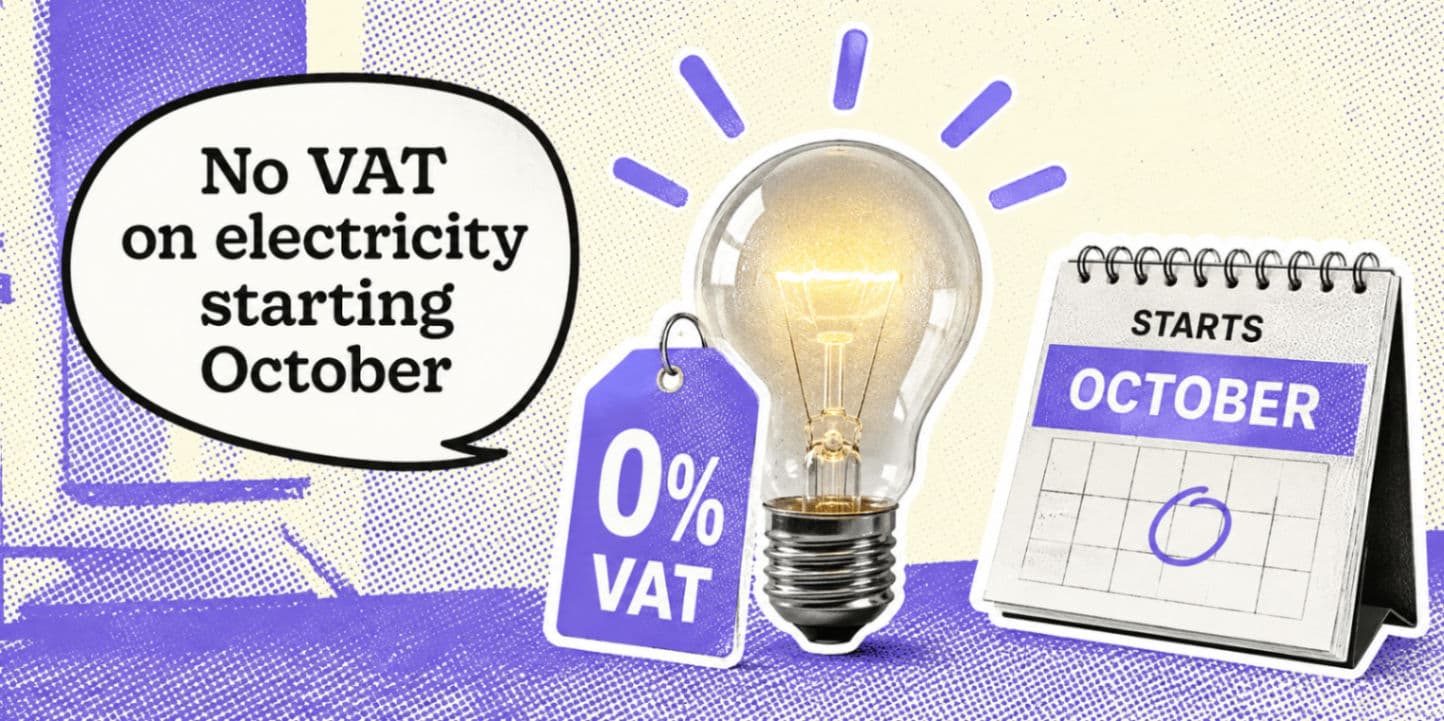

Andy Burnham has announced plans to remove VAT from domestic electricity bills, cutting the rate from 5% to 0%.
The move is expected to save a typical household around £45 a year, although the exact amount will depend on how much electricity you use.
It is not a life-changing saving. But because VAT is being removed from electricity rather than gas, it could slightly improve the financial case for heat pumps and other electric technologies.
How much could you save?
Removing 5% VAT from an electricity bill reduces the final VAT-inclusive amount by around 4.76%.
Annual electricity bill | Approximate saving |
£600 | £29 |
£900 | £43 |
£1,200 | £57 |
£1,800 | £86 |
Higher-electricity users, including homes with heat pumps or electric vehicles, are likely to save more.
The important caveat is that wholesale prices and future price-cap changes could still push bills up. The VAT cut reduces what you would otherwise pay. It does not guarantee that your next bill will be lower.
What does it mean for solar panels?
Slightly cheaper grid electricity means each unit of solar power used at home is worth a little less.
That is because solar panels save money mainly by reducing the electricity you need to buy from your supplier.
For example, if a household uses 2,500kWh of its own solar electricity each year, removing VAT could reduce the annual value of that electricity by around £30, depending on tariff rates.
That will not suddenly make solar panels a poor investment. It could simply lengthen the estimated payback period by a few months.
Export payments through the Smart Export Guarantee are separate and would not automatically fall because VAT has been removed from electricity bills.
Will solar panel installations become cheaper?
No.
The announcement relates to electricity bills, not the cost of buying solar panels.
Qualifying domestic solar-panel and battery installations already benefit from 0% VAT under separate rules.
What does it mean for heat pumps?
Heat-pump owners are likely to benefit more because heat pumps use electricity to heat the home.
A system consuming 4,000kWh of electricity each year could save roughly £50 on its unit charges from the VAT reduction alone.
That makes heat pumps slightly cheaper to run and reduces the price gap between electricity and gas.
It does not guarantee that a heat pump will always be cheaper than a boiler. Running costs still depend heavily on:
Heat-pump efficiency
Gas and electricity prices
Insulation
Radiator sizing
Flow temperature
Heating demand
A well-designed heat pump could already compete with gas on running costs. A badly designed one will not be rescued by a relatively small VAT cut.
What does it mean for gas boilers?
Gas bills are not included in the proposed VAT cut.
Homes with gas boilers will still save a little on the electricity used for appliances, lighting, controls and the boiler pump, but they will not receive a direct reduction on the gas used for heating.
That makes gas boilers fractionally less competitive against heat pumps.
However, nobody should replace a working boiler purely to save £40 or £50 a year. Installation cost, property suitability and long-term energy prices matter far more.
What about solar panels and a heat pump together?
The effects pull in opposite directions.
Cheaper electricity lowers the running cost of the heat pump, but it also slightly reduces the value of the electricity produced by the solar panels.
Overall, a home with both technologies is still likely to benefit, particularly during winter when the heat pump relies more heavily on grid electricity.
Solar panels will continue to contribute most during daylight hours and the warmer months. They will not normally power a heat pump throughout winter without substantial grid support.
Heatable’s verdict
Scrapping VAT on electricity is useful, but it is not an energy-bill revolution.
For homeowners:
Heat pumps become slightly cheaper to run
Gas boilers become marginally less competitive
Solar-panel payback may become slightly longer
Solar and heat-pump installations do not receive an additional VAT cut
Higher-electricity users will save the most
The wider significance is that electricity is becoming cheaper relative to gas. That supports heat pumps and electrification, but VAT alone is too small a lever to transform the economics.