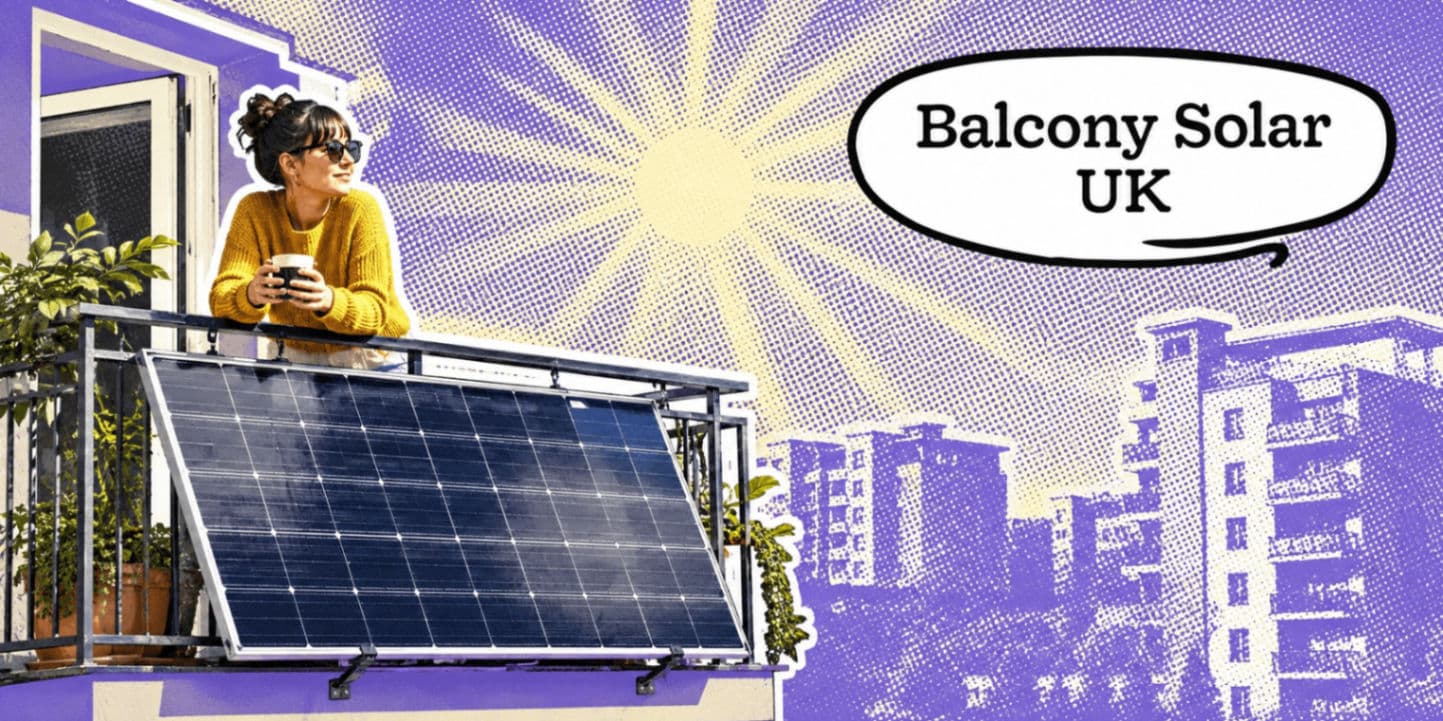

Balcony solar could give flat owners and renters a practical way to generate their own electricity, but UK rules, mounting requirements and plug-in restrictions mean it is not quite as simple as hanging up a panel and plugging it into the wall.
- What Are Balcony Solar Panels?
- Are Balcony Solar Panels Legal in the UK?
- Can You Plug Balcony Solar Panels Into a UK Socket?
- What Is the Safest Way to Use Balcony Solar?
- Do Renters and Leaseholders Need Permission?
- Will Balcony Solar Power My Flat?
- Is Balcony Solar Worth It?
- What Should You Look for When Buying Balcony Solar?
- Can Balcony Solar Earn Smart Export Guarantee Payments?
✔ Are balcony solar panels legal in the UK? Potentially, yes, but you may need permission from your landlord, freeholder, management company or local planning authority.
✔ Can you plug balcony solar panels into a normal UK socket? Not in the same straightforward way currently permitted in countries such as Germany.
✔ What is the easiest option? For most UK households, the safest and simplest setup is an off-grid solar panel connected to a portable power station.
Solar panels are great.
Roofs, unfortunately, are not always available.
Perhaps you live in a flat. Maybe you rent. Or maybe your roof belongs to a freeholder who responds to emails approximately once every geological era.
Whatever the reason, balcony solar panels may look like a clever alternative.
These smaller systems can generate electricity from balconies, terraces and other compact outdoor spaces, giving people without a suitable roof access to at least some solar power.
However, the UK rules are not quite as simple as some online retailers would have you believe.
Here is what you need to know before attaching a panel to your railings and declaring energy independence.
PS We offer MCS-certified solar panel installation nationwide. Simply answer these questions, get your fixed price and arrange your free design.
What Are Balcony Solar Panels?
Balcony solar panels are compact photovoltaic panels designed for smaller outdoor spaces, including:
Balconies
Terraces
External walls
Flat roofs
Small gardens
They are especially popular in parts of Europe, where homeowners and renters can install small plug-in systems that feed electricity directly into their homes.
A typical system may include one or two solar panels, a microinverter and a mounting frame.
However, there are two very different types of balcony solar system.
Grid-connected balcony solar
A grid-connected system supplies electricity to the electrical circuits inside your home.
That electricity can then be used by appliances throughout the property, reducing the amount imported from the grid.
Off-grid balcony solar
An off-grid system charges a battery or portable power station instead.
You then connect individual devices or appliances directly to the battery.
That distinction matters because off-grid systems are currently much easier to use safely and legally in the UK.
Are Balcony Solar Panels Legal in the UK?
There is no blanket ban on putting solar panels on a balcony.
However, the installation may still need to comply with rules covering:
Electrical safety
Planning permission
Structural safety
Building regulations
Leasehold restrictions
Landlord approval
Electricity network requirements
In other words, the panel itself is not usually the problem.
The potential problems are where you put it, how you secure it and what you connect it to.
Can You Plug Balcony Solar Panels Into a UK Socket?
You may have seen European balcony solar kits that claim you can install a panel, connect it to a microinverter and plug the system straight into a wall socket.
This is commonly known as plug-in solar.
It has become increasingly popular in countries such as Germany, but the UK does not currently have the same simple regulatory framework.
Standard UK sockets were designed to supply electricity to appliances. They were not designed to receive electricity from a solar generator.
Potential risks include:
Overloaded circuits
Incorrect circuit protection
Overheating cables
Problems with RCD protection
Incompatible or unapproved inverters
Unsafe use of extension leads
Multiple systems being connected to one circuit
The Government and electrical safety bodies are investigating how small plug-in solar systems could be introduced safely in future.
However, proposed regulations are not the same as permission that already exists.
For now, we would not recommend buying an imported balcony solar kit and plugging it into the nearest socket simply because the product description says “easy installation”.
Electricity is famously unsentimental about optimistic product descriptions.
What Is the Safest Way to Use Balcony Solar?
For most UK households, there are two realistic options.
Option 1: Use a Portable Solar Panel and Power Station
This is usually the simplest choice for renters, flat owners and anyone unable to install rooftop solar.
The solar panel is positioned on the balcony and connected directly to a portable power station.
The stored electricity can then be used to run or charge:
Phones
Tablets
Laptops
Wi-Fi routers
Lamps
Televisions
Fans
Small appliances
Because the system is not connected to the property’s electrical circuits, it avoids many of the complications associated with grid-connected solar.
The downside is that it does not automatically reduce electricity use across the whole property.
You need to plug devices directly into the power station to use the stored energy.
It is slightly less elegant, but substantially better than accidentally turning your living-room socket into a science experiment.
Option 2: Have a Small Solar System Professionally Installed
A qualified solar installer or electrician may be able to fit one or more panels to a balcony, wall or terrace and connect them safely to your home.
They will need to consider:
The condition of the electrical installation
Circuit protection
Earthing
Isolation equipment
Inverter compliance
Structural loading
Wind exposure
Distribution Network Operator requirements
This can provide a more conventional solar setup, with the generated electricity used throughout the property.
However, the cost of professional installation can make very small systems difficult to justify financially.
One professionally installed panel may be entirely possible, but the electrician is unlikely to accept payment in sunshine and good intentions.
Do You Need Planning Permission?
Possibly.
Solar panels often fall under permitted development rights, but balconies and flats are more complicated than standard rooftop installations.
Planning permission may be needed if the panels:
Significantly change the appearance of the building
Project beyond the balcony
Face a public highway
Are installed on a listed building
Sit within a conservation area
Are attached to a shared external wall
Planning rules also differ between England, Scotland, Wales and Northern Ireland.
Flats and maisonettes do not always receive the same permitted development rights as houses.
The safest approach is to contact your local planning authority before carrying out any permanent work.
Yes, that may involve forms.
Unfortunately, solar panels can convert sunlight into electricity, but not council paperwork into excitement.
Do Renters and Leaseholders Need Permission?
Almost certainly.
Even where a balcony is for your exclusive use, the railings, walls and exterior of the building may still belong to the landlord, freeholder or management company.
Your lease or tenancy agreement may restrict:
Drilling into external walls
Fixing equipment to railings
Altering the building façade
Installing electrical equipment outside
Changing the external appearance of the property
You may need written approval from:
Your landlord
The freeholder
The management company
The building insurer
Always get approval in writing.
A verbal “that should be fine” can develop a surprisingly poor memory when the managing agent notices a solar panel hanging above the communal entrance.
Can You Hang Solar Panels From Balcony Railings?
Potentially, but only with a suitable mounting system.
Solar panels can catch a considerable amount of wind. A poorly secured panel may act like a sail, particularly on upper floors or exposed buildings.
Do not rely on:
Cable ties
Temporary hooks
Rope
Generic clamps
Homemade wooden brackets
The phrase “that feels secure enough”
The mounting system should account for:
Panel dimensions
Panel weight
Railing material
Balcony height
Local wind exposure
Installation angle
Glass balustrades and decorative railings may not be suitable for clamping.
For larger panels or permanent installations, a structural assessment may be needed.
How Much Electricity Can Balcony Solar Generate?
Balcony solar output varies considerably.
A panel may be rated at 200W or 400W, but that figure is measured under controlled test conditions.
Actual generation depends on:
Direction
Shading
Panel angle
Time of year
Location within the UK
Nearby buildings
Trees
Balcony walls
Railings
Cloud cover
A south-facing balcony with minimal shading will usually perform best.
East-facing panels favour the morning, while west-facing panels generate more later in the day.
North-facing balconies are generally much less suitable.
A well-positioned 200W panel might generate roughly 120 to 200kWh per year, although many balcony installations will produce less.
Vertical panels may perform reasonably well during parts of the year, particularly when the sun is lower, but they usually generate less annually than optimally angled rooftop panels.
Will Balcony Solar Power My Flat?
No, not by itself.
A small balcony system is unlikely to cover major electrical loads such as:
Electric showers
Electric heating
Ovens
Tumble dryers
Kettles
Large air-conditioning units
It may, however, help cover smaller loads such as broadband equipment, lighting, laptops and device charging.
A 200W panel in good sunlight could potentially run a laptop and router during the day, with any remaining electricity stored in a battery.
That is useful.
It just will not transform a one-bedroom flat into a miniature power station.
Is Balcony Solar Worth It?
It can be, but the financial case is often less exciting than the marketing.
Balcony solar makes the most sense when:
Your balcony receives plenty of direct sunlight
You cannot install rooftop solar
You already want a portable power station
You can use the electricity during the day
You value backup power
The panel can be mounted safely
You can take the equipment with you when you move
It may not be worthwhile when:
The balcony is heavily shaded
The property faces north
The freeholder will not approve it
Installation costs are high
You need to buy a large battery purely for savings
The panel is hidden behind solid walls or opaque railings
The biggest trap is buying an expensive solar generator solely to reduce electricity bills.
A £1,000 panel and battery system may only save a modest amount each year.
The numbers become more attractive if you also use the battery for camping, backup power, outdoor work or future travel.
Best Balcony Solar Products in the UK
For UK users, we recommend focusing on off-grid panels and portable power stations rather than imported plug-in microinverter kits.
Amazon stocks plenty of options, but quality varies substantially.
Here are some of the better-known choices.
Jackery SolarSaga 200W
Best premium portable panel
The Jackery SolarSaga 200W is a foldable solar panel designed primarily for use with Jackery Explorer power stations.
It includes an integrated stand, making it easier to position on a balcony without permanently altering the building.
Pros
Easy to position
Foldable and portable
Good build quality
Designed for Jackery batteries
Suitable for renters
Cons
Relatively expensive
Bulky when fully opened
Best compatibility is within the Jackery ecosystem
This is a strong option for anyone who wants a polished, portable setup with minimal faffing.
EcoFlow 220W Portable Solar Panel
Best all-round alternative
EcoFlow’s 220W portable solar panel is designed for use with its RIVER and DELTA power stations.
It is foldable, portable and suitable for temporary balcony use where permanent mounting is not possible.
EcoFlow also offers app-based monitoring, allowing you to see how much electricity the system is generating.
Pros
Good power output
Useful monitoring
Compatible with popular EcoFlow batteries
Suitable for temporary installations
Established manufacturer
Cons
Premium pricing
Can be awkward to position in small spaces
Connector and voltage compatibility still need checking
It is a good choice for people who enjoy monitoring every watt and would absolutely notice if output dropped by 3% at 2:15pm.
Renogy 200W Flexible Solar Panel
Best lightweight option
Flexible panels can be useful where a heavy framed panel would be difficult to install.
Renogy’s 200W flexible panel is much lighter than a conventional glass module and can accommodate gently curved surfaces.
Pros
Lightweight
Easier to mount
Suitable for awkward areas
Established solar brand
Cons
Flexible panels can run hotter
Potentially shorter lifespan than rigid panels
Requires careful mounting
Not designed to be repeatedly folded
This may be a sensible option where weight is the main concern, although rigid panels generally offer better long-term durability.
ECO-WORTHY 200W Solar Panel Kits
Best budget option
ECO-WORTHY offers several lower-cost solar panels and kits through Amazon UK.
These can work for basic off-grid systems, provided you check the panel specification, connectors and charge-controller requirements.
Pros
Lower cost
Wide product range
Suitable for smaller projects
Available in rigid and flexible formats
Cons
Product quality varies by model
Listings sometimes combine several products
Instructions may be less polished
Compatibility requires more checking
This is the more affordable route, but read the exact listing rather than assuming every 200W kit includes the same equipment.
Amazon product pages occasionally contain more variations than a DFS sale.
Jackery Explorer Solar Generator Bundles
Best complete beginner system
Jackery sells bundled power stations and solar panels, removing much of the compatibility guesswork.
A smaller Explorer unit may be enough for phones, laptops and lighting, while larger models can support televisions, appliances and backup power.
Pros
Panel and battery are designed to work together
Simple setup
Portable
Established warranty support
Cons
More expensive than buying components separately
Larger models are heavy
High-capacity batteries may be excessive for a small balcony
Choose the battery based on what you genuinely intend to power.
Buying the largest model available does not create more sunlight.
EcoFlow RIVER and DELTA Bundles
Best for monitoring and fast charging
EcoFlow’s RIVER and DELTA systems combine portable batteries with compatible solar panels.
They are particularly good for users who want fast mains charging, detailed monitoring and a wide choice of battery capacities.
Pros
Good app
Fast charging
Wide product range
Useful for backup power
Strong portable ecosystem
Cons
Can become expensive
Some European balcony products are not designed for straightforward UK socket use
Model names can be confusing
Make sure you are buying a portable off-grid solar generator rather than a European grid-feed balcony package.
The two may look similar on a product page but have very different electrical and regulatory implications.
What Should You Look for When Buying Balcony Solar?
Before ordering anything, check the following.
Panel dimensions
A 400W panel can be much larger than expected.
Measure the balcony properly, including doors, railings and access routes.
Weight
The panel and mounting system must be safely supported.
Lightweight does not automatically mean wind-safe.
Compatibility
Check that the panel voltage, current and connectors are compatible with the battery or power station.
Do not rely solely on the fact that both products are described as “solar compatible”.
Cable length
Balcony layouts are rarely as convenient as product photography suggests.
Make sure the cable can reach the battery without being trapped, stretched or routed across a doorway.
Waterproofing
Solar panels are normally weather-resistant, but portable power stations may not be.
Keep batteries dry and properly ventilated.
Warranty
Choose a recognised manufacturer with UK support.
A 25-year performance claim is less impressive when the seller disappears from Amazon next Thursday.
Flexible or Rigid Solar Panels?
Rigid panels generally offer:
Better durability
Better cooling
Longer expected lifespan
Lower cost per watt
Flexible panels generally offer:
Lower weight
Easier mounting
Better suitability for curved surfaces
Easier temporary installation
For a permanent installation, a rigid panel will usually be the better option.
For a rented flat or weight-sensitive balcony, a flexible or foldable panel may be more practical.
Can Balcony Solar Earn Smart Export Guarantee Payments?
Usually not if you are using an off-grid battery system.
Smart Export Guarantee payments apply to eligible grid-connected renewable installations that export electricity through an approved meter.
A portable solar panel connected to a power station does not export electricity to the grid.
A professionally installed grid-connected balcony system may qualify, but the likely export income from one or two panels will be small.
The better strategy is usually to use the electricity yourself.
What Does Balcony Solar Cost?
Typical prices are roughly:
Equipment | Typical Cost |
100W portable panel | £100 to £250 |
200W portable panel | £200 to £500 |
Small power station | £250 to £600 |
Medium power station | £600 to £1,200 |
Mounting equipment | £50 to £250 |
Professional installation | Varies |
A basic portable setup may cost around £500 to £1,000.
A larger premium system can easily exceed £1,500.
That is why balcony solar should not be viewed purely as a quick money-saving purchase.
For most users, its value lies in a combination of electricity savings, portability and backup power.
The Future of Balcony Solar in the UK
The UK Government and electrical safety organisations are considering how plug-in solar could be introduced safely.
A future UK standard may allow small systems of around 800W to be installed using approved equipment, suitable connectors and mandatory registration.
That could make balcony solar much more accessible for renters and flat owners.
For now, however, the UK remains behind countries such as Germany.
Until the rules change, buyers should stick to one of two options:
A portable off-grid solar panel and power station.
A professionally installed grid-connected system.
The third option, buying an unknown microinverter from an online marketplace and hoping for the best, is not really an option.
Balcony Solar UK: The Verdict
Balcony solar can be worthwhile for people who live in flats, rent their homes or cannot access a suitable roof.
However, it remains a relatively niche option in the UK.
The simplest approach is to use a portable panel with a compatible solar generator or power station.
This gives you access to renewable electricity without modifying the property’s electrical installation.
A grid-connected system may deliver greater savings, but it will usually require professional installation, permission from the building owner and compliance with network requirements.
So, can you generate electricity from a balcony in the UK?
Yes.
Can you hang any panel from any railing and plug it into any socket?
Very much no.
Have access to a suitable roof?
A full home solar installation will almost always generate substantially more electricity and offer better long-term savings than a small balcony setup.
Heatable installs MCS-certified solar panel and battery systems across the UK, with fixed online pricing and no awkward home sales appointments.