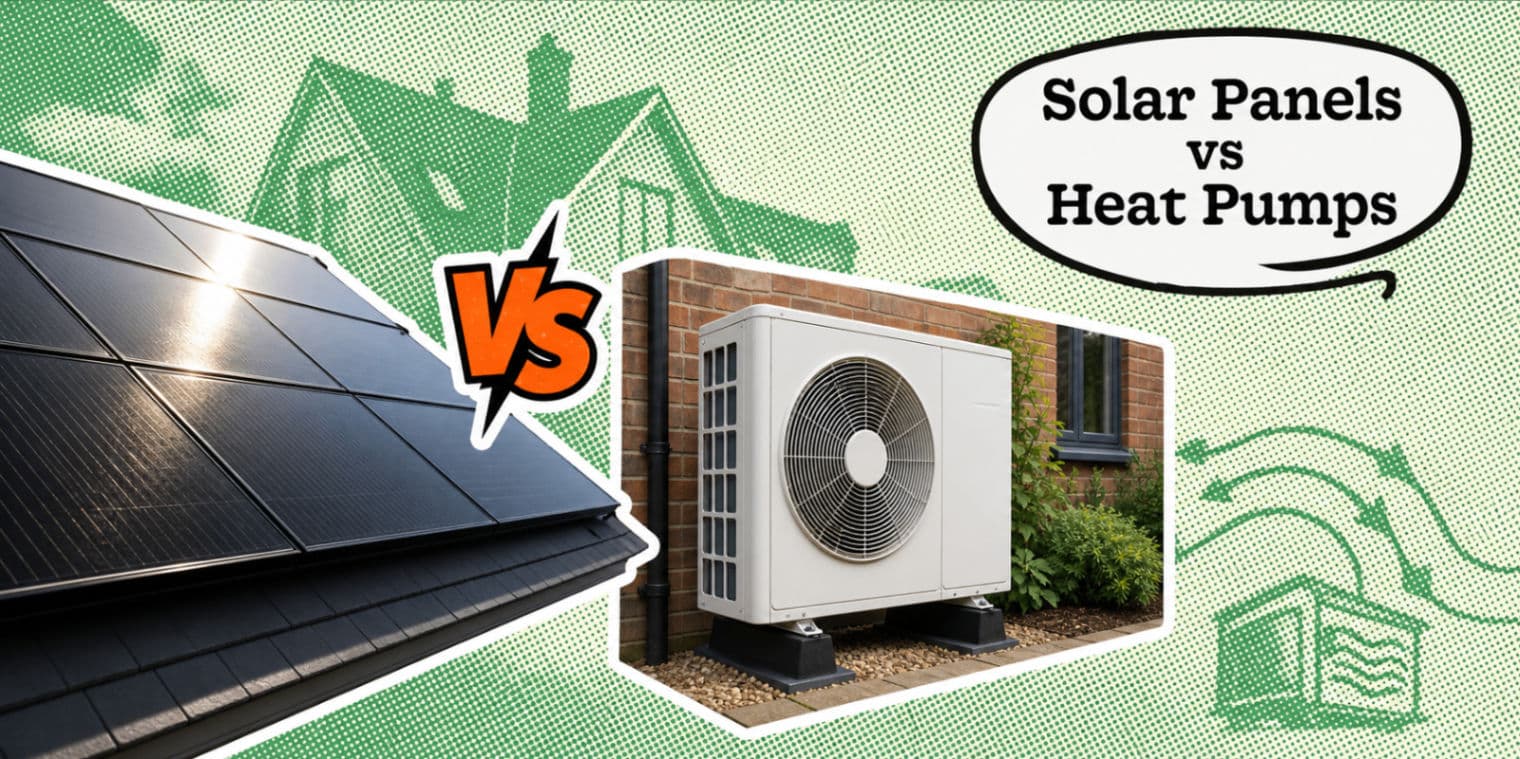

Solar panels and heat pumps are regularly lumped together under the great big umbrella of “things that make your home greener”.
However, they perform entirely different jobs.
Solar panels generate electricity. Heat pumps heat your home and hot water.
Comparing the two is therefore a little like comparing a toaster with a fridge: both use electricity and live in your house, but you’d be deeply disappointed if you asked either to do the other’s job.
So, should you install solar panels, a heat pump or both? Here’s the honest answer.
PS We offer MCS-certified solar panel installation nationwide. Simply answer these questions, get your fixed price and arrange your free design.
Solar panels vs heat pumps: the quick answer
Solar panels are usually the better choice if your main aim is to reduce the amount of electricity you buy from the grid.
A heat pump makes more sense if you want to replace a gas, oil or LPG heating system with a low-carbon alternative.
They are not direct rivals, and installing both can make sense. Solar panels can generate some of the electricity used by a heat pump, although they will not normally power it completely throughout the year.
Solar panels | Heat pump | |
Primary job | Generate electricity | Heat your home and hot water |
Energy source | Daylight | Heat from the air, ground or water |
Uses electricity? | Generates it | Yes |
Replaces a boiler? | No | Usually |
Typical domestic installation cost | Around £6,000–£9,000 for a 4–5kW system | Commonly around £7,000–£13,000 for an air source system |
Main property requirement | A reasonably suitable, unshaded roof | A properly designed heating system and suitable outdoor space |
Works in winter? | Yes, but with lower output | Yes |
Can the two work together? | Absoutely | Also absolutely |
Prices are broad estimates. Your actual cost will depend on the property, equipment and complexity of the installation.
What is the difference between solar panels and heat pumps?
Solar photovoltaic panels, usually shortened to solar PV, turn daylight into electricity.
That electricity can be used by appliances around your home, stored in a battery or exported to the grid through an eligible tariff. Solar panels still generate on cloudy days, just less enthusiastically than they do under clear summer skies.
A heat pump does not generate electricity. It uses electricity to move existing heat from outside your home to the inside.
An air source heat pump extracts heat from the outdoor air and transfers it into your heating system. It can then provide space heating and, with the right setup, hot water.
In simple terms:
Solar panels reduce how much electricity you need to buy.
A heat pump changes how you heat your home.
Installing both can reduce your reliance on fossil fuels and the grid.
How do solar panels work?
Solar panels contain photovoltaic cells that produce direct-current electricity when exposed to daylight.
An inverter converts this into alternating-current electricity, which is the type used by most household appliances. Your home uses the solar electricity first, with any shortfall supplied by the grid.
If the panels produce more than you are using, the surplus can be:
exported to the grid;
stored in a home battery; or
diverted to a compatible appliance or hot-water system.
Solar generation varies by season, roof direction, shading, location and system design. A south-facing roof will often produce the highest annual output, but east- and west-facing roofs can still be perfectly viable.
A battery is not essential. It can help you use more of your own solar electricity later in the day, but it also increases the upfront cost and will not automatically deliver a better financial return.
Sadly, batteries do not contain a tiny emergency sun.
How does a heat pump work?
A heat pump collects low-temperature heat from outside and raises it to a useful temperature using a refrigeration cycle.
Although it requires electricity, a well-designed heat pump can deliver several units of heat for each unit of electricity it consumes. Its actual efficiency will depend on factors including:
the outdoor temperature;
the heating flow temperature;
the quality of the system design;
radiator or underfloor-heating capacity;
insulation and heat loss; and
how the system is controlled.
Heat pumps tend to work most efficiently when supplying lower-temperature heat steadily over longer periods. This is different from a boiler blasting very hot water through the radiators whenever somebody declares that it is “a bit nippy”.
Some homes need larger radiators, insulation improvements or changes to pipework. Properties replacing a combi boiler will also normally need space for a hot-water cylinder.
This is why a proper room-by-room heat-loss calculation matters. Heat pumps are excellent when designed around the building. Guessing the required size based solely on the number of bedrooms is less excellent.
Which costs more: solar panels or a heat pump?
A typical 4–5kW domestic solar installation may cost approximately £6,000 to £9,000. Roof access, scaffolding, panel specification, inverter choice and electrical work can all affect the final price. Adding battery storage will increase it further.
Air source heat pump installations commonly cost around £7,000 to £13,000 before grants, although complex properties and additional heating upgrades can cost more.
Eligible homeowners in England and Wales may receive support through the Boiler Upgrade Scheme.
At the time of writing, the scheme offers £7,500 towards qualifying air-to-water, ground source and water source heat pumps.
From 21 July 2026 until 31 March 2027, eligible off-gas-grid properties can receive £9,000 towards qualifying air-to-water or ground source systems.
Grant rules can change, so always check the latest Ofgem Boiler Upgrade Scheme guidance rather than relying on something your neighbour vaguely remembers reading on Facebook.
Which will save more money?
There is no universal winner.
Solar panels can reduce electricity bills by replacing electricity that you would otherwise purchase from the grid. You may also receive payments for eligible exported electricity.
Heatable’s analysis of industry installation data suggests a typical 4–5kW solar system may cost around £6,000 to £9,000. Its financial performance will depend heavily on:
annual generation;
how much electricity you use directly;
import and export tariffs;
whether you add a battery; and
how long you remain in the property.
Heat-pump savings are more complicated because you are swapping one heating fuel for another.
A heat pump may reduce running costs when replacing expensive electric resistance heating, oil or LPG. Compared with a modern gas boiler, the outcome depends on the heat pump’s seasonal efficiency and the relative prices of gas and electricity.
In other words, “heat pumps are always cheaper to run” is too simplistic. So is “heat pumps always cost more”. The property, system design and tariff decide the result.
Solar savings are primarily linked to electricity generation and use. Heat-pump running costs are linked to the amount of heat your home needs and how efficiently the system supplies it.
Do solar panels power a heat pump?
Yes, but usually only partly.
A heat pump can use electricity generated by your solar panels whenever the panels are producing power and the heat pump is running. This reduces the amount drawn from the grid.
The slight snag is called Britain.
Heat pumps generally use the most electricity during cold winter weather, when heating demand is highest. Solar panels produce most of their annual electricity during the brighter months, when heating demand is much lower.
This seasonal mismatch means a normal domestic solar array is unlikely to cover all of a heat pump’s annual electricity consumption directly.
It can still make a useful contribution, particularly during spring and autumn. Solar electricity may also help power hot-water production during brighter periods.
A battery can shift solar electricity from daytime into the evening, but it cannot store July’s sunshine until January. Domestic batteries normally move energy across hours, not seasons.
Should you install solar panels or a heat pump first?
This depends on what you are trying to achieve.
Choose solar panels first if:
your roof has good solar potential;
you want to reduce electricity purchases;
your existing heating system is still relatively new;
you use a meaningful amount of electricity during daylight hours; or
you expect to add an electric vehicle or heat pump later.
Choose a heat pump first if:
your boiler is approaching replacement;
you currently heat with oil, LPG or direct electric heating;
you want to move away from fossil-fuel heating;
your home is suitable or can be sensibly upgraded; or
you qualify for substantial grant support.
Consider installing both if:
you want to electrify your heating and generate electricity at home;
your roof and heating system are both suitable;
the total investment fits your budget; and
each system has been designed using realistic consumption data.
If your home is poorly insulated, reducing heat loss may deserve attention before either installation. Insulation does not have a glossy app or sit handsomely on the side of the house, but it can reduce heating demand for decades.
Which is better for the environment?
Both technologies can reduce household carbon emissions, but in different ways.
Solar panels replace some grid electricity with renewable electricity generated at your property.
Heat pumps can replace direct fossil-fuel combustion with electric heating. Their emissions depend on their efficiency and the carbon intensity of the electricity supplying them.
As Britain’s electricity system becomes cleaner, the carbon benefit of well-performing heat pumps can improve further.
Using solar panels and a heat pump together can therefore be a strong low-carbon combination. It is still important to size both properly; installing unsuitable or oversized equipment is not made sensible by attaching the word “green” to it.
Solar panels vs heat pumps: the verdict
Solar panels and heat pumps solve different problems, so neither is inherently better.
Choose solar panels if your priority is generating electricity and reducing grid consumption. Choose a heat pump if your priority is replacing a fossil-fuel heating system.
If your property and budget allow, the strongest answer may be both: a properly designed heat pump to heat the home, supported by solar panels generating a portion of the electricity it uses.
The important words there are “properly designed”.
At Heatable, we install both solar-panel systems and heat pumps across the UK. That means we can assess each technology on its own merits rather than mysteriously concluding that the only sensible option is whichever one we happen to sell.
Get a fixed-price solar estimate or explore your heat-pump options online to see what could work for your home.
Next Steps For Your Solar Journey:
When planning to install solar panels for your home, there are several important factors to consider. Make sure to refer to the following guides to help you make informed decisions:
To dive deeper into these topics, head over to our advice section, check out our YouTube channel for informative videos, or read a customer case study to see how others have benefited from their solar installation.
Get a Quote for Solar Today
Without boasting, you should get your solar installed with us, here's why:
Thousands of Happy Customers: We boast an average score of 4.9 on Trustpilot, outperforming the market leader.
Which? Trusted Trader: Heatable is proudly recognised as a Which? Trusted Trader.
MCS Accredited: Our accreditation by the Microgeneration Certification Scheme (MCS) ensures high-quality standards.
Exclusive Panels: We offer REA Fusion solar panels, available only through Heatable.
Consumer Protection: As members of the HIES consumer code, we provide 2-year deposit protection.
Flexible Payment Options: Choose from multiple payment methods, including finance options.
Fixed Price Guarantee: Enjoy transparency with no hidden costs.
Save Your Quote: You can save your quote and decide later.
Bespoke Design Tool: Draw your own conclusion (literally) on whether solar is worth it for you, here.