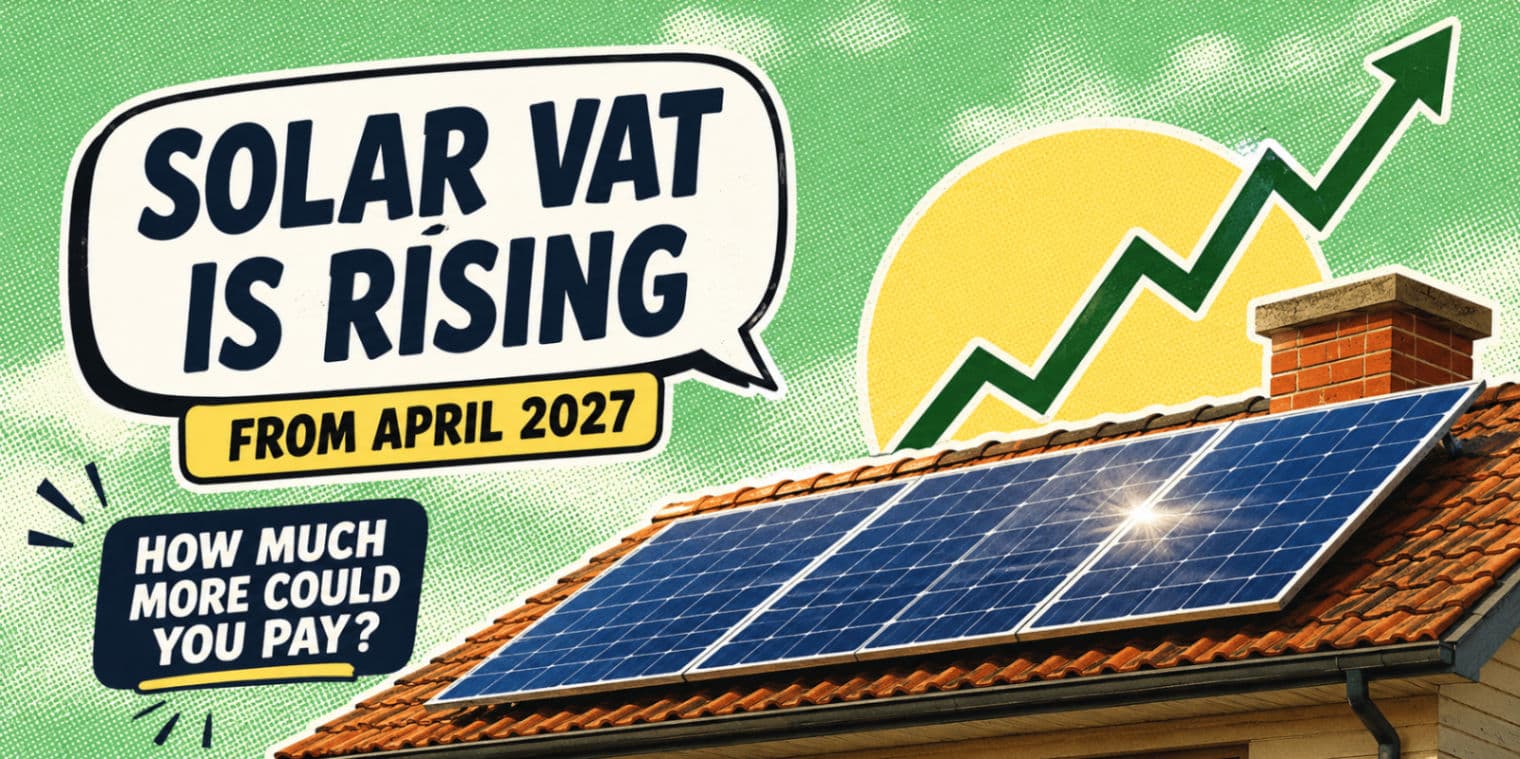

Solar panel VAT is changing from April 2027. Here’s why it’s happening, how it could affect average installation costs, and what homeowners should know before getting a quote.
Solar panels, battery storage and heat pumps have benefited from generous VAT relief in recent years.
Since April 2022, qualifying energy-saving installations in Great Britain have been charged at 0% VAT, helping homeowners reduce the upfront cost of going green.
But that relief is not permanent.
From 1 April 2027, the current 0% VAT rate is due to end. Qualifying energy-saving material installations are expected to return to the reduced VAT rate of 5%.
That means solar panels, battery storage, air source heat pumps and some fixed air conditioning systems could become more expensive from April 2027.
And the VAT rise may not be the only pressure on prices.
Hardware costs, changes to Chinese export rebates and rising energy prices could all affect the real-world cost and value of installing solar over the next 12 to 18 months.
Here’s what is changing, how much more homeowners could pay, and what to check before booking an installation.
PS We offer home solar panel installation nationwide. Simply answer these questions, get your fixed price and arrange your free design.
What is the 2027 solar VAT change?
At the moment, many domestic renewable and energy-saving installations qualify for 0% VAT under the government’s energy-saving materials relief.
This applies to qualifying installations in Great Britain and covers the supply and installation of eligible products.
The 0% VAT rate is currently due to run until 31 March 2027.
From 1 April 2027, the relief is expected to revert to the reduced VAT rate of 5%.
That means a qualifying installation that currently attracts no VAT will, from April 2027, be charged at 5% VAT unless the government extends or changes the policy before then.
🎥 Watch our YouTube video explaining the whole story:
Which products are affected?
The energy-saving materials relief covers a wide range of technologies.
Qualifying products can include:
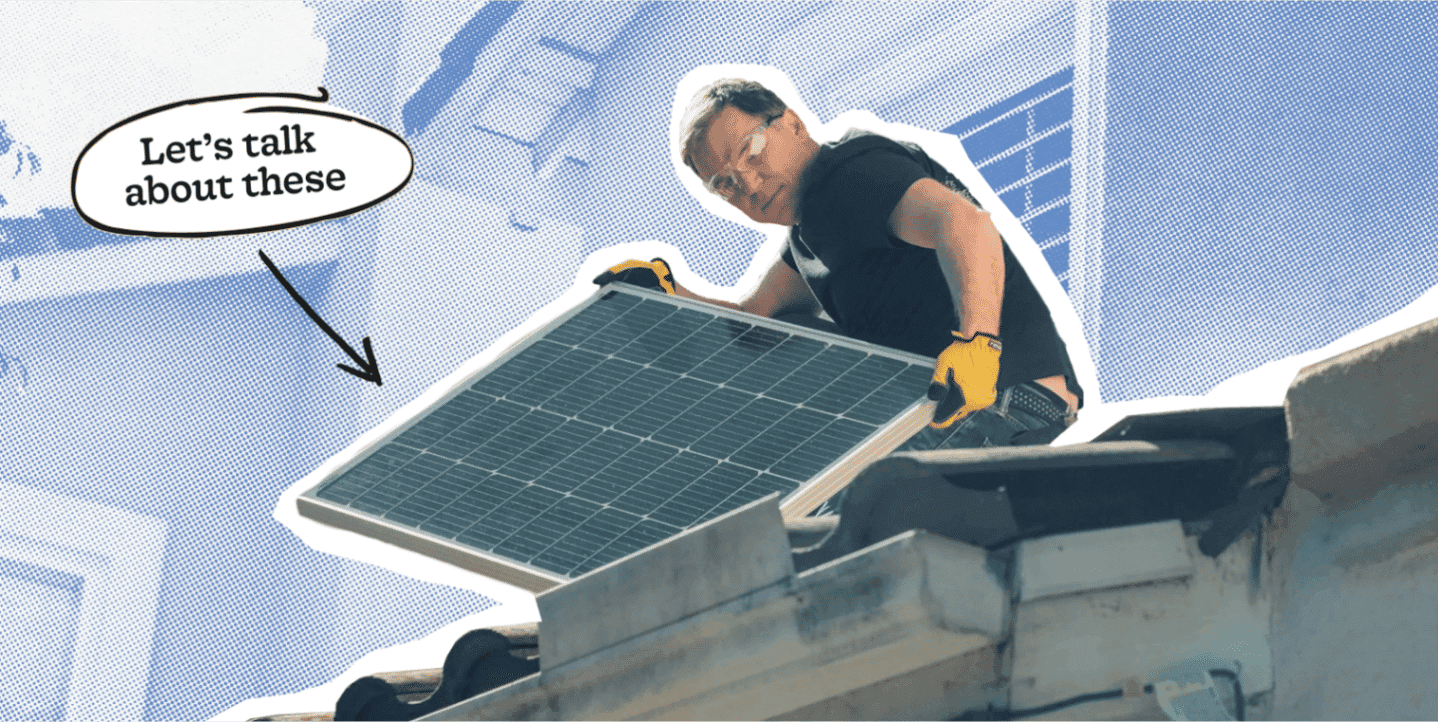
Solar panels
Electrical battery storage
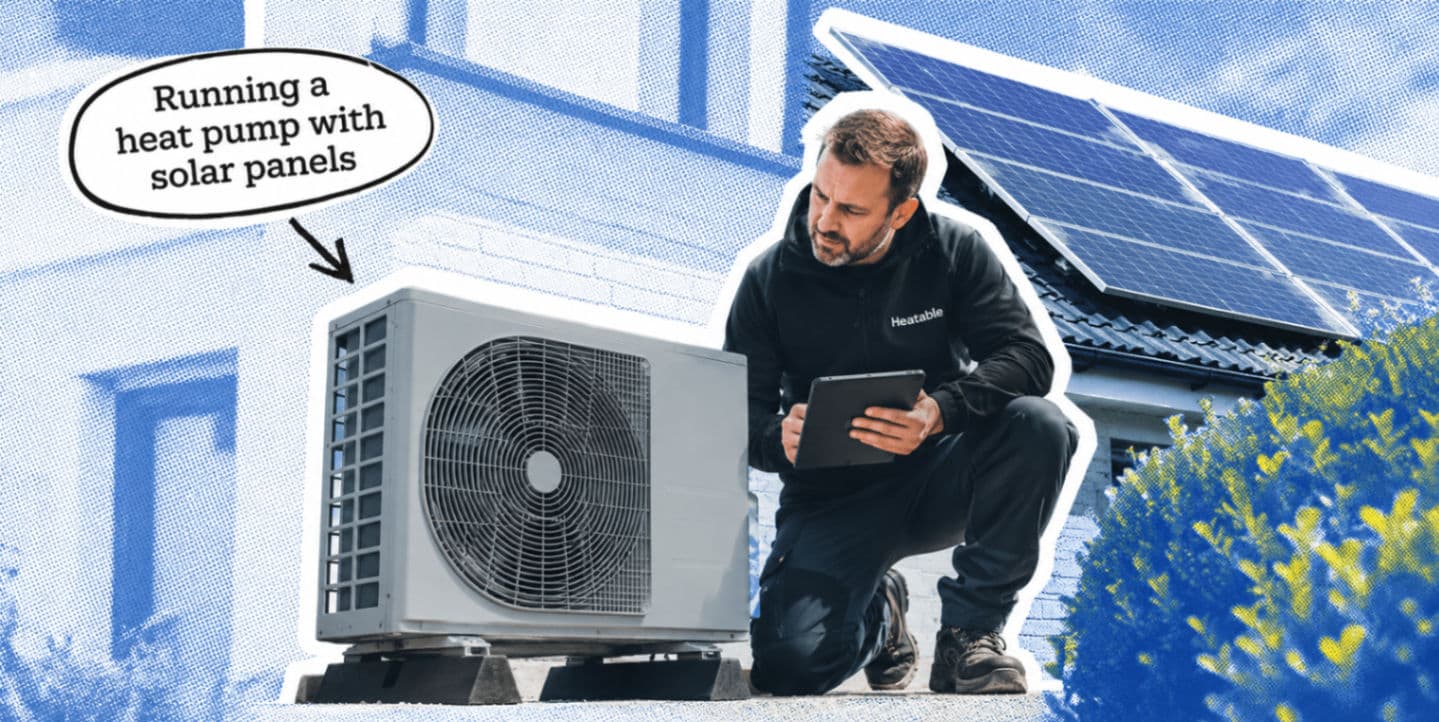
Air source heat pumps
Ground source heat pumps
Water source heat pumps
Insulation
Draught proofing
Smart heating controls
Certain fixed air conditioning systems, where they qualify as air source heat pumps
The relief generally applies to the installed job, not just the hardware.
So, on a qualifying solar installation, the VAT treatment can apply to the panels, inverter, battery, labour, scaffolding and other essential installation work.
Gas boilers are different. They are not part of this relief and remain subject to the standard VAT rate.
How much more could solar cost from April 2027?
The simplest way to look at the VAT change is this:
A £10,000 qualifying solar installation currently charged at 0% VAT costs £10,000.
At 5% VAT, the same installation would cost:
£10,000 + 5% VAT = £10,500
So the VAT rise alone would add £500 to a £10,000 job.
But that only tells part of the story.
The underlying cost of the system could also change before April 2027, especially if equipment prices rise.
Why the final increase could be higher than 5%
Solar and battery prices are affected by more than UK VAT policy.
A large share of solar panels, batteries and related components are manufactured in China. Changes to Chinese export rebates on solar and battery products are expected to put pressure on global hardware pricing.
There are also raw material pressures. Solar and battery manufacturing depends on materials such as polysilicon, aluminium and lithium carbonate. If these rise, the cost of finished equipment can rise too.
This does not mean every UK solar quote will automatically jump by the same amount.
Installers use different suppliers, different stock arrangements and different product ranges. Some may be able to absorb part of the increase for a while.
But if equipment costs rise across the supply chain, homeowners are likely to see at least some of that reflected in future quotes.
Example: a £10,000 solar and battery installation
Let’s use a realistic example.
Suppose a solar and battery installation costs £10,000 today at 0% VAT.
A typical installed price includes more than just equipment. It also includes labour, scaffolding, certification, design, electrical work and installer margin.
For simplicity, let’s assume materials make up around 60% of the job.
That gives us:
Cost element | Example amount |
Materials and equipment | £6,000 |
Labour, scaffolding, certification and margin | £4,000 |
Total today at 0% VAT | £10,000 |
Now assume the hardware element rises by 10%.
That adds:
10% of £6,000 = £600
The pre-VAT installation cost becomes:
£10,000 + £600 = £10,600
Now apply 5% VAT from April 2027:
£10,600 + 5% VAT = £11,130
So, in this example, a system costing £10,000 today could cost around £11,130 after equipment inflation and the VAT change.
That is an increase of roughly £1,130, or about 11%.
This is not a guaranteed forecast. Actual prices will depend on system size, product choice, installer pricing, stock availability, exchange rates and future policy decisions.
But it shows why the 2027 change is not just a simple 5% issue.
Why rising electricity prices matter too
A higher installation cost is not good news.
But it does not automatically weaken the case for solar.
That is because solar and battery storage save money by reducing the amount of electricity you need to buy from the grid.
If grid electricity becomes more expensive, every unit of electricity your system generates, stores and uses at home becomes more valuable.
So, while solar could cost more to install from April 2027, it may also protect homeowners from higher future energy costs.
That is the important trade-off.
The economics of solar do not necessarily fall apart because the upfront price rises. But the longer you wait, the more likely you are to face a higher install cost before you start capturing the savings.
Will installers absorb the VAT rise?
In most cases, probably not.
VAT is charged to the customer and collected by the installer on behalf of HMRC. If the VAT rate changes, installers will usually need to reflect that in their pricing.
Some installers may try to hold headline prices for a short period, especially if they have stock secured at older prices.
But across the market, it is unlikely that installers will absorb both a VAT rise and equipment cost increases without passing at least some of that cost on.
Solar installation is already a competitive market. The better installers still need enough margin to design, install, insure and support systems properly.
A suspiciously cheap quote is not always a bargain.
Could the government extend the 0% VAT relief?
It could.
Governments can change tax policy, and the current VAT relief could technically be extended.
But homeowners should not rely on that happening.
The 0% VAT rate already has a scheduled end date. If the government does nothing, the rate reverts to 5% from April 2027.
Extending the relief would require an active policy decision and would reduce potential VAT receipts for the Treasury.
So, while an extension is possible, the safer planning assumption is that the 5% rate will apply from 1 April 2027 unless the government confirms otherwise.
Does paying a deposit before April 2027 protect the 0% VAT rate?
Possibly, but do not assume it automatically protects the full installation.
VAT can depend on the “tax point”, which is the date a supply is treated as taking place for VAT purposes.
In some cases, receiving an invoice or making a payment before a VAT change can affect which rate applies.
But the detail matters.
A deposit paid before 1 April 2027 may only create a tax point for that deposit, not necessarily the full job.
The final VAT treatment can depend on the contract, invoice dates, payment schedule and any transitional rules introduced before the change.
If your installation could fall close to the deadline, ask your installer these questions before signing:
What VAT rate is included in the quote?
What happens if the installation is completed after 31 March 2027?
Does paying a deposit secure the VAT treatment for the whole job or only the deposit?
What date will appear on the invoice?
Will the quoted price change if the VAT rate changes before installation?
Can the VAT position be confirmed in writing?
This is not a minor admin detail.
If your job crosses the deadline and the quote was unclear, the difference could be hundreds of pounds.
Should you install solar before April 2027?
If you are only casually considering solar, this is not a reason to rush into a poor decision.
A solar system still needs to be properly designed around your roof, usage, battery requirements, export tariff and long-term plans.
But if you have already decided that solar, battery storage or a heat pump is right for your home, there is a strong argument for getting quotes sooner rather than later.
Installing before April 2027 could help you:
Avoid the scheduled 5% VAT increase
Reduce exposure to possible hardware price rises
Start saving on electricity sooner
Lock in a system design before any pre-deadline demand spike
Avoid being caught by longer installer lead times
The key is not to panic.
The key is to avoid drifting into the deadline by accident.
What homeowners should do next
If you are thinking seriously about solar, now is a good time to get a fixed quote and understand your options.
Before committing, make sure you know:
The full installed cost
Whether battery storage is included
Which panels and inverter are being specified
The expected annual generation
The estimated self-consumption rate
The export tariff assumptions
The warranty terms
The installation lead time
The VAT position if the job runs close to April 2027
A properly designed solar and battery system should be judged over decades, not just against a single tax deadline.
But tax deadlines still matter.
And this one could make waiting more expensive.
Get a solar quote with Heatable
You can get a fixed-price solar quote online with Heatable in around 60 seconds.
You can also book a free design call with one of our solar experts to discuss your roof, battery options, expected savings and installation timeline.
Get a Quote for Solar Today
Without boasting you should get your solar installed with us, here's why:
Thousands of Happy Customers: We boast an average score of 4.9 on Trustpilot, outperforming the market leader.
Which? Trusted Trader: Heatable is proudly recognised as a Which? Trusted Trader.
MCS Accredited: Our accreditation by the Microgeneration Certification Scheme (MCS) ensures high-quality standards.
Exclusive Panels: We offer REA Fusion solar panels, available only through Heatable.
Consumer Protection: As members of the HIES consumer code, we provide 2-year deposit protection.
Flexible Payment Options: Choose from multiple payment methods, including finance options.
Fixed Price Guarantee: Enjoy transparency with no hidden costs.
Save Your Quote: You can save your quote and decide later.
Bespoke Design Tool: Draw your own conclusion (literally) on whether solar is worth it for you, here.