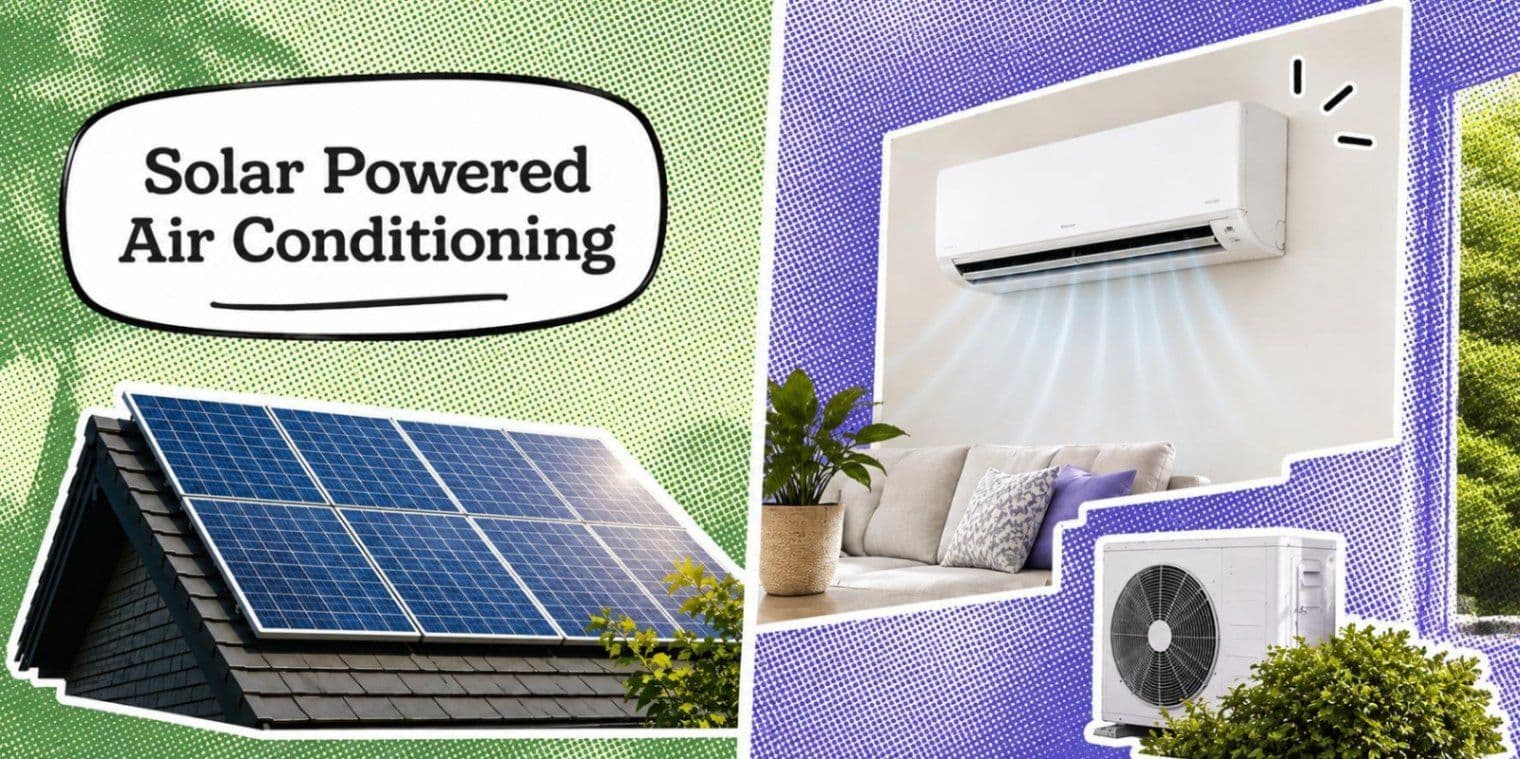

Solar-powered air conditioning sounds like an obvious win.
- What is a solar-powered air conditioner?
- Can solar panels really power air conditioning in the UK?
- How many solar panels would you need to run an air conditioner?
- What happens when clouds roll in?
- Does adding a solar battery make air conditioning more worthwhile?
- What setup do you actually need?
- Do you need special solar-compatible air conditioning?
- How much would solar-powered air conditioning cost?
- How much does solar actually save on air conditioning?
- Could you run your air conditioning completely off-grid?
The hottest, sunniest days are exactly when your solar panels are generating the most electricity, so why not use that power to cool your home?
In principle, that is exactly how it works.
But in the UK, the phrase solar-powered air conditioner can be slightly misleading. In most homes, you do not install a special air conditioner that plugs directly into a solar panel.
Instead, you install a normal mains-powered air conditioning system alongside solar PV, and your home uses the solar electricity whenever it is available.
Add a battery and the equation changes again, because excess solar generated during the day can potentially be used to run the air conditioning later.
So, can you realistically run air conditioning from solar panels in Britain?
Yes. And in some circumstances, the two technologies are actually a very good match.
Here's how it works, what equipment you need and what it is likely to cost.
PS We offer MCS-certified solar panel installation nationwide. Simply answer these questions, get your fixed price and arrange your free design.
What is a solar-powered air conditioner?
There are technically dedicated solar air conditioners available internationally, including systems that accept DC electricity directly from photovoltaic panels.
But that's not how we'd normally recommend approaching it in a UK home.
For most homeowners, a better setup is:
Solar panels → inverter → your home's electrical system → air conditioner
The solar panels generate DC electricity, the solar inverter converts it into the AC electricity used around your home, and your air conditioner simply becomes another electrical appliance drawing from that supply.
If your panels are producing more power than the house currently requires, the air conditioning can effectively run using your excess solar generation.
If there isn't enough solar available, the grid automatically supplies the difference.
No dramatic switching. No special solar air conditioner. And thankfully no extension lead running from the roof.
Can solar panels really power air conditioning in the UK?
Yes.
And unusually for a large electrical appliance, air conditioning has one major advantage when paired with solar:
You tend to need it most when solar generation is highest.
Solar PV output typically peaks around the middle of the day during sunny weather.
That is also when a home begins absorbing significant heat and when an air conditioning system is likely to be working.
This overlap means air conditioning can potentially make better use of solar generation than appliances that are predominantly used at night.
The important thing is understanding the difference between the cooling capacity of an air conditioner and the amount of electricity it actually consumes.
A 3.5kW air conditioner does not necessarily consume 3.5kW of electricity.
Modern split air conditioners are heat pumps. They move heat rather than converting electricity directly into cooling, which means they can deliver several kilowatts of cooling from considerably less electrical input.
For example, published data for Daikin's Perfera range shows its 3.4kW model has a nominal cooling electrical input of around 0.80kW.
That makes solar-powered cooling considerably more realistic than it might initially sound.
How many solar panels would you need to run an air conditioner?
There isn't one answer because it depends on:
The size of your air conditioning system
How many rooms you're cooling
Your solar array size
Roof orientation and shading
Weather conditions
What else in the house is consuming electricity
But we can use a realistic example.
Imagine you have:
A 4kWp solar PV system
A modern 2.5–3.5kW split air conditioner
An air conditioner consuming roughly 0.5–1kW while operating
On a bright summer afternoon, a 4kWp solar installation may be generating several kilowatts.
Your air conditioner could therefore consume only part of the electricity being generated, leaving the remainder available for your fridge, washing machine, computer and other appliances.
The UK Government itself uses 4kW of solar PV as a representative domestic installation size in its modelling of home electrification.
Of course, a 4kWp array doesn't constantly produce 4kW.
Clouds, orientation, temperature, shading and the time of day all affect generation.
That's why calling an air conditioner "solar powered" shouldn't imply that the grid suddenly becomes unnecessary.
What happens when clouds roll in?
Nothing particularly exciting.
Your home simply imports electricity from the grid.
With a conventional grid-connected solar installation, your air conditioner isn't normally choosing between "solar mode" and "grid mode".
The electricity generated by your panels is used by appliances in your home first. If your house needs more power than the solar panels are producing, additional electricity comes from the grid.
For example:
Solar generation: 1.8kW
Air conditioner: 0.8kW
Rest of home: 0.5kW
Your panels are producing enough electricity to cover everything.
Now imagine a cloud passes overhead:
Solar generation: 0.4kW
Air conditioner: 0.8kW
Rest of home: 0.5kW
Your home needs 1.3kW but solar is producing only 0.4kW.
The remaining 0.9kW simply comes from the grid.
Does adding a solar battery make air conditioning more worthwhile?
Potentially, yes.
But this is where the economics become more complicated.
A battery allows surplus solar electricity generated during the day to be stored instead of immediately exported.
You can then use that electricity later.
The UK Government describes this as one of the primary benefits of combining solar PV with battery storage: excess daytime generation can be stored and used when solar production falls.
For air conditioning, that's particularly useful because UK homes can remain hot well into the evening.
Without a battery, your solar generation might look something like:
1pm: High solar output + AC running
4pm: Good solar output + AC running
7pm: Low solar output + AC still running
10pm: No solar + bedroom AC running
During the evening, you're increasingly relying on grid electricity.
With a battery, excess generation from earlier in the day could instead supply part or all of that evening demand.
How big a battery would you need?
Again, it depends on your system.
Let's assume your bedroom air conditioner averages around 0.6kW while running.
If it ran at that average power for five hours:
0.6kW × 5 hours = 3kWh
In theory, around 3kWh of usable battery capacity would cover that particular load.
Real-world calculations need to account for things such as:
Battery conversion losses
Other household electricity demand
Battery reserve settings
Variations in AC compressor output
Available solar generation that day
This is why installing a giant battery purely to run air conditioning usually doesn't make financial sense.
If you're already considering a battery for whole-home energy management, though, air conditioning becomes another useful load for it to support.
Battery capacity isn't the only thing that matters
This bit is often overlooked.
A battery has two important specifications:
Capacity, measured in kWh, tells you how much energy it stores.
Power output, measured in kW, tells you how much electricity it can deliver at once.
You need both to be sufficient.
A 10kWh battery could theoretically store plenty of energy for your air conditioner, but if its inverter could only provide a very low output, it might struggle with several high-powered appliances running simultaneously.
For a typical single-room inverter air conditioner, this isn't usually particularly challenging.
But if you're planning:
Multi-split air conditioning
Whole-home cooling
An EV charger
An electric oven
An induction hob
A heat pump
then battery inverter capacity becomes much more important.
Your solar and battery installer should assess the home's peak demand, not simply sell you the largest number of kWh they can fit on the wall.
What setup do you actually need?
For most UK homes, a sensible solar-powered air conditioning setup would look something like this:
Option 1: Air conditioning + existing solar
If you already have solar PV, this is the easiest option.
You simply install a conventional fixed split air conditioning system.
During periods when your solar panels are producing electricity, that generation contributes towards the air conditioner's consumption.
You generally don't need a special "solar-compatible" AC unit.
Option 2: Solar + air conditioning
If you're installing both technologies together, you'll typically need:
Solar PV panels
Solar inverter
Generation monitoring
Consumer unit connection
Indoor air conditioning unit
Outdoor AC condenser
Refrigerant pipework
Electrical supply to the AC system
A qualified air conditioning installer should size the AC system according to the cooling requirements of the room rather than the size of your solar array.
Option 3: Solar + battery + air conditioning
This adds:
Home battery storage
Battery inverter or hybrid inverter
Energy management controls
A hybrid solar inverter can allow both the solar panels and battery to operate through an integrated system.
Alternatively, an AC-coupled battery can potentially be added to an existing solar installation.
Neither approach is universally superior. It depends on the equipment already installed and what you're trying to achieve.
Do you need special solar-compatible air conditioning?
Usually, no.
This is one of the biggest misconceptions around solar-powered AC.
If you have normal grid-connected solar PV, virtually any conventional mains-powered air conditioner can consume electricity generated by your panels.
Compatibility is therefore primarily between:
your solar/battery inverter and your home's electrical installation
rather than between the solar panels and the air conditioner itself.
What we'd favour is an efficient inverter-driven split system, because it can vary compressor speed rather than constantly cycling at full output.
That usually means quieter operation, better temperature control and lower electricity consumption.
Air conditioners that work well with solar
There isn't a special Heatable-approved category labelled "solar air conditioner".
Instead, look for efficient fixed split systems with high seasonal efficiency.
Examples of established systems sold in the UK include:
Daikin Perfera
Daikin's Perfera is available in multiple capacities and offers seasonal cooling efficiencies of up to A+++.
The smaller models are particularly interesting from a solar perspective because their nominal electrical demand can be relatively modest.
Published Daikin data gives approximately:
2.0kW cooling model: 0.44kW nominal electrical input
2.5kW cooling model: 0.56kW
3.4kW cooling model: 0.80kW
4.2kW cooling model: 0.97kW
That's well within the generation capability of a decent domestic solar installation during good conditions.
Mitsubishi Electric MSZ-AY
The Mitsubishi Electric MSZ-AY / MSZ-AP range is another strong option.
It uses inverter technology and is available across a wide spread of capacities from around 1.5kW to 7.1kW.
Mitsubishi describes the range as energy efficient and offers Wi-Fi control on applicable models.
Mitsubishi Electric MSZ-LN
The MSZ-LN is Mitsubishi Electric's more premium domestic option.
It combines inverter cooling and heating with advanced controls and is available in capacities ranging from approximately 1.8kW to 5.0kW in the UK domestic range.
Again, nothing inside it needs to know your electricity came from solar panels.
Panasonic Etherea
Panasonic's Etherea range is another efficient inverter-driven option.
Published specifications for previous Etherea models illustrate just how different cooling output can be from electrical consumption.
A 2.5kW cooling model, for example, was rated at around 0.525kW nominal electrical input.
The exact current model and specification should always be checked before installation.
How much would solar-powered air conditioning cost?
This depends on which pieces of the puzzle you already own.
As rough UK budgeting territory:
Air conditioning
A professionally installed single-room split system might typically run into the low thousands of pounds.
Multi-room systems can rise substantially depending on:
Number of indoor units
Pipe runs
Outdoor unit size
Electrical work
Access
Brand
Installation complexity
Whole-home air conditioning can therefore become a sizeable project.
Solar panels
A typical domestic solar array is another several-thousand-pound investment.
The exact cost varies enormously according to:
Number and type of panels
Roof access
Scaffolding
Inverter
Electrical work
Optimisers
Roof layout
Government solar cost statistics are updated regularly and show continued variation according to system size and installation type.
Battery storage
This is where costs can jump.
Which? reports that domestic battery storage can range from under £2,000 to around £10,000, depending on capacity, technology and manufacturer.
Batteries are currently VAT-exempt when installed domestically, including standalone installations, until 31 March 2027 under the current government policy.
So a complete solar + battery + multi-room AC installation can easily become a five-figure home energy project.
That's why we'd be very cautious about installing all three technologies solely to save money on summer cooling.
The economics probably won't stack up.
How much does solar actually save on air conditioning?
Let's use a deliberately simple example.
Suppose your air conditioner averages:
0.8kW
And you run it for:
6 hours
That's:
4.8kWh of electricity
At the current July–September 2026 Ofgem electricity price-cap average of 26.11p/kWh, buying all of that electricity from the grid would cost roughly:
£1.25
If solar provided all 4.8kWh, you'd avoid purchasing that electricity.
That doesn't mean you've "made" £1.25, because exporting excess solar can also earn money under a Smart Export Guarantee tariff.
The real financial benefit is therefore - avoided import cost – lost export income
This distinction matters.
Solar electricity isn't genuinely free once you've bought the system, and exported electricity has value.
Does a battery improve the payback?
Not automatically.
Battery storage can increase your self-consumption, meaning you use more of the electricity your solar panels generate rather than exporting it.
But batteries are expensive.
Which? notes that whether battery storage saves money depends on factors including installation cost, tariffs, battery lifetime and how effectively the system is controlled.
If the only reason you're considering a £5,000+ battery is to avoid buying a pound or two of electricity on hot evenings, you've created a fairly heroic solution to a fairly modest problem.
The argument becomes much stronger when the battery also helps with:
Evening household electricity use
Cheap overnight tariffs
EV charging strategies
Heat pump operation
Avoiding peak electricity rates
Solar self-consumption
Grid flexibility tariffs
In other words:
Don't buy a battery for your air conditioner. Buy a battery for your home, then let your air conditioner benefit from it.
Could you run your air conditioning completely off-grid?
Technically, yes.
Practically, we'd advise most UK homeowners not to design the system around that goal.
You'd need enough:
Solar generation
Battery capacity
Battery inverter power
Backup capacity
to handle poor weather as well as perfect summer days.
And therein lies the problem.
Sizing an off-grid system around the occasional cloudy UK summer day would mean paying for substantially more solar and battery capacity than you'd normally need.
Grid connection gives you an enormous virtual backup battery without filling your garage with actual batteries.
What about portable air conditioners?
You can run a portable AC unit from solar electricity too.
Again, your solar system doesn't particularly care what appliance is consuming the power.
But portable air conditioners are generally a less elegant solution than fixed split systems.
They typically:
Require a large exhaust hose
Are noisier
Are less efficient
Allow additional heat to enter through poorly sealed windows
If you own your property and want a long-term cooling solution, we'd normally favour a professionally installed inverter split system.
Can air conditioning actually make solar panels more worthwhile?
Potentially.
One of the persistent problems with domestic solar is the mismatch between when electricity is produced and when households consume it.
A typical family may generate lots of solar electricity around lunchtime while using the most electricity after returning home in the evening.
Air conditioning is unusual because its consumption tends to correlate with sunshine.
That's useful.
Rather than exporting large amounts of electricity during a hot afternoon, you're effectively using some of that generation directly to prevent your home overheating.
And because cooling the property earlier can reduce the amount of cooling needed later, a sensible control strategy may work better than waiting until 8pm and trying to rescue an already roasting bedroom.
The smartest way to use solar-powered air conditioning
If you already have solar panels, we'd approach it like this:
1. Choose an efficient inverter split AC system.
2. Size it according to the room, not your solar array.
3. Run more cooling during periods of strong solar generation.
4. Pre-cool rooms before solar output falls.
5. Use smart controls rather than setting the thermostat ridiculously low.
6. Consider battery storage only as part of your wider household energy strategy.
If you already have a home battery, you can go a step further and configure your energy management system to retain enough charge for evening cooling.
One thing to check before adding solar or batteries
Solar panels and battery systems that connect to the electricity network need to comply with UK electrical and network requirements.
Your installer may need to notify or seek approval from your Distribution Network Operator (DNO) depending on the system.
Government guidance confirms that solar PV and battery installations connecting to the grid need to be registered with the relevant DNO.
Use properly qualified installers rather than treating solar, batteries and air conditioning as three separate DIY projects.
There are enough inverters involved already.
So, is solar-powered air conditioning worth it in the UK?
If you're installing solar panels purely because you want cheaper air conditioning, probably not.
British cooling demand is still too seasonal for that alone to justify several thousand pounds of solar equipment.
But that's not really the interesting use case.
If you already have solar, air conditioning is arguably one of the more logical appliances to run from it because your cooling demand and solar generation often occur at the same time.
And if you're already planning solar plus battery storage for broader reasons, efficient air conditioning fits surprisingly neatly into the system.
You don't need a special solar-powered air conditioner.
You need:
an efficient air conditioner + a properly designed solar installation + sensible controls.
Add battery storage and you can shift some of that cheap daytime electricity into the evening too.
That's less exciting than a magical air conditioner powered directly by sunshine.
But it's also considerably more practical.
Next Steps For Your Solar Journey:
When planning to install solar panels for your home, there are several important factors to consider. Make sure to refer to the following guides to help you make informed decisions:
To dive deeper into these topics, head over to our advice section, check out our YouTube channel for informative videos, or read a customer case study to see how others have benefited from their solar installation.
Get a Quote for Solar Today
Without boasting you should get your solar installed with us, here's why:
Thousands of Happy Customers: We boast an average score of 4.9 on Trustpilot, outperforming the market leader.
Which? Trusted Trader: Heatable is proudly recognised as a Which? Trusted Trader.
MCS Accredited: Our accreditation by the Microgeneration Certification Scheme (MCS) ensures high-quality standards.
Exclusive Panels: We offer REA Fusion solar panels, available only through Heatable.
Consumer Protection: As members of the HIES consumer code, we provide 2-year deposit protection.
Flexible Payment Options: Choose from multiple payment methods, including finance options.
Fixed Price Guarantee: Enjoy transparency with no hidden costs.
Save Your Quote: You can save your quote and decide later.
Bespoke Design Tool: Draw your own conclusion (literally) on whether solar is worth it for you, here.