
Government funding schemes have a frustrating habit of sounding universal before the eligibility criteria arrive.
- What is the Warm Homes Loan Scheme?
- Is the Warm Homes Loan Scheme a solar panel grant?
- How much cheaper could Warm Homes solar finance be?
- What can you finance through the Warm Homes Plan?
- Can you combine the loan with the Boiler Upgrade Scheme?
- Who will qualify for Warm Homes solar panel loans?
- How do you apply for a Warm Homes solar loan?
You hear about grants, incentives and billions of pounds in funding. Then, when you look more closely, the support is restricted to a narrow group of households, specific postcodes or people receiving certain benefits.
The new Warm Homes Loan Scheme could be different.
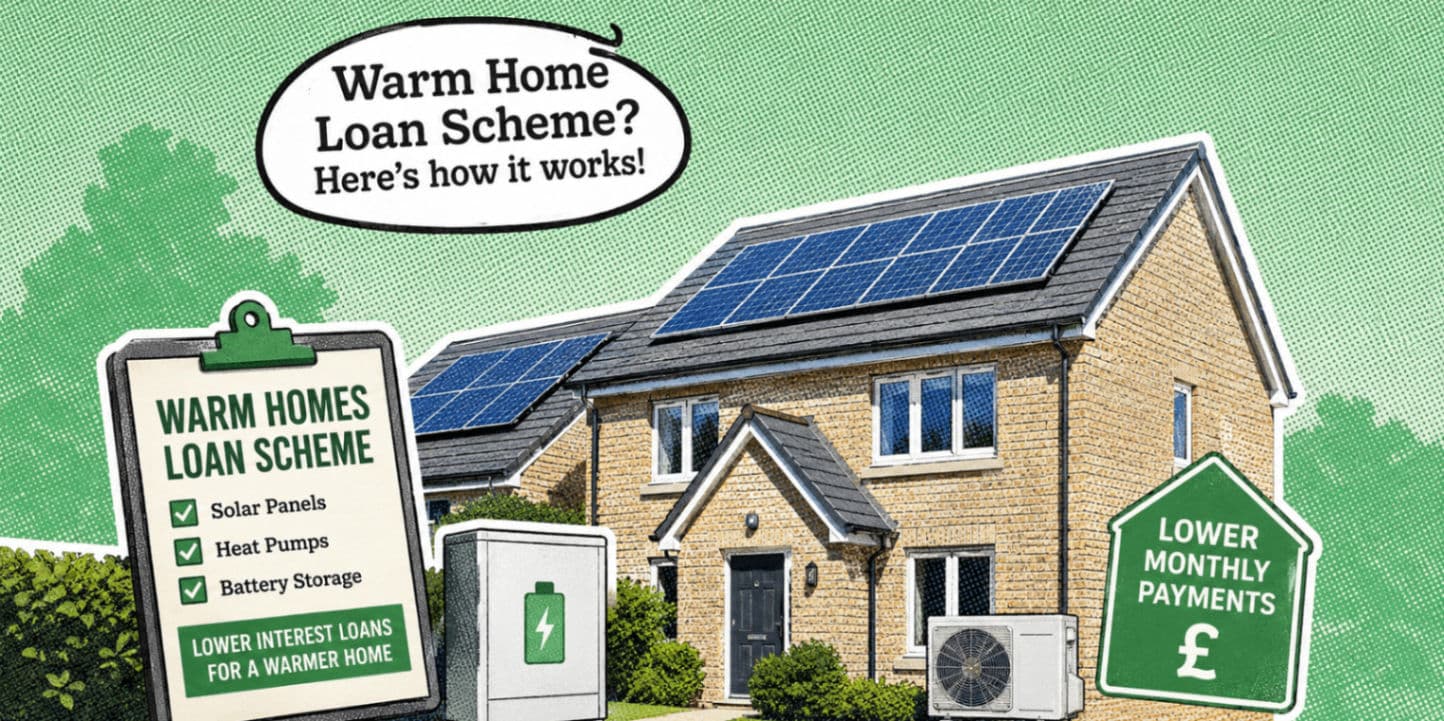
Rather than limiting support to households on low incomes, the scheme is intended to help a much wider range of homeowners and private landlords finance improvements such as:
Insulation
Other eligible home energy upgrades
The government is not simply handing homeowners cash. Instead, it is supporting lenders so they can offer qualifying customers finance at rates below their usual market rates.
That distinction matters.
The scheme could make solar panels and batteries considerably more affordable for households that cannot, or would prefer not to, pay the full installation cost upfront.
However, lenders are still being approved and the final consumer products, interest rates and launch dates have not yet been confirmed.
Here is what we know so far.
Planning solar panels or battery storage? Get a personalised Heatable quote and book a free solar design consultation. We can assess your property, design the right system and explain the finance options available to you.
🔑 Key takeaways:
The Warm Homes Loan Scheme, or WHLS, is part of the wider government-backed Warm Homes Plan.
It is designed to provide lower-cost finance, not an automatic cash grant paid directly to homeowners.
Solar panels, home batteries and heat pumps are among the eligible technologies.
The scheme is expected to cover owner-occupied and privately rented homes.
There is no general means test stated for the loan scheme, although borrowers will still need to pass the lender’s normal credit and affordability checks.
The government is making up to £300 million of grant capital available to participating lenders to help reduce financing costs.
Solar finance could be combined with support from the Boiler Upgrade Scheme when installing an eligible heat pump.
Lenders are currently applying to participate. Final interest rates and consumer launch dates have not yet been announced.
What is the Warm Homes Loan Scheme?
The Warm Homes Loan Scheme is a government-backed initiative intended to make borrowing for home energy improvements cheaper.
It forms part of the wider Warm Homes Plan, under which the government has committed £15 billion of public investment to upgrading homes and reducing energy bills.
The wider plan includes:
£5 billion for schemes supporting households on low incomes
£2 billion of support for consumer loans
£2.7 billion for the Boiler Upgrade Scheme
Up to £5 billion for the Warm Homes Fund and other forms of innovative finance
The government says the Warm Homes Loan Scheme will use £300 million of grant capital to help participating lenders reduce the cost of eligible finance products.
An additional portion of the Warm Homes Fund is intended to support low- and zero-interest lending at scale.
The government’s stated ambition is to provide homeowners with cheaper ways to fund solar panels, batteries, heat pumps and other energy-saving measures.
🎥 Watch our YouTube video for a full breakdown of how the Warm Homes Loan Scheme works:
Is the Warm Homes Loan Scheme a solar panel grant?
Not in the conventional sense.
Homeowners will not ordinarily receive a grant that simply pays part of their solar installation bill.
Instead, the government will provide funding to approved lenders. That support can reduce the principal or financing cost behind an eligible loan, allowing the lender to offer customers a lower interest rate than it might normally charge.
The process is expected to work broadly as follows:
A participating lender creates an eligible green home finance product.
The government approves the lender and its proposed product.
A homeowner applies through the lender or an approved installation partner.
The lender assesses the applicant under its normal credit and affordability rules.
Government support reduces the cost of providing the loan.
The customer receives a lower rate than the lender’s equivalent standard finance product.
The precise structure may differ between lenders. Some could offer standalone home-improvement loans, while others may use mortgage-linked borrowing or different forms of secured and unsecured finance.
How much cheaper could Warm Homes solar finance be?
The final rates have not been announced.
The government’s scheme documents describe products offered below lenders’ normal market rates, but they do not guarantee a specific rate for every customer.
The actual rate you receive is likely to depend on:
The participating lender
The type and size of loan
The repayment term
Whether the borrowing is secured or unsecured
Your credit history
Your income and existing financial commitments
The technology being installed
To illustrate the potential effect, consider a £10,000 solar panel and battery installation financed over five years.
Example finance | Representative rate used | Approximate monthly payment | Approximate total interest | Approximate total repaid |
Standard finance example | 9.9% APR | £212 | £2,718 | £12,718 |
Reduced-rate example | 4.9% APR | £188 | £1,296 | £11,296 |
In this illustration, reducing the interest rate from 9.9% to 4.9% saves approximately £1,422 over five years.
These calculations are examples, not quotations or predictions of the rate that will eventually be available through the scheme. A longer repayment term may reduce the monthly payment but generally increases the total amount of interest paid.
See what solar could cost for your home. Get a fixed-price Heatable solar estimate online, then speak to our design team about panels, battery storage and suitable payment options.
What can you finance through the Warm Homes Plan?
The scheme rules allow lenders to support a range of eligible home energy improvements.
Solar panels
Solar photovoltaic panels are included.
A correctly designed solar system can reduce the amount of electricity a household needs to buy from the grid. Surplus electricity can also be exported through a Smart Export Guarantee tariff.
The financial benefit depends on factors including:
Roof orientation and pitch
Shading
System size
Household electricity consumption
When electricity is used
Whether battery storage is installed
The import and export tariffs selected
Solar battery storage
Battery storage may be financed alongside a new solar installation or, subject to the participating lender’s product rules, as a standalone improvement.
A battery stores electricity for later use. This can include surplus solar generation during the day or cheaper electricity imported during an off-peak tariff period.
For many households, adding a battery increases the proportion of generated solar electricity used within the home.
Air-source heat pumps
Air-to-water heat pumps are included among the eligible technologies.
These systems extract heat from the outside air and use it to heat water for radiators, underfloor heating and hot-water cylinders.
Eligible households may also be able to combine lower-cost finance with a Boiler Upgrade Scheme grant.
Ground-source heat pumps
Ground-source heat pumps are also included, although installations are generally more complex and expensive because they require buried ground loops or boreholes.
Air-to-air heat pumps
Air-to-air heat pumps provide heating directly through indoor air-conditioning units and can usually provide cooling during warmer weather.
They are now supported separately by the Boiler Upgrade Scheme, with eligible installations receiving up to £2,500.
Insulation and energy-efficiency measures
The wider scheme also covers qualifying energy-efficiency improvements. The precise measures offered will depend on the individual lender’s approved finance product.
EV chargers
An EV charger may be eligible when included as part of a wider package involving solar panels or battery storage. It is not expected to qualify as a standalone measure under the initial rules.
Can you combine the loan with the Boiler Upgrade Scheme?
Yes, the government intends the low-cost finance to work alongside the Boiler Upgrade Scheme.
The standard Boiler Upgrade Scheme grants currently include:
£7,500 towards an eligible air-to-water heat pump
£7,500 towards an eligible ground-source heat pump
£2,500 towards an eligible air-to-air heat pump
£5,000 towards an eligible biomass boiler
A temporary £9,000 grant is also being introduced for qualifying off-gas-grid properties replacing certain oil or LPG heating systems with an air-to-water or ground-source heat pump. It is scheduled to apply from 21 July 2026 until 31 March 2027.
For example, a homeowner could potentially:
Receive a Boiler Upgrade Scheme grant towards an eligible heat pump.
Finance the remaining heat-pump cost through an approved low-interest product.
Include solar panels and battery storage within the wider home upgrade package.
That could make a combined solar, battery and heat-pump installation more accessible without requiring the household to fund the full cost upfront.
Eligibility for the Boiler Upgrade Scheme remains separate, and the installation must meet its technical and certification requirements.
Who will qualify for Warm Homes solar panel loans?
The government has designed the loan scheme to be significantly broader than support targeted specifically at households in fuel poverty.
It is intended to cover:
Homeowners
Owner-occupiers
Private landlords
Eligible properties across Great Britain, subject to rollout arrangements
The loan scheme itself is not currently presented as means-tested.
However, “available to everyone” should not be interpreted as “every applicant is guaranteed finance”.
The lender will still need to assess:
Affordability
Credit history
Income
Existing borrowing
Financial commitments
The proposed loan term
Whether the property and installation meet the scheme rules
A lower government-backed rate does not remove the lender’s regulatory duty to avoid unaffordable lending.
Some applicants may need to choose a smaller system, make a deposit or spread the repayments over a longer term. Others may not be approved.
Are landlords eligible?
Private landlords are included within the intended scope of the scheme.
This could be particularly useful as landlords face increasingly demanding energy-efficiency expectations across the private rented sector.
However, the lender may apply different affordability, property or borrowing criteria to landlords. It is also possible that not every participating lender will serve every type of applicant.
Landlords should therefore compare the total cost of borrowing, tax treatment, expected bill savings and potential effect on the property’s value rather than choosing a product purely because it carries government support.
Are free solar panels available under the Warm Homes Plan?
Some households may receive fully funded improvements, but this is separate from the mainstream loan offer.
The Warm Homes Plan includes billions of pounds for low-income and fuel-poor households. In England, the Warm Homes: Local Grant can provide free energy-saving improvements to qualifying privately owned and privately rented homes.
Eligibility can depend on:
Household income
Receipt of certain benefits
The property’s postcode
The home’s current Energy Performance Certificate rating
The local authority’s delivery rules
The Warm Homes: Local Grant generally targets low-income households living in homes rated EPC D to G.
Most working households should not assume they will receive a completely free solar installation. Their main route under the new scheme is more likely to be subsidised finance.
How do you apply for a Warm Homes solar loan?
Consumer applications are not open yet.
The application window that opened on 24 June 2026 is for lenders, not homeowners.
Participating lenders must first:
Apply to join the scheme.
Demonstrate that they meet the required FCA, operational and conduct standards.
Complete the government’s approval process.
Submit individual finance products for approval.
Launch those products to consumers.
The first lender application window closes on 17 July 2026, with the initial lender onboarding window scheduled for 12 to 24 August 2026. The official scheme currently runs until 31 March 2030.
The government has not yet published a firm date on which the first homeowner will be able to complete an application.
Once products launch, you are likely to apply either:
Directly through a participating lender
Through an approved solar or renewable-energy installer working with that lender
Through a mortgage provider offering a qualifying green finance product
What should you do before applications open?
You do not need to wait before planning your installation.
Get a proper system design
A solar quotation should be based on the property, not simply the maximum number of panels that will fit on the roof.
The installer should consider:
Annual electricity use
Daytime and evening consumption
Roof dimensions
Roof direction and pitch
Shading
Inverter capacity
Battery size
Potential future demand from an EV or heat pump
Check the installer’s accreditations
Use an installer with the certifications and consumer protections required by the scheme and your chosen lender.
For solar and heat-pump installations, MCS certification is likely to be central. It is also generally required to access the Smart Export Guarantee and the Boiler Upgrade Scheme.
Compare the complete installed price
A low interest rate does not rescue an overpriced installation.
Compare:
Total system price
Panel and inverter specifications
Usable battery capacity
Scaffolding
Electrical work
Monitoring
Warranties
Estimated generation
Export arrangements
Total amount repayable
The proper comparison is not merely one lender’s APR against another. It is the complete system, complete finance cost and expected long-term performance.
Avoid designing the system around a hypothetical loan
Do not order unnecessary equipment merely because cheaper finance may become available.
A larger battery is not automatically better. Nor does installing the maximum possible number of panels necessarily produce the best return.
The right package should be based on credible consumption and generation modelling.
Why choose Heatable?
Applying separately for an installation and finance can create unnecessary friction.
You may need to obtain a technical proposal, check the installer’s certification, approach a lender, provide supporting documents and confirm that every part of the project complies with the lender’s rules.
Heatable brings the major parts of that process together.
We can provide:
A personalised solar and battery design
Clear, fixed installation pricing
MCS-certified installation
Solar panels, battery storage, heat pumps and EV chargers
Help comparing available payment options
A free consultation with an experienced renewable-energy specialist
As approved Warm Homes Loan Scheme products reach the market, we will update customers on the available rates, eligibility requirements and application process.
Start planning your home energy upgrade. Get your Heatable quote and book a free design call today.
We will help you build the right solar, battery or heat-pump package without the industry waffle.
Is it worth waiting for the Warm Homes Loan Scheme?
Possibly, but not automatically.
Waiting could make sense when:
You need to borrow most or all of the installation cost.
Your current finance options have relatively high interest rates.
The installation is not urgent.
You expect to qualify for a participating lender’s product.
Installing sooner could still make more sense when:
You can access genuine 0% finance.
You can pay cash without weakening your emergency reserves.
Your home has particularly high electricity use.
Delaying means losing substantial solar generation and bill savings.
Equipment or installation prices rise before the loan becomes available.
An existing tariff or incentive makes the project attractive now.
The critical calculation is not simply whether future borrowing may be cheaper.
You need to compare the likely interest saving against the energy savings forgone while waiting, any change in installation prices and the risk that you may not qualify for the eventual product.
The bottom line
The Warm Homes Loan Scheme could address one of the biggest barriers to installing solar panels: the upfront cost.
Unlike a narrowly targeted grant, it is being designed as a broader financing programme for homeowners and private landlords. Government support will be delivered through approved lenders, reducing the cost of eligible solar, battery and heat-pump finance.
That does not mean free solar panels, guaranteed approval or one universal low rate.
The final consumer products still need to be launched, and the government has not confirmed exactly when applications will open or what interest rates lenders will offer.
Nevertheless, this is more than a vague policy announcement. The lender application process is underway, £300 million of grant capital has been committed to the scheme, and the first lenders are due to begin onboarding in August 2026.
For households that want solar panels but cannot justify paying the entire cost upfront, the result could be genuinely useful: properly installed home energy technology, financed at a materially lower cost.
Ready to explore solar? Get a personalised Heatable quote and book your free design consultation. We will assess your roof, energy use and future plans to create a system that actually makes sense for your home.