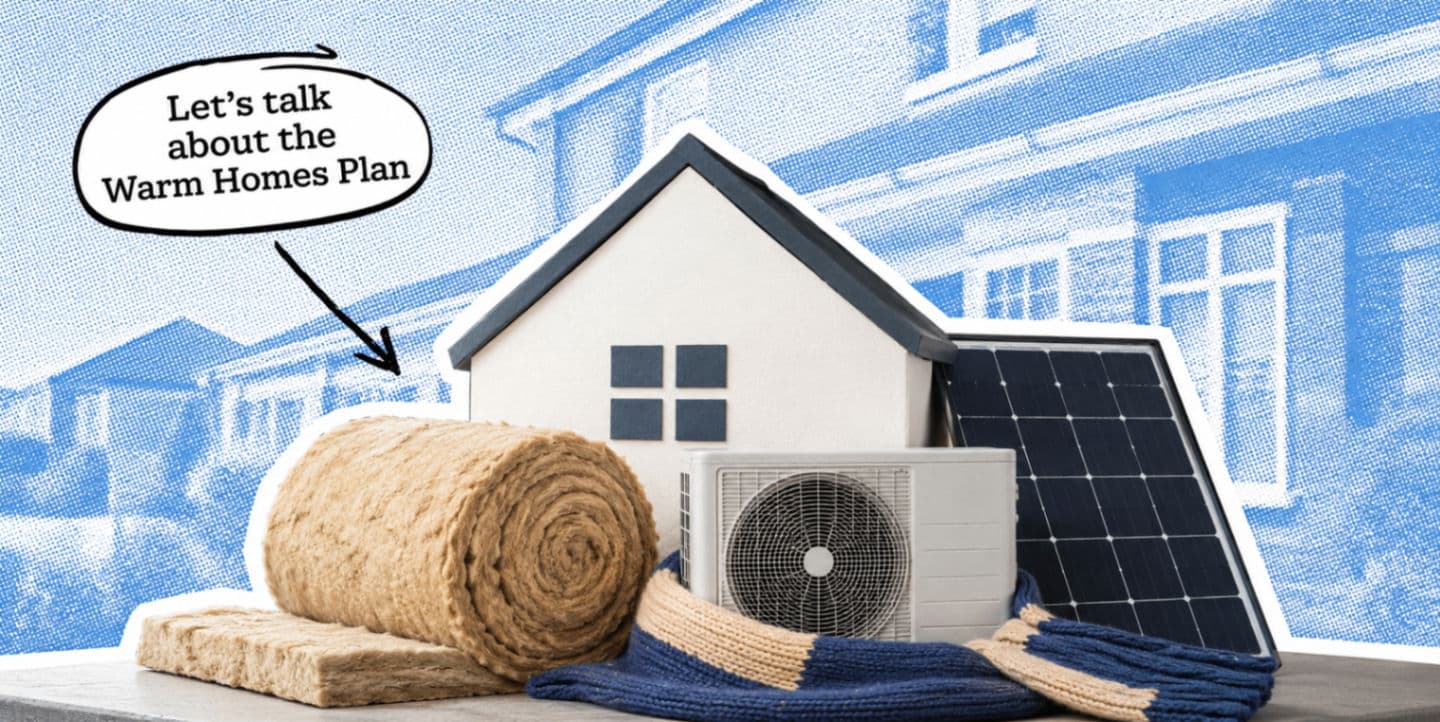

The Warm Homes Plan is the government’s big promise to make UK homes cheaper, warmer and cleaner to run. Lovely.
- First, what is the Warm Homes Plan?
- What could the Warm Homes Plan pay for?
- Does the Warm Homes Plan mean free solar panels?
- Should you wait before installing solar panels?
- What does this mean for heat pumps?
- Should you get insulation before solar or a heat pump?
- What about batteries?
- What does the Warm Homes Plan mean for renters?
- What does it mean for new-build homes?
But what does that actually mean for normal homeowners?
Are we all getting free solar panels?
Will heat pumps suddenly become affordable?
Should you wait before upgrading your boiler, solar panels or insulation?
And is this another one of those government schemes that sounds great, then turns into a form, a postcode lottery and a mild headache?
Let’s unpack it….
PS We offer MCS-certified solar panel installation nationwide. Simply answer these questions, get your fixed price and arrange your free design.
First, what is the Warm Homes Plan?
The Warm Homes Plan is a government scheme designed to upgrade millions of UK homes by 2030.
The aim is simple enough:
Lower bills.
Warmer homes.
Less wasted energy.
Less reliance on gas.
More solar, batteries, insulation and low-carbon heating.
In other words, it is the government’s attempt to drag Britain’s homes into the 21st century.
Which, frankly, is overdue.
A lot of UK homes still leak heat like a budget tent in February. So if the plan works properly, it could make a real difference.
The key phrase there is: if it works properly.
What could the Warm Homes Plan pay for?
The plan is expected to support a mix of home energy improvements, including:
Home upgrade | What it does |
Insulation | Keeps more heat inside your home |
Solar panels | Generate your own electricity |
Battery storage | Stores solar or cheap off-peak electricity |
Heat pumps | Replace gas, oil or electric heating with cleaner heating |
Smart controls | Help you use energy more efficiently |
Low-carbon heating | Includes heat pumps and other cleaner heating options |
So, yes, solar panels are part of the picture.
So are heat pumps.
So are batteries.
So is insulation.
And that last one matters more than people like to admit.
Because there is no point fitting clever tech to a home that loses heat faster than you can put it in.
Does the Warm Homes Plan mean free solar panels?
For some households, potentially.
For most households, probably not.
That is the honest answer.
The Warm Homes Plan is heavily focused on helping lower-income households, fuel-poor households and people living in inefficient homes.
So if your home has a poor EPC rating and your household meets the income, benefits or postcode eligibility rules, you may be able to access fully funded or heavily funded improvements.
These could include solar panels, depending on your home and what your local scheme decides is suitable.
But if you are an average-income homeowner with a reasonably efficient home, you should not assume the government is about to pay for your full solar panel installation.
More likely, you may benefit from:
Low or zero-interest finance
0% VAT on eligible energy-saving materials
Smart Export Guarantee payments
Battery storage incentives or finance
Existing heat pump grants
Better support as the scheme expands
Still useful.
Just not the same as “free solar for everyone”.
Who is most likely to qualify?
You are more likely to benefit from direct grant support if:
You live in England
Your home has an EPC rating of D, E, F or G
You own your home, or rent privately
Your household income is below the qualifying threshold
You receive certain benefits
You live in an eligible postcode area
Your local council is taking part in delivery
The current Warm Homes: Local Grant is mainly aimed at privately owned homes in England, including owner-occupiers and private renters.
If you qualify, your council or its delivery partner will usually assess your home and recommend suitable measures.
That means you probably will not just get to pick “solar panels and battery, please” like you are ordering from a menu.
Your home will be assessed, then the recommended upgrades will depend on the property, funding and eligibility.
What if you do not qualify?
Then the Warm Homes Plan may still matter, but in a different way.
The government has talked about low and zero-interest loans for home energy upgrades. These could help households pay for things like:
Solar panels
Batteries
Heat pumps
Heat batteries
Insulation
Other low-carbon home improvements
This could be genuinely useful.
Solar panels can already pay back well for the right home, but the upfront cost is still the awkward bit.
A low-interest loan could make the maths work for more households, especially if monthly repayments are partly offset by lower electricity bills.
But, and this is important, don’t make plans around a scheme that has not fully launched yet.
Until the final loan details are live, homeowners should be careful about waiting indefinitely.
A future government-backed loan might be good.
But lost savings are real too.
Should you wait before installing solar panels?
Maybe.
But probably not just because “a government scheme is coming”.
You should consider waiting if:
You may qualify for free or heavily funded upgrades
Your home has a poor EPC rating
Your income is within the eligibility range
Your local council is already delivering Warm Homes upgrades
You cannot afford solar without future finance
You probably should not wait if:
You are unlikely to qualify for grant funding
Your roof is suitable for solar
You use a decent amount of electricity
You can afford the installation now
You want to start cutting your bills sooner
You are planning to add a battery, EV charger or heat pump
This is the bit people get wrong.
Waiting for a better deal can make sense.
But waiting for a vague future deal while your bills keep rolling in? Not always smart.
Solar is already supported through 0% VAT and export payments. If the numbers work now, delaying could simply mean postponing years of savings.
What does this mean for heat pumps?
The Warm Homes Plan is also good news for heat pumps.
Heat pumps are one of the government’s preferred ways to reduce home heating emissions, especially as the electricity grid gets cleaner.
The Boiler Upgrade Scheme already offers grants towards eligible heat pump installations. The Warm Homes Plan keeps heat pumps firmly in the picture and adds wider support for cleaner heating.
This could include:
Air source heat pumps
Ground source heat pumps
Air-to-air heat pumps
Heat batteries
Smart heating controls
That wider mix is important.
Not every home is the same. A Victorian terrace, a 1970s semi and a new-build flat do not all need the same heating solution.
So it is good to see policy slowly moving away from “one approved answer for every home” and towards a broader mix of technologies.
Should you get insulation before solar or a heat pump?
Sometimes, yes.
Solar panels can still make sense even if your home is not perfectly insulated, because they deal with electricity rather than heat loss.
But heat pumps are more sensitive to the quality of your home.
A heat pump works best when your home can hold onto heat reasonably well.
That does not mean every home needs to be turned into a Passivhaus before installing one, but obvious problems should be fixed.
Things like:
Loft insulation
Cavity wall insulation
Draught-proofing
Better controls
Larger or more suitable radiators, where needed
This is where the Warm Homes Plan could be useful.
The best home upgrades are not always the flashiest. Sometimes the boring stuff saves the most money.
Not very glamorous. Very effective.
What about batteries?
Batteries could become a bigger part of the Warm Homes Plan because they solve one of solar’s main problems: timing.
Solar panels generate electricity during the day.
Most homes use a lot of electricity in the morning and evening.
A battery helps close that gap.
It can store your excess solar electricity so you can use it later, rather than exporting it straight to the grid.
A battery can also work with smart tariffs, charging when electricity is cheaper and discharging when electricity is more expensive.
That can make your home energy system much cleverer.
Not always cheaper instantly. But cleverer.
And if you have solar panels, a heat pump or an EV, a battery becomes even more interesting.
What does the Warm Homes Plan mean for renters?
Potentially, quite a lot.
The Warm Homes Plan includes a push to improve private rented homes, including higher minimum energy efficiency standards.
That matters because renters often get stuck with the bills, while landlords decide whether to invest in the property.
Not ideal.
If the standards tighten as planned, landlords will have to take energy efficiency more seriously.
That could mean more insulation, better heating systems and possibly solar panels on some rented homes.
For tenants, that should mean warmer homes and lower bills.
For landlords, it means inefficient properties are becoming a bigger financial and regulatory risk.
What does it mean for new-build homes?
The government wants new homes to be built with better energy efficiency, cleaner heating and solar panels by default where suitable.
This is one of the most sensible parts of the whole thing.
Adding solar panels and clean heating during construction is usually easier than retrofitting them later.
So, in theory, new homes should increasingly come with:
Better insulation
Low-carbon heating
Solar panels
Smart controls
Lower running costs
That should have happened years ago, but better late than never.
The big caveat is quality.
A badly designed “eco home” is still a badly designed home. Solar needs a suitable roof. Heat pumps need proper sizing. Insulation needs proper installation. Ventilation needs to be considered.
Box-ticking will not cut it.
Will the Warm Homes Plan lower your energy bills?
That is the whole point.
But the answer depends on what you install, how well it is designed and how you use energy.
For example:
Insulation can reduce heat loss
Solar panels can cut electricity imports
Batteries can increase solar self-consumption
Heat pumps can reduce reliance on gas or oil
Smart controls can reduce waste
Better tariffs can shift usage to cheaper times
The biggest savings usually come when upgrades work together.
Solar on its own can be good.
Solar with a battery can be better.
Solar with a battery, heat pump and smart tariff can be better again.
But only if the system is designed properly.
That is the bit homeowners should care about most.
Not the scheme name. Not the political announcement. Not the shiny brochure.
The design.
The sensible way to approach it
If you are thinking about upgrading your home, here is the practical order:
1. Check your EPC
Your EPC rating can affect grant eligibility and gives you a starting point for what your home needs.
2. Check local grant support
If you might qualify for the Warm Homes: Local Grant, check with your council before paying privately for work.
3. Look at your energy usage
Solar makes more sense when you use enough electricity to benefit from it.
4. Check your roof
Orientation, shading, roof size and roof condition all matter.
5. Think about batteries
A battery can improve the value of solar, especially if you use electricity in the evening or want to use smart tariffs.
6. Review your heating
If your boiler is old, your home uses oil or LPG, or you are planning a bigger renovation, a heat pump may be worth looking at.
7. Avoid panic buying
Any installer using “government scheme” as a pressure tactic deserves immediate suspicion.
Good installers explain the numbers.
Bad installers sell urgency.
So, is the Warm Homes Plan good news?
Yes.
With caveats.
The Warm Homes Plan is good news because it recognises something obvious: UK homes need serious upgrades.
Energy bills are too high.
Too many homes are poorly insulated.
Solar panels should be more common.
Heat pumps need better support.
Batteries are becoming more useful.
And homeowners need clearer, cheaper routes to upgrade.
But the plan will only be as good as its delivery.
If it becomes a slow, confusing, council-by-council postcode lottery, it will frustrate people.
If it is delivered well, it could help millions of homes cut bills and reduce wasted energy.
Final verdict
The Warm Homes Plan could make solar panels, batteries, heat pumps and insulation more accessible across the UK.
But do not assume it means free upgrades for everyone.
If you are on a lower income or live in an inefficient home, check whether you qualify for grant support.
If you do not qualify, keep an eye on future low or zero-interest finance options.
But if solar already makes sense for your home, waiting for the perfect government scheme may not be the smartest move.
A well-designed solar panel system can already reduce your electricity bills, help protect you from future price rises and make your home more energy independent.
The Warm Homes Plan may make that easier.
But you do not always need to wait for Westminster to make your roof useful.