
Air conditioner stopped working just as the temperature outside decides to become vaguely Mediterranean? Typical.
- Can You Fix an Air Conditioner Yourself?
- How to Fix an Air Conditioner That's Not Working
- How to Fix an Air Conditioner That Isn't Cooling
- What Should You Do If Your Air Conditioner Freezes Up?
- Why Is My Air Conditioner Making a Strange Noise?
- Why Does My Air Conditioner Smell?
- When Should You Call an Air Conditioning Engineer?
- Should You Repair or Replace Your Air Conditioner?
- Is Your Air Conditioner Beyond Repair?
- Can I Install a Replacement Air Conditioner Myself?
The good news is that not every air conditioning problem means an expensive repair. Dirty filters, incorrect settings and blocked airflow can often be sorted safely at home in a few minutes.
Other faults, particularly anything involving refrigerant, internal electrics or the compressor, need to be left to a qualified air conditioning engineer.
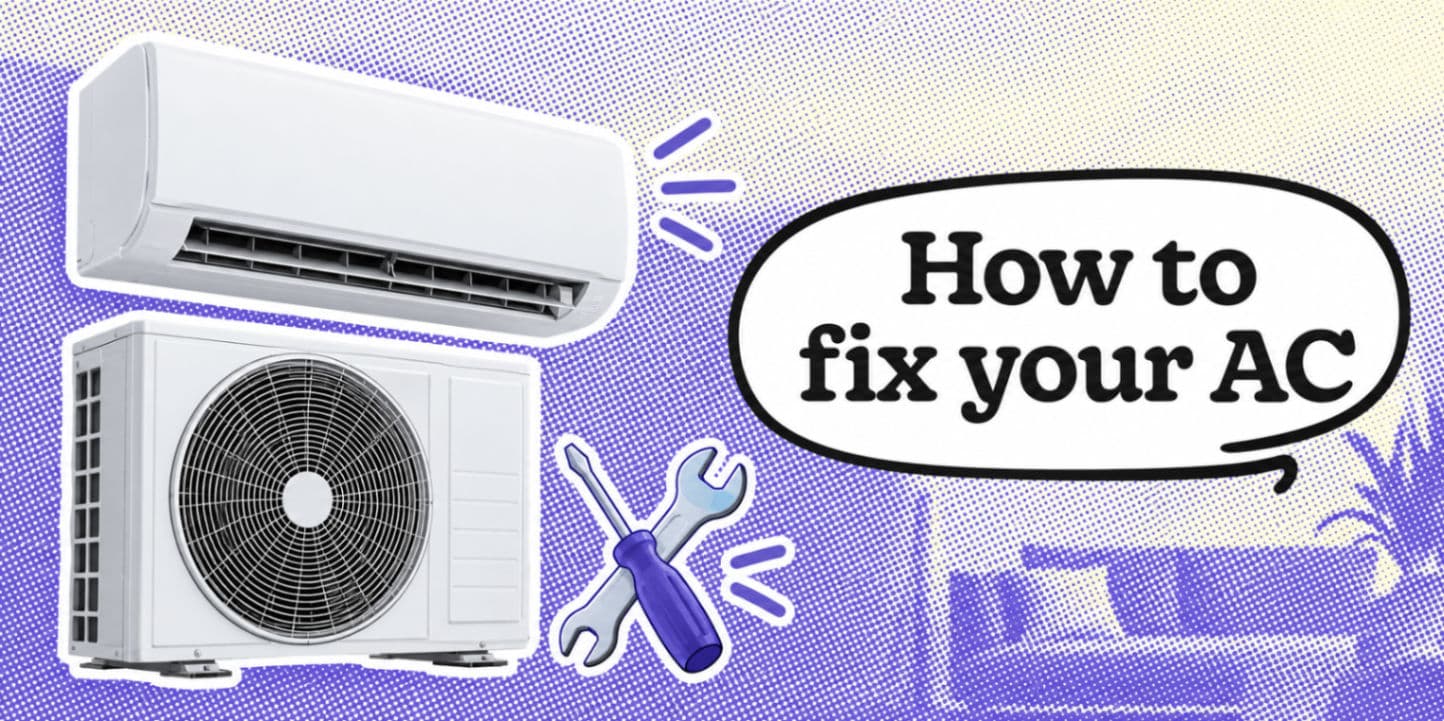
In this guide, we'll explain how to fix an air conditioner, which checks you can safely carry out yourself and when it makes more sense to repair or replace your system.
💨 Ready to chill without the guesswork? Find out exactly what size air conditioner you need - and get a fixed price in seconds here.
Can You Fix an Air Conditioner Yourself?
Sometimes, yes.
There are several basic air conditioning problems that homeowners can troubleshoot without touching any of the important bits.
Cleaning the filters, checking the remote, making sure the unit is actually set to cooling mode and removing leaves from around the outdoor unit are all reasonable DIY jobs.
Opening the unit and attempting to repair electrical components, refrigerant pipework or the compressor is a very different story.
In Great Britain, anyone carrying out work involving F-gas refrigerants must hold the appropriate qualifications.
Companies servicing stationary air conditioning equipment for other people must also hold the relevant company certification.
As a rough rule:
Problem | DIY or engineer? | What to do |
Dirty air filter | DIY | Remove and clean according to the manufacturer's instructions |
Wrong temperature/mode | DIY | Check the controller settings |
Flat remote batteries | DIY | Replace batteries |
Leaves around outdoor unit | DIY | Carefully clear accessible debris with the system switched off |
Air conditioner not cooling | DIY First | Check filters, settings and airflow, then call an engineer |
Water leaking | Engineer if persistent | Switch off and arrange an inspection |
Ice on the unit or pipework | Engineer | Switch off and allow it to defrost |
Refrigerant leak | Engineer | Do not attempt to repair or refill it yourself |
Electrical fault | Engineer/electrician | Switch the system off |
Compressor fault | Engineer | Professional diagnosis required |
How to Fix an Air Conditioner That's Not Working
Before assuming the worst, start with the basics.
[1] Check the Power
Yes, this sounds painfully obvious. Still worth checking.
Make sure the indoor unit has power and that any local isolator hasn't accidentally been switched off.
If the system has tripped a circuit breaker, you can reset it once if it is safe to do so.
If it immediately trips again, stop there.
Repeatedly resetting a tripping circuit isn't a repair. It could indicate a fault with the air conditioner or electrical supply and should be investigated by a competent professional.
[2] Check the Air Conditioning Settings
An air conditioner can be working perfectly while appearing to do absolutely nothing useful because it has been put in the wrong mode.
Check that the system is set to cooling mode, usually shown by a snowflake symbol, rather than fan, heating or dehumidification mode.
Then set the target temperature below the current room temperature.
If your room is 26°C and the air con is set to 27°C, for example, there is little reason for the compressor to start cooling.
Give it a few minutes after changing the setting too. Many modern systems deliberately delay compressor operation after being switched on.
[3] Clean the Air Conditioner Filter
A dirty filter is one of the first things we'd check when an air conditioner isn't cooling properly.
As air passes through the indoor unit, the filter catches dust, hair and other airborne debris.
Eventually, all that muck restricts airflow.
The result can be weaker cooling, longer running times and an air conditioner that sounds like it's trying considerably harder than it should.
Switch the unit off first, open the front panel according to the manufacturer's instructions and remove the filters.
Most reusable filters can be gently vacuumed or washed with lukewarm water. Allow them to dry completely before putting them back.
Don't reinstall a wet filter.
And don't start removing covers or components beyond the parts the manufacturer specifically intends homeowners to access.
[4] Check the Outdoor Unit
Your indoor air conditioner is only half of the system.
A typical split air conditioning system transfers heat outside through the condenser unit. If airflow around that outdoor unit becomes restricted, performance can suffer.
With the air conditioning switched off, check for obvious obstructions such as fallen leaves, weeds or accumulated debris.
Remove anything loose and easily accessible.
Avoid bending the delicate metal fins and don't attack the condenser with a pressure washer. More pressure isn't necessarily more cleaning. Sometimes it's just more damage.
If the coil itself is heavily contaminated, arrange a professional clean.
How to Fix an Air Conditioner That Isn't Cooling
If the unit switches on and blows air but the room stubbornly refuses to get cooler, there are several possible causes.
Start by checking the temperature setting and cleaning the filters.
Next, make sure neither the indoor nor outdoor unit has its airflow obstructed by furniture, curtains, vegetation or other objects.
If airflow looks normal but the air being produced still isn't particularly cold, you may have a more technical fault.
Possible causes include a refrigerant leak, failed temperature sensor, damaged fan, faulty control board or compressor problem.
Those are engineer jobs.
Don't buy a can of refrigerant online and attempt to "top up" your system yourself.
Air conditioning is a sealed system. If refrigerant levels are genuinely low, there is normally a reason for it, and simply adding more refrigerant without finding the underlying problem isn't a proper repair.
Why Is My Air Conditioner Blowing Warm Air?
Warm air doesn't automatically mean the system is broken.
First check that you've selected cooling rather than fan or heating mode.
Remember that many modern UK air conditioners are reverse-cycle systems, meaning the same unit can both cool and heat your home.
If the settings are correct, check the filters and outdoor condenser for restricted airflow.
Still getting warm air?
It's time to call an engineer.
Low refrigerant levels, faulty sensors, compressor problems and refrigerant control faults can all prevent the system from cooling properly.
How to Fix a Leaking Air Conditioner
A small amount of condensate is completely normal.
As warm, humid indoor air passes over the cold evaporator coil, moisture condenses out of it and is carried away through the condensate drainage system.
Water dripping somewhere it shouldn't, however, isn't normal.
A blocked condensate drain, badly installed pipework, frozen coil or damaged condensate pump can all cause water to appear around the indoor unit.
If you can see an obvious obstruction at the accessible end of a condensate drain, it may be possible to remove it without dismantling anything.
Otherwise, switch the system off and arrange an inspection.
Water and electrical equipment are not exactly famous for their compatibility.
What Should You Do If Your Air Conditioner Freezes Up?
Ice appearing on an indoor air conditioning unit or refrigerant pipework is another sign that something isn't right.
Restricted airflow from a very dirty filter can cause the evaporator coil to become too cold.
Low refrigerant levels can produce similar symptoms.
Switch the air conditioner off and allow the ice to thaw naturally.
While it's switched off, check and clean the filter.
Don't scrape the ice away with a tool and don't pour hot water over the unit.
If the air conditioner freezes again after the filter has been cleaned, book an engineer.
Repeated icing needs a proper diagnosis.
Why Is My Air Conditioner Making a Strange Noise?
Air conditioners aren't silent, but you quickly get used to what yours normally sounds like.
New rattling, grinding, buzzing or hissing noises deserve attention.
A light rattle may be something relatively simple, such as debris near the outdoor unit.
Grinding or screeching can point towards a fan motor, bearing or mechanical problem.
Electrical buzzing can indicate an electrical component or connection fault.
Persistent hissing may indicate refrigerant escaping from the system.
If the noise is coming from inside the equipment rather than something obviously loose outside it, switch the system off and get it checked.
Why Does My Air Conditioner Smell?
A slightly stale or musty smell often starts with moisture and dirt accumulating around the filter or evaporator section.
Clean the accessible filters first.
If the smell remains, the internal coil, condensate tray or drainage system may need professional cleaning.
A burning or electrical smell is different.
Switch the air conditioner off immediately and arrange for it to be inspected.
How to Fix an Air Conditioner Remote
If nothing happens when you press the remote, don't immediately blame the air conditioner.
Start by changing the batteries.
Check that nothing is blocking the signal between the remote and indoor unit.
You can also switch the air conditioner off at its normal power supply, wait a few minutes and restart it according to the manufacturer's reset procedure.
Some systems have Wi-Fi controllers or wired thermostats too, so check whether the air conditioner responds through another control method.
If the indoor unit works manually but not through the remote, you may simply need a replacement controller.
When Should You Call an Air Conditioning Engineer?
You don't need an engineer every time your air conditioner has a sulk.
But there is a clear point where sensible DIY troubleshooting ends.
Call a professional if you have refrigerant problems, repeated circuit trips, electrical or burning smells, persistent water leaks, recurring ice build-up, internal mechanical noises, compressor faults or an air conditioner that still doesn't work after you've checked the filters, settings and airflow.
For refrigerant work, make sure the person carrying it out has the appropriate F-gas qualification.
Should You Repair or Replace Your Air Conditioner?
Not every broken air conditioner is worth replacing.
A relatively young system with a blocked drain, dirty coil or replaceable component will usually be better repaired.
The calculation starts to change with an older system experiencing repeated failures or needing an expensive major component.
A well-maintained quality air conditioning system will often last around 10 to 15 years, although actual lifespan depends heavily on the equipment, installation quality, usage and maintenance.
If yours is reaching that sort of age and you're facing another substantial repair, compare the cost of fixing it with the cost and benefits of installing a new system.
A modern replacement could give you improved efficiency, quieter operation, better controls and reliable heating as well as cooling.
Is Your Air Conditioner Beyond Repair?
You don't have to keep throwing money at an ageing air conditioner.
If your current AC is becoming unreliable, get a fixed online quote for a replacement air conditioning system from Heatable.
Answer a few straightforward questions about your home, choose the system that works for you and we'll take care of the installation.
Get your fixed air conditioning quote with Heatable.
Can I Install a Replacement Air Conditioner Myself?
For a fixed split air conditioning system, this isn't a sensible DIY project.
Installation involves refrigerant pipework, pressure testing, evacuation and commissioning, alongside electrical and condensate connections.
Relevant refrigerant work must also be completed by suitably qualified professionals.
In other words, save the DIY enthusiasm for assembling the garden furniture.
How to Reduce the Chances of Your Air Conditioner Breaking Again
Most air conditioning systems don't suddenly wake up one morning and choose violence.
Problems tend to develop gradually.
Keeping filters clean, maintaining unobstructed airflow around the outdoor unit and having the system professionally maintained can help identify smaller problems before they become expensive ones.
Pay attention to changes too.
Reduced airflow, longer cooling times, unusual noises, new smells or unexplained increases in electricity consumption can all provide early warning that the system needs attention.
How to Fix an Air Conditioner: Final Verdict
If you're wondering how to fix an air conditioner, start simple.
Check the power, controller settings and filters, then make sure air can flow freely around both the indoor and outdoor units.
Those basic checks solve a surprising number of apparent AC problems.
If you're dealing with refrigerant, internal electrics, persistent leaks, recurring icing or mechanical faults, however, put the screwdriver down.
That's where an appropriately qualified air conditioning engineer takes over.
And if your current air conditioner is old, unreliable or becoming increasingly expensive to repair, replacing it may make better financial sense than keeping it alive one component at a time.
Next Steps For Your AC Journey:
When planning to install air conditioning for your home, there are several important factors to consider. Make sure to refer to the following guides to help you make informed decisions:
To dive deeper into these topics, head over to our advice section, check out our YouTube channel for informative videos.
Get a Quote for Air Conditioning Today ❄️
Here’s why homeowners choose us:
Thousands of Happy Customers: We have an average score of 4.9 on Trustpilot, outperforming the market leader.
Which? Trusted Trader: Heatable is proudly recognised as a Which? Trusted Trader.
FGAS Certified: Our FGAS certification ensures all air conditioning work is carried out to the required industry standards.
Flexible Payment Options: Choose from multiple payment methods, including finance options.
Fixed Price Guarantee: Enjoy transparency with no hidden costs.
Save Your Quote: Save your quote and come back to it whenever you’re ready.