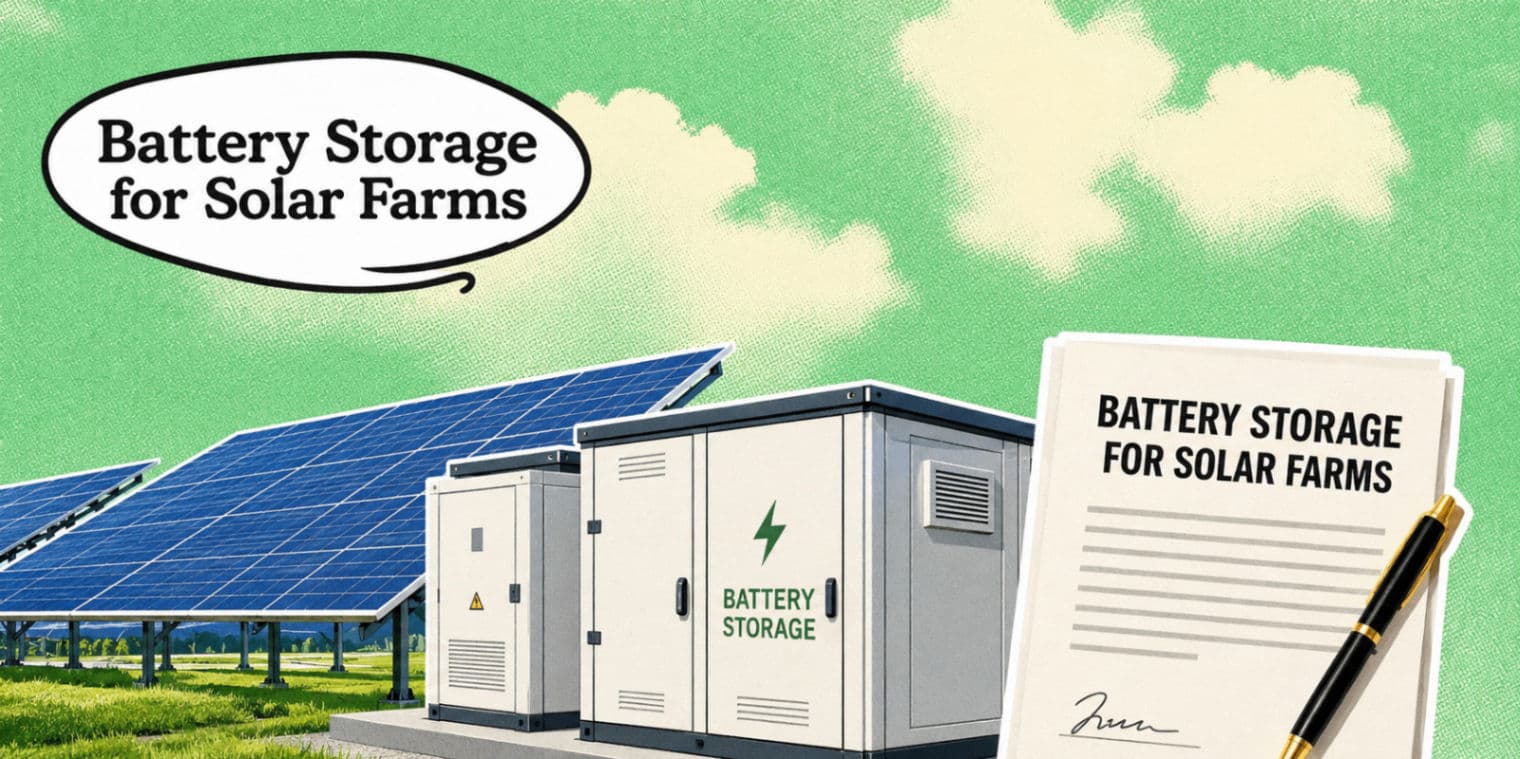

Solar farms are one of the UK’s most important renewable energy assets, but solar power has one obvious limitation: it only generates when the sun is shining.
- What is battery storage for solar farms?
- Why add battery storage to a solar farm?
- How does battery storage for solar farms work?
- What size battery does a solar farm need?
- Can battery storage be added to an existing solar farm?
- Does battery storage for solar farms need planning permission?
- Are there grants for solar farm battery storage?
That does not always line up neatly with when electricity is most valuable, most needed, or easiest for the grid to absorb.
That is where battery storage comes in.
By pairing a solar farm with a battery energy storage system, solar developers, landowners and commercial energy investors can store excess electricity generated during the day and release it later when demand is higher, prices are stronger, or the grid needs support.
Put simply: battery storage helps solar farms become more flexible, more commercially attractive and more useful to the wider energy system.
In this guide, we explain what battery storage for solar farms is, how it works, why it is increasingly being used alongside utility-scale solar, and what to consider before installing a system.
What is battery storage for solar farms?
Battery storage for solar farms, often called co-located battery energy storage, is the process of installing a large-scale battery system on or near a solar farm.
The solar farm generates electricity using photovoltaic panels. The battery then stores some or all of that electricity so it can be used or exported later.
Instead of sending all generated power directly to the grid at the moment it is produced, the site can hold energy back and release it strategically.
This can be useful when:
Solar generation is high but electricity prices are low.
The local grid cannot accept all the electricity being generated.
The solar farm is at risk of curtailment.
Electricity prices rise during evening peak periods.
The battery can earn revenue from grid balancing services.
The site has a private wire or power purchase agreement arrangement.
The operator wants to improve the commercial performance of the project.
In practice, a solar farm with battery storage behaves less like a simple generation asset and more like a controllable energy asset.
Why add battery storage to a solar farm?
Solar generation is predictable in the broad sense, but it is still variable. Output changes depending on the time of day, season, cloud cover and local conditions.
Without battery storage, a solar farm usually has three main options: export electricity to the grid, supply a private customer, or lose generation if the system is constrained.
Battery storage adds another option.
It allows electricity to be stored when it is less valuable or harder to export, then discharged when it is more valuable or more useful.
For solar farms, the main benefits include:
[1] Better use of generated electricity
Solar farms often produce the most electricity in the middle of the day.
However, electricity demand and wholesale prices are often higher later in the day, particularly during the early evening peak.
A battery allows the site to shift some of that daytime solar generation into higher-value periods.
This can improve the economics of the project, especially where the site is exposed to wholesale price movements or has a flexible export arrangement.
[2] Reduced curtailment
Curtailment happens when a renewable generator is asked, or required, to reduce output because the grid cannot absorb the electricity at that time.
For a solar farm, curtailment can mean lost generation and lost revenue.
Battery storage can help by absorbing excess electricity that might otherwise be curtailed, then exporting it later when the network has capacity.
It will not remove every curtailment issue, but it can make the site more flexible and reduce wasted generation.
[3] Stronger grid connection value
Grid connections are one of the biggest constraints in UK renewable energy development.
In some cases, a solar farm may have a grid connection that is underused at certain times of day.
In other cases, the site may have an export limit that prevents the full solar capacity from being sent to the grid at peak generation times.
A battery can help make better use of the available connection.
For example, the solar farm may charge the battery when generation exceeds the export limit, then discharge later when solar output falls.
This can allow the project to get more value from the same grid connection, subject to the connection agreement, technical design and network operator approval.
[4] Additional revenue streams
Battery storage systems can earn revenue in several ways.
Depending on the site, market access and trading strategy, these may include:
Energy arbitrage - charging when electricity is cheap or abundant and discharging when prices are higher.
Grid balancing services - helping the electricity system respond to supply and demand changes.
Capacity Market income - being available to provide electricity capacity when required.
Constraint management - helping reduce pressure on parts of the grid.
Optimising power purchase agreements - storing or releasing energy to match commercial contract terms.
Behind-the-meter supply - supporting a nearby business, industrial user or private wire customer.
The exact revenue model depends heavily on the project structure.
Battery storage is not a generic bolt-on with a guaranteed return. It needs to be sized, modelled and operated properly.
How does battery storage for solar farms work?
A solar farm with battery storage usually includes solar panels, inverters, battery containers, transformers, control systems, metering and grid connection equipment.
The solar panels generate electricity during daylight hours.
The battery then charges when it makes sense to store that electricity, either because export prices are low, the grid connection is constrained, or the site wants to save the energy for a higher-value period.
The battery discharges when the stored electricity is more useful. That might be during the evening peak, during a grid balancing event, or when a private wire customer needs power.
The system is usually controlled by an energy management system. This decides when the battery should charge, discharge or remain idle.
It may use solar forecasts, electricity prices, grid constraints, export limits and trading instructions to optimise performance.
Most modern large-scale battery systems use lithium-ion technology, usually housed in containerised units with integrated cooling, monitoring, fire safety and control equipment.
AC-coupled vs DC-coupled battery storage
Solar farms can be paired with batteries in different ways.
The two most common design approaches are AC coupling and DC coupling.
AC-coupled battery storage
In an AC-coupled system, the solar farm and battery have separate inverters.
The solar panels generate DC electricity, which is converted to AC by the solar inverter. The battery then charges from the AC side through its own battery inverter.
This is a common approach for retrofitting battery storage to an existing solar farm because the battery can be added without redesigning the entire solar generation system.
Advantages of AC coupling include:
Easier retrofit potential.
Separate operation of the solar farm and battery.
Flexible system design.
Simpler integration where the solar farm already exists.
DC-coupled battery storage
In a DC-coupled system, the battery is connected on the DC side of the solar system, before electricity is converted to AC.
This can allow the battery to capture energy before it passes through the inverter.
DC coupling can be attractive for new-build solar-plus-storage projects, particularly where the system is being designed as one integrated asset from the start.
Advantages of DC coupling include:
Potential efficiency benefits.
Ability to capture clipped solar generation.
More integrated solar and battery operation.
Potentially reduced inverter duplication.
The right choice depends on the site, grid connection, export limits, commercial model and whether the battery is being added to an existing solar farm or designed as part of a new project.
What size battery does a solar farm need?
There is no single correct battery size for a solar farm.
The right system size depends on several factors, including:
The capacity of the solar farm.
The grid export limit.
The site’s generation profile.
Local network constraints.
Electricity price patterns.
Whether the site has a private wire customer.
The desired duration of storage.
Available land and planning constraints.
Connection costs.
Target revenue streams.
Battery degradation assumptions.
Battery systems are usually described in terms of power and energy.
Power, measured in MW, tells you how quickly the battery can charge or discharge.
Energy, measured in MWh, tells you how much electricity the battery can store.
For example, a 10MW / 20MWh battery can discharge at 10MW for around two hours.
Oversizing the battery can increase capital cost without improving returns. Undersizing it can leave value on the table.
That is why proper modelling is essential.
Can battery storage be added to an existing solar farm?
Yes, battery storage can often be added to an existing solar farm, but it is not always straightforward.
The key questions are:
Is there enough land available?
Does the existing grid connection allow battery import and export?
Does the connection agreement need to be modified?
Is planning permission required?
Is the existing substation suitable?
Are there local network constraints?
Is the site layout suitable for battery containers, access roads and safety spacing?
Is the commercial case strong enough after connection, planning and equipment costs?
Who will operate and trade the battery?
Existing solar farms can be good candidates for battery storage because they already have grid infrastructure, land agreements and generation data.
However, the battery should not be treated as a simple add-on. The existing technical and commercial structure needs to be reviewed properly.
Does battery storage for solar farms need planning permission?
In most cases, yes.
Large-scale battery storage for solar farms will usually need planning permission, particularly where the project involves containerised battery units, substations, transformers, fencing, access roads, lighting or other permanent infrastructure.
For existing solar farms, it should not be assumed that the original solar farm planning consent automatically allows battery storage to be added. A new application or variation may be needed.
A planning application may need to address:
Landscape and visual impact.
Noise from cooling systems, inverters and transformers.
Fire safety and emergency access.
Flood risk and drainage.
Ecology and biodiversity.
Highways access and construction traffic.
Security fencing, CCTV and lighting.
Decommissioning and site restoration.
Planning rules can also vary depending on project size and location.
In England, local planning authorities generally decide renewable and low-carbon energy projects of 50MW or less, while larger energy infrastructure can follow different consenting routes. Battery storage also has its own planning considerations, so early advice is important.
Developers should speak to the local planning authority, the relevant network operator, planning consultants and the local fire and rescue service before submitting a proposal.
Are there grants for solar farm battery storage?
Direct grants for solar farm battery storage are limited.
For large commercial solar farms, battery storage is usually funded through private investment, project finance, asset finance, infrastructure funds, power purchase agreements, tolling arrangements, developer-funded models or zero capex structures.
Some local, regional, public sector or innovation funding may be available in specific cases, but there is no simple national grant that covers all solar farm battery storage projects.
For most solar farms, the bigger question is not “Can we get a grant?” but “Does the battery have a strong enough commercial case?”
That means looking at:
Capital cost.
Grid connection cost.
Planning cost.
Export limits.
Curtailment risk.
Wholesale electricity price spreads.
Battery degradation.
Trading and optimisation fees.
Warranty terms.
Potential grid services revenue.
Long-term investor return.
A grant can improve the economics of a project, but it should not be the foundation of the business case.
A well-designed battery storage project should make sense commercially before uncertain funding support is included.
Battery storage for solar farms: key takeaways 🔑
Battery storage can help solar farms store excess electricity, reduce wasted generation, improve grid flexibility and access additional revenue streams.
For many solar farm owners and developers, the attraction is simple: battery storage gives them more control over when and how electricity is exported.
However, the best results come from careful design and modelling.
The right battery size, connection arrangement, trading strategy, planning approach, funding structure and safety plan can make the difference between a strong investment and an underperforming asset.
Speak to Heatable about solar farm battery storage
If you are considering battery storage for a solar farm, Heatable can help you understand the options, assess feasibility and explore whether a commercial battery system could work for your site.
Whether you are developing a new solar project or looking to add storage to an existing solar farm, our team can help you review the technical and commercial case.
Get in touch with Heatable today to arrange a consultation and discuss your solar farm battery storage project.

![What size solar battery do I need? [UK, 2026]](/_next/image?url=https%3A%2F%2Fassets.heatable.co.uk%2F1720791617113_Fc5oG64OI.png&w=3840&q=75)