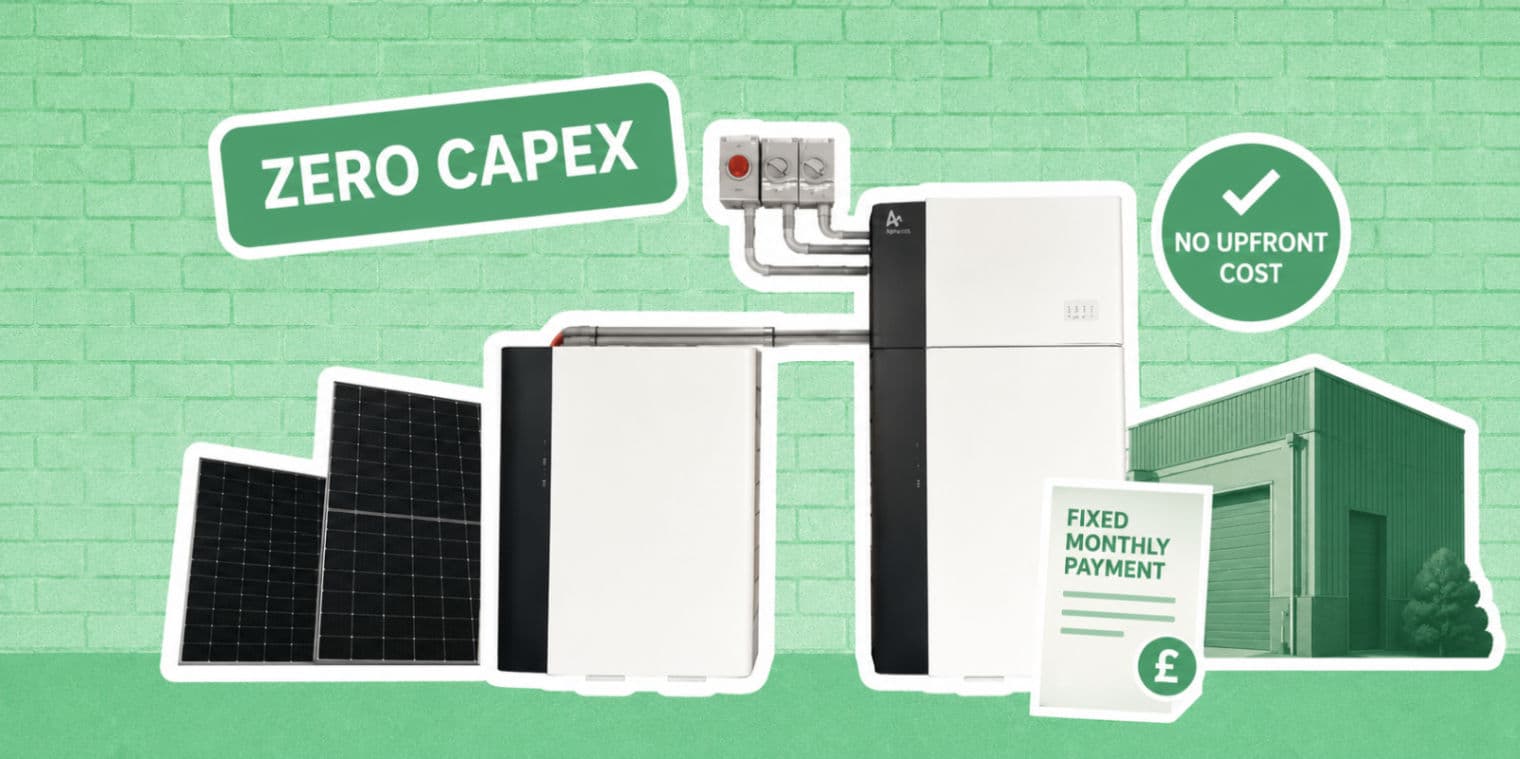

Battery storage is becoming an increasingly practical option for UK businesses looking to reduce energy costs, improve energy resilience, and make better use of cheaper or self-generated electricity.
- What is zero capex battery storage?
- How does zero capex battery storage work?
- Practical examples of commercial battery storage
- What are the main benefits of zero capex battery storage?
- Who is zero capex battery storage suitable for?
- What should businesses check before agreeing to a zero capex battery model?
For many organisations, the barrier is not interest. It is the upfront cost.
A commercial battery storage system can require a significant capital investment, especially for larger sites with high electricity demand. That can make it difficult for businesses to move forward, even when the long-term savings case looks attractive.
Zero capex battery storage is designed to solve that problem.
Instead of buying the battery system outright, eligible businesses may be able to access commercial battery storage through a funded model, helping them benefit from the technology without the large upfront capital outlay.
What is zero capex battery storage?
Zero capex means zero capital expenditure.
In simple terms, it means the business does not pay the full cost of purchasing and installing the battery system upfront.
Instead, a third-party provider funds, installs, owns, operates, or manages the battery system under a commercial agreement.
The business then benefits from the battery through lower energy costs, improved load management, better use of solar power, or another agreed commercial structure.
The exact model can vary. A zero capex battery storage arrangement may involve:
A lease
A power purchase agreement
An energy-as-a-service model
A shared savings agreement
A funded installation model
Another commercial finance structure
The aim is usually the same: to give the business access to battery storage without tying up capital in the equipment.
For businesses that want to reduce energy costs but preserve cash flow, this can be an attractive alternative to buying a commercial battery outright.
How does zero capex battery storage work?
A zero capex battery storage project usually starts with a review of the business’s electricity usage and site requirements.
The provider needs to understand whether battery storage is technically suitable and whether the commercial case is strong enough to support a funded model.
[1] Your energy usage is assessed
The first step is to look at how your business uses electricity.
This may include reviewing half-hourly consumption data, electricity tariffs, peak demand charges, operational hours, and seasonal usage patterns.
The goal is to understand when your business uses the most electricity, when electricity is most expensive, and whether a battery could reduce grid imports at the right times.
[2] The site is reviewed
The provider will also assess whether your site is suitable for a commercial battery system.
This may include looking at:
Available space
Grid connection capacity
Existing electrical infrastructure
Health and safety requirements
Access for installation and maintenance
Existing or planned solar panels
Future EV charging requirements
Not every site will be suitable, so this stage is important.
[3] A battery system is designed around your needs
If the site looks viable, the battery system is sized around your business’s electricity profile.
A battery that is too small may not deliver enough value. A battery that is too large may be unnecessarily expensive and harder to justify commercially.
The right system depends on how and when your business uses electricity.
ℹ️ Get renewable energy consultancy with Heatable
[4] The provider funds and arranges installation
Under a zero capex model, the provider typically funds the system and arranges the installation.
That means the business avoids the large upfront capital cost normally associated with buying and installing a commercial battery.
Depending on the agreement, the provider may also handle monitoring, maintenance, optimisation, and ongoing system performance.
[5] The battery stores electricity when it is cheaper or surplus
Once installed, the battery stores electricity when it makes commercial sense.
For example, it may charge:
Overnight, when electricity may be cheaper
During the day, using excess solar electricity
During periods of lower demand
When grid electricity is cleaner or less expensive
The stored electricity can then be used later.
[6] The battery discharges when electricity is more expensive
The battery can discharge electricity when the business would otherwise be importing more expensive power from the grid.
This can help reduce peak-time grid imports, lower demand-related costs, and improve the value of any on-site solar generation.
For example, a business might charge a battery overnight on a cheaper tariff, then use that stored electricity during the day when grid prices are higher.
Or a site with solar panels might store excess solar electricity during the afternoon, then use it later in the evening instead of exporting it at a lower rate and buying electricity back at a higher rate.
[7] Payments or savings are handled under the agreement
The financial structure depends on the type of zero capex model.
The business may pay a fixed service charge, lease payment, agreed electricity rate, or share part of the savings with the provider.
This is why it is important to understand the contract properly before signing.
Zero capex does not usually mean there is no cost at all. It means there is no large upfront capital purchase.
Practical examples of commercial battery storage
Commercial battery storage can be used in several ways.
Charging overnight on cheaper electricity
Some businesses use batteries to charge from the grid overnight, when electricity prices may be lower, then discharge during more expensive daytime or peak periods.
This can be useful for sites with predictable daytime electricity demand.
Storing excess solar electricity
Businesses with commercial solar panels may generate more electricity than they can use at certain times of day.
A battery can store that surplus solar electricity so it can be used later, rather than being exported to the grid.
This can improve the return from a commercial solar PV system.
Reducing peak-time grid imports
Some businesses face high costs during peak demand periods.
A battery can help reduce the amount of electricity imported from the grid during those times, potentially lowering overall electricity costs.
Supporting EV charging
As more businesses install EV chargers for fleets, staff, or customers, electricity demand can increase significantly.
Battery storage can help manage that demand by storing electricity and releasing it when chargers are in use.
This can be especially useful where grid capacity is limited or expensive to upgrade.
What are the main benefits of zero capex battery storage?
Zero capex battery storage can offer several benefits for the right business.
No large upfront capital outlay
The main advantage is avoiding the upfront cost of purchasing the battery system outright.
This can make commercial battery storage more accessible for businesses that want to improve energy performance but do not want to commit capital to the equipment.
Faster access to battery storage
Because the system is funded through a commercial agreement, some businesses may be able to move forward sooner than they would with a traditional purchase.
This can be useful for organisations trying to reduce operating costs, support sustainability targets, or prepare for increased electricity demand.
Reduced exposure to peak electricity prices
Battery storage can help businesses reduce reliance on the grid during more expensive periods.
This does not guarantee savings in every case, but for sites with the right usage profile, it can help lower exposure to peak electricity costs.
Better use of on-site solar generation
For businesses with solar panels, battery storage can increase the amount of solar electricity used on site.
Instead of exporting surplus solar electricity during the day, the business can store it and use it later when demand is higher.
Related: Battery storage for solar farms
Potential reduction in demand and grid import costs
Some commercial electricity bills include costs linked to peak demand or grid usage.
Battery storage may help reduce these costs by smoothing demand and reducing grid imports at key times.
The exact benefit depends on the site, tariff, and battery control strategy.
Improved energy resilience
Battery storage can support energy resilience by giving a site more flexibility over how it uses electricity.
In some cases, batteries may also be designed to provide backup capability, although this depends on the system specification and should not be assumed by default.
Support for decarbonisation and ESG goals
Battery storage can help businesses use more renewable electricity, especially when combined with solar panels.
This can support carbon reduction plans, ESG reporting, and wider sustainability goals.
Less operational burden
In some zero capex models, maintenance, monitoring, and optimisation are included as part of the agreement.
This can reduce the operational burden on the business, especially if the provider is responsible for system performance.
Who is zero capex battery storage suitable for?
Zero capex battery storage is usually best suited to businesses with significant electricity usage and a strong commercial case for battery storage.
It may be suitable for organisations with:
High electricity consumption
Predictable demand patterns
Expensive peak-time electricity costs
Existing commercial solar panels
Planned solar PV installation
Large daytime or evening electricity demand
EV charging infrastructure
Limited appetite for upfront capital investment
Examples of suitable sites may include:
Warehouses
Manufacturers
Cold storage sites
Retail units
Hotels
Offices
Farms and agricultural businesses
Schools
Public-sector buildings
EV charging locations
Businesses with high daytime or evening energy demand
However, it will not be right for every business.
Zero capex battery storage may be less suitable for very small sites, businesses with low electricity usage, short leases, uncertain occupancy, limited space for equipment, or electricity profiles that do not create enough savings opportunity.
A proper site assessment is essential.
Zero capex battery storage vs buying a battery outright
There is no single best option for every business.
Buying a commercial battery outright and using a zero capex model both have advantages and trade-offs.
Buying a battery outright
Buying outright gives the business ownership of the system.
This may offer greater long-term financial benefit, more control, and the ability to retain more of the savings generated by the battery.
However, it also requires capital investment.
The business may also be responsible for maintenance, monitoring, insurance, performance risk, and long-term system management.
For businesses with available capital and a long-term commitment to the site, outright purchase may be the better option.
Using a zero capex model
A zero capex model can reduce upfront risk and preserve cash flow.
Instead of committing capital to the battery system, the business accesses the technology through a funded agreement.
This can be attractive for businesses that want to reduce energy costs but prefer to keep capital available for other priorities.
However, the business may need to share savings, pay a service charge, commit to a long-term contract, or accept less control than it would have with outright ownership.
Which option is better?
Neither option is automatically better.
The right choice depends on:
Your electricity usage
Your current tariff
Your peak demand profile
Your cash position
Your tax position
Your operational needs
Your site lease or ownership status
Your long-term plans for the premises
Whether you already have or plan to install solar panels
Your appetite for ownership and performance risk
A proper commercial assessment should compare both options where possible.
What should businesses check before agreeing to a zero capex battery model?
Before entering into a zero capex battery storage agreement, businesses should understand the commercial terms clearly.
Key questions to ask include:
How long is the contract?
Zero capex agreements often involve long-term commitments.
Make sure the contract length fits your business plans, site lease, and expected occupancy.
Who owns the battery?
Clarify whether the provider owns the battery, whether ownership transfers later, or whether the business has an option to buy the system at the end of the agreement.
Who maintains and monitors the system?
Check who is responsible for maintenance, remote monitoring, performance optimisation, repairs, and replacement parts.
How are savings calculated?
Understand how savings are measured.
Are they based on actual consumption data, estimated savings, tariff assumptions, or a shared savings formula?
Are savings guaranteed or estimated?
There is a major difference between projected savings and guaranteed savings.
Businesses should be cautious of any proposal that makes unrealistic claims without clear data.
What are the early exit terms?
Check what happens if you move premises, sell the business, change operations, or want to end the agreement early.
Who is responsible for insurance?
Clarify whether the battery is covered by the provider, the business, or both.
What performance obligations apply?
Check whether the provider has obligations around system uptime, maintenance response times, and performance levels.
Are grid connection works required?
Some sites may need grid connection reviews or electrical upgrades.
This should be understood before signing.
Is the system compatible with solar panels?
If you already have solar panels, or plan to install them later, make sure the battery model supports this.
Can the system support future EV charging?
If your business expects to install EV chargers, ask whether the battery system can be designed with future electrification in mind.
What happens at the end of the agreement?
Find out whether the battery is removed, replaced, purchased, renewed, or transferred to your business at the end of the contract.
Does zero capex mean completely free?
No. This is an important point.
Zero capex does not usually mean the battery system is completely free.
It usually means there is no large upfront capital purchase.
The business may still pay through a lease, service agreement, energy contract, shared savings mechanism, or another commercial structure.
The benefit is that the business can access battery storage without having to fund the full installation cost upfront.
That can make the technology more accessible, but the agreement still needs to make financial sense.
How Heatable can help
Heatable can help businesses understand whether commercial battery storage is viable for their site, including funded or zero capex options where suitable.
Our commercial energy specialists can review your electricity usage, site requirements, solar PV potential, battery sizing, expected savings, grid considerations, and available commercial models.
We can help you understand whether a battery system is technically suitable, whether the numbers stack up, and whether a zero capex model could be a practical route forward.
For some businesses, buying a battery outright may make more sense. For others, a funded model may be the better fit.
The important thing is getting a proper assessment before making a decision.
Interested in zero capex battery storage for your business?
Contact Heatable today to arrange a commercial battery storage consultation.
Our commercial energy specialists can assess your site, review your electricity usage, and help you understand whether a funded battery storage solution could reduce your energy costs without the upfront capital investment.

![What size solar battery do I need? [UK, 2026]](/_next/image?url=https%3A%2F%2Fassets.heatable.co.uk%2F1720791617113_Fc5oG64OI.png&w=3840&q=75)