
Get solar without the upfront spend, but read the small print before signing away the sunshine.
Solar panels are great. Paying for a large commercial solar panel system upfront? Slightly less great.
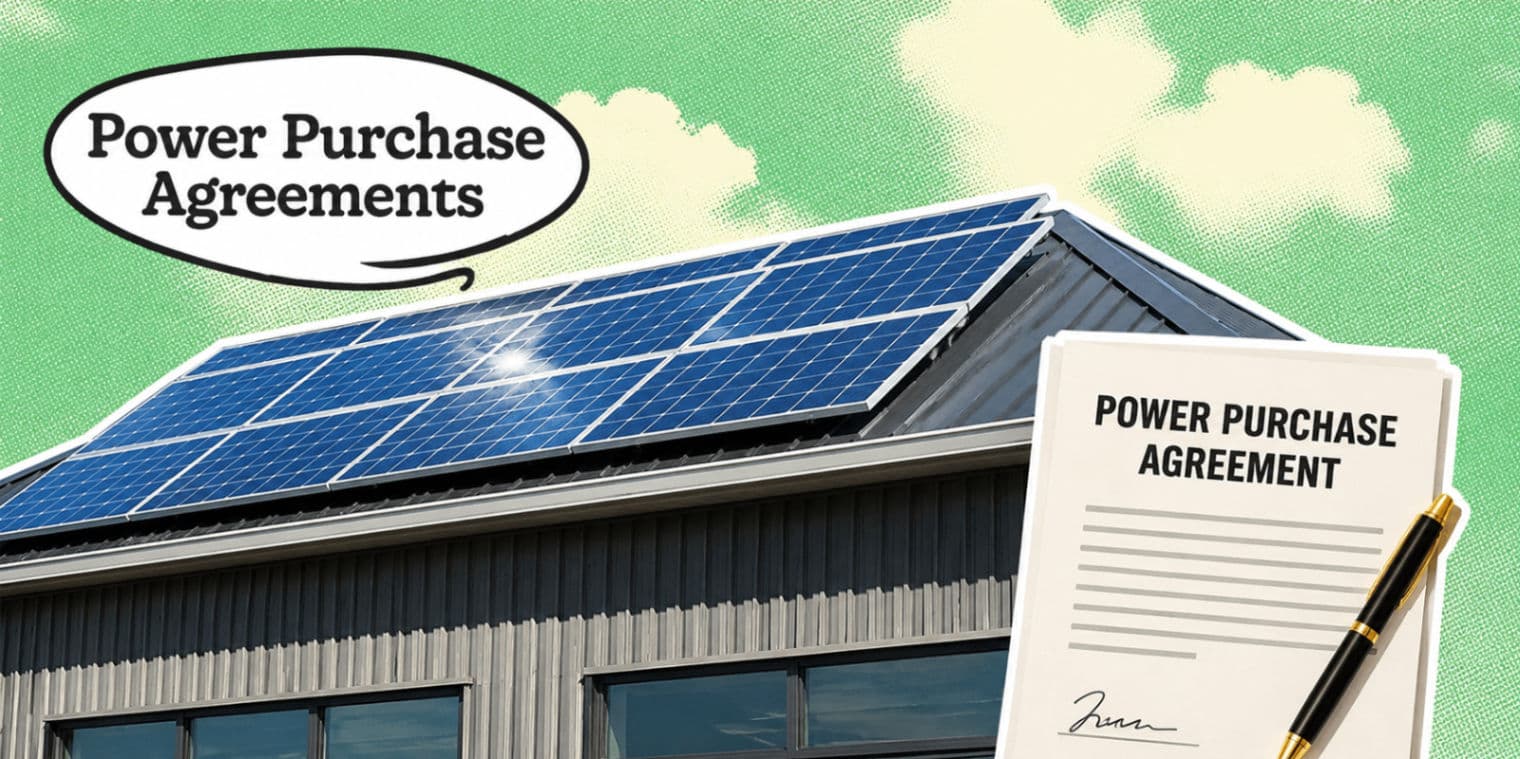
That is where a Power Purchase Agreement, usually shortened to PPA, comes in.
A solar PPA is a way for businesses to get solar panels installed without buying the system outright. Instead, a third-party provider funds, installs and usually maintains the panels, while your business agrees to buy the electricity they generate at an agreed rate.
In other words: you don’t buy the solar panels. You buy the solar power.
For businesses with big roofs, big bills and plenty of daytime electricity use, that can be very attractive. You get access to cheaper, cleaner electricity, without having to convince the finance team to part with a large chunk of capital.
But, naturally, there is a catch. PPAs are long-term contracts, and the fine print matters. A good one can be a smart route into solar. A bad one can leave you tied into a deal that looked better in year one than it does in year fifteen.
So, let’s unpack how they work.
ℹ️ Get renewable energy consultancy with Heatable
What is a Power Purchase Agreement?
A Power Purchase Agreement is a contract to buy electricity from someone else.
Simple enough.
In the case of solar, that “someone else” is usually a solar developer, investor or asset owner. They pay for the solar PV system to be designed and installed on your site, then sell the electricity it generates back to you.
Your business gets solar power. The provider gets a long-term customer. Everyone, in theory, goes home happy.
The important point is ownership. With a standard commercial solar installation, your business owns the panels. With a PPA, the provider usually owns the panels, and your business pays for the electricity they produce.
How does a solar PPA work?
A solar PPA usually works like this:
A provider looks at your site, roof space and electricity usage.
They work out whether solar makes commercial sense.
If it does, they design a system for your building.
A funder or developer pays for the installation.
The panels are installed on your roof, land or car park canopy.
Your business buys the solar electricity at an agreed price per kWh.
You continue buying any extra electricity you need from the grid.
The provider usually looks after monitoring, maintenance and repairs.
That is the basic trade-off.
You avoid the upfront cost, but you also give up ownership of the system and some of the long-term upside.
A simple example
Let’s say you run a warehouse with a large roof and heavy daytime electricity use.
You want solar, because your energy bills are painful and you’d rather not be quite so exposed to grid electricity prices.
But buying the system outright would mean spending a large amount upfront.
With a PPA, a solar provider installs the panels at little or no upfront cost. Your business then buys the electricity generated by those panels, usually at a rate designed to be cheaper than grid electricity.
When the sun is shining, you use solar power from your own roof. When the system is not generating enough, you buy the rest from the grid as normal.
So, rather than replacing your electricity supplier entirely, the PPA reduces how much electricity you need to buy from them.
Are PPAs mainly for businesses or homes?
PPAs are much more relevant for businesses than ordinary homeowners.
That’s because PPAs work best when there is scale. A large commercial roof, steady daytime demand and a chunky electricity bill give the numbers room to work.
A typical home solar system is much smaller. For most households, buying the panels outright or using solar finance is usually simpler than getting involved in a long-term third-party ownership agreement.
For businesses, though, PPAs can make sense because they solve a very specific problem:
“We want solar, but we don’t want to pay for the whole thing upfront.”
Who are solar PPAs best for?
Solar PPAs are usually best suited to organisations with high electricity use and decent roof or land space.
That can include:
warehouses;
factories;
farms;
distribution centres;
cold storage facilities;
supermarkets;
retail parks;
schools;
universities;
councils;
NHS sites;
leisure centres;
offices;
manufacturers.
The sweet spot is a site that uses lots of electricity during the day, because that is when solar panels are generating.
A refrigerated warehouse, factory or school is usually a stronger candidate than a site that barely uses electricity until the evening.
What are the benefits of a solar PPA?
1. You avoid the big upfront cost
This is the headline benefit.
Commercial solar can be a serious investment. A PPA lets your business access solar electricity without having to fund the installation itself.
That makes it useful for companies that want lower energy bills, but would rather keep capital available for other things.
2. You can reduce electricity costs
The electricity you buy through the PPA is usually priced below your grid electricity rate.
That means your business may be able to reduce its bills from day one, assuming the contract is structured properly.
3. You get more predictable energy pricing
Grid electricity prices are not exactly famous for being calm and predictable.
A PPA can give your business a clearer long-term price for at least part of its electricity usage. That can make forecasting easier, especially for energy-intensive sites.
4. Maintenance is usually handled for you
With most PPAs, the provider owns and maintains the system.
So, if the inverter needs replacing or the system needs monitoring, that usually sits with the provider rather than your business.
That is one of the reasons PPAs appeal to organisations that want the benefit of solar without becoming solar asset managers.
5. It can support your carbon reduction goals
Using solar electricity generated on-site can help reduce your reliance on grid power.
For businesses working towards ESG targets, net zero plans or supply chain carbon reporting, that can be useful. It is not just a nice shiny thing on the roof. It can be part of a real energy strategy.
What are the drawbacks?
Now for the less glossy bit.
PPAs can be useful, but they are still long-term contracts. And long-term contracts deserve suspicion until proven otherwise.
1. You don’t own the panels
This is the big one.
Because the provider owns the system, they also keep a share of the financial benefit. If your business buys the system outright, your long-term savings may be higher.
A PPA is often easier upfront. Ownership is often better over the full lifetime.
2. You are tied in for a long time
Solar PPAs often run for 10 to 25 years.
That might be fine if you own the building and expect to stay there. Less fine if your lease ends in five years, your operations might change, or you are not sure what the business will look like in a decade.
3. The annual price rises matter
Some PPAs have fixed prices. Others include annual increases.
That is not automatically bad, but it needs proper modelling. A deal that looks cheap today may not look so charming after 15 years of uplifts.
4. Roof issues can become awkward
If your roof needs replacing halfway through the agreement, what happens?
Who pays to remove the panels? Who pays to reinstall them? What happens to the lost generation?
These are boring questions, which usually means they are important.
5. You still need the grid
A solar PPA does not mean your business is suddenly off-grid.
You will still need electricity at night, during winter, on cloudy days and whenever your demand exceeds what the panels are generating.
The PPA reduces your grid reliance. It does not usually eliminate it.
PPA vs buying commercial solar panels outright
This is the real decision.
A PPA is not automatically better than buying solar panels. It just solves a different problem.
Option | Upfront cost | Who owns the system? | Maintenance | Long-term savings | Best for |
Buy outright | High | Your business | Your business / installer package | Usually highest | Businesses with available capital |
Solar finance | Low to medium | Usually your business | Your business | High, after repayments | Businesses that want ownership |
Solar PPA | Low or none | Provider / funder | Usually provider | Usually lower than ownership | Businesses avoiding capex |
Solar lease | Low or none | Third party | Usually third party | Depends on terms | Businesses wanting fixed payments |
If you have the capital and want the best lifetime return, buying the system may be stronger.
If you want solar without the upfront spend, a PPA may be the cleaner route.
What should you check before signing a solar PPA?
Before signing anything, check:
the contract length;
the starting electricity rate;
whether the rate is fixed or rises each year;
who owns the panels;
who maintains the system;
what happens if the roof needs work;
whether there are minimum usage clauses;
whether you can exit early;
what happens if you sell or leave the building;
who benefits from exported electricity;
what happens at the end of the agreement.
Do not judge the deal by the year-one saving alone. That is rookie behaviour.
You need to understand the full contract, because this is not a quick energy tariff switch. It is a long-term infrastructure agreement.
Are solar PPAs worth it?
A solar PPA can be worth it if your business has high daytime electricity use, a suitable site and a desire to install solar without upfront investment.
They are especially useful for businesses that want:
lower electricity costs;
reduced exposure to grid prices;
maintenance handled by someone else;
support for carbon reduction targets.
But they are not the best option for everyone.
If your business can afford to buy the system outright, ownership may give you better long-term savings. If your site usage is low, your roof is unsuitable, or your lease is short, a PPA may not stack up.
The simplest way to put it is this:
A PPA helps you get solar sooner. Buying the system usually helps you keep more of the savings.
Related: Battery storage for solar farms
Are PPAs available for homeowners?
Residential PPAs do exist in some markets, but they are not the main route for most UK homeowners.
For domestic solar, the usual options are:
buying solar panels outright;
using solar finance;
combining solar with battery storage;
using export tariffs to sell unused electricity.
Because home solar systems are smaller, PPAs are generally more relevant to commercial solar than residential solar.
Final verdict
A Power Purchase Agreement is a useful way for businesses to install solar panels without buying the system upfront.
It can cut energy costs, reduce carbon emissions and make solar commercially viable for organisations that do not want to commit capital to a full installation.
But the trade-off is control.
You get easier access to solar, but you do not usually own the system. You get lower upfront cost, but you are tied into a long-term contract. You may save money from day one, but you may not save as much as you would by owning the panels outright.
So, is a PPA worth it?
For the right business, yes. Especially if you have a large roof, strong daytime electricity use and a long-term plan to stay on-site.
For everyone else, it needs careful comparison against buying, financing or leasing the system.
Solar is usually a good idea. Signing a 20-year contract without reading the small print is not.
Financial Disclaimer
The figures in this guide are indicative and for general information only.
They are not a quote, financial advice, tax advice or a guaranteed return.
Actual costs, savings and payback periods depend on site-specific factors, including electricity usage, tariff structure, system size, installation complexity, grid connection requirements, export terms, maintenance costs, finance costs and future energy prices.
Businesses should obtain a site-specific feasibility assessment and seek professional tax or financial advice where required before making an investment decision.
Considering Commercial Solar Panels For Your Business?
Commercial solar panels can reduce energy costs, improve energy resilience, support carbon reduction and help businesses take more control over electricity use.
But the business case depends on the site.
The right next step is a proper feasibility assessment using real energy data, roof information and commercial modelling.
Speak to Heatable about commercial solar panels for your business.