
Combi boilers are the UK’s favourite. One box. No tanks. Hot water on demand. The boiler equivalent of moving into a flat and pretending you’ve got your life together.
- What is a system boiler?
- System boiler vs combi boiler vs regular (conventional) boiler
- Do system boilers need a tank in the loft?
- Who is a system boiler suitable for?
- When a system boiler might not be the best idea
- Pros of a system boiler
- Cons of a system boiler
- How much do system boilers cost?
- How to choose the right system boiler (without losing the will to live)
- What size system boiler do I need?
- System boiler size calculator
But if you’ve got a bigger home, more than one bathroom, or a household where everyone seems to shower like they’re being paid by the minute, a combi can start to feel…stressed.
That’s where a system boiler comes in.
A system boiler heats your radiators like any normal boiler, but for hot water it works with a separate hot water cylinder (usually in an airing cupboard).
The big difference vs older “regular/conventional” setups is that a system boiler is mains fed, and most of the key components are built into the boiler - meaning it’s typically neater, faster to install, and can deliver more consistent hot water to multiple outlets (assuming your mains pressure is decent).
In other words - a system boiler is built for households that actually use hot water.
What is a system boiler?
A system boiler is a boiler that:
stores hot water in a hot water cylinder
takes its water supply from the mains, not a loft tank
So instead of heating hot water “live” every time you open a tap (like a combi), it heats a store of hot water in advance and keeps it ready for when you need it.
And yes - that does mean you might actually be able to run two showers at once without a family argument.
System boiler vs combi boiler vs regular (conventional) boiler
Let’s stop pretending these are complicated. They’re not.
Combi boilers:
A combi is one unit that does heating + hot water, and makes hot water on demand (no cylinder).
Best for: smaller homes and flats, 1 bathroom, limited storage space
Why people love them: hot water whenever you want, no cylinder, tidy install
Where they struggle: multiple showers/taps at once (flow rate limits)
System boilers:
A system boiler does heating as normal, but stores hot water in a separate cylinder.
Best for: homes with 2+ bathrooms, families, high hot water demand
Why people love them: strong hot water performance across multiple outlets
Where they struggle: you can run out of stored hot water if everyone goes feral
Regular (conventional) boilers:
A regular boiler also uses a cylinder - but traditionally it often relies on a cold water storage tank in the loft as part of the system.
Best for: some older heating systems, certain low-pressure areas, legacy setups
Downside: more tanks, more space, more “what is this pipe even doing”
Do system boilers need a tank in the loft?
In most modern system boiler setups: no.
That loft tank is more associated with regular/conventional systems.
A system boiler is mains-fed, which is partly why it can deliver better, more consistent water pressure than an old gravity-fed loft-tank setup.
But… and this is the part people miss:
you still need the hot water cylinder.
So you’re not avoiding tanks entirely - you’re just avoiding the loft tank.
(And yes, your airing cupboard will be involved. It always is.)
🎥 Prefer video? Check out our YouTube video on system boilers below:
Who is a system boiler suitable for?
System boilers are technically suitable for loads of homes.
But the real question is: when is a system boiler the best choice?
A system boiler is usually a strong option if:
[1] You’ve got more than one bathroom
If two showers can run at the same time in your home, they probably will. And combis don’t always enjoy that lifestyle.
[2] You’ve got a family (or housemates) with high hot water demand
Multiple showers, baths, dishes, laundry, and a mysterious addiction to hot taps “just to rinse something quickly”.
[3] You want better hot water performance than a combi can realistically give
Combis have a maximum hot water flow rate. A system boiler with a correctly sized cylinder can supply multiple outlets more comfortably.
[4] You’ve got space for a cylinder
If you don’t have an airing cupboard (or anywhere else sensible), a system boiler becomes a harder sell.
When a system boiler might not be the best idea
If you’re short on space
A combi is unbeatable for compact installs. A cylinder takes up real estate.
If your mains water pressure is poor
System boilers are mains-fed, which is great…unless your mains supply is weak.
In that case, performance depends on your incoming flow/pressure and sometimes you’ll need a different approach (or upgrades).
If you want true “unlimited” hot water
With a system boiler, you’ve got a store of hot water. Once it’s gone, it needs reheating.
If you want hot water forever, no matter what your household does, you may prefer a combi (or a very carefully designed cylinder setup).
Curious to know how condensing boilers differ from combi boilers? Read condensing boilers vs combi boilers.
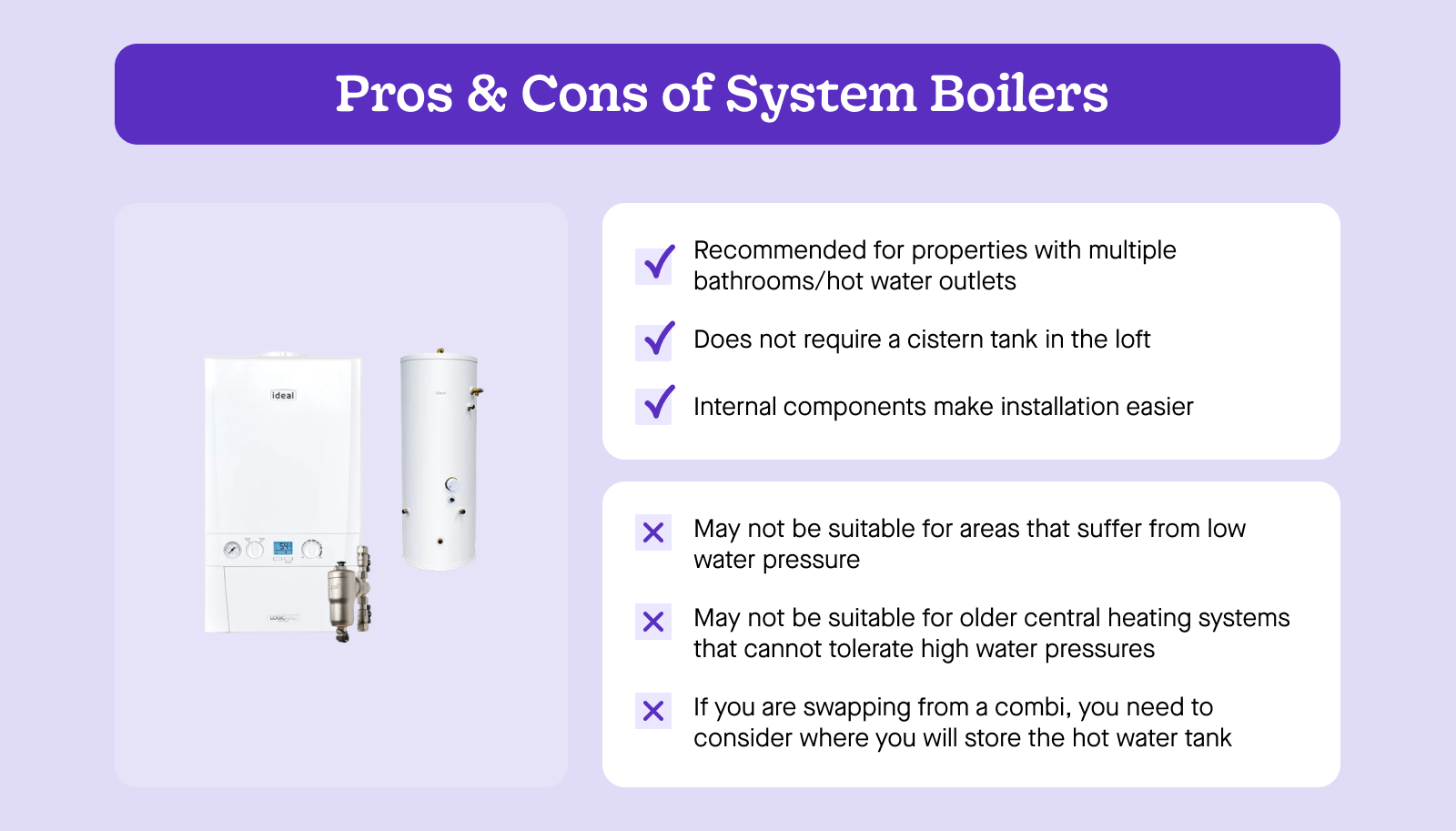
Pros of a system boiler
Better for simultaneous hot water use
This is the headline. A system boiler is built for households where “one shower at a time” is not a thing.
Generally strong water pressure
Because it’s mains-fed, system boilers can give better, more consistent pressure than older gravity-fed regular boiler systems.
More forgiving for larger homes
Big homes usually equal more bathrooms, more demand, and more moments where three people try to use hot water at once like it’s a team sport.
Cylinder can give you a backup option
Many hot water cylinders include an immersion heater (electric backup). Not every setup, not every cylinder - but it’s common.
That means if your boiler fails, you may still be able to heat water via immersion.
(We’ll always confirm what you’ve actually got, because assuming is how you end up cold and angry.)
Cons of a system boiler
You can run out of hot water
If your cylinder is small and your household is enthusiastic, you can empty it. When it’s empty, it needs time to recover.
It takes up space
A cylinder is not a small item. You are sacrificing cupboard space for hot water glory.
Sizing matters more than people think
Most “system boiler problems” aren’t system boiler problems. They’re wrong cylinder size or wrong boiler output for the home.
Too small → you run out.
Too big → you’re heating more water than you need.
And yes, both can be annoying.
How much do system boilers cost?
System boiler install costs vary mainly based on what you’re swapping from and what’s already there.
Like-for-like swap (system to system)
This is usually the most straightforward and affordable route - especially if you’re keeping the existing cylinder and the pipework isn’t a horror show.
Curious to know which boiler brand performed worst? Find out in our report of the worst boilers.
Converting from a combi to a system boiler
This typically costs more because you’re adding:
a cylinder
extra pipework
controls changes
sometimes a new cupboard plan (or a divorce)
Converting from a system to a combi
Also often more expensive, because you’re removing the cylinder, reworking pipework, and reconfiguring the system.
If you want the real price for your home, the fastest route is our quote tool - you’ll get a fixed price on screen, not “£2,000–£4,000 depending on the vibes”.
How to choose the right system boiler (without losing the will to live)
Picking a good boiler still comes down to the same boring but important stuff:
Reliability. Warranty. Price. Serviceability.
Brand matters, but so does:
correct sizing
proper system design
decent installation
A brilliant boiler installed badly is still a bad boiler.
A “less sexy” boiler installed properly will often outperform the fancy one.
What size system boiler do I need?
A rough rule of thumb for heating output in many small-to-medium homes is:
Allow around 1.5kW per radiator, plus roughly 3kW for hot water
So:
8 radiators: 8 × 1.5kW + 3kW ≈ 15kW
15 radiators: 15 × 1.5kW + 3kW ≈ 26kW
That’s a rough guide - real sizing depends on insulation, radiator sizes, property type, cylinder size, and hot water demand.
If you want it sized properly, we do that as part of your quote. No maths. No spreadsheets. No tears.
Note: If you have an older boiler and are suffering from lockouts and lukewarm water, you may want to consider whether you have a faulty heat exchanger.
Water storage cylinders and tanks of regular and system boilers can be heated through solar panels after installation. Soak it in.
Recommended heating guides:
System boilers - The best system boilers available
Irrespective of your type of boiler, be it regular, combi or system – the foundations of picking a good one remain the same:
Is it reliable?
Is it well priced?
And does it have a good warranty?
Want an exact price of a new boiler? Use our boiler quote calculator (your fixed price will appear on screen).
#1 - Viessmann system boilers
Viessmann are statistically the UK’s most reliable boilers, Which? Best Buy award winners and through Heatable – all come with a 10-year parts & labour warranty. It’s German magic.
Viessmann Model | Warranty | Price |
Vitodens 100 19kW | 10 Years | |
Vitodens 100 26kW | 10 Years | |
Vitodens 100 30kW | 10 Years | |
Vitodens 100 35kW | 10 Years |
#2 - Ideal system boilers
Ideal boilers are a mainstay in the British heating industry and have been delivering quality boilers for longer than your Dad has been looking for his glasses. They offer outstanding value for money and there’s no finer option for a tight budget.
Ideal Model | Warranty | Price |
Ideal Logic 15kW | 5 Years | |
Ideal Logic 18kW | 5 Years | |
Ideal Logic 24kW | 5 Years | |
Ideal Logic 30kW | 5 Years |
#3 - Vaillant system boilers
Vaillant has always had boilers in abundance so we’ve just picked the best ones. They’re a sturdy and reliable British company with a great reputation and decent warranties – albeit a touch overpriced in our opinion.
Vaillant Model | kW Output | Warranty | Price |
ecoTEC Plus | 12 - 37kW | 5 Years | |
ecoFIT Pure | 12 - 30kW | 2 Years | |
ecoTEC Exclusive | 27kW | 5 Years |
#4 - BAXI system boilers
BAXI are the underdogs of the boiler world, quietly going about their business in the background. They may be guilty of producing too many boilers, but their system boilers are more limited and they’ve done a ruddy good job with impressive 7-year warranties.
Baxi Model | kW | Warranty | Price |
Megaflow | 15 - 32kW | 7 Years | Get Quotes (for better boilers) |
600 | 15 - 24kW | 7 Years | Get Quotes for better boilers) |
#5 - Worcester system boilers
Perhaps the only boiler you think you’ve heard of. An outstanding boiler company, with a great reputation and some fantastic boilers – but beware, they certainly have the price to match it.
Worcester Model | kW Output | Warranty | Price |
Greenstar i / 8000 | 9 - 24kW | 10 Years |
How much do system boilers cost?
Typical Heatable costs for Ideal Logic system boilers, based on a straightforward like-for-like system boiler swap.
Boiler | Warranty | Price Guide | Price |
Ideal logic 15kW | 5 Year (Parts & Labour) | £2,105 | |
Ideal logic 18kW | 5 Year (Parts & Labour) | £2,200 | |
Ideal logic 24kW | 5 Year (Parts & Labour) | £2,295 | |
Ideal logic 30kW | 5 Year (Parts & Labour) | £2,690 |
Typical Heatable costs for Viessmann system boilers, based on a straightforward like-for-like system boiler swap.
Boiler | Warranty | Price Guide | Price |
Viessmann 100 19kW | 10 Year (Parts & Labour) | £1,999 | |
Viessmann 100 26kW | 10 Year (Parts & Labour) | £2,105 | |
Viessmann 100 30kW | 10 Year (Parts & Labour) | £2,405 | |
Viessmann 100 35kW | 10 Year (Parts & Labour) | £2,660 |
Check out our new boiler costs guide for something more comprehensive and if you want to know which boiler to choose, see our best condensing boilers review.
Swap a system to a combi boiler?
Converting from a pre-existing system boiler to a combi boiler is going to be significantly more expensive due to the extra materials and work required.
Typical Heatable costs for Ideal & Viessmann combi boilers [converted from system boilers].
Combi | Warranty | Price Guide | Price |
Ideal Logic Combi 24kW | 5 Year (Parts & Labour) | £2,790 | |
Ideal Logic Combi 30kW | 5 Year (Parts & Labour) | £2,990 | |
Viessmann 050 29kW | 10 Year (Parts & Labour) | £2,939 | |
Viessmann 100 30kW | 10 Year (Parts & Labour) | £3,370 |
Heatable’s conversion prices include full removal of your old boiler & system cylinder, installation and upgrading of pipework if required and – obviously – your new combi boiler.
The only thing not included in a Heatable order is a stuffed meerkat.
System boiler size calculator
Sticking with your loyal system boiler? Get the right size...
Getting the wrong size system boiler isn’t quite as bad as forgetting to wear pants in public. People won’t point and laugh. But you will be extremely let down with yourself for such a basic error.
No. of radiators | Calculation | Minimum kW Size |
6 Radiators | 6x 1.5kW + 3kW | 12kW |
8 Radiators | 8x 1.5kW + 3kW | 15kW |
12 Radiators | 12x 1.5kW + 3kW | 21kW |
15 Radiators | 15x 1.5kW + 3kW | 26kW |
20 Radiators | 20x 1.5kW + 3kW | 33kW |
Essentially, for small to medium-sized homes – allow 1.5kW per radiator + 3kW for your cylinder.
For something way more comprehensive, read our boiler size guide.
Don’t like maths? Let Heatable do the whole thing for you - get quotes.
How to get a new boiler 👻
You may need a new boiler.
You may need it fast, and with affordable monthly payments.
You may even need it from a company with top end local engineers, with 10,000 Trust Pilot reviews to back them up. Plus a Which? Trusted Trader award for good measure.
You may need a new boiler quote from us, Heatable 😘