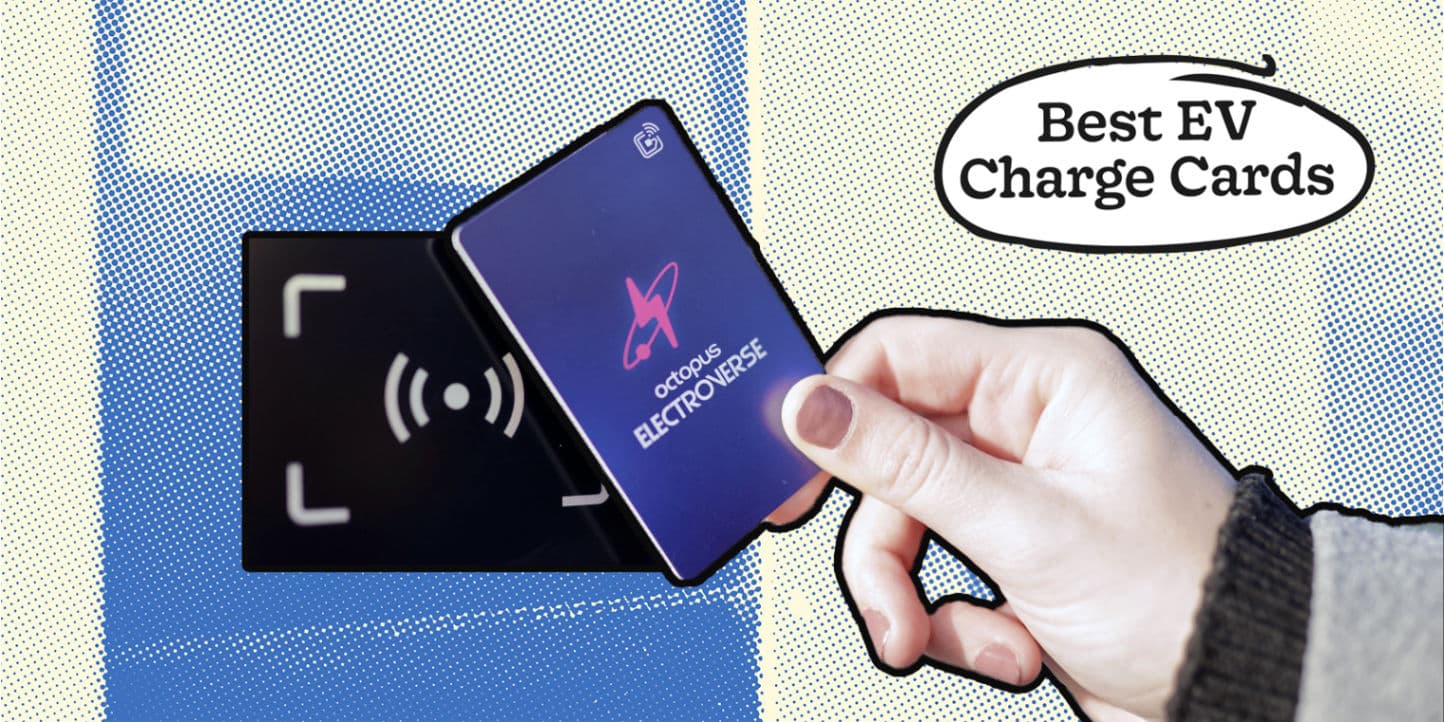

You’re cruising down the M6 in your shiny new EV, battery edging into the “don’t-push-it” zone. You pull into a public charger, open your wallet… Tesco Clubcard, Costa, a gym card from 2017 – but nothing that’ll actually start the charger.
Welcome to public EV charging in the UK: part refill, part game show, part “why do I need another card for this?”
The good news? It is improving. From late 2024, contactless payments are required on all new public chargers over 8kW, plus existing rapid chargers over 50kW. At most motorway hubs and retail parks you now just plug in, tap your bank card and watch the kWh roll in.
There’s a snag, though: contactless is usually the “walk-up” price - handy, but often the priciest way to charge, with none of the discounts or perks regular users can unlock.
That’s where EV charge cards and apps come in. They’re not just glorified key fobs – they unlock better rates, simpler billing and access to hundreds of networks through a single login. Roaming services like Octopus Electroverse can roll Ionity hubs, supermarket rapids and council car parks into one account, so you’re not playing app whack-a-mole every time you need a top-up.
In this guide, we’ll ditch the jargon (RFID = tap-to-pay chip, basically) and help you decide whether you even need a charge card in 2025. If you mostly top up at home on a smart tariff like Octopus Go, your debit card and a good map app might be enough.
But if you’re clocking motorway miles, running a small fleet or planning Euro road trips, the right mix of cards and apps could save you serious money over a year – and finally put that overstuffed, underperforming wallet into retirement.
PS We offer EV charger installation nationwide. Simply answer these questions, get your fixed price and arrange your free quote. 🚗
Do you even need an EV charge card in 2026?
Let’s be honest, public charging in the UK isn’t the dark art it was five years ago.
With more than 70,000 public charge points live by the end of 2024 (and growing fast), you can usually just roll up, tap your bank card and get a charge.
On top of that, new rules mean most rapid and ultra-rapid chargers now have to offer contactless, and all new public charge points above 8kW must do the same. So in plenty of places, public charging really is as simple as paying for a coffee.
But before you ditch the idea of charge cards completely, it’s worth understanding your options:
[1] Tapping your bank card
Easiest option by miles - plug in, tap, done.
Thanks to the new regulations, this is now standard on most new “fast” and rapid chargers, especially at motorway services and big retail parks.
The downside? You’re typically paying the headline “walk-up” price, with no loyalty discounts, and getting neat VAT receipts for expenses can be a hassle.
[2] Network-specific apps
Download the app for a particular network (think bp pulse, Shell Recharge, etc.), create an account and start/stop sessions on your phone.
Handy if you mainly use one operator near home or work.
Less fun if you’re doing long trips and end up juggling four different logins just to get to Cornwall and back.
[3] Roaming apps/cards (e.g. Octopus Electroverse, OVO Charge powered by Bonnet)
These are the MVPs for people who roam around a lot.
One app (and often an RFID card) gives you access to dozens of networks in the UK and across Europe, with everything rolled into one bill.
Some throw in tasty extras too - for example, Octopus Electroverse gives Octopus Go and Intelligent Go customers 5–8% off public charging when they link their accounts.
OVO Charge, built on Bonnet’s platform, offers subscription “Boosts” that knock a percentage off public charging prices as well.
So, when is a charge card genuinely worth it?
You’re a motorway warrior
If you’re regularly bouncing up and down the M1/M6/M25, you’ll end up using a mix of networks.
A roaming app/card simplifies everything and can shave a chunk off your annual charging bill via built-in discounts.
You claim business mileage
One monthly invoice for all your public charging, with itemised VAT receipts, is a lot easier than digging through card statements and guessing which £23.40 was your Glasgow trip.
You want roaming perks
Energy-tariff tie-ins (like Electroverse with Octopus Go/Intelligent Go) can cut costs across all compatible chargers, not just one brand.
European coverage is a nice bonus if you’re planning summer road trips.
You’re Scotland-heavy
If you spend a lot of time north of the border, ChargePlace Scotland’s RFID card is strongly recommended.
You can use the app in many places, but some posts only accept the card – and a lot of sites are council-backed, so pricing is often low and can even be free, depending on the local authority.
Bottom line: In 2025, EV charge cards aren’t essential for everyone, but for regular public-charger users they can turn chaos into a system.
Base the decision on how and where you actually drive, not on the marketing hype.
Main types of EV charge cards & apps
UK public charging is basically a buffet: loads of choice, but you only need a couple of good options on your plate.
Everything falls into three main camps - roaming apps/cards, single-network cards, and pure mapping apps – all sitting on top of simple contactless.
Roaming apps/cards
Roaming apps and cards are your Swiss Army knives. One login, lots of networks.
Octopus Electroverse, for example, covers a huge chunk of the UK and Europe and lets Octopus Go/Intelligent Go customers shave around 5–8% off public charging when they link their accounts.
OVO Charge (built on Bonnet’s platform) takes a similar approach: you can pay-as-you-go or bolt on a small monthly “Boost” to knock up to about 15% off every session across compatible networks.
Zapmap now straddles the line between map and roaming too: you plan routes and then pay on supported networks via Zap-Pay or the new Zapmap charging card, so all your VAT-friendly receipts live in one place.
Network-specific cards
Network-specific cards make sense if you mostly live on one brand. bp pulse is the classic example: pay a monthly sub (around £7–8) and you get roughly 20% off compared with just rocking up and tapping your bank card, which adds up fast if you hammer their rapid sites.
In Scotland, ChargePlace Scotland’s £10 RFID card is still very handy; once you’ve ordered it, you can access thousands of chargers, many of which are council-run and priced well below typical motorway rates – sometimes even free, depending on the local authority, so it’s always worth checking the live map for current tariffs.
Mapping apps
Finally, mapping and planning apps hold it all together.
Zapmap is still the default UK “where can I plug in?” tool, with filters for speed, connector and price plus live status on loads of networks and the option to pay on supported chargers.
PlugShare adds crowd-sourced photos and reviews that are great for trips into Europe, while Google Maps and in-car EV nav are getting better at weaving chargers into your route automatically.
For many drivers, that combo – map app + contactless + maybe one roaming app – is all you’ll ever need.
Best EV Charge Cards in 2026 - At a Glance:
We've crunched the latest 2025 data: coverage from 50K-1M points, subs from free to £8/month, and perks like discounts or free cards.
Baseline: contactless is universal on rapids but premium-priced. Prices fluctuate (check apps), but these models hold steady.
Provider/Card | Type | Best For | How You Pay | Approx. Pricing Models | Stand-out Perks | Potential Downsides |
Octopus Electroverse | Roaming (multi-network) | Motorway miles, Octopus customers | App, free RFID card, contactless | No sub; pay per kWh + 5-8% discounts for Octopus users | 1M+ global points; plunge pricing (up to 50% off green slots); free salary sacrifice scheme | Discounts network-dependent; app needed for full features |
Zapmap + Zap-Pay | Mapping + pay (multi-network) | Route planning, occasional users | App, charging card (£10 one-off) | No sub; pay per kWh + Premium discounts (£2.99/month) | 95% UK coverage; live filters/reviews; CarPlay integration | Fewer roaming partners than Electroverse; Premium for best deals |
OVO Charge (Bonnet) | Roaming (multi-network) | Urban drivers, bundles | App, RFID card | Boost subs £2-£8/month for 10-15% off; pay per kWh | 700K+ Europe points; rewards rollover; CO2 tracking | Boost value iffy for low-mileage; network gaps in rural spots |
BP Pulse Charge Card | Network-specific | Fleet/business, BP loyalists | App, RFID card | £7.85/month sub for 20% off; PAYG otherwise | 14K+ UK points; hybrid fuel option; 1-month free trial | Sub eats into light-use savings; app glitches reported |
Shell Recharge Card | Network-specific | Highway roaming, rewards fans | App, free RFID/key fob | No sub; pay per kWh + 35p/session (capped £7/month) | 25K+ UK/Europe; GO+ rewards; Ionity access | Transaction fees add up; app CVC hassle |
ChargePlace Scotland Card | Network-specific | Scottish drivers/tourists | App, £10 RFID card | Mostly free (90%); £0.20-£1.50/kWh paid | 4K+ Scotland points; overstay fines vary | App unreliable in remotes; England-limited |
Just Use Contactless + Apps | Baseline (no card) | Home-heavy, casual top-ups | Bank card tap + mapping apps | Full retail per kWh (e.g., 79p ultras) | No setup; works everywhere new | No discounts; receipt hunting for claims |
How to pick the right EV charge card for you
You don’t need a deck of RFID in the junk drawer - for most people, one app and maybe one card is plenty.
Think in real-world profiles, not brand logos:
“I’m an Octopus Energy customer.”
Electroverse is the obvious starting point. It’s free to join, works on hundreds of thousands of chargers across the UK and Europe, and if you’re on Octopus Go or Intelligent Go you get 5% or 8% off all Electroverse charging once you link your accounts. Add Zapmap (or your favourite map app) purely for route planning and live status.
“Most of my driving is in Scotland.”
Order the ChargePlace Scotland access card (one-off £10) so you’re covered in spots where app or contactless access is patchy, especially in rural areas.
Then layer Electroverse on top, which now plugs into nearly 2,900 CPS chargers – handy when you’d rather just use one app.
“I hammer the motorways for work.”
Start with a roaming app/card like Electroverse or OVO Charge (powered by Bonnet) so you can use multiple networks and get one bill.
OVO Charge’s “Boost” add-ons, for example, give around 10–15% off public charging for a small monthly fee.
If you’re constantly landing at the same bp sites, a bp pulse subscription on top can undercut their walk-up contactless price.
“I barely use public chargers.”
If home or workplace charging covers most of your miles, keep it simple: contactless + a planning app (Zapmap / Google Maps / in-car nav) is fine.
You can always bolt on a roaming app later if your usage ramps up.
Bottom line: start with the least you can get away with – one free roaming app or CPS card – drive with it for a month, then only add extra tools if you’re actually feeling pain.
Features, networks and discounts shift fast, so always double-check what’s included in 2025 before you commit.
Money-saving tips for public EV charging
Public charging doesn’t have to feel like buying airport coffee. A few simple habits go a long way:
Don’t always chase the fastest plug.
Ultra-rapids (150kW+) are brilliant when you’re in a rush, but they usually cost more per kWh than 50kW rapids or AC posts.
If you’re stopping for 30–40 minutes anyway, a slightly slower but cheaper charger can work out better value overall.
Check the price before you plug in.
Apps like Zapmap, Electroverse and OVO Charge show live or recent tariffs for most sites.
A 30-second price check can save you from paying top whack when there’s a cheaper unit across the car park.
Use roaming and energy-bundle discounts.
Electroverse’s tie-ins with Octopus Go / Intelligent Go (5–8% off across Electroverse) or OVO Charge’s Boost subscriptions (10–15% off public charging) knock a quiet chunk off every session if you charge on the road regularly.
Fleet cards like Paua do a similar job for business users, giving access to tens of thousands of connectors across 40+ networks on a single invoice.
Think “destination” rather than “shiny hub”.
Motorway forecourts are convenient, but supermarkets, retail parks and hotels can be significantly cheaper – and sometimes throw in loyalty perks.
Sainsbury’s Smart Charge pays out Nectar points when you plug in, and Tesco’s Pod Point chargers now earn Clubcard points at many sites.
If you’re staying overnight, a slower on-site charger can work out cheaper than two ultra-rapid blasts.
Tie it all together with cheap home energy: a smart EV tariff or home solar means public charging becomes the occasional top-up, not the main event – which is exactly where your wallet wants it.
Next Steps For Your EV Charger Journey:
When planning to install an EV charger for your home, there are several important factors to consider. Make sure to refer to the following guides to help you make informed decisions:
To dive deeper into these topics, head over to our advice section or check out our YouTube channel for informative videos.
Looking for the best deal on a new EV Charger?
If you’re aiming to get the best deal on a new EV charger, consider getting a quote from us. Here’s why:
Installation within 24 hours.
Thousands of satisfied customers with an average score of 4.9 on Trustpilot, surpassing the market leader.
Which? Trusted Trader: Heatable is proudly recognised as a Which? Trusted Trader.
Price match guarantee: We will match any like-for-like cheaper quote.
Flexible payment options, including interest-free finance.
Up to a 12-year guarantee on selected models.
Fixed price guarantee: No hidden costs.
Save your quote and decide later.
Get an instant fixed price on a new EV charger here.