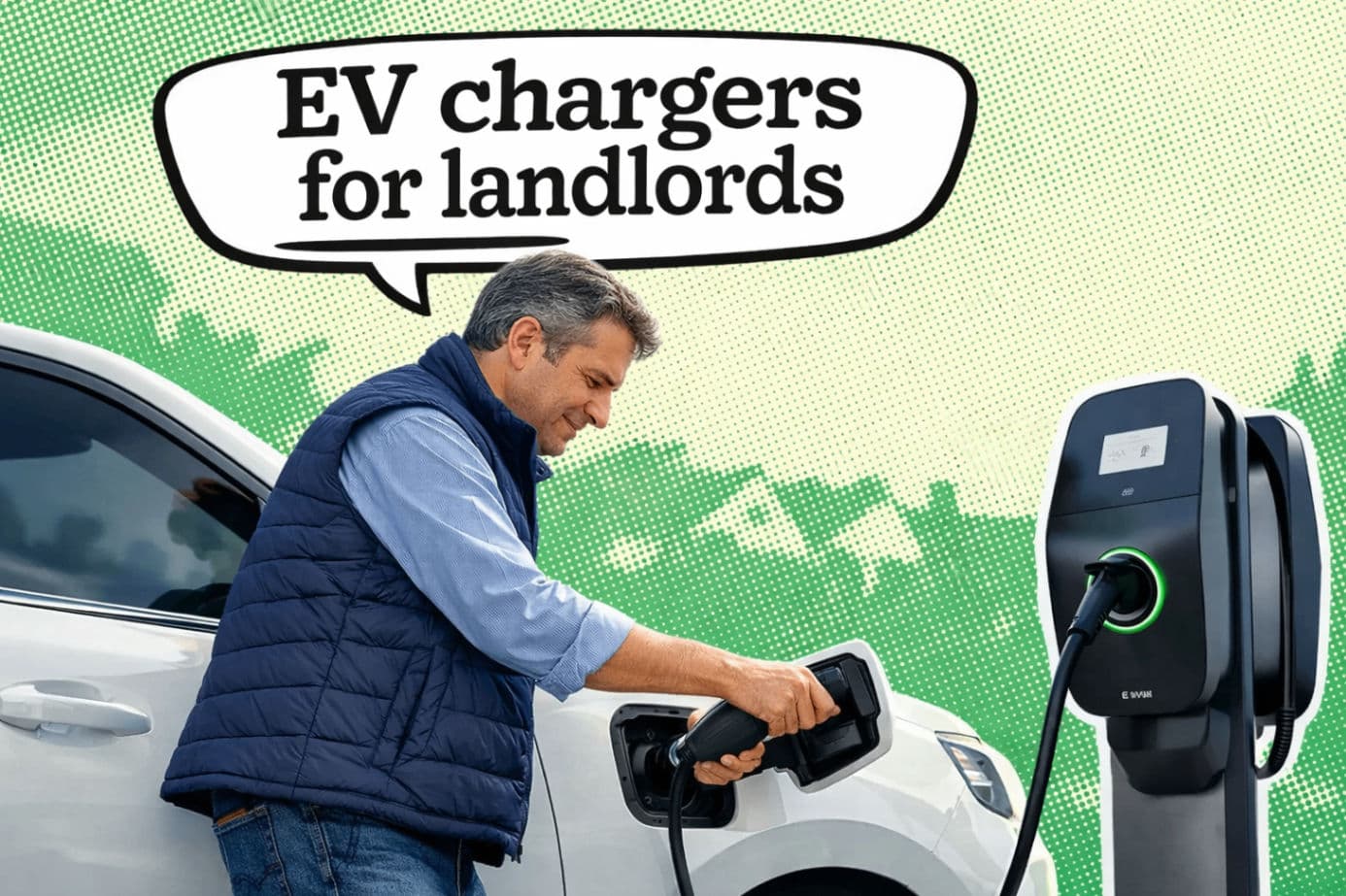

Being a landlord in 2026 is basically a never-ending game of “what do tenants expect next?”
- Are EV Chargers Worth It for Landlords?
- The Big Question: Are There Grants for Landlord EV Chargers?
- What If a Tenant Asks to Install an EV Charger?
- The Leasehold Problem (AKA: The One That Starts the Headache)
- Can the Property Actually Handle an EV Charger?
- Who Pays for the EV Charger? (And How to Avoid a Future Argument)
- What About Flats, Shared Parking… and “Who Pays the Electric?”
- What Type of Charger Makes Sense for a Rental Property?
First it was reliable broadband. Then it was modern kitchens.
Now? More and more renters are asking one question before they even book a viewing:
“Can I charge my EV here?”
And honestly… it’s a fair ask.
If someone drives electric (or is planning to), having a home charger isn’t just a nice-to-have. It’s the difference between cheap overnight charging on the driveway… and a weekly ritual of queueing at a public charger behind three taxis and a stressed-out delivery van.
So if you’re a UK landlord wondering whether you should install an EV charger - or what to do when your tenant requests one - you’re in the right place.
We’ll break it down in plain English: costs, grants, permissions, leasehold headaches, electrical capacity, and how to handle the awkward landlord-tenant money chat without it turning into a drama.
PS We offer EV charger installation nationwide. Simply answer these questions, get your fixed price and arrange your free quote. 🚗
Are EV Chargers Worth It for Landlords?
In most cases: yes - as long as the property has off-street parking.
A proper home charger makes a rental more appealing, helps you stand out on Rightmove, and quietly future-proofs the property for the next wave of tenants (because EV ownership isn’t exactly going backwards).
Even if your current tenant doesn’t drive electric yet, you’re adding a feature that’s quickly becoming “standard” - the same way double glazing and combi boilers went from nice-to-have to basically expected.
And the best part? Unlike big renovations, installing an EV charger is usually pretty painless. It’s often a day’s work, with minimal disruption, and you end up with a modern upgrade that genuinely makes the home more usable.
The Big Question: Are There Grants for Landlord EV Chargers?
Yes - and this is the bit most landlords completely miss.
There are UK government-backed schemes that can reduce the cost of installing an EV chargepoint at a rental property.
In most cases, this support comes via OZEV (Office for Zero Emission Vehicles) - usually through the EV Chargepoint Grant.
But (and there’s always a but) eligibility depends on a few key boxes being ticked, like:
the property being rented out
having off-street parking or a clearly marked, private bay
using an OZEV-approved installer
and if the property is leasehold… having permission to install anything in the first place
The biggest “don’t mess this up” moment:
Check your eligibility before you book the install.
Not after. Not halfway through. Before.
Because once the charger’s installed, you usually can’t rewind time and claim the grant retroactively - and that’s an expensive lesson to learn.
What If a Tenant Asks to Install an EV Charger?
This is quickly becoming the most common EV charger scenario for landlords:
Tenant moves in.
Tenant buys an EV.
Tenant messages you:
“Hey - can I install a charger?”
A lot of landlords hear that and immediately picture chaos: drilling, cables everywhere, awkward cost chats, insurance headaches… and the classic question:
“Who owns it when they move out?”
But here’s the truth: a tenant asking for an EV charger is usually a good sign.
It often means they’re planning to stay put, they care about the place, and (crucially) they’re asking permission instead of doing anything risky or DIY behind your back.
The best response? Calm, helpful, and structured.
This is the vibe you want to give:
“I’m open to it - as long as it’s safe, properly installed, and we agree the details.”
You can be friendly and protect yourself. No drama needed.
A smart next step is to say you’ll look into the practicalities - and ask them to confirm the parking setup, because everything depends on whether they have:
a driveway / off-street parking (easy win)
an allocated parking space (still doable)
shared or ‘first come first served’ parking (usually a nightmare)
Once you know which one you’re dealing with, the rest gets a lot easier to plan.
The Leasehold Problem (AKA: The One That Starts the Headache)
If you’ve got a rental house with its own driveway, this is usually a non-issue.
You install the charger, everyone’s happy, life moves on.
But if you own a leasehold flat (or anything in a managed development with shared parking)… welcome to the fun part.
Because suddenly it’s not just your decision.
Installing an EV charger might mean running cables through communal areas, drilling into shared walls, or attaching kit to parts of the building you technically don’t fully own.
And this is where things get spicy.
Even if your tenant has an allocated parking bay, you’ll often still need approval from the freeholder or managing agent. Some are great.
Some take six weeks to reply. And some react like you’ve asked if you can park a forklift in the lobby.
Before you agree to anything, check these four things:
Is the parking space actually included in the lease?
(Allocated on paper, not just “you usually park there”.)
Does the lease allow alterations or new electrical works?
If it says “no changes without consent”… that’s your answer.
Do you need written permission from the management company/freeholder?
Spoiler: you probably do.
Are there rules about external cabling, trunking, or wall-mounted equipment?
Because some places treat a small cable run like it’s an architectural crime.
One more thing landlords miss:
If it’s a newer development, there may already be plans for EV charging across the whole site.
In that case, it can actually be smarter to push for a proper shared upgrade - rather than doing a one-off charger install that becomes a “why does that flat get one?” argument later.
Can the Property Actually Handle an EV Charger?
This is the other big landlord panic:
“Is this going to blow up the electrics?”
Good news: a properly installed EV charger is safe.
But you do need to think about electrical load - because a 7kW charger isn’t a tiny plug-in gadget. It’s a serious extra demand, especially in a home where the tenant might already be rinsing the power with:
electric showers
induction hobs
tumble dryers
home office setups
and (increasingly) heat pumps
The landlord-friendly solution: smart charging + load balancing
This is why we almost always recommend a smart EV charger with load balancing.
Load balancing basically means the charger behaves itself.
If the house is already pulling a lot of power (shower on, oven on, tumble dryer going full send), the charger automatically dials down so it doesn’t overload anything.
In plain landlord terms: fewer problems, fewer callouts, and far less chance of you paying for a surprise upgrade you didn’t budget for.
That said, sometimes a property does need extra work - like a fuse upgrade or a bit of electrical upgrading. Not always a deal-breaker… but it can affect the cost and timeline.
Who Pays for the EV Charger? (And How to Avoid a Future Argument)
This is where it can get awkward if you don’t set expectations early.
Because from the tenant’s side, it feels like a personal upgrade.
From your side, it’s a property improvement.
And if nobody agrees what’s happening… it turns into a weird conversation later, usually around the time they’re handing the keys back.
Here are the three ways this usually goes:
1) The landlord pays (the “easy life” option)
Best if you want the property to stand out and you’re happy treating it as a long-term value add.
You own it, it stays, and future tenants get the benefit too. Simple.
2) The tenant pays (with permission)
Totally possible - but only if it’s agreed properly in writing.
You’ll want to cover things like:
do they remove it when they leave?
or does it stay?
do you reimburse anything?
who’s responsible for maintenance?
Without that, it turns into a strange “we need to talk…” conversation later. Nobody wants that.
3) Split the cost (usually the most realistic compromise)
This works well when the charger adds value to the property…but the tenant is getting the day-to-day benefit right now.
A common setup is:
landlord covers the standard installation contribution
tenant covers any upgrades (extra cabling, fuse work, premium charger model, etc.)
Whatever you choose: keep it simple, and put it in writing.
You don’t need a 12-page legal contract - you just need clarity.
What About Flats, Shared Parking… and “Who Pays the Electric?”
If the charger is connected to the tenant’s own meter, billing is easy.
They pay their electricity bill like normal, and EV charging just becomes part of that. No spreadsheets. No awkward WhatsApps. No drama.
Where it gets messy is flats and communal supplies.
If the charger would be wired into a landlord supply or a shared building supply, you need a plan for how usage is tracked and paid for - otherwise you’re heading straight into:
“My neighbour’s charging their Tesla on my electricity.”
(And yes, it happens.)
In these setups, chargers with usage monitoring, access control, or billing features can help… but the best solution is usually simpler:
✅ Make sure the charger is linked to the correct meter in the first place.
Because once it’s connected wrong, every month becomes a “can we just split it?” argument.
What Type of Charger Makes Sense for a Rental Property?
Most landlords want the same thing:
Something reliable that doesn’t generate phone calls.
So the sweet spot tends to be:
a reputable charger brand (not a mystery box from the internet)
a proper warranty
smart scheduling (so tenants can charge overnight on cheap rates)
load balancing (so the electrics don’t throw a tantrum)
Tethered vs untethered: the quick landlord answer
You’ll usually have two options:
Tethered = cable attached
✅ easiest for tenants (plug in and go)
✅ fewer “I’ve lost my cable” messages
Untethered = no cable attached
✅ looks neater
✅ more universal
…but tenants need their own lead
For most rental properties, tethered is the simplest win.
The Landlord Bottom Line
If you’ve got off-street parking and you’re renting out a UK property in 2026, an EV charger is quickly becoming one of the smartest upgrades you can make.
Just don’t wing it. Do it properly:
check grant eligibility first
if it’s leasehold, get permission before anything starts
use a smart charger with load balancing
agree who pays / who owns it in writing
Do that, and an EV charger stops being “a hassle”… and becomes a genuine selling point - for tenants now, and resale value later.
Next Steps For Your EV Charger Journey:
When planning to install an EV charger for your home, there are several important factors to consider. Make sure to refer to the following guides to help you make informed decisions:
To dive deeper into these topics, head over to our advice section or check out our YouTube channel for informative videos.
Looking for the best deal on a new EV Charger?
If you’re aiming to get the best deal on a new EV charger, consider getting a quote from us. Here’s why:
Installation within 24 hours.
Thousands of satisfied customers with an average score of 4.9 on Trustpilot, surpassing the market leader.
Which? Trusted Trader: Heatable is proudly recognised as a Which? Trusted Trader.
Price match guarantee: We will match any like-for-like cheaper quote.
Flexible payment options, including interest-free finance.
Up to a 12-year guarantee on selected models.
Fixed price guarantee: No hidden costs.
Save your quote and decide later.
Get an instant fixed price on a new EV charger here.