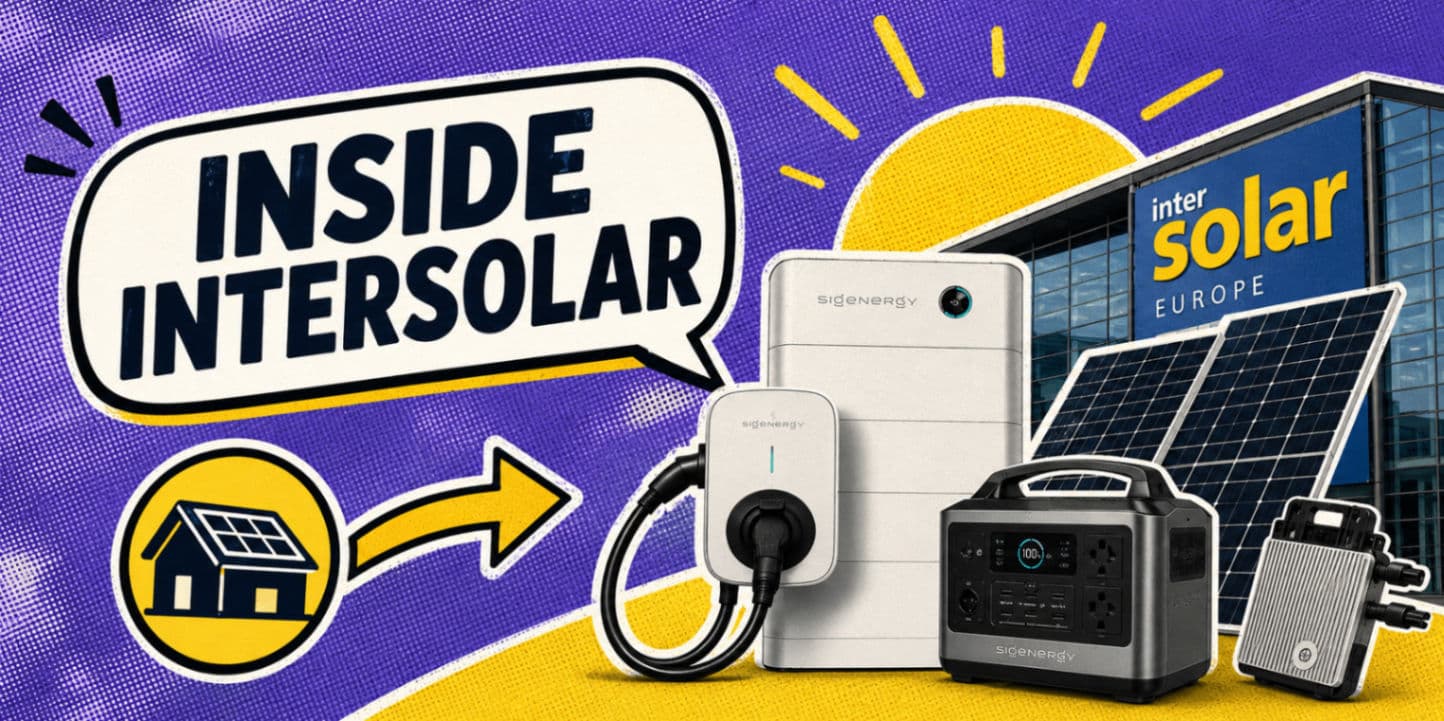

Every year, the solar industry gathers at Intersolar Europe in Munich to show off what is coming next.
Think of it as the Geneva Motor Show, but for solar panels, inverters, batteries, EV chargers and home energy technology. If a manufacturer has a new product, a new battery platform or a smarter way to manage electricity at home, there is a good chance it appears here first.
Heatable visited the show at Munich Messe to see what is likely to shape the UK solar market over the next few years.
The big themes were clear: better home batteries, simpler backup power, smarter EV charging, microinverters, plug-in solar, and more joined-up home energy systems.
Here are the main products and trends we found.
🎥 Watch our YouTube video from our visit to the Intersolar event:
Sigen Energy: one of the biggest names to watch
For the UK market, one of the most interesting stands at Intersolar was Sigen Energy.
Sigen Energy has grown quickly in the home battery and solar storage market, especially with its SigenStor system.
SigenStor is already known for being a premium, all-in-one battery system that combines battery storage, inverter technology and energy management in a clean stackable design.
At Intersolar, Sigen Energy showed several new and upcoming products, including:
A new SigenStor Neo platform
New EV charging technology
Portable battery products
Microinverter options
Additional safety features and demonstrations
The SP2 battery system, a more entry-level alternative
The most interesting announcement for UK homeowners was SigenStor Neo.
What is SigenStor Neo?
SigenStor Neo is a new battery platform from Sigen Energy.
At first glance, it looks similar to the existing SigenStor system, but Sigen Energy made it clear that Neo is not simply a replacement. Instead, it is a new platform that will sit alongside the existing SigenStor range.
That matters because it means the current SigenStor system is not being made obsolete. The existing product remains part of the range, while Neo gives installers and customers another option.
The key idea is that Sigen Energy now has multiple battery platforms for different needs, budgets and installation scenarios.
Is SigenStor Neo replacing SigenStor?
No. Based on what Sigen Energy told us at Intersolar, SigenStor Neo is not replacing SigenStor.
The existing SigenStor system remains available and established in the market. Neo is an additional platform, developed using newer technology, improved components and updated product design.
That means homeowners should not view Neo as “the new one” and SigenStor as “the old one”. A better way to think about it is that Sigen Energy is building a wider product range, with different systems suited to different homes and price points.
Built-in backup: a major feature
One of the most interesting differences with SigenStor Neo is its built-in gateway functionality.
Backup power is becoming a much bigger priority for UK homeowners. More people are asking what happens during a power cut, whether their solar panels will still work, and whether their home battery can keep key circuits running.
With many battery systems, backup requires additional equipment, such as a separate gateway or backup box. With SigenStor Neo, the backup gateway is built in.
That could make a big difference to certain installations, because it may reduce the amount of extra kit required. However, it will not automatically make every installation simpler. In some homes, a separate gateway can still make practical sense, especially if the battery is located far away from the consumer unit.
In other words, built-in backup is a big feature, but the right setup still depends on the property.
Why backup power is becoming more important
For many years, UK solar was mainly sold around savings. The basic question was: how much can you reduce your electricity bill?
That is still important, but it is no longer the whole story.
More homeowners now want energy resilience. They want to know whether they can store cheap off-peak electricity, use more of their own solar power, and keep parts of the home running if the grid goes down.
A well-designed solar and battery system can help with all three.
The important detail is that not every solar battery automatically gives you backup power during an outage. You usually need the right equipment, the right wiring, and a properly designed backup setup.
That is why integrated backup features, like those shown on SigenStor Neo, are worth paying attention to.
A new bidirectional EV charger
Sigen Energy also showed a new AC EV charger with bidirectional capability.
In simple terms, bidirectional charging means electricity can move both ways. Instead of only charging the car from the house, the car can potentially discharge electricity back to the home or grid.
This is often described as vehicle-to-home or vehicle-to-grid technology, depending on how the system is used.
The big idea is straightforward: an electric car has a large battery. In many cases, the battery in an EV is much bigger than the battery installed on the wall of a house. If that stored energy can be used intelligently, it could become part of the wider home energy system.
Stopping your EV from draining your home battery
One practical issue with EV charging is that some setups do not manage the relationship between the home battery and the car very well.
For example, say your home battery has charged overnight on a cheap tariff. You then plug in your EV, which has a much larger battery.
In some systems, the car charger can accidentally pull energy from the home battery, effectively dumping your carefully stored electricity into the vehicle.
That is not always what you want.
A smarter charger should be able to recognise the EV load and prevent the home battery from discharging into it unnecessarily. It sounds basic, but in real-world installations, it can be a major headache.
This is exactly the kind of problem newer home energy ecosystems are trying to solve.
Portable batteries and plug-in solar
Another trend at Intersolar was portable battery storage and plug-in solar.
Plug-in solar is already a much bigger topic in parts of Europe, and it is starting to attract attention in the UK. The idea is that smaller solar systems can be installed more simply than a full rooftop array, often with smaller inverter and battery products designed for balconies, gardens, garages or smaller spaces.
Sigen Energy showed portable battery products that can work with plug-in solar, with UK availability expected.
This will be an interesting category to watch. It is unlikely to replace full solar and battery installations for most homeowners, but it could open up smaller-scale solar to people who cannot install a traditional rooftop system.
For example, plug-in solar may appeal to:
Renters, where suitable and permitted
Flats or apartments with limited roof access
Homes with smaller outbuildings
People who want a lower-cost entry point into solar
Customers who want portable backup power for camping or outdoor use
That said, UK electrical rules, grid compliance and installation requirements matter. Plug-in solar should not be treated as a DIY free-for-all. Any product used in the UK needs to be suitable, compliant and safely installed.
Microinverters for awkward roofs
Another useful product shown at the Sigen Energy stand was a range of microinverters.
Microinverters are small inverters that work at panel level, rather than relying on one central string inverter for the whole array.
They can be useful where a roof is complicated, partly shaded, split across different orientations, or where only a few panels can be installed in a specific location.
What was especially interesting here was the idea of using microinverters selectively.
In some installations, you may not need microinverters on every panel. Instead, you might use them only on the awkward section of roof, while the rest of the system runs through a more conventional inverter setup.
That could be useful for UK homes where people want to add panels wherever they can, including:
Garage roofs
Rear extensions
Side elevations
Small roof sections
Outbuildings
Partly shaded areas
This matters because modern solar installations are becoming less uniform. Not every home has one large, south-facing, unshaded roof. A lot of real homes have chimneys, dormers, extensions, trees, garages and odd roof angles.
Better microinverter integration could help make those homes more viable for solar.
The rise of the whole-home energy ecosystem
One of the clearest trends from Intersolar is that solar is becoming less about individual products and more about complete ecosystems.
A few years ago, a home might have had:
Solar panels from one manufacturer
An inverter from another
A battery from another
An EV charger from another
A separate monitoring app
A separate backup box
That can work, but it often creates friction. Products may not communicate properly, monitoring can be messy, and features like battery control, EV charging and backup can become more complicated than they need to be.
The new generation of solar technology is moving towards joined-up systems where panels, batteries, EV chargers, backup functions and monitoring apps work together.
That is the direction Sigen Energy appears to be pushing in.
For homeowners, the benefit is not just a cleaner app. It can mean better control, better savings, easier troubleshooting and a more future-proof installation.
Battery safety is improving too
Sigen Energy also demonstrated several safety features built into its battery systems.
Battery safety is not the most glamorous part of solar technology, but it is one of the most important. Home batteries store a lot of energy, so good design needs to include multiple layers of protection.
The safety system demonstrated included features such as:
Temperature monitoring
Smoke detection
Physical and thermal separation between battery packs
Protective gel pack linings
A pressure relief valve
Fire suppression as a final layer of protection
The pressure relief valve is designed to deal with gas expansion in a failure scenario. If a cell overheats and gas builds inside the unit, the system is designed to vent that pressure safely rather than allowing it to continue building.
The thermal separation between battery packs is also important. If one cell or pack begins to overheat, the aim is to stop that heat spreading to neighbouring cells.
These are the kinds of details that separate serious battery manufacturers from cheaper, less considered alternatives.
What is the Sigen Energy SP2?
Alongside the more premium systems, Sigen Energy also showed the SP2.
The SP2 is a more entry-level battery system. Unlike SigenStor, it is not the same kind of all-in-one stack. It uses a separate hybrid inverter and battery setup, with single-phase and three-phase options shown at the stand.
The SP2 appears to be aimed more directly at the value end of the market, competing with cheaper battery systems while still sitting inside the Sigen Energy range.
That gives customers another option.
In simple terms:
SigenStor remains the premium all-in-one system
SigenStor Neo appears to sit between the premium and more accessible parts of the range
SP2 is the more budget-conscious option
Final UK pricing, specification and suitability will depend on launch details, installation requirements and product availability.
What does this mean for UK homeowners?
The main takeaway from Intersolar is that solar technology is getting smarter, more integrated and more flexible.
For UK homeowners, that is good news.
It means future systems should be better at handling real-world homes, real-world electricity tariffs and real-world energy behaviour. Instead of simply generating solar power during the day, the best systems will help you decide when to store energy, when to use it, when to charge your car, and how to protect your home during outages.
The big trends to watch are:
More affordable battery options
Better backup power
Smarter EV charger integration
Bidirectional charging
Plug-in solar
Microinverters for awkward roof layouts
More complete home energy ecosystems
Stronger battery safety features
For anyone thinking about solar, this is why product choice matters. A solar installation is not just about putting panels on a roof. The inverter, battery, charger, app, backup setup and installation design all affect how well the system performs.
Should you wait for new solar products?
This is the obvious question whenever new technology is announced.
Should you install solar now, or wait for the next generation of products?
The honest answer is: it depends.
If your current electricity bills are high, your roof is suitable and you can benefit from solar and battery storage now, waiting indefinitely for the next product is usually not the best strategy. There will always be another new product around the corner.
However, if you are specifically interested in whole-home backup, bidirectional EV charging, or an upcoming battery platform like SigenStor Neo, it may be worth discussing the timing with an expert installer.
The right answer depends on your home, your energy usage, your EV plans, your tariff, your budget and whether you care more about maximum savings, resilience, premium design or future expandability.
Speak to Heatable about solar and battery storage
If you are considering solar panels, battery storage, EV charging or a full home energy system, Heatable can help you work out what actually makes sense for your property.
We can look at your roof, electricity usage, battery options, backup requirements and budget, then recommend a system that is properly designed around your home.
Whether you are interested in a premium Sigen Energy setup, a more affordable battery system, or simply want to understand whether solar is worth it, we can help.
Get a free solar quote from Heatable today and speak to our team about the best solar and battery options for your home.
Final thoughts
Intersolar 2026 made one thing clear: the solar market is moving quickly.
The next wave of home energy products is not just about better panels or bigger batteries. It is about smarter systems that can manage solar, storage, EV charging, backup power and tariffs together.
For UK homeowners, that should mean more choice, better performance and more ways to reduce reliance on the grid.
The challenge is choosing the right system, not just the newest one.
That is where good design, good installation and honest advice matter.