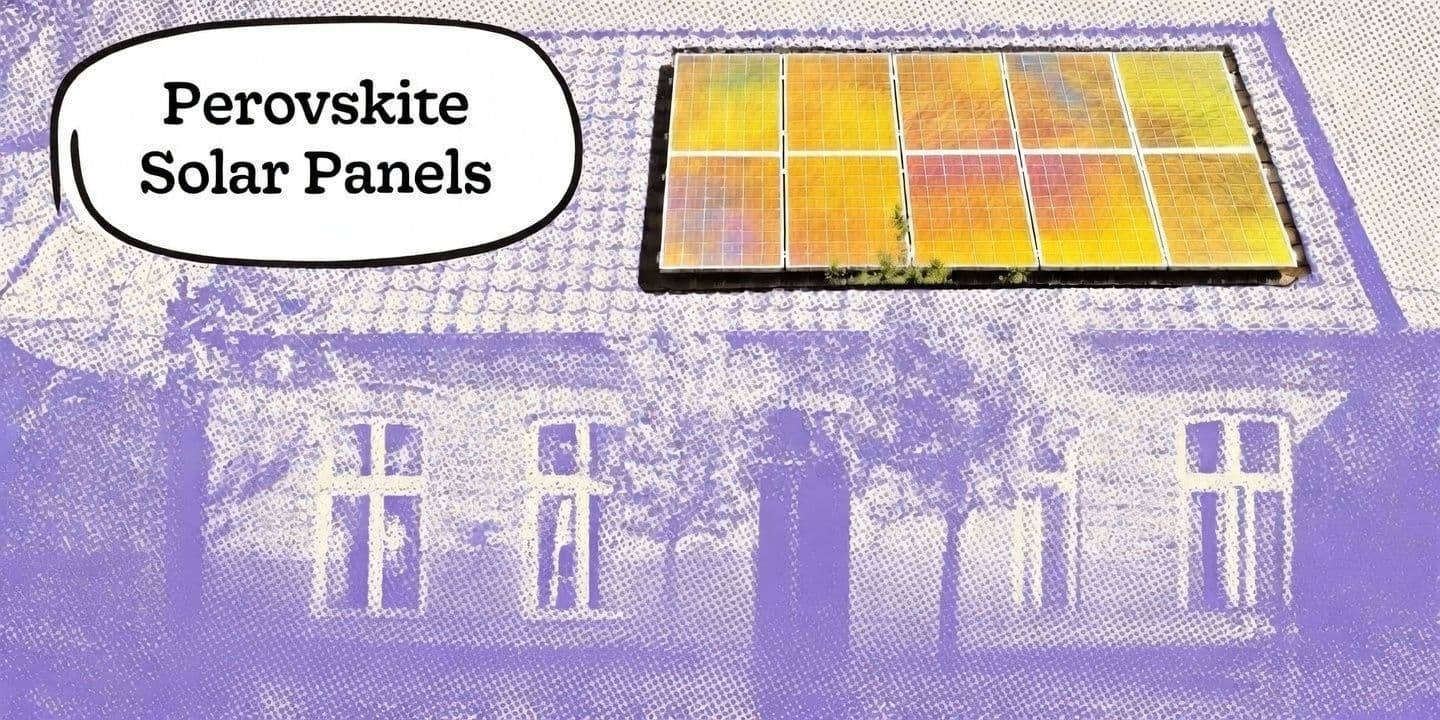

Perovskite solar panels are one of the most talked-about developments in solar tech right now.
- What are perovskite solar panels?
- Why scientists (and us Brits) are excited about perovskite
- The big problem: durability
- Perovskite vs traditional solar panels
- Are perovskite solar panels available yet?
- Will perovskite replace traditional solar?
- Should homeowners wait for perovskite panels?
- How efficient are perovskite solar panels?
- Pros and cons of perovskite solar panels
Why? Because they promise something pretty appealing: higher efficiencies, lower production costs, and potentially better performance than the silicon panels most homes use today.
Sounds great - but there’s a catch…
While researchers have been busy smashing lab records, perovskite solar panels are not yet a realistic option for most UK homeowners. Right now, they are still mostly confined to testing, pilot projects, and headlines about what could be coming next.
So, are perovskite panels genuinely the future of solar? Or are they still too early to matter if you are thinking about installing panels on your home today?
In this guide, we’ll cut through the hype, explain how perovskite solar panels work, how they compare with standard silicon panels, and whether they are actually worth waiting for.
PS We offer MCS-certified solar panel installation nationwide. Simply answer these questions, get your fixed price and arrange your free design.
What are perovskite solar panels?
Perovskite solar panels are one of the most exciting new developments in solar tech.
Most of the panels on UK roofs today use crystalline silicon - a proven and reliable technology that has dominated the market for years.
Perovskite solar cells use a semiconductor material with a distinctive crystal lattice structure that is highly effective at absorbing sunlight and converting it into electricity.
Because this structure captures a broader portion of the solar spectrum and allows efficient charge transport, it has attracted significant attention as a potential next-generation alternative to conventional silicon cells.
They can also be made in ultra-thin layers, giving them the potential to be lighter, cheaper, and more flexible than traditional panels.
That does not mean silicon is on the way out just yet, though.
Right now, the biggest opportunity is in tandem panels, where perovskite is combined with silicon to boost efficiency rather than replace it altogether.
So, while you cannot yet kit out your roof with perovskite panels as easily as standard solar, the technology is moving fast - and it could play a big role in the next generation of home solar.
Why scientists (and us Brits) are excited about perovskite
There is a good reason perovskite solar technology gets so much attention.
Put simply, it has the potential to make solar panels more efficient, cheaper to produce, and more versatile than the silicon panels most homes use today.
That efficiency point matters most.
Traditional silicon solar panels tend to operate in the 20% to 23% efficiency range, whereas perovskite technology - especially in tandem designs paired with silicon - has already produced much higher results in testing. In simple terms, that means more electricity from the same amount of sunlight.
For UK homes, that is a big deal. We are not exactly spoiled with endless sunshine, so any technology that can generate more power from limited daylight is naturally going to attract attention.
There is also real excitement around manufacturing.
Perovskite solar cells could eventually be made using simpler, lower-cost production methods than traditional silicon, which raises the possibility of cheaper solar panels in the future. They can also be made in lighter and thinner layers, which opens the door to new uses beyond standard rooftop systems.
That could include everything from building-integrated solar to more lightweight panel designs that are easier to install.
So, while perovskite panels are not yet ready to replace conventional solar on UK homes, the reason researchers are excited is pretty straightforward: the technology could push solar further, faster, and make it even more effective in the years ahead.
Related: What is the 33% rule with solar?
The big problem: durability
This is where things get tricky for perovskite solar panels.
They may offer huge promise on efficiency, but they still have a big weakness: they are not yet as durable as traditional silicon panels.
That matters a lot.
Standard silicon panels are popular for a reason - they are reliable, long-lasting, and built to handle decades of real-world weather.
Perovskite cells, on the other hand, have historically been more vulnerable to moisture, heat, and UV damage, which can shorten their lifespan.
So while lab results are impressive, homeowners need more than impressive lab results. They need solar panels that will keep performing year after year on a real roof in real weather.
That is why durability is still the biggest obstacle standing in the way of mainstream adoption.
The technology is improving fast, but until perovskite panels can prove the same kind of long-term reliability as silicon, they are still more of a future prospect than a practical rooftop option today.
Perovskite vs traditional solar panels
Let's compare apples to pears - or rather, perovskites to silicon.
Here's a no-nonsense table to make it crystal clear:
Feature | Perovskite Panels | Traditional Silicon Panels |
Efficiency potential | Sky-high (up to 34%+ in tandem) | Solid 20–23% typical |
Cost potential | Cheaper to make, once scaled | Affordable now, thanks to maturity |
Lifespan | Improving (aiming for 25+ years) | Proven 25–30 years |
Availability | Emerging - limited commercial in 2026 | Everywhere, ready for install |
Are perovskite solar panels available yet?
Sort of - but not in the way most homeowners mean.
Perovskite solar technology has started to move beyond the lab. Oxford PV, a UK-founded company, began commercial shipments of perovskite-on-silicon tandem panels in 2024, with its first products aimed at larger-scale customers rather than everyday domestic installs.
Its first market panels were reported at 24.5% module efficiency, and the company has also announced a 26.9% residential-size module efficiency result.
That is a big step forward, but it does not mean perovskite panels are widely available for UK homes yet.
At the moment, availability is still very limited, and most activity is happening through commercial deployments, pilot production, and manufacturer-led scale-up plans rather than mainstream residential sales.
Oxford PV itself says its near-term production will be allocated across utility customers, speciality products, and pilot residential applications while it works towards larger-scale manufacturing.
Other major manufacturers are moving in the same direction. Qcells announced a 28.6% certified efficiency for a commercially scalable perovskite-silicon tandem cell in late 2024, while LONGi has reported further tandem-efficiency progress in 2025.
So the short answer is this - yes, perovskite solar panels now exist in the real world - but no, they are not yet a normal off-the-shelf option for most UK homeowners.
For now, conventional silicon panels remain the practical choice if you want solar on your roof today. Perovskite is getting closer, but it is still early.
Will perovskite replace traditional solar?
Replace? Nah, more like upgrade.
The future's in tandem panels, layering perovskite on silicon to catch more sunlight wavelengths.
Oxford PV aims for 27% by 2027 and 30% by 2030 - ideal for the UK's variable light.
This hybrid approach boosts existing tech without binning it.
In Britain, where incentives like the Smart Export Guarantee reward extra generation, tandems could supercharge returns.
Should homeowners wait for perovskite panels?
Tempted to twiddle your thumbs? We get it - the allure of "better" tech is strong. But waiting could mean missing out on years of savings.
Current silicon panels are beasts: efficient, durable, and plummeting in price.
In the UK, with energy costs sky-high, installing now could cut bills by hundreds annually, plus capture government perks.
Why delay? Modern panels pay back in 6-10 years here, and with our solar panel installation guide. It's easier than ever.
Perovskites are exciting, but like waiting for the perfect weather - sometimes you just grab the umbrella and go.
How efficient are perovskite solar panels?
Efficiency is the main reason perovskite solar technology has generated so much excitement.
Most solar panels installed on UK homes today operate at around 20–23% efficiency, meaning they convert roughly a fifth of the sunlight that hits them into usable electricity.
That might sound low, but it is actually very good by solar standards and has improved steadily over the past decade.
Perovskite cells, however, have been moving forward at an unusually fast pace.
In laboratory settings, researchers have already demonstrated perovskite-silicon tandem cells exceeding 30% efficiency, which is a major leap compared with traditional panels.
The idea behind tandem panels is simple: combining two different materials allows the panel to capture a wider range of sunlight wavelengths, squeezing more electricity out of the same sunlight.
Commercial versions are naturally a bit lower than those lab results, but even the first perovskite-silicon modules entering early production are reporting efficiencies above 24–25%.
That might not sound like a huge jump at first glance, but in solar terms it is significant.
Higher efficiency means a system can generate more electricity from the same roof space, which is particularly useful in places like the UK where roof area and sunlight can both be limited.
That said, efficiency is only part of the story. Until perovskite panels can match silicon for long-term reliability, those impressive numbers remain more of a glimpse of the future than a practical upgrade for most homes.
Pros and cons of perovskite solar panels
Like most emerging technologies, perovskite solar panels come with both exciting advantages and a few big unanswered questions.
Pros:
Higher efficiency potential
Perovskite-based panels - especially tandem designs - have demonstrated significantly higher efficiency potential than traditional silicon panels.
Potentially lower manufacturing costs
Perovskite cells can be produced using simpler manufacturing processes, which could eventually make solar panels cheaper to produce at scale.
Lightweight and flexible designs
Because the active layers can be extremely thin, perovskite technology could enable lighter panels and new applications such as building-integrated solar or flexible solar surfaces.
Rapid technological progress
Few solar technologies have improved as quickly as perovskites. Efficiency records have climbed dramatically in just over a decade of research.
Cons:
Durability is still a challenge
Perovskite cells have historically struggled with long-term stability when exposed to moisture, heat, and UV radiation.
Limited real-world track record
Silicon panels have decades of proven performance. Perovskite panels are still building that real-world reliability data.
Not widely available yet
Despite impressive lab results, perovskite solar panels are not yet a mainstream option for homeowners.
Still developing commercially
Manufacturers are working to scale production, but widespread residential availability is likely still several years away.
The bottom line
Perovskite solar panels are the solar world's rising star - higher efficiencies, lower costs, and UK innovation leading the way via Oxford PV .
They're edging into commercial use in 2026, but for homeowners, silicon remains the sensible pick - proven, available, and ready to tackle your energy bills today.
When perovskites hit homes en masse, they'll elevate solar further.
Next Steps For Your Solar Journey:
When planning to install solar panels for your home, there are several important factors to consider. Make sure to refer to the following guides to help you make informed decisions:
To dive deeper into these topics, head over to our advice section, check out our YouTube channel for informative videos, or read a customer case study to see how others have benefited from their solar installation.
Get a Quote for Solar Today
Without boasting you should get your solar installed with us, here's why:
Thousands of Happy Customers: We boast an average score of 4.9 on Trustpilot, outperforming the market leader.
Which? Trusted Trader: Heatable is proudly recognised as a Which? Trusted Trader.
MCS Accredited: Our accreditation by the Microgeneration Certification Scheme (MCS) ensures high-quality standards.
Exclusive Panels: We offer REA Fusion solar panels, available only through Heatable.
Consumer Protection: As members of the HIES consumer code, we provide 2-year deposit protection.
Flexible Payment Options: Choose from multiple payment methods, including finance options.
Fixed Price Guarantee: Enjoy transparency with no hidden costs.
Save Your Quote: You can save your quote and decide later.
Bespoke Design Tool: Draw your own conclusion (literally) on whether solar is worth it for you, here.