
Solar panels are simple enough in theory - your roof generates electricity, your home uses it, and your energy bills become a bit less hideous.
Then someone mentions the 33% rule, and suddenly it sounds like solar panels come with terms and conditions.
Thankfully, it’s not that dramatic.
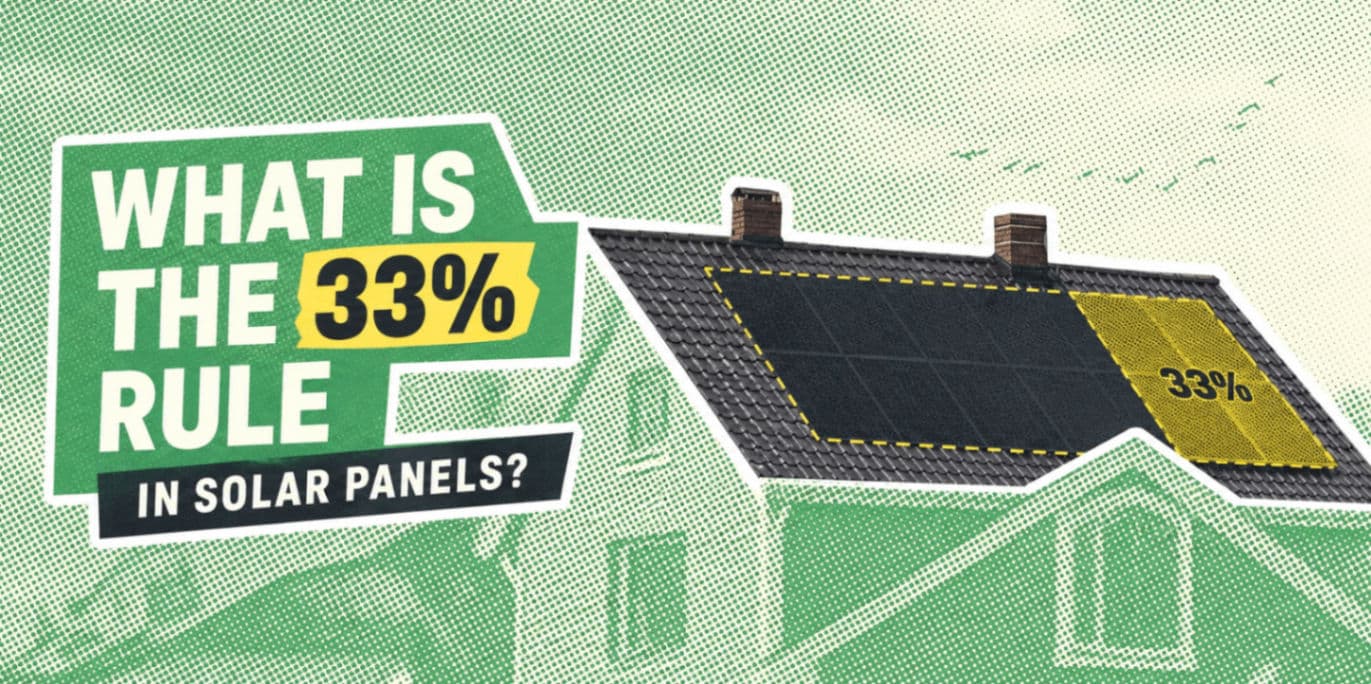
The 33% rule in solar panels is a rough rule of thumb about how much of your solar electricity you use at home, instead of sending it back to the grid.
In this guide, we’ll explain what the 33% rule actually means, why it matters for solar savings, and whether it’s something homeowners really need to worry about.
PS We offer MCS-certified solar panel installation nationwide. Simply answer these questions, get your fixed price and arrange your free design.
What does the 33% rule actually mean?
The 33% rule is really about self-consumption.
In normal-person English, that means how much of the electricity your solar panels generate is actually used in your home, rather than being exported back to the grid.
So, if your panels are busy producing electricity while you’re running the washing machine, charging your laptop, or boiling the kettle for your 14th tea of the day, that counts as self-consumption.
If your panels generate electricity and your home doesn’t need it at that moment, the excess is usually sent back to the grid.
For example, let’s say your solar panels generate 3,600 kWh of electricity in a year.
Annual solar generation | Used in the home | Exported to the grid |
3,600 kWh | 1,188 kWh | 2,412 kWh |
In this example, your home would use 1,188 kWh of solar electricity directly.
The remaining 2,412 kWh would be exported back to the grid.
That exported electricity is not necessarily wasted - you may be able to earn money from it through a solar export tariff.
But in most cases, the electricity you use at home is worth more, because it reduces how much power you need to buy from your supplier.
Not glamorous. Very useful.
Why does using your own solar electricity matter?
Because not all solar electricity is worth the same amount.
Annoying, but true.
Solar panels can save you money in two main ways:
1. They reduce how much electricity you need to buy from your supplier.
2. They let you export unused electricity back to the grid, usually through a solar export tariff.
The first one is usually worth more.
That is because the electricity you buy from the grid typically costs more than the amount suppliers pay you for exporting electricity.
So, when your panels generate electricity and your home uses it straight away, you avoid buying that electricity from your supplier.
Lovely.
When your panels generate electricity and your home does not need it, the excess is exported back to the grid.
You may still get paid for it, but usually at a lower rate than the saving you would have made by using it yourself.
That gap is why self-consumption matters.
And it is the whole point of the 33% rule.
It is basically saying: the more of your own solar electricity you use at home, the better the financial return is likely to be.
Not exactly thrilling dinner-party material, granted.
But useful when you are trying to make solar panels pay their way.
Is the 33% rule an official solar panel rule?
No.
The 33% rule is not an official solar panel rule.
It is not part of UK planning law, it is not an MCS requirement, and it is not a government target.
Your installer does not need to enforce it, and nobody is going to turn up at your door because your dishwasher missed the sunny bit of Tuesday.
The 33% rule is simply a financial rule of thumb.
It helps give homeowners a quick sense of whether a solar panel system is likely to generate enough usable electricity to make financial sense.
But it should not be treated as a pass-or-fail test.
You could use less than 33% of your solar electricity and still benefit from solar panels, especially if your export tariff is decent or your installation cost is competitive.
Equally, using 33% or more does not automatically guarantee a brilliant payback period.
The real answer depends on the full picture, including:
how much your system costs
how much electricity your panels generate
how much electricity your household uses
when you use electricity
your import electricity rate
your export tariff
whether you have battery storage
whether you have, or plan to get, an EV or heat pump
So yes, the 33% rule is useful.
But it is not magic.
Solar panels still require numbers, sadly.
Example: how the 33% rule works
Let’s put it into actual numbers, because “use one-third of your solar electricity” is helpful, but also slightly GCSE worksheet.
Imagine your solar panels generate 3,600 kWh of electricity per year.
Using the 33% rule, you would aim to use around one-third of that electricity directly in your home.
Solar electricity | Amount |
Total annual generation | 3,600 kWh |
Used at home, based on 33% | 1,188 kWh |
Exported to the grid | 2,412 kWh |
The 1,188 kWh used in your home reduces how much electricity you need to buy from your supplier.
The 2,412 kWh exported to the grid may earn you money through a solar export tariff.
Your actual savings depend on the gap between two things:
how much you pay to buy electricity from the grid
how much you are paid for exporting electricity back to the grid
That is why generic solar payback claims should be treated with a raised eyebrow.
A system that generates 3,600 kWh per year will not deliver the same savings for every household.
Same panels, same generation, different results.
Because the real money bit depends on how much of that electricity you actually use.
What affects whether you hit the 33% rule?
The biggest factor is timing.
Solar panels generate most of their electricity during daylight hours.
Which is helpful, obviously, because daylight is sort of their whole thing.
The problem is that many homes use most of their electricity in the morning and evening, when people are cooking, showering, watching TV, charging devices, or opening the fridge for the eighth time to see if dinner has magically appeared.
That mismatch is why some households export more solar electricity than they use.
You are more likely to use around 33% or more of your solar power if:
someone is home during the day
you run appliances during daylight hours
you use smart plugs or timers
you charge an EV at home while the sun is out
you have solar battery storage
your system is properly sized for your usage
your household uses a fair amount of electricity
You are less likely to hit 33% if the home is empty all day and you have no battery, smart controls, or flexible appliance habits.
That does not mean solar panels are a bad idea.
It just means the numbers need to be looked at properly before anyone starts making big promises about savings.
Annoying, yes.
But still better than guessing.
What if you use less than 33% of your solar electricity?
Using less than 33% of your solar electricity does not mean your solar panels are pointless.
It just means more of the electricity your panels generate is being exported to the grid, rather than being used directly in your home.
That can affect your savings.
Why? Because exported electricity is often worth less than the electricity you avoid buying from your supplier.
So, if you export most of your solar power, your payback period may be longer.
Not ideal.
Not disastrous either.
Solar panels could still be worthwhile if:
your installation cost is competitive
your roof gets plenty of usable sunlight
your export tariff is decent
your household electricity use may increase
you plan to get an EV or heat pump
you might add battery storage later
The 33% rule should be treated as a warning light, not a stop sign.
If your expected self-consumption is well below 33%, it is worth checking the numbers properly before going ahead.
But it does not automatically mean solar panels are a bad investment.
It just means the savings need a closer look.
Which, admittedly, is less exciting than “free electricity from the sky”.
But much more useful.
Next Steps For Your Solar Journey:
When planning to install solar panels for your home, there are several important factors to consider. Make sure to refer to the following guides to help you make informed decisions:
To dive deeper into these topics, head over to our advice section, check out our YouTube channel for informative videos, or read a customer case study to see how others have benefited from their solar installation.
Get a Quote for Solar Today
Without boasting you should get your solar installed with us, here's why:
Thousands of Happy Customers: We boast an average score of 4.9 on Trustpilot, outperforming the market leader.
Which? Trusted Trader: Heatable is proudly recognised as a Which? Trusted Trader.
MCS Accredited: Our accreditation by the Microgeneration Certification Scheme (MCS) ensures high-quality standards.
Exclusive Panels: We offer REA Fusion solar panels, available only through Heatable.
Consumer Protection: As members of the HIES consumer code, we provide 2-year deposit protection.
Flexible Payment Options: Choose from multiple payment methods, including finance options.
Fixed Price Guarantee: Enjoy transparency with no hidden costs.
Save Your Quote: You can save your quote and decide later.
Bespoke Design Tool: Draw your own conclusion (literally) on whether solar is worth it for you, here.