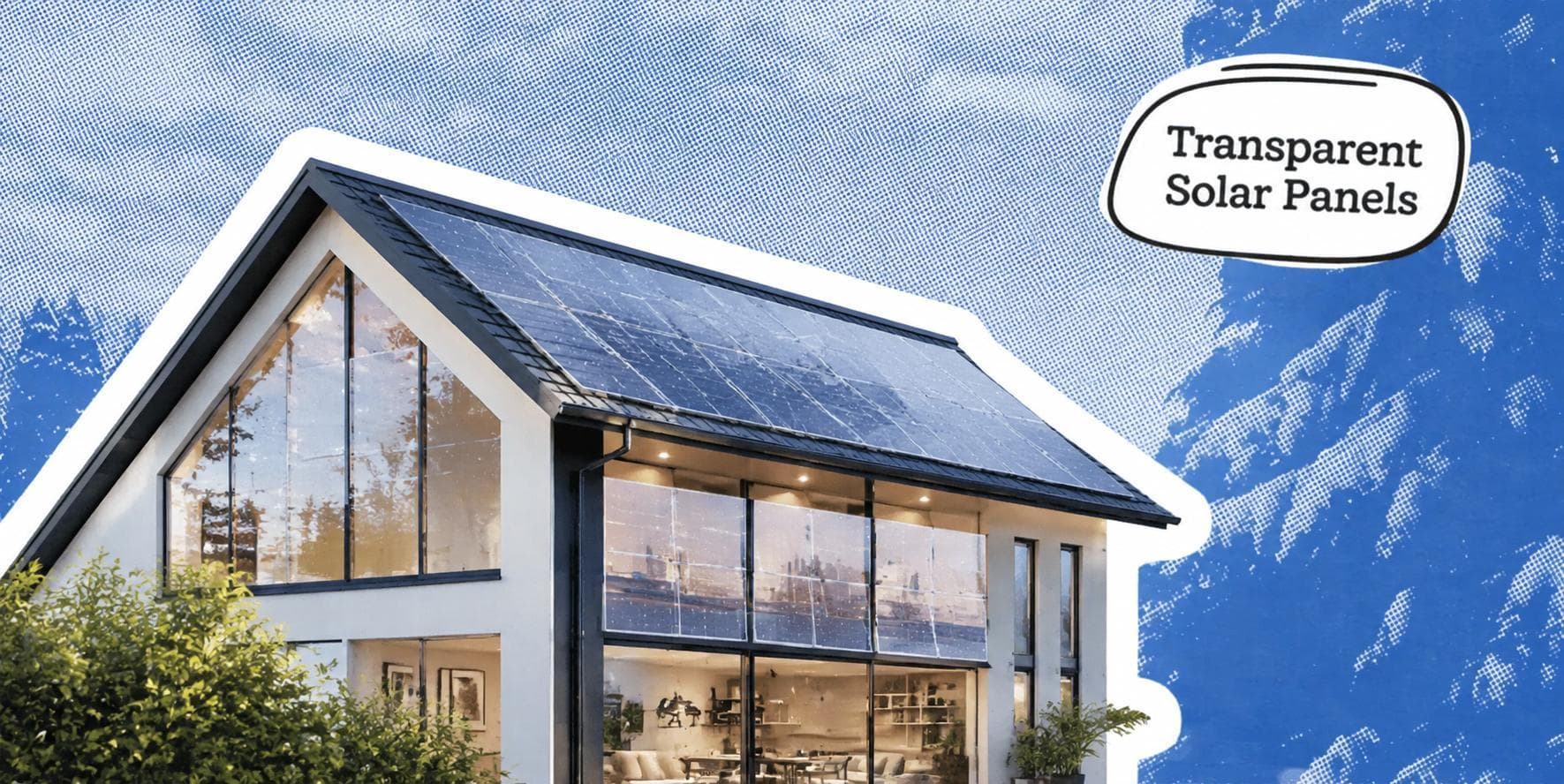

Imagine if your windows could do more than just let sunlight in. What if they could quietly turn that sunlight into electricity too?
- What are transparent solar panels?
- How do transparent solar panels work?
- Are transparent solar panels available in the UK?
- How much do transparent solar panels cost?
- Transparent solar panels vs normal solar panels
- Are transparent solar panels more energy efficient?
- Pros and cons of transparent solar panels
- Should you wait for transparent solar panels?
Transparent solar panels promise a future where your glass could help power your home - but are solar windows the next big thing, or just another bit of clever tech that sounds better than it works?
Solar panels have come a long way.
A few decades ago, the idea of powering your home with sunlight sounded a bit like something from a futuristic sci-fi film.
Now, thousands of UK homes have shiny panels sitting on their roofs, quietly saving money every time the sun decides to make an appearance.
But what if your roof wasn’t the only thing that could generate electricity?
What if your windows could help power your home too?
That is the idea behind transparent solar panels, also known as clear solar panels, invisible solar panels or solar windows.
The concept sounds almost too good to be true: glass that lets you see outside while also producing electricity.
But before you start planning a futuristic glass extension that looks like it belongs on a billionaire’s eco-home, there is a catch.
Transparent solar technology is exciting, but it is not quite ready to replace the solar panels you see on UK rooftops today.
So, are transparent solar panels the future of home energy, or are they still a few years away from becoming genuinely useful?
Let’s take a look…
PS We offer MCS-certified solar panel installation nationwide. Simply answer these questions, get your fixed price and arrange your free design.
What are transparent solar panels?
Transparent solar panels are a type of photovoltaic technology designed to generate electricity while allowing visible light to pass through.
Traditional solar panels work by absorbing sunlight using silicon solar cells.
They are essentially very efficient “sun sponges”, soaking up as much energy as possible and converting it into electricity.
Transparent solar panels take a different approach.
Instead of absorbing all visible light, they are designed to capture invisible parts of the light spectrum, such as ultraviolet and infrared wavelengths, while allowing normal light through.
The result?
A window that still looks like a window but can also generate electricity.
At least, that is the idea.
In reality, most transparent solar products today are not completely invisible. Many are better described as semi-transparent solar glass, with a slight tint or reduced clarity.
How do transparent solar panels work?
The tricky part is balancing two things:
Letting enough light through so the glass remains useful
Capturing enough sunlight to generate worthwhile amounts of electricity
And this is where transparent solar faces its biggest challenge.
A traditional solar panel is designed with one job: produce electricity.
A transparent solar window has two jobs: produce electricity and still function as a window.
It is a bit like asking your fridge to also be your oven. Technically possible, but one of the jobs will probably involve some compromises.
Research into transparent photovoltaic technology has consistently found a trade-off between transparency and efficiency.
The clearer the glass becomes, the less sunlight it captures and the less electricity it produces.
Are transparent solar panels available in the UK?
Yes, but not in the way many people imagine.
If you search “transparent solar panels”, you might expect to find a catalogue of products ready to install on your home tomorrow.
Unfortunately, we are not quite there yet.
Most transparent solar technology is currently aimed at:
Commercial buildings
Office blocks
Glass skyscrapers
Architectural projects
Solar façades
Specialist developments
For the average UK homeowner, transparent solar windows are still more of a “watch this space” technology rather than something you would ask your local installer to fit next week.
Which companies are making transparent solar panels?
Several companies are working to bring transparent solar technology into the mainstream.
Ubiquitous Energy - ClearView Power
Ubiquitous Energy is one of the most recognised names in transparent solar.
The company’s ClearView Power technology uses a transparent coating designed to absorb ultraviolet and infrared light while allowing visible light through.
The aim is simple:
Turn ordinary windows into electricity generators without making them look like solar panels.
The good bits:
Almost invisible appearance
Could integrate into normal architectural glass
Ideal for buildings where appearance matters
The not-so-good bits:
Not widely available to UK homeowners
Produces less electricity than normal solar panels
Still moving towards large-scale commercial use
The biggest opportunity is probably not your kitchen window.
It is huge glass buildings where thousands of square metres of windows currently sit there doing nothing more exciting than reflecting pigeons.
ClearVue Technologies - solar glass for buildings
Australian company ClearVue Technologies develops photovoltaic glass designed for buildings.
Rather than adding solar panels onto a structure, the glass itself becomes part of the energy system.
Potential applications include:
Windows
Skylights
Glass roofs
Building facades
Greenhouses
The company has tested its solar glazing technology in real-world environments, including buildings designed to measure energy performance.
The good bits:
Makes unused glass surfaces productive
Designed specifically for architecture
Could be valuable where roof space is limited
The not-so-good bits:
Currently aimed mainly at commercial projects
More expensive than normal glazing
Lower output than traditional solar panels
SolarWindow
SolarWindow is developing transparent electricity-generating coatings that could potentially be applied to glass surfaces.
The big idea?
A future where skyscrapers are covered in windows that generate electricity.
Considering some modern buildings have enormous glass facades, the potential energy gains could be significant.
The good bits:
Huge potential for cities
Minimal visual impact
Could transform existing glass buildings
The not-so-good bits:
Still developing commercially
Not a mainstream consumer product
Costs and long-term durability remain challenges
How much do transparent solar panels cost?
This is where things become a little less futuristic and a little more painful for your wallet.
Traditional solar panels have become affordable because manufacturers have spent decades improving production.
Transparent solar is still a specialist technology.
There is currently no simple “£X per panel” price.
Costs depend on:
The size of the glass
Transparency level
Whether it replaces existing windows
Installation complexity
Electrical connections
As a rough comparison:
Technology | Typical cost |
Traditional solar PV system | Around £6,000–£10,000 for many UK homes |
Solar roof tiles | Around £10,000–£20,000+ |
Transparent solar glass | Bespoke pricing, currently significantly higher |
For most homeowners, transparent solar is unlikely to win the financial argument today.
Transparent solar panels vs normal solar panels
So, the big question:
Are transparent solar panels better than normal solar panels?
Currently, no.
Traditional solar panels are still the champions when it comes to generating electricity cheaply.
Transparent solar is not trying to beat rooftop solar.
It is trying to make places that could never have solar before generate electricity.
Can transparent solar panels power a UK home?
Technically, yes.
Practically, probably not very well yet.
The problem is simple: homes have much more roof space than window space.
A typical solar installation might use 10–16 rooftop panels.
Replacing a few windows with transparent solar glass would produce nowhere near the same amount of electricity.
Where transparent solar becomes genuinely interesting is:
High-rise buildings
Office blocks
Large glass extensions
Commercial developments
A skyscraper with thousands of windows has a completely different opportunity compared with a three-bedroom semi-detached house.
Are transparent solar panels more energy efficient?
This is where things get more complicated.
Windows are not just there to let light in. They also affect:
Heat loss
Solar heat gain
Insulation
Heating demand
A badly designed solar window could generate electricity but increase heating costs.
Research has shown that transparent photovoltaic windows can improve building energy performance in some situations, but the results depend heavily on climate, building design and window orientation.
For the UK, where heating demand is significant, this balance is particularly important.
Pros and cons of transparent solar panels
Advantages
They look much better
Let’s be honest: not everyone loves the look of solar panels.
Some homeowners want cheaper energy but do not want their Victorian terrace or carefully designed extension covered in panels.
Transparent solar could offer a much more discreet option.
They unlock new solar space
Millions of square metres of glass receive sunlight every day but generate no electricity.
Transparent solar could change that.
They could transform future buildings
Imagine buildings where:
Windows generate electricity
Roofs generate electricity
Walls generate electricity
Batteries store the energy
That future is exactly what researchers and companies are working towards.
Disadvantages
Lower efficiency
This is the big one.
Traditional solar panels win because they are designed purely for energy production.
Transparent solar has to compromise.
Higher costs
Right now, you are paying for cutting-edge technology rather than the cheapest electricity possible.
Limited availability
Most UK solar installers currently specialise in traditional PV systems, not solar windows.
Still relatively unproven
Traditional solar panels have decades of performance data.
Transparent solar is still finding its place.
Should you wait for transparent solar panels?
For most UK homeowners, no.
If your goal is to reduce energy bills, installing traditional solar panels, ideally combined with battery storage, is still the sensible choice.
Transparent solar is exciting because it could change how buildings generate energy.
But it is unlikely to replace rooftop solar.
The future probably is not that transparent solar instead of normal solar, it’s transparent solar alongside normal solar.
One day, your windows, roof, walls and other surfaces could all contribute towards powering your home.
But for now?
The humble rooftop solar panel remains the boring-but-brilliant winner.
And sometimes, boring is exactly what you want when it is saving you money.
Next Steps For Your Solar Journey:
When planning to install solar panels for your home, there are several important factors to consider. Make sure to refer to the following guides to help you make informed decisions:
To dive deeper into these topics, head over to our advice section, check out our YouTube channel for informative videos, or read a customer case study to see how others have benefited from their solar installation.
Get a Quote for Solar Today
Without boasting you should get your solar installed with us, here's why:
Thousands of Happy Customers: We boast an average score of 4.9 on Trustpilot, outperforming the market leader.
Which? Trusted Trader: Heatable is proudly recognised as a Which? Trusted Trader.
MCS Accredited: Our accreditation by the Microgeneration Certification Scheme (MCS) ensures high-quality standards.
Exclusive Panels: We offer REA Fusion solar panels, available only through Heatable.
Consumer Protection: As members of the HIES consumer code, we provide 2-year deposit protection.
Flexible Payment Options: Choose from multiple payment methods, including finance options.
Fixed Price Guarantee: Enjoy transparency with no hidden costs.
Save Your Quote: You can save your quote and decide later.
Bespoke Design Tool: Draw your own conclusion (literally) on whether solar is worth it for you, here.