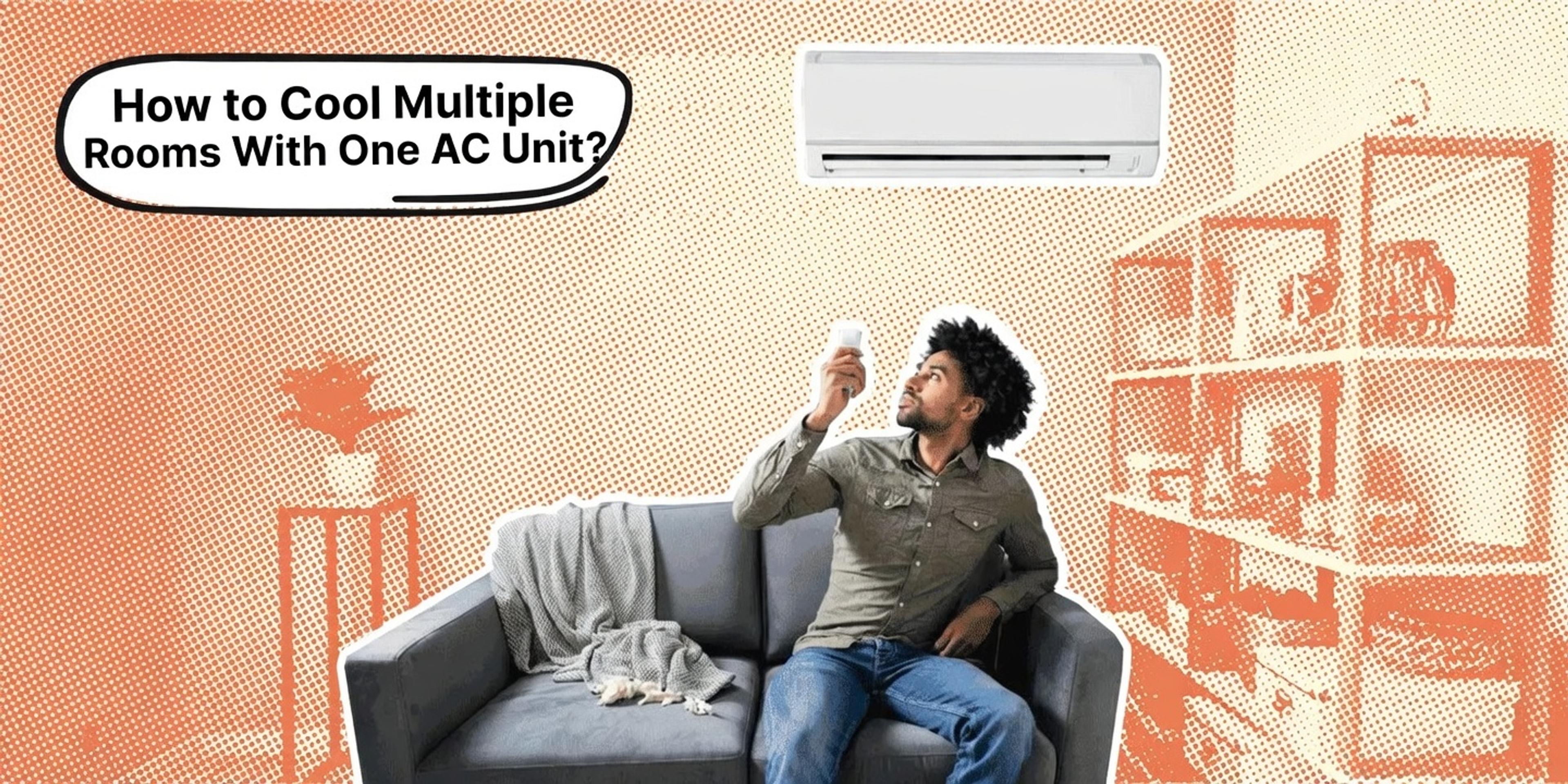

As hotter weather becomes a more regular part of UK summers, more homeowners and renters are looking for simple ways to keep their homes cool and comfortable. One question comes up time and again: can a single AC unit cool more than one room?
- Can one air conditioner cool multiple rooms?
- What affects whether one unit can cool more than one room
- The main ways to cool multiple rooms with one system
- Portable air conditioners for multiple rooms – and why they have limits
- Tips to improve cooling across several rooms
- Situations where one AC unit usually will not be enough
- What setup is best for different home types
In many cases, the answer is yes.
But it depends on the layout of your home, the type of air conditioning system you choose, and how effectively you use it.
A well-planned split or multi-split system can cool several connected spaces without the need for a separate unit in every room. That could include a living room, kitchen, bedroom, or home office. Portable air conditioners, on the other hand, are usually far less effective beyond one room.
This guide looks at the most realistic ways to achieve multi-room cooling in a typical UK home, whether you live in a compact flat, a terraced house, or a two-storey property.
You’ll find out which options work best, where the limitations are, and when it may be worth considering a different setup.
Ready to beat the heat and get cool? Find out exactly what size air conditioner you need and get a fixed price in seconds here.
🔑 Key points:
One AC unit can cool multiple rooms, but it depends on your layout and system type.
Single-split systems work best in open-plan spaces.
Multi-split systems are usually the best option for cooling separate rooms.
Ducted systems can cool a whole home but are less common in UK properties.
Portable AC units are best for single-room use, not multi-room cooling.
Room size, airflow, insulation, stairs, and sun exposure all affect performance.
Open-plan homes are easier to cool than closed-off or multi-storey layouts.
Fans, open doors, closed blinds, and sealed draughts can improve results.
One unit is usually not enough for two-storey homes or homes with many regularly used rooms.
For most UK homes, a multi-split system offers the best balance of comfort, efficiency, and flexibility.
Can one air conditioner cool multiple rooms?
Yes, but not every type of air conditioner is suited to the task.
A single-split system can work well in open-plan downstairs spaces, where cool air can move more freely between connected areas.
For separate rooms, a multi-split system is usually the most practical option.
This setup uses one outdoor unit connected to several indoor units, allowing you to cool different rooms more effectively from one main system.
Ducted air conditioning can cool an entire home, but it is less common in existing UK properties because it requires space for ductwork and is typically more complex to install.
Portable air conditioners are the least effective choice for cooling multiple rooms. They are designed for single-room use and tend to lose efficiency quickly once you try to spread cool air beyond the space they are in.
What affects whether one unit can cool more than one room
Several practical factors determine how effectively cool air can move through your home and how far a single unit can realistically reach.
[1] Room size and total cooling load
The size of the area matters most.
A typical 2.5–3.5 kW wall-mounted unit can usually cool a space of around 15–25 m² comfortably.
Try to stretch that across two or three rooms with a combined area above 40 m², and you are likely to end up with uneven temperatures and weaker performance.
[2] Layout and airflow
Cool air travels best through open, connected spaces.
Open-plan living areas, wide hallways, and rooms with doors left open give it a much better chance of circulating naturally.
By contrast, narrow corridors, closed fire doors, and awkward L-shaped layouts tend to restrict airflow and create warm spots.
[3] Insulation and draughts
A well-insulated home will hold on to cool air far more effectively.
Insulated walls, loft space, and modern windows all help maintain a steady indoor temperature.
In older terraced homes or flats with single glazing, gaps, draughts, and thinner building materials can let cool air escape much more quickly.
[4] Doors, hallways, stairs, and ceiling height
The shape and structure of your home also make a difference.
Standard UK ceiling heights of around 2.4 metres are generally manageable, but high ceilings in loft conversions or older Victorian properties increase the volume of air that needs to be cooled.
Stairs can also work against you, drawing warm air upwards and making upstairs rooms harder to cool from a unit located downstairs.
[5] Sun exposure and upstairs heat build-up
Some rooms simply get hotter than others.
South-facing spaces and upstairs bedrooms often hold on to heat for longer, especially in semi-detached and terraced homes where roofs absorb strong afternoon sun.
In these conditions, a single downstairs unit will usually struggle to cool the top floor without extra support.
The main ways to cool multiple rooms with one system
Single-split AC for open-plan spaces
A single-split system, with one indoor unit connected to one outdoor unit, works best in open-plan kitchens, dining areas, and living spaces in flats or smaller homes.
It provides powerful, quiet cooling for one main zone and is often the simplest way to improve comfort without overcomplicating the setup.
You can usually expect good results in spaces up to around 30–35 m², especially when doors are left open and airflow is not obstructed.
In a modern flat or compact house, this can be the most practical and cost-effective answer to the question of whether one air conditioner can cool multiple rooms.
Multi-split systems
A multi-split system is usually the best option when you want to cool several separate rooms while keeping independent control over each one.
With this setup, a single outdoor unit connects to two, three, or even five indoor units placed in different rooms around the home.
That means you can cool the living room, kitchen, and bedrooms from one main system while setting each room to a different temperature.
This type of ductless air conditioning is especially popular in UK homes because it avoids the disruption and space requirements of ductwork.
Ducted or whole-home systems
Ducted air conditioning is designed to cool the whole home more evenly, with the main equipment hidden in the ceiling or floor and conditioned air delivered through discreet vents.
It can be an excellent solution in new builds, loft conversions, or major renovation projects where the system can be planned in from the start.
However, it is usually more expensive and more complex to install in existing terraced, semi-detached, or older properties, where adding ductwork can be disruptive and space is often limited.
Portable air conditioners for multiple rooms – and why they have limits
Portable air conditioners are easy to move and do not require permanent installation, which makes them appealing at first. The problem is that they are not really built for multi-room cooling.
Because the unit needs an exhaust hose to vent hot air outside, it can only cool the room it is actually in. A fan may help push some cooler air into a neighbouring space, but the effect is usually limited.
The further the air has to travel, the weaker the cooling becomes, and the more energy the unit tends to use.
For that reason, portable models are best seen as a short-term or single-room solution rather than a true multi-room system.
Tips to improve cooling across several rooms
You can stretch the performance of any system with a few low-cost habits:
Use fans to move cool air - place a fan near the doorway of the cooled room to push air into the hall or next room. A second fan further along can help keep it moving.
Keep doors open - cool air needs space to circulate. Closed doors can stop it from reaching the rooms beyond.
Shut blinds or curtains during the day- blocking direct sun helps rooms stay cooler, especially in south-facing spaces.
Seal draughts - gaps around windows and doors let cool air escape, which makes your system work harder.
Focus on the rooms you use most - it is usually better to cool the spaces you are actually using rather than trying to chill the whole house at once.
Make small changes that add up - these simple habits can turn a home that feels slightly cooler into one that feels properly comfortable.
Situations where one AC unit usually will not be enough
One AC unit can only do so much. In some homes, asking it to cool every room evenly is simply unrealistic.
It will usually struggle if:
you want to cool upstairs and downstairs at the same time in a two-storey home
your property has more than four separate rooms in regular use
insulation is poor and the house gains heat quickly, which is common in older UK homes
you want different temperatures in different rooms
In these situations, it is often more practical to install a second system or choose a multi-split setup from the start.
What setup is best for different home types
Flats
A single-split or small multi-split system is often enough for open-plan living and one or two bedrooms.
The main limitation is usually outdoor unit space, so it is worth checking any lease or freeholder rules before going ahead.
Small houses, terraced homes, and semi-detached homes
For many of these properties, a multi-split system is the sweet spot.
It can cool the main living space along with one or two bedrooms, and usually suits the layout without major disruption.
Two-storey homes
Cooling both floors with one unit is difficult.
Warm air rises, which means upstairs rooms are usually the hardest to keep comfortable.
In most cases, the best solution is a multi-split system with units on both floors, or a downstairs single-split paired with a separate upstairs unit.
Loft conversions and home offices
These spaces often need their own indoor unit, especially if they heat up quickly or are used for long periods.
If you already have a multi-split system, extending it is often more cost-effective than starting again with a separate setup.
Cost vs efficiency considerations
Portable units are the cheapest to buy, usually costing between £150 and £800, but they are also the least efficient and the least effective for cooling more than one room.
A professionally installed single-split system usually starts at around £1,500 to £2,500 including VAT. For many homes, it is the most affordable fixed option if you mainly want to cool one larger area.
A multi-split system for two to four rooms typically costs between £3,000 and £7,500 installed, depending on the number of indoor units and how complex the pipework is.
While the upfront cost is higher, running costs are usually lower than portable units because split systems are far more efficient.
It is also worth remembering that systems containing refrigerant gas must be installed professionally. A good installer will not just fit the unit properly, but also help you choose the right capacity and positioning for your home.
Final verdict on how to cool multiple rooms with one AC unit
For most UK homes, a multi-split system offers the best balance of comfort, efficiency, and flexibility.
It lets you cool several rooms from one outdoor unit without the cost and disruption of full ductwork.
A single-split system can work very well in open-plan spaces, while portable units are really only suited to occasional use in one room at a time.
The right choice comes down to your layout, your budget, and how many rooms you genuinely need to keep cool on a regular basis.
Next Steps For Your AC Journey:
When planning to install air conditioning for your home, there are several important factors to consider. Make sure to refer to the following guides to help you make informed decisions:
To dive deeper into these topics, head over to our advice section, check out our YouTube channel for informative videos.
Get a Quote for Air Conditioning Today ❄️
Here’s why homeowners choose us:
Thousands of Happy Customers: We have an average score of 4.9 on Trustpilot, outperforming the market leader.
Which? Trusted Trader: Heatable is proudly recognised as a Which? Trusted Trader.
FGAS Certified: Our FGAS certification ensures all air conditioning work is carried out to the required industry standards.
Flexible Payment Options: Choose from multiple payment methods, including finance options.
Fixed Price Guarantee: Enjoy transparency with no hidden costs.
Save Your Quote: Save your quote and come back to it whenever you’re ready.