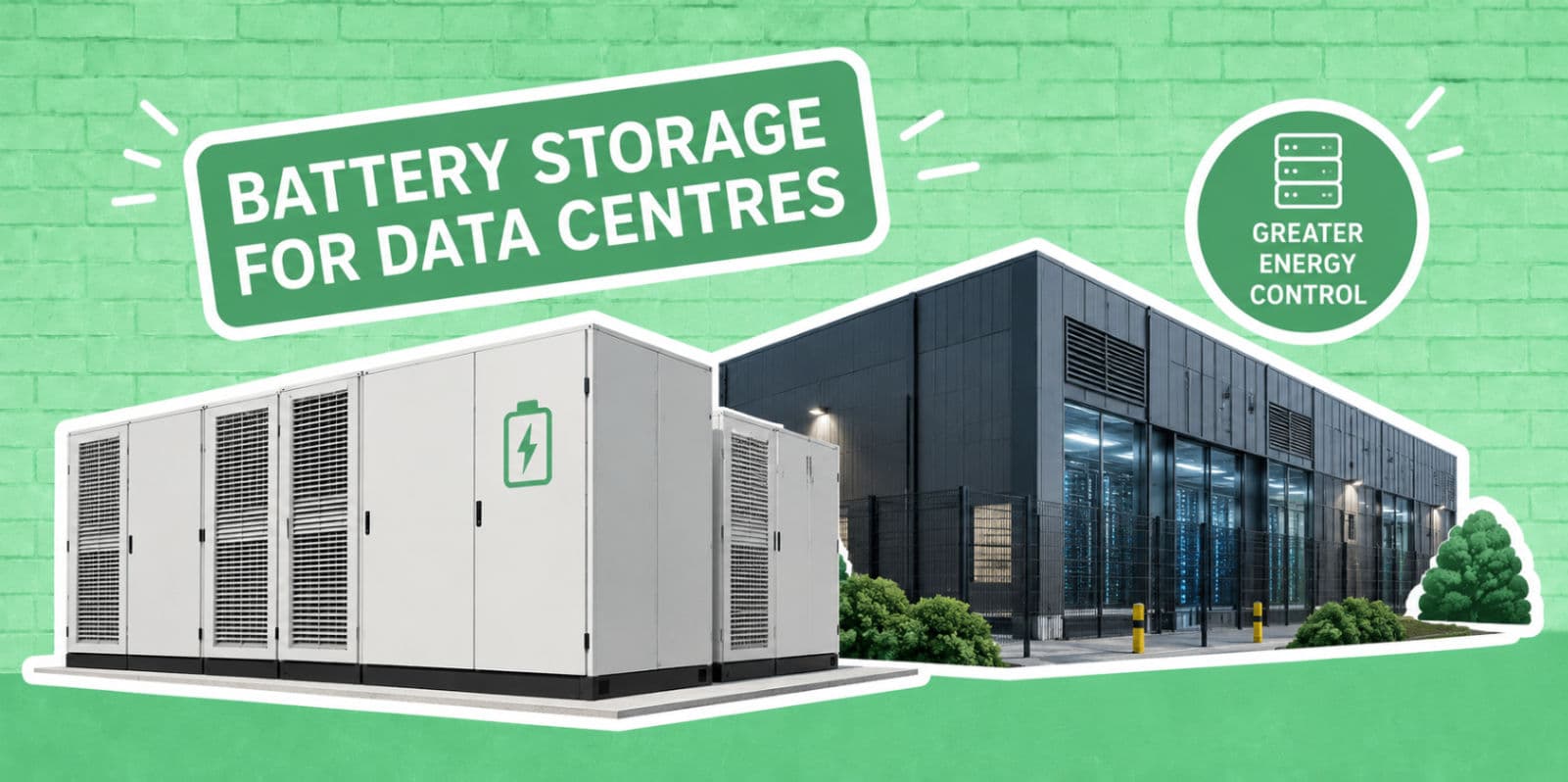

Battery storage can help data centres cut peak demand, use cheaper electricity and add extra resilience. Here’s how it works and where it fits.
- What is battery storage for data centres?
- BESS vs UPS: what's the difference?
- Can batteries help data centres become more flexible?
- Can data centre batteries provide backup power?
- How big does a data centre battery need to be?
- What battery technologies are used in data centres?
- How much does data centre battery storage cost?
- What about battery degradation?
Data centres don't exactly sip electricity.
Servers, cooling systems, networking equipment and backup infrastructure all need power, usually 24 hours a day.
And with AI pushing computing demand even higher, getting enough electricity into a data centre is becoming almost as important as what happens inside it.
Battery storage can help.
A Battery Energy Storage System, or BESS, can store electricity and discharge it when it's needed, giving data centre operators another way to manage energy costs, peak demand, grid constraints and resilience.
So where does battery storage fit into a modern data centre?
ℹ️ Talk to Heatable about commercial battery storage and see what could work for your business.
What is battery storage for data centres?
A Battery Energy Storage System stores electricity so it can be used later.
For a data centre, that could mean charging the battery:
When grid electricity is cheaper
When on-site solar is generating
When demand across the site is relatively low
When renewable electricity is particularly abundant
The battery can then discharge when electricity prices rise or site demand increases.
At first glance, that might sound fairly similar to a traditional UPS.
It isn't quite the same thing.
BESS vs UPS: what's the difference?
Data centres have used batteries for years.
Uninterruptible Power Supply systems are designed primarily to keep critical equipment running when the mains electricity supply fails.
They bridge the gap between losing grid power and backup generators starting, or provide enough time for equipment to shut down safely.
A BESS usually has a broader job.
It can be used for:
Energy storage
Peak shaving
Load shifting
Renewable energy storage
Grid flexibility
Backup power
Supporting existing UPS infrastructure
There can also be some crossover between the two.
Modern data centre battery systems are increasingly being designed to do more than simply sit waiting for a power cut.
That matters because a battery that's already sitting on site may be able to earn its keep during normal operation too.
Why battery storage matters for data centres
The main problem is pretty obvious: data centres need a lot of electricity, and they need it reliably.
The UK is also seeing a sharp increase in applications for new data centre grid connections.
Ofgem reported in July 2026 that demand connection applications had risen from 41GW to 125GW in less than a year, with data centre projects accounting for at least 80GW of that pipeline.
That doesn't mean every one of those projects will be built.
It does show just how quickly electricity demand from the sector is growing.
Battery storage can help operators make better use of the grid connection they already have.
Peak shaving
One of the most useful jobs for a data centre battery is shaving short periods of high electricity demand.
Say a site's normal demand sits at 8MW but occasionally jumps to 10MW.
Instead of importing the full 10MW from the grid, a battery could discharge during the peak and cover part of the additional load.
The grid sees a flatter demand profile.
For the operator, that can help reduce exposure to certain demand-related electricity costs and may also reduce pressure on the site's connection capacity.
The exact financial benefit depends on the electricity contract, network charges and how the site operates.
Load shifting
Battery storage can also move electricity consumption from one time of day to another.
If electricity is cheaper overnight, for example, a battery can charge then and discharge during a more expensive period.
The servers don't know the difference.
They're still getting electricity.
You've just changed when some of that electricity was bought.
Whether this works financially depends on the difference between electricity prices, battery efficiency, degradation and how frequently the system is cycled.
Making better use of renewable electricity
Battery storage can also work alongside renewable generation.
A data centre with on-site solar could store excess electricity rather than exporting it immediately.
The stored energy can then be used later when solar output falls.
For very large data centres, on-site solar alone is unlikely to cover anything close to total demand, simply because the electrical load can be enormous.
But battery storage can still help make better use of whatever renewable generation is available.
The same principle also applies where operators are trying to match electricity consumption more closely with periods of abundant renewable generation on the wider grid.
Battery storage and grid constraints
This is becoming a particularly interesting issue for data centres.
Getting a large new grid connection isn't always quick or easy.
And adding more electrical capacity to an existing site can involve expensive network upgrades.
Battery storage doesn't magically create extra electricity.
But it can help manage how much power the site draws from the grid at any one time.
If a data centre can reduce peaks or temporarily supply part of its own demand, it may be able to operate more flexibly within an existing connection.
That's likely to become increasingly valuable as data centre demand grows.
Can batteries help data centres become more flexible?
Yes, and this is starting to move beyond theory.
In March 2026, National Grid and a group of technology companies carried out a UK trial showing that an AI computing cluster could reduce its electricity demand by more than a third in under a minute without disrupting critical workloads.
The trial wasn't simply about batteries, but it points towards a much wider change in how data centres could interact with the electricity system.
Instead of behaving as a completely fixed load, future sites could combine:
Battery storage
Workload management
Flexible cooling
On-site generation
Smart energy controls
That could allow a data centre to respond to what's happening on the grid rather than drawing the same amount of electricity regardless.
For an industry that has historically prized absolute consistency, that's quite a shift.
Can data centre batteries provide backup power?
Yes, but the design matters.
A BESS can potentially support a data centre during a grid outage, but it shouldn't automatically be treated as a replacement for a traditional UPS or standby generator.
Data centres normally use several layers of resilience.
A typical setup might combine the grid, a UPS, battery storage and a backup generator, with each one stepping in when needed.
A larger BESS could sit alongside parts of that system and provide additional stored energy.
How useful that is depends on:
Battery capacity
Maximum output
Required runtime
Generator configuration
UPS design
Redundancy requirements
Critical and non-critical loads
Running a 20MW data centre for several hours is very different from keeping it alive for thirty seconds while generators start.
The required battery size changes dramatically.
How big does a data centre battery need to be?
There isn't a sensible standard size.
Two figures matter most.
MW
Megawatts tell you how much power the battery can deliver at once.
This determines how much of the data centre's load the battery can support.
MWh
Megawatt-hours tell you how much energy the battery can store.
This determines how long it can keep supplying that power.
For example, a 10MW / 20MWh battery could theoretically provide 10MW for around two hours, before allowing for operating limits and losses.
A data centre battery should normally be sized around things such as:
Site electrical demand
Peak demand
Required backup duration
UPS architecture
Generator capacity
Grid connection limits
Electricity pricing
Renewable generation
Planned future expansion
Buying more battery capacity than the site can realistically use doesn't automatically produce a better return.
What battery technologies are used in data centres?
Lithium-ion remains the most common technology for modern battery storage.
Within that category, different chemistries are available.
Lithium iron phosphate, or LFP, has become particularly common in stationary energy storage because of its cycle life and thermal characteristics.
Other technologies may also have a role, including:
Vanadium flow batteries
Sodium-ion batteries
Lead-acid batteries
Liquid-air energy storage
Other long-duration technologies
For conventional UPS systems, lead-acid batteries are still found across many existing data centres.
For larger energy storage applications, lithium-ion systems are much more common.
The right choice depends on what the battery is actually supposed to do.
How much does data centre battery storage cost?
There's no useful flat-rate answer.
A multi-megawatt battery installation is an infrastructure project, not something you price by browsing a product page.
Cost depends on:
MW output
MWh storage capacity
Battery chemistry
Inverters and power conversion
Transformers
Switchgear
Grid connection work
Cooling
Fire detection and suppression
Site preparation
Monitoring and control systems
UPS integration
Containerisation
Planning requirements
The economics should be considered across the full lifetime of the system.
That means looking at potential energy savings, avoided infrastructure costs, grid services, degradation and replacement requirements rather than comparing the upfront cost alone.
How can a data centre battery save money?
There are several possible routes.
Reducing peak electricity demand
The battery can discharge when the site's electricity consumption reaches its highest point.
Buying electricity at cheaper times
Energy can be stored when electricity is cheaper and used when prices rise.
Using more renewable electricity
On-site generation can be stored rather than exported or curtailed.
Delaying electrical upgrades
In some cases, managing peaks may reduce or delay the need for additional grid capacity or other electrical infrastructure.
Grid flexibility
Larger batteries may be able to participate in flexibility or balancing markets, subject to the site's setup and commercial arrangements.
Britain already relies heavily on battery storage to provide short-term flexibility to the electricity system.
The Government reported 7.5GW of grid-scale battery capacity at the end of 2025, with a further 2.3GW added during that year alone.
A behind-the-meter data centre battery operates differently from a standalone grid battery, but some of the same principles apply.
What about battery degradation?
Battery capacity doesn't stay fixed forever.
Every charge and discharge cycle contributes to degradation.
Temperature, depth of discharge, charging speed and battery chemistry all affect how quickly that happens.
For a data centre, this becomes particularly important if the same battery is expected to provide both:
Emergency backup
Day-to-day energy management
You don't want aggressive daily cycling to compromise the battery's ability to perform when there's an actual outage.
The control strategy needs to maintain enough reserve capacity while still allowing the system to be used commercially.
Are data centre battery systems safe?
They can be, provided they're properly designed and managed.
Large lithium-ion battery systems store a significant amount of energy in a relatively small space.
That means fire safety and thermal management need to be taken seriously.
Design considerations can include:
Battery chemistry
Fire detection
Fire suppression
Ventilation
Thermal monitoring
Cell-level monitoring
Separation distances
Emergency access
Automatic isolation
Battery management systems
The UK Government describes the fire risk from lithium-ion grid batteries as small but material and has continued to develop its approach to battery safety as deployment increases.
A data centre adds another complication: the battery is sitting next to some very expensive infrastructure.
Placement and compartmentalisation matter.
Do data centres need planning permission for battery storage?
Potentially.
Planning requirements depend on the location, physical scale and capacity of the battery installation.
Larger projects may also need input from the Distribution Network Operator, local planning authority and fire and rescue service.
Other considerations can include:
Grid connection agreements
Electrical protection
Noise
Fire safety
Environmental requirements
Access
Site security
For anything at multi-megawatt scale, these considerations need to be dealt with early rather than once the battery containers have already been ordered.
Can battery storage reduce reliance on diesel generators?
Potentially, but replacing generators entirely is harder.
Diesel generators can continue operating as long as there's fuel available.
A battery has a fixed amount of stored energy.
For short outages, battery storage may be able to reduce or avoid generator use.
For longer outages, generators can still provide much greater endurance.
A more realistic approach for many sites is to use batteries and generators together.
The battery can respond instantly, while the generator provides longer-duration backup.
Over time, alternatives such as hydrogen, renewable fuels and longer-duration storage may change that setup further.
Is battery storage worth it for data centres?
It can be, particularly where the battery has more than one job.
The strongest business cases are likely to be sites where storage can:
Reduce peak demand
Shift electricity consumption
Support grid-constrained connections
Store renewable energy
Improve resilience
Support UPS systems
Provide grid flexibility
Using a multi-million-pound battery exclusively for the occasional power cut can leave an expensive asset doing very little most of the year.
Letting it support normal site operation as well can change the economics considerably.
The trick is doing that without compromising resilience.
Data centre battery storage with Heatable
Data centres don't need generic battery systems.
They need something designed around the site's load, grid connection and resilience requirements.
At Heatable, we'd start with the electricity data.
That means looking at:
Base load
Peak demand
Half-hourly consumption
Grid capacity
Existing UPS systems
Backup generators
Electricity tariffs
Renewable generation
Planned expansion
From there, the battery can be sized around what the site actually needs.
No enormous battery installed simply because there's space for one.
No fantasy payback numbers.
Just a system designed around the data centre.