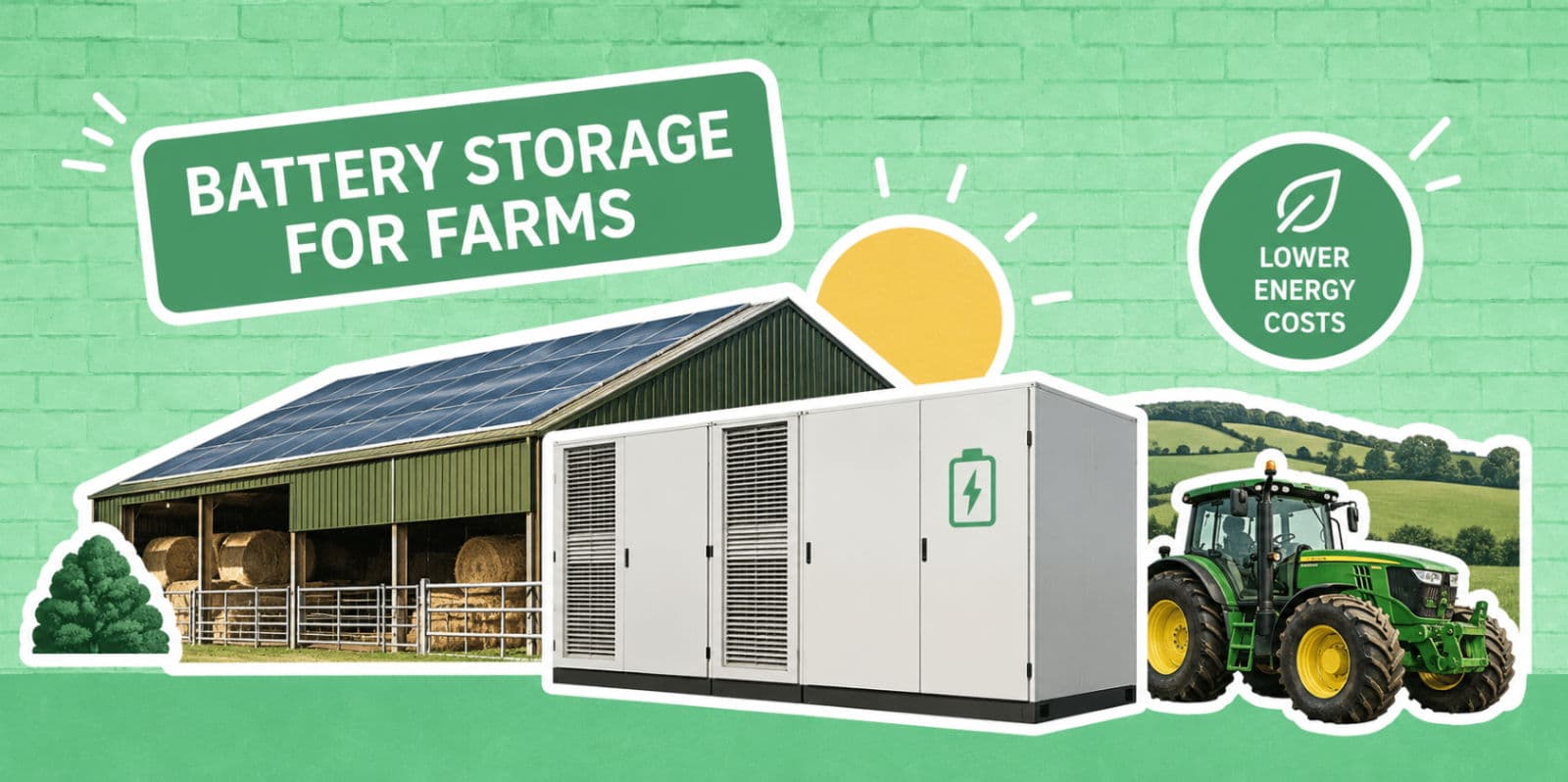

Farms are using more electricity than ever, and paying more attention to where it comes from. Battery storage can help you keep more of your own solar power, cut the amount you buy from the grid and make better use of cheaper electricity when it’s available.
- What is battery storage for farms?
- Why battery storage can work well on farms
- What can a farm battery be used for?
- Can farm batteries charge using cheap electricity?
- How much does farm battery storage cost?
- How much can a farm save with battery storage?
- Can a farm battery provide backup power?
- How long do farm batteries last?
- Can you add battery storage to existing farm solar panels?
Milking equipment, refrigeration, ventilation, irrigation, grain drying, lighting and processing equipment can all add up to a pretty hefty electricity bill.
And while solar panels can help bring those costs down, there's one obvious problem - your farm doesn't necessarily use the most electricity when the sun is out.
That's where battery storage systems shine.
A commercial battery lets you store electricity and use it later, whether that's surplus power from your solar panels or cheaper electricity bought from the grid.
For farms with high or predictable energy use, that can make battery storage well worth looking at.
ℹ️ Talk to Heatable about commercial battery storage and see what could work for your business.
What is battery storage for farms?
A farm battery works in much the same way as a home solar battery, only bigger.
Electricity is stored in the battery instead of being used straight away or exported back to the grid.
You can then use that stored electricity when your farm needs it.
Depending on the setup, a battery can be charged using:
Solar panels
Electricity from the grid
Other on-site renewable generation
A combination of different sources
Commercial systems can range from relatively small batteries for modest agricultural sites to much larger containerised systems capable of storing hundreds of kilowatt-hours of electricity.
The right option depends on how much electricity your farm actually uses, and when it uses it.
Why battery storage can work well on farms
Agricultural businesses can be a particularly good fit for battery storage.
That's mainly because farms often combine high electricity demand with large roof areas, plenty of solar potential and fairly predictable patterns of energy use.
You can use more of your own solar power
Agricultural buildings can be ideal for solar panels.
Barns, sheds, poultry houses and warehouses often have large roof areas capable of supporting sizeable commercial solar systems.
The problem is that solar panels produce most of their electricity during the day.
If your farm doesn't need all of that electricity at the time it's generated, the surplus is usually exported to the grid.
A battery gives you somewhere else to put it.
Instead of exporting excess solar power, you can store it and use it later in the day when your electricity demand increases.
That means more of the power generated on your roof stays on your farm.
ℹ️ Get renewable energy consultancy with Heatable experts
You can reduce electricity bought from the grid
The more electricity you can produce and store yourself, the less you may need to buy from the grid.
For farms with high electricity consumption, that can make a noticeable difference.
A battery can also be used to cover periods when your electricity demand is particularly high.
For example, a dairy farm might have a large spike in electricity use during milking.
Rather than meeting all of that demand from the grid, the battery can discharge at the same time and cover part of the load.
This is often referred to as peak shaving.
Not the most exciting name, but potentially a useful way of cutting costs.
What can a farm battery be used for?
The best use case depends on the type of farm you're running.
[1] Dairy farms
Dairy farms can use significant amounts of electricity, particularly around milking times.
Common electrical loads include:
Milking equipment
Vacuum pumps
Milk cooling
Refrigeration
Water heating
Lighting
If you've also got solar panels, a battery can store electricity generated during the day and make it available later when demand rises.
[2] Poultry farms
Poultry farms can have fairly consistent electricity demand thanks to ventilation, lighting, feeding equipment and environmental controls.
That can make them a good fit for solar and battery storage, particularly where electricity use continues into the evening or overnight.
[3] Arable farms
Energy use on arable farms can be more seasonal.
Grain drying, ventilation, irrigation and handling equipment can all create periods of high electricity demand.
Because that demand may change significantly through the year, proper system sizing is especially important.
A battery that looks perfect during harvest could spend the rest of the year twiddling its thumbs.
[4] Cold storage and food processing
Cold storage can be particularly energy hungry.
If your farm uses refrigeration, packing equipment or food-processing machinery, battery storage may help reduce how much electricity you need to import during expensive or high-demand periods.
[5] EVs and electric machinery
Electric vehicles and agricultural machinery are becoming more common.
That means farms are likely to see electricity demand increase as more vehicles, forklifts and equipment need charging.
Battery storage can help manage that extra demand without relying entirely on the grid at the same time.
Can farm batteries charge using cheap electricity?
Yes.
You don't necessarily need solar panels for a battery to be useful.
If your commercial electricity tariff gives you cheaper electricity at certain times of day, the battery can be charged during those periods and discharged later when electricity costs more.
For example, you could charge the battery overnight and then use that electricity during the day.
Whether that makes financial sense depends on:
Your electricity tariff
The difference between cheap and expensive rates
Battery efficiency
How often the battery is used
Battery degradation
Your farm's electricity demand
The cost of the system
This is why battery storage needs to be properly modelled rather than sold off the back of a brochure.
How big should a farm battery be?
Bigger isn't always better.
A commercial battery should be sized around your actual electricity use.
There are two figures you'll usually see when looking at battery systems:
kWh
Kilowatt-hours tell you how much electricity the battery can store.
A 200kWh battery can store up to 200kWh of energy.
kW
Kilowatts tell you how much power the battery can deliver at once.
That matters because a battery could have plenty of stored energy but still be unable to meet a large electrical load if its output is too low.
When sizing a battery for a farm, it's worth looking at:
Annual electricity consumption
Half-hourly electricity data
Peak electricity demand
Existing solar generation
Planned solar panels
Seasonal demand
Operating hours
Export limits
Future machinery or EV charging
The aim is to install a battery your farm will actually use, not simply the biggest one you can fit on site.
How much does farm battery storage cost?
There's no useful flat price for commercial battery storage.
The cost can vary considerably depending on the size of the battery and the work required to install it.
Things that can affect the price include:
Battery capacity
Power output
Battery chemistry
Inverters
Electrical upgrades
Switchgear
Monitoring equipment
Groundworks
Enclosures
Fire-safety requirements
Grid connection work
Solar integration
For commercial systems, the more useful question is usually whether the battery can generate a sensible return over its lifetime.
A cheap battery isn't much use if you've got no real use for the electricity stored inside it.
How much can a farm save with battery storage?
There's no single figure.
The savings depend almost entirely on how your farm uses electricity.
Battery storage can save money in a few different ways.
Using more solar power on site
If you've already got solar panels, storing excess electricity can increase the amount of solar power you use yourself.
That may be more valuable than exporting the electricity back to the grid.
Buying electricity when it's cheaper
If your electricity price changes throughout the day, a battery can potentially charge during cheaper periods and discharge when prices are higher.
Reducing peak demand
A battery can help cover short periods of high electricity use rather than drawing all of that power from the grid.
Dealing with export limits
Some sites are restricted in how much electricity they can export.
Battery storage can absorb some of the excess solar generation instead.
The key thing is to look at your own consumption data.
If someone gives you an exact payback period without seeing your electricity usage, take it with a fairly large pinch of salt.
Can a farm battery provide backup power?
It can, but only if the system has been designed for it.
Not every solar and battery installation will keep running during a power cut.
Standard grid-connected systems may shut down when the grid goes off.
If you want the battery to keep certain equipment running, that needs to be included in the system design.
For a farm, that could include:
Refrigeration
Ventilation
Milking equipment
Pumps
Lighting
Control systems
Backup power can be extremely useful, but it shouldn't be assumed to come as standard.
How long do farm batteries last?
Commercial batteries gradually lose capacity as they age and are charged and discharged.
Manufacturers usually provide warranties based on things such as:
Years of use
Number of cycles
Total energy throughput
Remaining usable capacity
It's worth looking beyond the headline battery size when comparing systems.
Warranty terms, usable capacity and expected degradation can all have a big impact on long-term value.
Are farm battery systems safe?
Battery storage needs to be installed properly.
Commercial systems can involve large amounts of stored electrical energy, so safety, location and system design all matter.
Depending on the size of the installation, considerations may include:
Battery chemistry
Ventilation
Fire detection
Emergency access
Thermal management
System monitoring
Separation distances
Larger battery systems may also be subject to additional planning and fire-safety requirements.
For example, planning guidance in England recommends early engagement with the relevant fire and rescue service for lithium-ion battery storage developments of 1MWh or more.
For most farms, the main point is simple: use an installer who knows what they're doing.
Do farms need planning permission for battery storage?
Sometimes.
The requirements depend on the size and location of the system.
You may need to consider:
Planning permission
Grid connection requirements
DNO approval
Export limits
Electrical upgrades
Fire-safety requirements
Larger commercial systems are naturally more involved than sticking a domestic battery in the garage.
Your installer should check these requirements as part of the design process.
Can you add battery storage to existing farm solar panels?
In many cases, yes.
If your farm already has solar panels, a battery can often be added to the existing system.
The installer will normally need to check:
Your existing inverter
Solar array size
Electricity usage
Export arrangements
Grid connection
Available electrical capacity
Battery size
Adding storage can be a good way to get more value from an existing solar system, particularly if you're currently exporting a lot of unused electricity.
Should farms install solar panels and batteries together?
Not always.
Sometimes solar panels on their own make more financial sense.
Sometimes solar and battery storage work better together.
And in some cases, it may make sense to install solar first and add a battery later.
It comes down to how much electricity you use and when you use it.
That's why a decent commercial solar design should start with your electricity data rather than a salesperson picking a system size out of thin air.
Is battery storage worth it for farms?
It can be.
Battery storage tends to make more sense on farms with:
High electricity use
Large solar installations
Regular periods of high demand
Evening or early-morning electricity use
Time-of-use electricity tariffs
Grid export restrictions
Plans to install EV chargers or electric machinery
A need for backup power
The strongest case is often where the battery is doing more than one job.
For example, the same system might store surplus solar electricity, reduce peak demand and provide backup power to important equipment.
That's when the numbers can start to look much more interesting.
Farm battery storage with Heatable
No two farms use electricity in exactly the same way.
So there's not much point selling every farm the same battery.
At Heatable, we'd start by looking at how much electricity you're using, when you're using it and whether you've already got solar panels in place.
From there, we can work out whether battery storage is likely to make financial sense and what size system would actually suit the site.
No pointless oversizing.
No made-up savings figures.
Just a system built around how your farm actually uses energy.