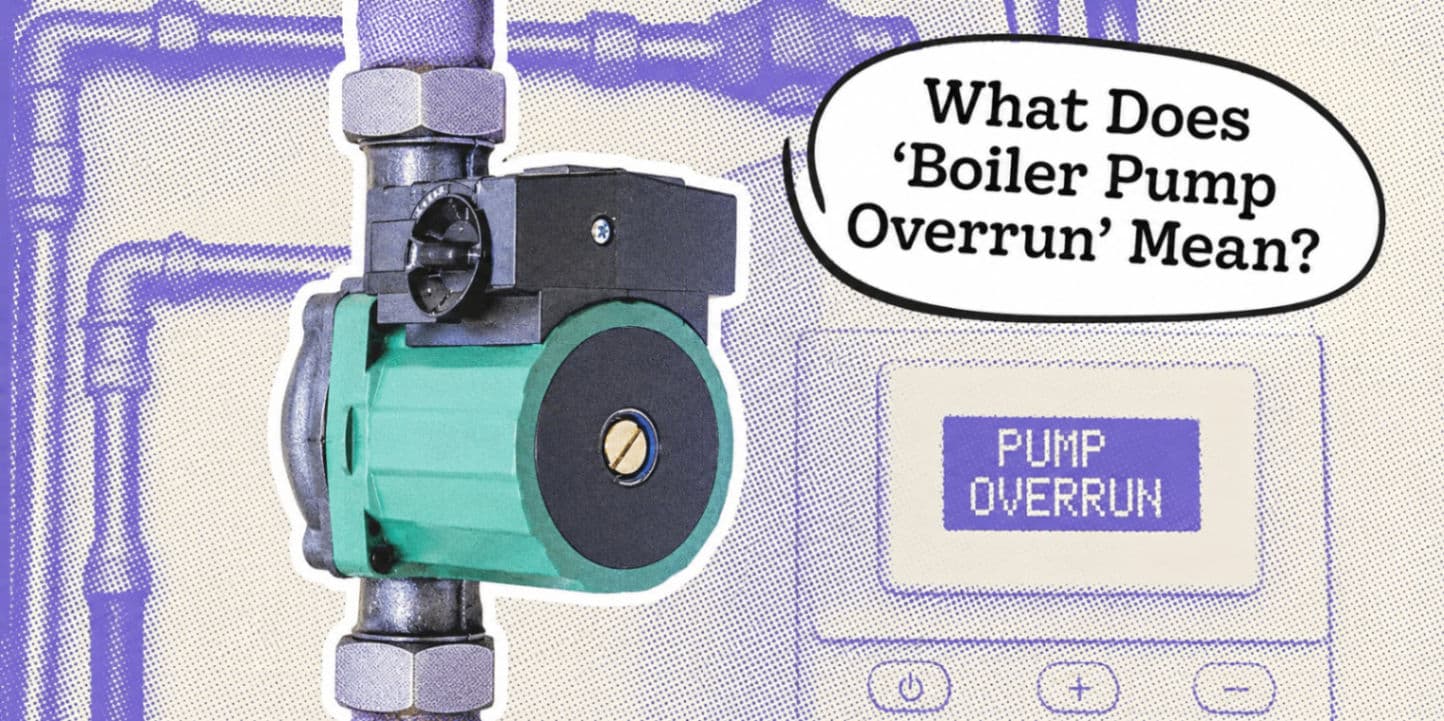

If your boiler is displaying “pump overrun”, or you can hear the pump running after the heating has gone off, it can look like something has gone wrong.
In many cases, it has not.
Boiler pump overrun is usually just your boiler finishing the job properly.
The burner has stopped, but the pump keeps circulating water for a short period to move leftover heat away from the boiler and around the system.
In other words, your boiler is not being dramatic. It is cooling itself down.
That said, pump overrun should not go on forever. If your boiler is stuck in pump overrun, the radiators are not heating properly, or the pump seems to run constantly, it may point to a fault with the pump, controls, valves, sensors, wiring or circulation.
Here is what boiler pump overrun means, why it happens, how long it should last, and when it needs an engineer.
Boiler old, unreliable and costing a fortune in repairs? Simply answer these questions, get your fixed price and you could get a new one installed as quick as tomorrow.
What is boiler pump overrun?
Boiler pump overrun is a built-in boiler function where the central heating pump continues running after the boiler’s burner has switched off.
The pump does this to circulate hot water through the boiler and heating system for a little longer.
This helps remove residual heat from the boiler’s heat exchanger, prevents heat from sitting in one place, and helps protect internal components from unnecessary thermal stress.
Think of it like a fan running after an oven or laptop has been switched off. The main heat source has stopped, but the system still needs a short cool-down period.
On many modern boilers, pump overrun is completely normal. You may see it displayed as “pump overrun”, “pump run-on”, “S.7”, “anti-cycling”, “cooling mode” or a similar manufacturer-specific message, depending on the boiler brand and model.
Why does pump overrun happen?
Pump overrun usually happens after your boiler has been producing heat for your radiators or hot water.
When the room thermostat or timer tells the boiler to stop heating, the gas burner switches off. However, the boiler itself is still hot.
The heat exchanger, pipework and water inside the boiler may still contain a lot of heat.
Rather than shutting everything down instantly, the boiler keeps the pump running to move that heat away safely.
This is especially useful after a longer heating cycle, after hot water use, or when the boiler has been working hard on a cold day.
In most cases, this is not a fault. It is a normal safety and efficiency feature.
How long should boiler pump overrun last?
Pump overrun usually lasts a few minutes. On some boilers it may be around three minutes.
On others, it may be closer to five or ten minutes, depending on the boiler model, temperature, system design and how much residual heat needs to be moved.
The exact overrun time is controlled by the boiler’s electronics and sensors. Some boilers use a fixed overrun period, while others allow the pump to run until the boiler temperature has dropped to a safe level.
So, if your boiler pump carries on for a short while after heating or hot water use, that is usually nothing to worry about.
However, if the pump runs for a very long time, runs constantly, or the boiler keeps showing pump overrun without actually heating the home properly, it is worth investigating.
Is pump overrun a boiler fault?
Not usually.
Pump overrun is often a normal boiler status, not an error code.
The confusion happens because it can appear on the boiler display in the same place you would expect to see a fault message.
A normal pump overrun might look like this:
The heating or hot water has just been on.
The burner switches off.
The pump continues running for a few minutes.
The boiler then goes quiet.
Heating and hot water work normally next time.
That is usually fine.
A problematic pump overrun might look like this:
The pump runs constantly.
The boiler gets stuck on a pump overrun message.
Radiators stay cold.
Hot water works but heating does not, or vice versa.
The boiler repeatedly starts, stops and enters overrun.
The boiler locks out or shows an overheating fault.
The system makes unusual noises, such as gurgling, humming, knocking or whining.
That is when pump overrun changes from “normal cool-down behaviour” to “possible symptom”.
Common causes of excessive pump overrun
If pump overrun lasts too long or keeps happening at odd times, there are several possible causes.
1. Residual heat in the boiler
This is the normal one. The boiler has been working, so the pump keeps running to remove leftover heat.
If the overrun only lasts a few minutes and everything else works, it is probably doing exactly what it should.
2. Poor circulation
If water cannot move around the system properly, the boiler may struggle to clear heat from the heat exchanger. This can make the pump run for longer than expected.
Poor circulation can be caused by sludge, airlocks, a blocked filter, partially closed valves, a sticking pump, blocked pipework or a restricted heat exchanger.
You might also notice cold spots on radiators, noisy pipework, slow heat-up times or the boiler cutting out.
3. A faulty or sticking pump
The pump itself may be weak, seized, sticking or running at the wrong speed.
A tired pump can make humming, buzzing or grinding noises. It may also get hot, fail to move water properly, or run without actually circulating enough water through the system.
4. Motorised valve or diverter valve problems
On some systems, valves control where hot water goes. For example, to the radiators, hot water cylinder or internal hot water circuit on a combi boiler.
If a valve sticks, fails to open properly, or sends the wrong signal back to the boiler, the boiler can behave oddly.
You may get hot water but no heating, heating when you only asked for hot water, or repeated pump overrun because the boiler is not seeing the right demand.
5. Thermostat, timer or wiring issues
Sometimes the boiler is not actually stuck in overrun. It is being told to keep running by a thermostat, programmer, receiver, wiring centre or control fault.
This is more common where smart thermostats, zone valves or older external controls are involved. The boiler may think there is still demand, even when the householder believes the heating is off.
6. Temperature sensor or PCB fault
The boiler uses sensors to judge temperature and decide when it is safe to stop the pump.
If a sensor is giving inaccurate readings, or the printed circuit board is misinterpreting those readings, the pump may run at the wrong time or for too long.
This is not a DIY diagnosis. It needs proper testing.
Why is my boiler pump running when the heating is off?
A boiler pump can run when the heating is off for several reasons.
The most likely reason is normal pump overrun. The heating demand has ended, but the boiler is still cooling itself down.
Some boilers also run the pump periodically as an anti-seize feature. This helps stop the pump from sticking after long periods without use, particularly during summer.
Other possibilities include frost protection, hot water preheat, smart thermostat settings, a stuck motorised valve, a wiring issue, or a boiler fault.
The key question is duration. A short pump run after use is usually normal. A pump that runs for hours, runs overnight, or never seems to stop is not something to ignore.
Can I stop pump overrun?
You generally should not try to stop normal pump overrun.
It exists to protect the boiler. Cutting power to the boiler while it is cooling down can trap heat inside the appliance and may increase stress on internal components.
If the boiler is working normally, let the overrun finish.
If pump overrun is excessive, the answer is not to disable it. The answer is to find out why the boiler thinks it needs to keep running.
What should you check first?
There are a few safe checks homeowners can do before calling an engineer.
First, check whether the boiler has only just finished a heating or hot water cycle. If it has, give it a few minutes.
Next, check the boiler pressure. Many sealed central heating systems sit around 1 to 1.5 bar when cold, although the correct pressure can vary by boiler and property. If the pressure is too low or unusually high, that could point to a system issue.
Check whether the radiators are heating evenly. Cold spots, gurgling noises or radiators that stay cold may indicate air or circulation problems.
Check the thermostat and timer settings. Make sure the heating is genuinely off, not being called by a schedule, frost protection mode or smart thermostat routine.
If your system has a magnetic filter and you are comfortable checking it externally, look for obvious signs of leaks around the filter or pipework. Do not remove boiler casing or interfere with gas components.
If the boiler shows a fault code, write it down before resetting anything. Fault codes are useful diagnostic clues.
When should you call a Gas Safe engineer?
You should call a Gas Safe registered engineer if:
The pump runs constantly.
The boiler is stuck on pump overrun.
Heating or hot water is not working properly
The boiler keeps locking out.
You see overheating or temperature-related fault codes.
There are leaks around the boiler or pipework.
The pump is noisy, very hot or vibrating heavily.
Radiators are cold even though the boiler appears to be running
You need to remove the boiler case to investigate further.
Gas boiler work should only be carried out by someone legally qualified to do it. In the UK, that means a Gas Safe registered engineer.
Gas Safe Register is the official gas registration body, and the engineer should be qualified for the specific type of work being carried out.
Does pump overrun mean I need a new boiler?
Not necessarily.
A pump overrun message on its own does not mean your boiler is broken, dying or plotting one final expensive tantrum before winter.
If the boiler works normally and the pump only runs briefly after heating or hot water, you probably do not need to do anything.
However, if pump overrun is happening alongside poor heating performance, regular lockouts, strange noises, leaks, repeated faults or expensive recurring repairs, it may be a sign that the system needs attention.
Sometimes the fix is simple, such as bleeding radiators, replacing a faulty valve, cleaning a blocked filter, correcting wiring or changing a pump.
In other cases, especially with older boilers, repeated circulation or control issues can make replacement the more sensible long-term option.
As a rough rule, if your boiler is over 10 years old, out of warranty and starting to need regular repairs, it is worth comparing the repair cost against the cost of a modern replacement boiler.
Boiler pump overrun: the short version
Boiler pump overrun means the pump keeps running after the burner has switched off.
It usually happens so the boiler can move leftover heat away from the heat exchanger and cool down safely.
A few minutes of pump overrun is normal.
Constant pump overrun, repeated overrun messages, cold radiators, hot water problems, lockouts or unusual noises are not normal and should be checked.
So, if your boiler briefly whirs away after the heating turns off, it is probably just doing its cool-down lap.
If it is still going long after the rest of the house has moved on with its evening, get it looked at.
Get a Quote for a New Boiler Today
If you’re aiming to get the best deal on a new boiler, consider getting a quote from us, here’s why:
Gas Safe installation within 24 hours.
Thousands of satisfied customers with an average score of 4.9 on Trustpilot, surpassing the market leader.
Which? Trusted Trader: Heatable is proudly recognised as a Which? Trusted Trader.
Price match guarantee: We will match any like-for-like cheaper quote.
Flexible payment options, including interest-free finance.
Up to 12-year guarantee on selected boilers.
Fixed price guarantee: No hidden costs.
Save your quote and decide later.
Get an instant fixed price on a new boiler, here.
To learn more about boilers, visit our advice section, check out our YouTube channel, or read customer testimonials here.
Heat Happy.