
If you've recently had solar panels, a heat pump or another renewable technology installed, you may have been told to keep hold of your MCS certificate.
But what exactly is it, what does an MCS certificate look like, and why might you need one?
An MCS certificate is an official record showing that a renewable energy installation has been registered under the Microgeneration Certification Scheme (MCS) and declared compliant with the relevant MCS requirements by an MCS-certified installer.
Think of it as an important part of your renewable system's paperwork.
In this guide, we'll explain what you should expect to see on an MCS certificate, how you get one and why it's worth keeping safe.
PS We offer MCS-certified solar panel installation nationwide. Simply answer these questions, get your fixed price and arrange your free design.
What is an MCS certificate?
An MCS certificate is generated following the installation of an eligible small-scale renewable energy system by an MCS-certified installer.
MCS defines the certificate as a statement that an installation has been completed in line with its scheme requirements.
The installer registers the installation on the MCS Installations Database (MID) and generates the corresponding certificate.
Importantly, the certificate relates to the specific installation at your property. It isn't simply evidence that the installer happens to be MCS certified.
MCS-certified installers are required to register applicable installations and raise the certificate, generally within 30 calendar days of commissioning.
An MCS certificate is issued once your installer has completed the work, registered the installation with MCS, and confirmed that it meets the relevant requirements.
What does an MCS certificate look like?
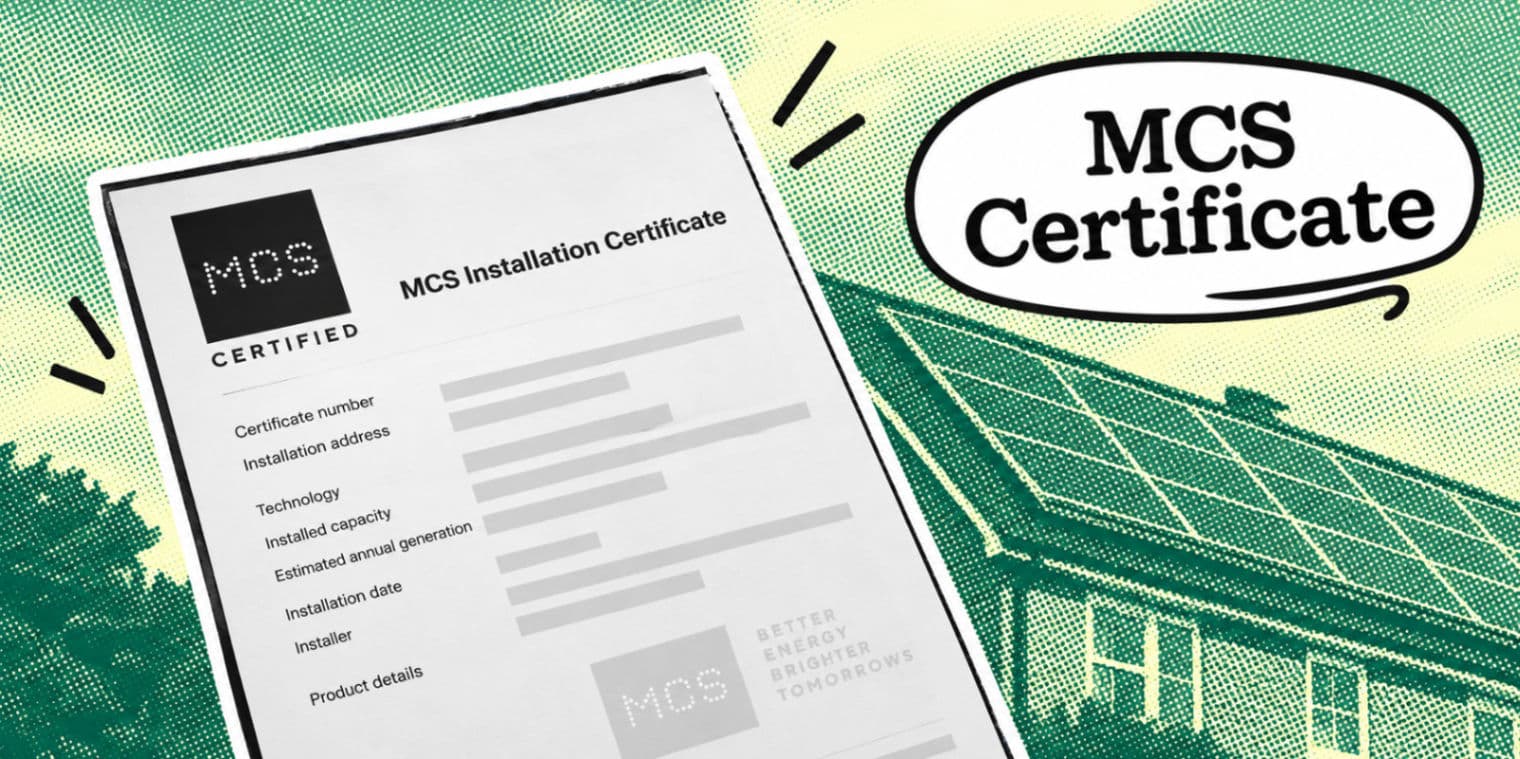
An MCS certificate isn't particularly flashy. It's essentially an official record of your renewable energy installation, showing what was installed, where it was installed and who carried out the work.
The exact layout can vary depending on the technology, but you should expect to see details such as:
Your unique MCS certificate number
The installation address
The name and details of your MCS-certified installer
The date the system was installed or commissioned
The type of technology installed, such as solar PV or a heat pump
Details of the equipment used
The total installed capacity
Relevant MCS product certification details
Estimated annual generation, where applicable
Planning or Building Regulations information
Any relevant financial protection details
For solar PV systems, for example, the certificate will usually include the system's total installed capacity and its estimated annual electricity generation.
So, if you've been sent a PDF after your installation and you're wondering whether it's the right document, check for the MCS branding, certificate number, your property details, installer information and the technical details of your system.
It's worth keeping hold of it, too. You may need it later for things like export tariffs, grants, warranty queries or when selling your home.
Example of the information on an MCS certificate
Imagine you've had a 10-panel solar PV system installed.
Your certificate may contain information broadly along these lines:
Detail | Example |
Technology | Solar photovoltaic (PV) |
Property | Your installation address |
Installer | MCS-certified installation company |
Installation date | Date the system was commissioned |
Installed capacity | For example, 4.4kWp |
Estimated generation | Predicted annual electricity generation |
Equipment | Details of relevant certified products |
Certificate number | Unique MCS reference |
The exact fields can differ according to the technology and installation.
A heat pump certificate, for example, will naturally contain different technical information from one issued for solar panels.
What is the purpose of an MCS certificate?
An MCS certificate is basically proof that your renewable energy system has been properly registered through MCS.
It might look like just another bit of installation paperwork, but it's an important document to keep hold of.
You could need it when applying for certain grants, setting up payments for exported solar energy, or even selling your home further down the line.
Here's where it can come in handy:
It proves your installation is MCS registered
Your certificate links your solar panels, heat pump or other eligible technology to a record held on the MCS Installations Database.
In other words, you've got something official to show that the installation was registered through the scheme rather than simply taking the installer's word for it.
You may need it for grants and schemes
MCS certification is also tied to some government-backed renewable energy schemes.
For example, heat pump installations funded through the Boiler Upgrade Scheme need to meet the relevant MCS requirements.
So, if you're planning to take advantage of a grant, it's worth checking the MCS requirements before choosing your installer rather than discovering there's a problem once the work is finished.
It can help you get paid for excess solar energy
Got solar panels? Your system could be sending unused electricity back to the grid.
Under the Smart Export Guarantee (SEG), participating energy suppliers pay eligible homeowners for the electricity they export.
When you apply for an export tariff, your supplier will usually want evidence that your solar installation meets the necessary requirements.
Your MCS paperwork is therefore one of those documents you'll be glad you didn't delete from your inbox.
Bottom line: the certificate might not look particularly exciting, but it can unlock some pretty important benefits from your renewable energy system.
Selling your home
An MCS certificate is also useful paperwork to have when selling a property with solar panels, a heat pump or another certified renewable system.
A prospective buyer or conveyancer may want documentation showing when the system was installed, by whom and under which certification arrangements.
It's much easier to provide the certificate than try to reconstruct the installation history years later.
Which technologies can have an MCS certificate?
MCS covers several types of small-scale renewable technology, but for most UK homeowners the big two are:
Solar PV panels
Heat pumps
Other eligible low-carbon technologies can also fall under the MCS scheme, but these are the ones you're most likely to come across at home.
The key thing is to check that your installer is MCS certified for the specific technology you're having fitted.
A company being MCS certified doesn't automatically mean it's certified to install everything.
So, if you're getting solar panels or a heat pump, check before signing on the dotted line. It's much easier than trying to fix a certification problem after the installation is complete.
How do you get an MCS certificate?
The good news is that you don't usually need to apply for one yourself.
If you're using an appropriately MCS-certified installer, they handle the process as part of the installation.
Here's roughly what happens:
1. You choose an MCS-certified installer
First, make sure the installer is certified for the technology you're buying.
You can check this using the official MCS installer directory.
2. Your system is installed
Your installer designs and fits the system in line with the relevant MCS requirements.
This is important because MCS isn't just a logo installers can stick on their website. Certified installers have to meet specific standards and are subject to assessment.
3. The system is commissioned
Once everything is installed and working as it should, the installer formally commissions the system and records the necessary details.
4. The installation is registered with MCS
Your installer then adds the system to the MCS Installations Database, which is the central record of MCS-registered installations.
5. Your certificate is generated
Once the installation has been registered, your MCS certificate can be generated.
This confirms the details of the installation and records the installer's declaration that the work meets the relevant MCS requirements.
You should then receive a copy for your records.
Pro tip: don't file it away somewhere impossible to find. Keep your MCS certificate alongside your warranties, electrical certificates and other installation documents. You'll thank yourself later if you need to set up an export tariff, make a warranty claim or sell the property.
Who actually issues the MCS certificate?
This bit can get confusing, because there are two different things going on.
Your installer registers the completed installation through the MCS system, and the certificate is then generated from the MCS Installations Database.
That is different from the installer being MCS certified themselves.
An installer has to go through an approved Certification Body, provide the necessary evidence, pass assessments and continue meeting the required standards to keep their certification.
So, in simple terms:
MCS installer certification applies to the company carrying out the work.
Your MCS certificate applies to the actual solar panel or heat pump installation at your property.
Related? Yes.
The same thing? No.
How does an installer become MCS certified?
They can't just fill in a form, pay a fee and stick an MCS logo on the van.
Installers have to show that they can meet the relevant MCS requirements for the technology they want to install.
That normally means applying through an approved MCS Certification Body, providing supporting documents and completing the required assessments.
And it doesn't stop there.
Certified installers have to continue meeting MCS requirements if they want to keep their certification.
That's part of what makes an MCS certificate more meaningful than a simple receipt saying someone fitted a heat pump or a set of solar panels.
Do I legally need an MCS certificate?
Not always.
Having solar panels or a heat pump without an MCS certificate doesn't automatically mean the system is illegal.
But here's the catch.
If you want access to certain grants, export tariffs or other schemes, you may need an installation that meets the relevant MCS requirements.
The main thing to watch is what happens if you don't have one.
Without the right MCS paperwork, you could run into problems applying for certain grants, export tariffs or other renewable energy schemes.
Potentially, yes.
That's why it's worth checking the MCS status of your installer before the work starts, rather than trying to sort it out once the system is already on your roof or outside your house.
How long does it take to get an MCS certificate?
You probably won't get your certificate the second your installer packs up and leaves.
The system first needs to be commissioned and registered.
Under MCS requirements, applicable certificates should generally be raised within 30 calendar days of the commissioning date.
In reality, many installers will sort it sooner.
If a few weeks have passed and you've still heard nothing, it's worth giving your installer a nudge and asking whether the system has been registered with MCS.
What if I haven't received my MCS certificate?
Start with the installer.
Ask whether your installation has been registered on the MCS Installations Database and request a copy of the certificate.
It's worth being specific, because an invoice, electrical certificate or equipment warranty is not the same thing as an MCS certificate.
If the installer says the system is MCS registered but still can't provide the certificate, you can contact MCS directly for help.
Can I replace a lost MCS certificate?
Usually, yes.
If you've deleted the original email, lost the paperwork or bought a home where the previous owner didn't leave everything behind, the installation may still be recorded on the MCS database.
Your first port of call should usually be the original installer.
If that's not possible, contact MCS with as much information as you have about the property and installation.
And once you get a replacement, save it somewhere sensible.
Future-you will appreciate it.
Is an MCS certificate the same as a solar panel warranty?
No. They're completely different things.
Your MCS certificate relates to the installation and its registration through MCS.
Your manufacturer's warranty covers the actual equipment, such as your solar panels, inverter, battery or heat pump.
You may also receive separate documents for things like:
Workmanship warranties
Product warranties
Inverter warranties
Battery warranties
Electrical installation certificates
Building Regulations
DNO paperwork
Solar export arrangements
Performance estimates
Insurance or financial protection
Our advice?
Keep the lot.
Your solar panels or heat pump could be with the property for decades, and paperwork that's easy to find today can become surprisingly difficult to track down years later.
How can I check whether an installer is MCS certified?
Before you sign anything, check the company on the official MCS installer directory.
You should be able to see details such as their certification number, Certification Body and the technologies they're certified to install.
That last point matters.
A company being MCS certified doesn't necessarily mean it's certified for every technology covered by the scheme.
So if you're having a heat pump fitted, for example, make sure the company's certification actually covers heat pumps.
It takes a couple of minutes to check and could save you a serious headache later.
MCS certificates: the bottom line
An MCS certificate isn't exactly the most exciting part of getting solar panels or a heat pump installed.
But it is one of those boring-looking documents that can turn out to be surprisingly important.
It gives you a formal record of the installation and may be needed for things like grants, export tariffs or selling the property later on.
So before choosing an installer, check that they hold the right MCS certification.
And once the work is done, make sure you actually get the certificate.
Then save it somewhere you won't lose it.
Looking to install solar panels or a heat pump?
Heatable keeps the process refreshingly simple.
Get a clear online quote, see your options upfront and arrange your installation without the usual sales waffle.
Next Steps For Your Solar Journey:
When planning to install solar panels for your home, there are several important factors to consider. Make sure to refer to the following guides to help you make informed decisions:
To dive deeper into these topics, head over to our advice section, check out our YouTube channel for informative videos, or read a customer case study to see how others have benefited from their solar installation.
Get a Quote for Solar Today
Without boasting you should get your solar installed with us, here's why:
Thousands of Happy Customers: We boast an average score of 4.9 on Trustpilot, outperforming the market leader.
Which? Trusted Trader: Heatable is proudly recognised as a Which? Trusted Trader.
MCS Accredited: Our accreditation by the Microgeneration Certification Scheme (MCS) ensures high-quality standards.
Exclusive Panels: We offer REA Fusion solar panels, available only through Heatable.
Consumer Protection: As members of the HIES consumer code, we provide 2-year deposit protection.
Flexible Payment Options: Choose from multiple payment methods, including finance options.
Fixed Price Guarantee: Enjoy transparency with no hidden costs.
Save Your Quote: You can save your quote and decide later.
Bespoke Design Tool: Draw your own conclusion (literally) on whether solar is worth it for you, here.