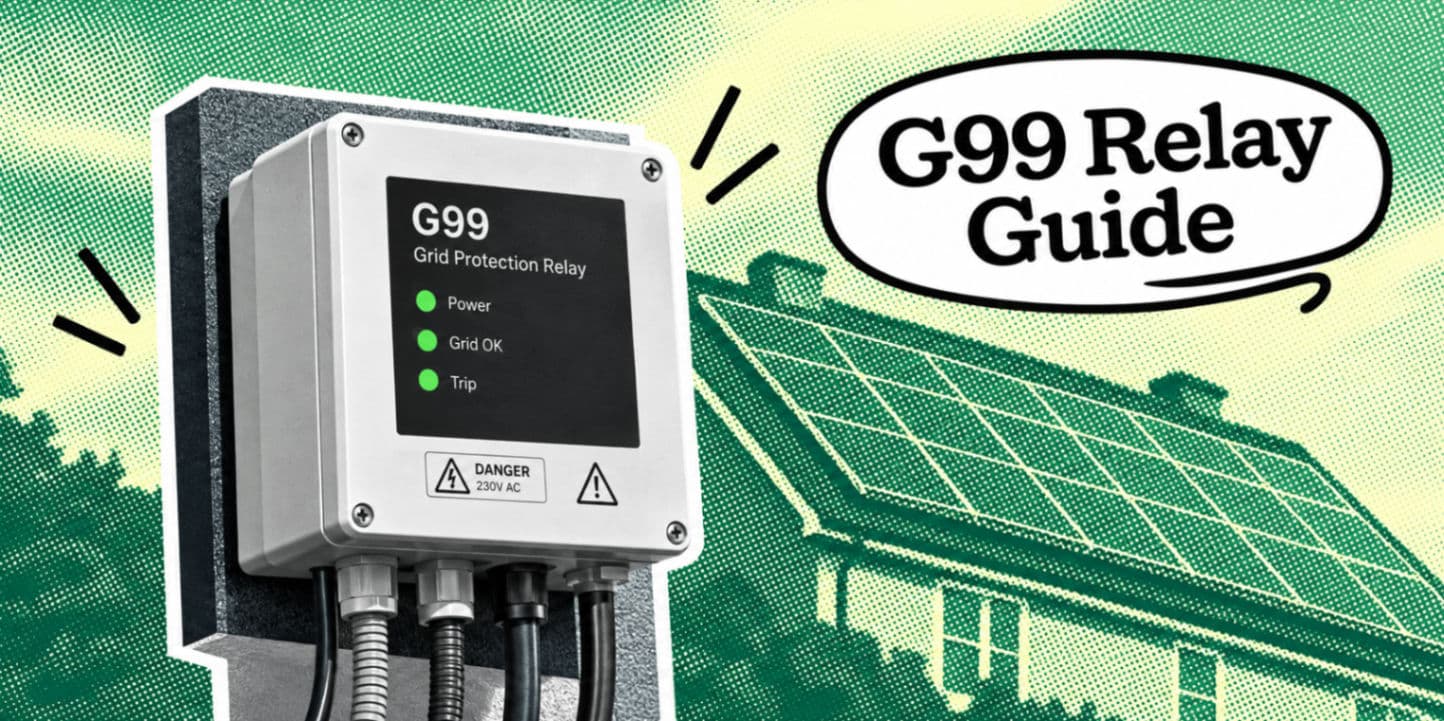

If you're installing a larger solar PV system or adding battery storage, you may hear your installer mention a G99 relay.
Not exactly the most exciting bit of solar tech.
But it does an important job.
A G99 relay helps make sure your solar or battery system disconnects safely from the grid if something goes wrong.
It's linked to Engineering Recommendation G99, the rules used for connecting larger or more complex electricity-generating systems to the local grid.
So, when do you actually need one, what does it do, and why does your DNO care?
Here's the simple version…
PS We offer MCS-certified solar panel installation nationwide. Simply answer these questions, get your fixed price and arrange your free design.
What is a G99 relay?
A G99 relay is a protection device used on some solar, battery and other electricity-generating systems.
Its job is to keep an eye on what's happening on the grid.
If the voltage or frequency moves outside the allowed limits, or the grid supply disappears altogether, the relay can tell the system to disconnect.
That helps protect:
The local electricity network
Engineers working on the grid
Your solar or battery equipment
The wider connection between your home and the network
Despite the name, a “G99 relay” isn't one specific branded product.
It's really shorthand for interface protection that meets the requirements of G99.
What does a G99 relay actually do?
Most of the time, your solar or battery system runs happily in the background without you thinking about it.
The relay sits there checking that the grid is behaving normally.
It can monitor things like:
Voltage
Frequency
Loss of mains
Changes in grid frequency
If something goes outside the allowed limits, it tells the system to disconnect.
That's particularly important if the local grid goes down.
You don't want your solar panels or battery continuing to feed electricity into a section of network that engineers may believe is switched off.
Why does that matter?
Imagine there's a fault on your street and the DNO cuts power to part of the network.
Engineers may then need to work on cables they expect to be dead.
If nearby solar or battery systems carried on exporting electricity, that could create an obvious safety problem.
That's why generation systems need protection that can recognise abnormal grid conditions and disconnect when required.
Once the grid is back within the correct limits, the system can reconnect after the required delay.
Most homeowners won't ever see any of this happening.
And that's exactly how it should be.
What is G99?
G99 is the set of rules covering how electricity-generating equipment connects to Britain's distribution networks.
For domestic solar, you'll usually hear about G98 or G99.
Standard | Typically used for |
G98 | Smaller generation systems |
G99 | Larger or more complex generation systems |
For a single-phase home, the G98 threshold is generally 16A per phase, which works out at around 3.68kW of generation.
Once you move beyond that, G99 may come into play.
That said, this is where things start to get more nuanced.
A system being G99 doesn't automatically mean you'll need a separate relay box installed on the wall.
Do all G99 installations need a separate relay?
No.
This is probably the most important point in the whole guide.
A solar or battery system can fall under G99 without needing a separate standalone relay.
Many modern inverters already have suitable protection built in.
If the inverter is appropriately type-tested and meets the relevant requirements, that built-in protection may be enough.
A separate external relay is more likely on:
Larger systems
Multiple-inverter setups
Commercial installations
More complicated solar and battery systems
Installations where the DNO asks for extra protection
So if your installer says “this is a G99 job”, don't immediately picture another large box appearing next to your consumer unit.
The actual setup depends on the system design.
When might you need a separate G99 relay?
You're more likely to need dedicated external protection if the installation is larger or more complicated.
That can include:
Several inverters
High-capacity solar systems
Commercial arrays
Solar plus battery setups
Equipment without suitable built-in protection
Installations with specific DNO requirements
Your installer should work this out during the design and application process.
You shouldn't need to diagnose it yourself.
What does a G99 relay monitor?
The relay is basically looking for signs that the grid has moved outside normal operating conditions.
Overvoltage
If the grid voltage gets too high, the system may need to disconnect.
Undervoltage
The same applies if the voltage drops too low.
Overfrequency
The UK grid normally operates at around 50Hz.
If the frequency rises too far, the protection can operate.
Underfrequency
Likewise, a significant drop in frequency can trigger disconnection.
Loss of mains
The system also needs to detect when the wider grid supply disappears.
This helps stop your solar or battery system creating an unwanted “island” of live electricity.
What happens when a G99 relay trips?
If the relay detects a problem, it disconnects the generating system from the grid.
That doesn't necessarily mean your solar panels or battery are faulty.
It may simply mean the protection system is doing its job.
Once grid conditions return to normal, the system can reconnect after the required waiting period.
If it keeps tripping, though, something needs checking.
Repeated trips could point to:
High local grid voltage
Incorrect settings
Wiring problems
A commissioning issue
A fault with the equipment
The answer isn't to turn the protection down and hope for the best.
The cause needs investigating.
Can G99 relay settings be changed?
Not casually.
The protection settings form part of the agreed grid connection arrangement.
They shouldn't be tweaked just because the system is being inconvenient.
If changes are needed, your installer may need to involve the DNO.
This is one of those areas where “just change the setting” is definitely not the right approach.
What is a DNO?
DNO stands for Distribution Network Operator.
They're the company responsible for the local electricity network serving your home.
They're not necessarily the company you buy your electricity from.
Your energy supplier sends the bill.
Your DNO looks after the cables, substations and wider local network.
Because solar panels and batteries can export electricity back onto that network, the DNO needs to know what you're connecting.
Do I need DNO approval for a G99 system?
Usually, yes.
This is one of the main differences between G98 and G99.
Some smaller G98 systems can be installed and then notified afterwards.
With G99, the installer will usually need to apply to the DNO before the system is connected.
The DNO may then:
Approve the design
Ask for changes
Set an export limit
Request additional protection
Require network work before connection
Again, your installer should handle this for you.
How does the G99 application process work?
From the homeowner's point of view, it should be fairly uneventful.
Your installer will usually:
Design the system.
Check whether G98 or G99 applies.
Identify your DNO.
Submit the technical details.
Wait for the DNO's response.
Install and commission the system once approved.
Complete the required paperwork.
You may be asked for details such as your MPAN or information about your existing electricity supply.
But most of the technical paperwork should sit with the installer.
Does a G99 relay need testing?
Yes.
There's not much point fitting protection if nobody checks that it actually works.
Depending on the installation, testing can include:
Checking the relay settings
Confirming the system disconnects correctly
Testing voltage protection
Testing frequency protection
Checking loss-of-mains protection
Confirming reconnection behaviour
On larger or more complicated systems, the DNO may also ask for a witness test.
What's the difference between G99 and G100?
These two often get mentioned together, but they do different jobs.
G99 is about connecting generation safely to the grid.
G100 is about limiting how much electricity you export.
For example, imagine you install a 10kW solar system but the local network will only allow you to export 5kW.
You may still be able to keep the larger solar system if an approved export limitation scheme is used.
That export control is where G100 comes in.
So yes, one installation can involve both G99 and G100.
Can battery storage trigger G99?
Yes.
This is worth knowing if you're adding a battery to an existing solar system.
A battery isn't just treated like another household appliance.
If its inverter can export electricity to the grid, it forms part of the generation setup.
So even if your original solar system was covered by G98, adding a battery can change the overall connection arrangement.
Your installer should check the combined system rather than looking at the battery on its own.
What about solar plus battery systems?
This is where things can get a bit more interesting.
Say you already have a 3.68kW solar inverter.
You then add a separate battery inverter.
Even if each device looks fairly modest in isolation, the DNO may consider the combined generation capacity.
There are streamlined routes for some solar-plus-storage setups, but the exact rules depend on the equipment and configuration.
The main takeaway is simple:
Don't assume adding a battery has no impact on your existing grid connection.
Make sure the installer checks it.
Does a G99 relay limit how much solar you can export?
Usually, no.
This gets mixed up a lot.
G99 protection is mainly there to make sure the generation system disconnects safely when grid conditions aren't right.
If the DNO wants to limit how much electricity you export, that's normally handled through a G100 export limitation scheme.
Same installation, different job.
Is G99 the same as MCS?
No.
They're completely separate.
MCS is about installer and installation certification.
G99 is about connecting generation safely to the electricity network.
A solar installation may involve both.
It may also involve:
Building Regulations
Electrical certification
DNO approval
G98 or G99
G100
Product warranties
Export tariff paperwork
Which sounds like a lot.
Fortunately, a good installer should deal with most of it for you.
Do I need to buy a G99 relay myself?
No.
Definitely not.
If your installation needs additional interface protection, it should be designed into the system by the installer.
Buying a random relay online isn't going to make an installation G99 compliant.
The equipment needs to be:
Suitable for the system
Correctly configured
Properly connected
Tested
Accepted as part of the DNO connection arrangement
Leave this one to the professionals.
G99 relays: the bottom line
A G99 relay is there to make sure larger or more complex solar and battery systems disconnect safely when the grid isn't behaving as it should.
But not every G99 installation needs a separate relay.
Modern inverters may already contain suitable protection, while bigger or more complicated systems may need additional external equipment.
For homeowners, the main thing is making sure your installer understands the DNO process and designs the system properly from the start.
Because finding out your shiny new solar setup can't be connected as planned is not the kind of surprise anyone wants after the panels are already on the roof.
Next Steps For Your Solar Journey:
When planning to install solar panels for your home, there are several important factors to consider. Make sure to refer to the following guides to help you make informed decisions:
To dive deeper into these topics, head over to our advice section, check out our YouTube channel for informative videos, or read a customer case study to see how others have benefited from their solar installation.
Get a Quote for Solar Today
Without boasting you should get your solar installed with us, here's why:
Thousands of Happy Customers: We boast an average score of 4.9 on Trustpilot, outperforming the market leader.
Which? Trusted Trader: Heatable is proudly recognised as a Which? Trusted Trader.
MCS Accredited: Our accreditation by the Microgeneration Certification Scheme (MCS) ensures high-quality standards.
Exclusive Panels: We offer REA Fusion solar panels, available only through Heatable.
Consumer Protection: As members of the HIES consumer code, we provide 2-year deposit protection.
Flexible Payment Options: Choose from multiple payment methods, including finance options.
Fixed Price Guarantee: Enjoy transparency with no hidden costs.
Save Your Quote: You can save your quote and decide later.
Bespoke Design Tool: Draw your own conclusion (literally) on whether solar is worth it for you, here.