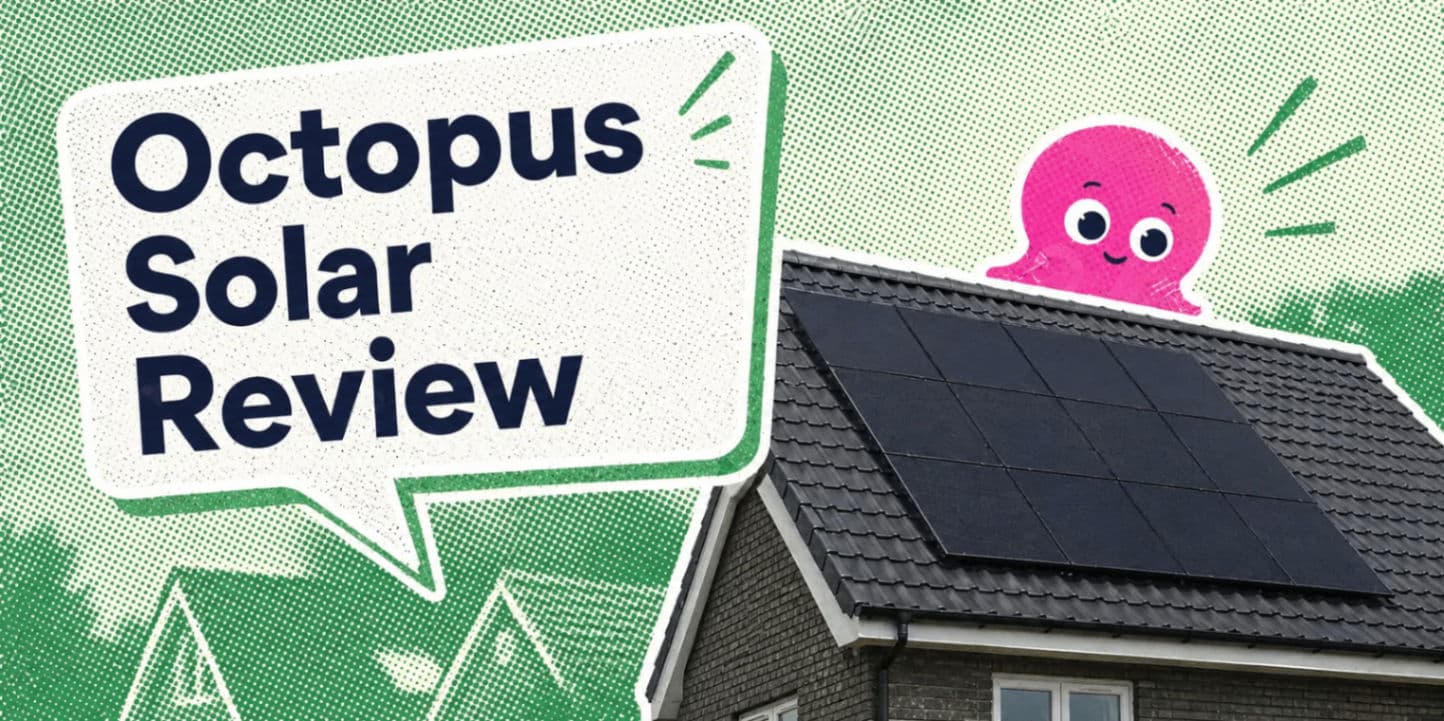

Octopus Solar may be worth considering if you want solar panels, battery storage, and smart import/export tariffs from a large, recognisable UK energy supplier.
- Octopus Solar vs Heatable Solar comparison
- What does Octopus Solar actually offer?
- How does the Octopus Solar quote process work?
- Octopus Solar price - are they good value?
- Solar savings - what can Octopus Solar realistically save?
- Octopus Solar and tariffs - is this their biggest advantage?
- Warranties - don’t just look at the biggest number
- Reviews - how should you read Octopus Solar reviews?
- So, is Octopus Solar worth it?
But it is not automatically the best choice for every home.
Solar value depends on more than the provider’s name. System design, hardware, installation quality, battery sizing, roof orientation, usage habits, warranties, export rates, and aftercare all matter.
This guide looks at where Octopus Solar appears strong, where the details need checking, and how to compare it fairly with specialist solar installers before you commit.
PS We offer MCS-certified solar panel installation nationwide. Simply answer these questions, get your fixed price and arrange your free design.
🔑 Key Points:
Octopus Solar can be a strong option if you want solar, battery storage, and energy tariffs under one provider.
The biggest advantage is convenience - installation, import tariffs, export tariffs, and energy account support can sit within the Octopus ecosystem.
Price needs checking carefully - compare full system specs, not just headline install cost.
Solar savings depend on your home - roof direction, shading, battery size, daytime usage, electricity rates, and export tariff all matter.
Aftercare matters as much as installation - check who handles faults, workmanship issues, manufacturer claims, scaffolding problems, and export setup.
Warranties are layered - panels, inverter, battery, workmanship, insurance-backed guarantees, and performance warranties are not the same thing.
Heatable may suit customers who want a specialist solar installation route, clear workmanship cover, MCS certification, insurance-backed protection, and a focused renewables installation process.
Octopus Solar vs Heatable Solar comparison
Category | Octopus Solar | Heatable Solar |
Quote process | Online quote journey based on postcode/property details; final design depends on roof, usage, photos/survey and suitability checks | Online quote journey; system design depends on roof, property details, battery requirements, usage and survey checks |
Installer type | Large energy supplier offering solar, battery and tariffs | Specialist online installer offering solar, batteries, boilers and renewables |
Solar + battery | Offers solar PV and home battery systems | Offers solar PV and battery storage systems |
Tariff integration | Strong potential advantage due to Octopus import/export tariffs and wider energy ecosystem | Customers can still use suitable export/import tariffs, but tariff supply is separate from installation |
Hardware | Check current panel, inverter and battery brands at quote stage | Check current panel, inverter and battery brands at quote stage |
Warranty | Check panel, inverter, battery, performance and workmanship warranty terms directly before ordering | Heatable states solar installations include workmanship warranty and insurance-backed protection; product warranties depend on selected system |
Aftercare | Octopus promotes post-install support and customer service; check exactly how solar faults/export setup issues are handled | Heatable promotes aftercare routes and installer support; check what is installer-led vs manufacturer-led |
Accreditations | Check current MCS/RECC/NAPIT/electrical compliance details before ordering | Heatable states MCS certification, RECC registration and electrical certification where applicable |
Reviews | Octopus Energy has a very large Trustpilot profile, but customers should filter specifically for solar installation reviews where possible | Heatable has a strong review profile, but customers should filter specifically for solar/battery installs where possible |
Best fit | Customers wanting one ecosystem for energy, export, EV, battery and solar | Customers wanting a specialist installer-led solar/battery process with clear system and workmanship checks |
What does Octopus Solar actually offer?
Octopus Solar offers home solar panel and battery installations in the UK.
Put simply, that means they can help you get set up with:
Solar panels for your roof.
Battery storage, so you can store more of the electricity you generate.
Smart/export tariffs, so you can sell unused electricity back to the grid.
An online quote journey.
Post-install support.
The big selling point is convenience.
Octopus is not just trying to sell you solar panels. It is offering solar as part of a wider home energy setup, including electricity supply, smart tariffs, export payments, EV tariffs, batteries, and app-based account monitoring.
For some households, that joined-up experience will be genuinely useful. Especially if you already use Octopus, like the brand, or want your energy supplier, solar installer, and export tariff sitting under one roof.
But here’s the important bit.
Solar is still a technical installation, not a simple tariff switch.
So while Octopus may score well for brand familiarity and convenience, you should still compare the actual system being offered.
That means checking the panel spec, battery size, inverter or microinverter setup, warranties, installation standards, projected savings, and aftercare.
Because with solar, the logo on the quote matters far less than what is actually going on your roof.
How does the Octopus Solar quote process work?
Octopus Solar starts with an online quote.
That is useful, because it gives you a quick idea of what your system could look like and what it might cost. But as with any solar quote, the final design depends on your actual home, not just a few details entered online.
Octopus says it installs a minimum of 2 solar panels, with the recommended number of panels worked out at quote stage based on your roof and electricity usage. The design can also be adjusted depending on roof size and suitability.
In other words, the online quote is a starting point, not something to accept blindly.
The final price and setup may depend on things like:
Your postcode
Roof size and direction
Roof type
How many panels can fit
Whether you add a battery
Scaffolding and access
Shading
Electrical work
DNO approval, if needed
Survey photos and design checks
The final system specification
Octopus also says permission from the local distribution network operator may be needed before you can export electricity to the grid.
Once that is sorted, you should receive an export MPAN, which is needed for export payments.
Before accepting a quote, check exactly what is included.
Ask what panels, inverter, battery and warranties are being quoted.
Check whether scaffolding, bird protection, MCS registration, DNO paperwork and export tariff setup are included too.
Also ask what happens if the design changes after survey.
That bit matters.
An online solar quote can look great at first, then change once the roof layout, shading, access, scaffolding, electrics or export permissions are checked properly.
A good quote should not just be cheap. It should be clear.
Octopus Solar price - are they good value?
There is no single “best” solar price, because every home is different.
Octopus promotes solar systems from a published starting price for a small 2-panel installation with no battery. Battery storage is not included in that entry-level price.
That gives you a useful starting point, but it does not tell you whether Octopus will be cheap, expensive, or good value for your home.
The only fair way to compare Octopus Solar with Heatable, or any other installer, is on a like-for-like basis.
That means checking whether each quote includes the same:
Number of panels
Panel wattage
Inverter or microinverter setup
Battery capacity
Mounting system
Scaffolding and access requirements
Bird protection
Monitoring app
Warranty terms
DNO/export paperwork
Finance terms, if you are paying monthly
A cheaper quote is not always a better quote.
It may simply include fewer panels, a smaller battery, a different inverter, weaker warranty cover, or fewer extras. And with solar, those details can make a big difference to long-term performance.
Price red flags to watch for
Be careful if:
The quote does not name the panel brand or model
Battery capacity is unclear
The inverter brand is missing
Scaffolding is not clearly included
Bird protection is treated as an unexplained add-on
Export setup sounds vague
Warranty terms are described only as “up to”
The quote focuses on monthly payments, not the total cost
The real question is not just, “Who is cheaper?”
It is, “Who is offering the best complete system for this home, with the clearest warranty, installation standards, and aftercare?”
Solar savings - what can Octopus Solar realistically save?
Solar can reduce electricity bills, but savings should never be treated as guaranteed.
Octopus promotes solar and battery systems alongside smart tariffs and export opportunities, including battery-friendly tariff options designed to improve savings or export returns.
But your actual savings depend on:
System size.
Roof orientation.
Shading.
Where you live.
Electricity consumption.
Whether you are home during the day.
Battery capacity.
Export tariff.
Import tariff.
EV ownership.
Heat pump ownership.
Future electricity prices.
Octopus cites the Energy Saving Trust’s broad payback estimate of 9–13 years, while also noting that payback depends on location, time spent at home, household electricity use, roof size, roof orientation, and whether the system includes a battery.
Solar usually works best when your system is designed around your actual usage, not just your roof space.
Oversizing, undersizing, or choosing the wrong battery capacity can all affect payback.
Before accepting any solar quote, ask for:
Estimated annual generation.
Estimated self-consumption.
Estimated export.
Battery charge/discharge assumptions.
Payback estimate.
Assumed electricity import rate.
Assumed export rate.
Degradation assumptions.
Any maintenance assumptions.
A credible savings forecast should show its assumptions. If the assumptions are unrealistic, the payback estimate may be too.
Octopus Solar and tariffs - is this their biggest advantage?
This is probably one of Octopus Solar’s strongest selling points.
Octopus is not just a solar installer. It is also an energy supplier with smart tariffs, export tariffs, EV tariffs, and battery-friendly options.
So if you already use Octopus, or you like the idea of keeping your solar, battery, import tariff and export payments in one place, the setup can feel simpler.
That convenience is real.
For homes with solar panels and battery storage, Octopus offers export options such as Outgoing Octopus, alongside other solar-related tariffs.
These can help you get paid for electricity you send back to the grid, and may work especially well if your system is designed around your usage, battery, and import/export rates.
But tariffs are only part of the picture.
A smart tariff will not rescue a badly designed solar system. And an export rate does not matter much if the panels, inverter, battery, or installation are not right for your home.
A good solar installation still needs:
Proper system design
Safe roof work
Quality electrical installation
Sensible battery sizing
Correct commissioning
MCS certification
Clear handover
Reliable aftercare
So yes, Octopus has a strong ecosystem advantage.
But you should still compare the actual installation against specialist solar installers.
The tariff setup may be slick, but the hardware, design, workmanship, warranty and support still need to stack up.
Warranties - don’t just look at the biggest number
Solar warranties are often misunderstood.
A “25-year warranty” can sound simple, but it may only apply to the panels - not the inverter, battery, workmanship, scaffolding damage, app, or electrical components.
Solar warranties can include:
Panel product warranty.
Panel performance warranty.
Inverter warranty.
Battery warranty.
Workmanship warranty.
Insurance-backed guarantee.
Roof penetration/water ingress cover.
Monitoring/app warranty.
Octopus promotes panels with a 25-year product warranty and, on its solar pages, also refers to 30-year power output or linear power output warranties. Its battery warranty terms vary depending on the battery product installed.
Octopus also lists different battery options, including Tesla Powerwall 3, Fox EVO and Enphase options, with warranty terms varying by product.
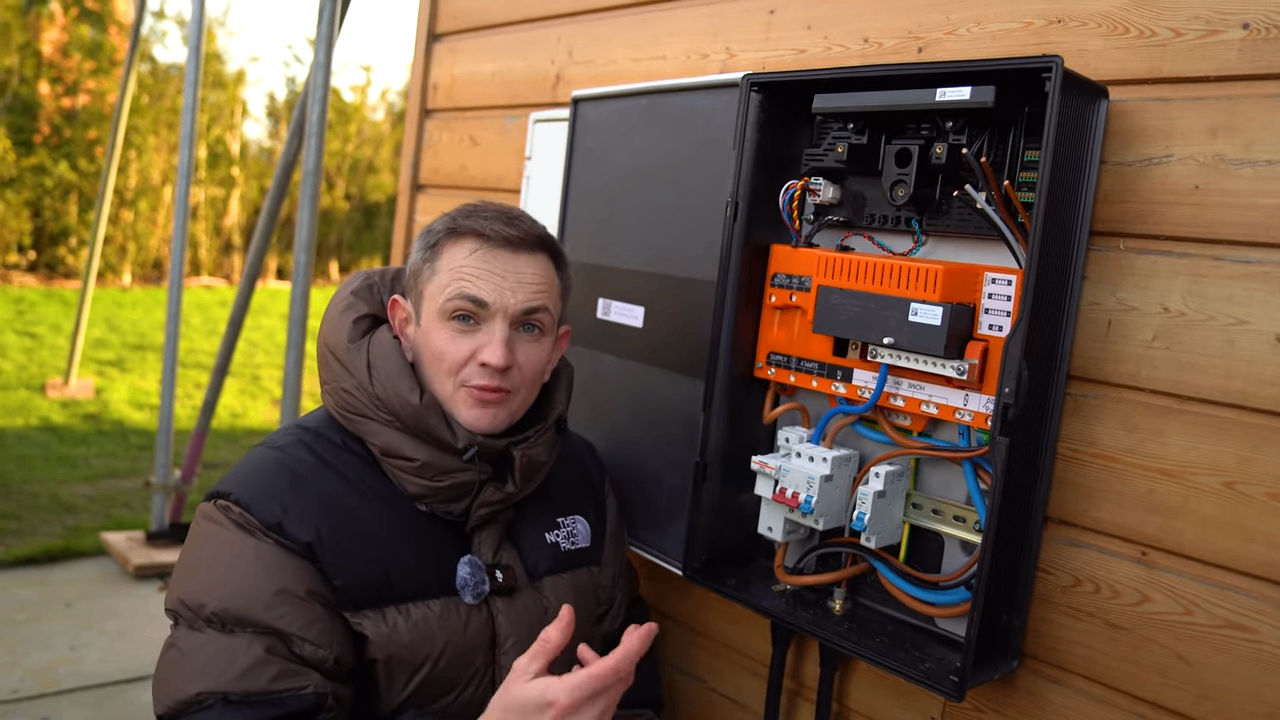
Heatable states that its solar installations include workmanship warranty cover and an insurance-backed warranty by IWA.
It also says its LONGi panels come with a 30-year product and performance warranty, though customers should check the exact product/system selected in their own quote.
Always check:
What is the panel product warranty?
What is the panel performance warranty?
What is the inverter warranty?
What is the battery warranty?
What is the workmanship warranty?
Is there insurance-backed protection?
Who pays labour if a manufacturer part fails?
Is replacement guaranteed or repair-only?
What maintenance is required?
Is annual servicing needed?
The biggest number on the quote is not always the most important one.
Reviews - how should you read Octopus Solar reviews?
Octopus Energy has a very large Trustpilot profile with hundreds of thousands of reviews. At the time checked, Trustpilot showed more than 790,000 reviews for Octopus Energy overall.
That is useful context, but it should not be treated as a pure solar installation score.
Many Octopus Energy reviews relate to energy supply, billing, switching and customer service rather than solar panel installation specifically. Customers should filter for solar-specific terms where possible.
Look for reviews mentioning:
Solar.
Battery.
Installation.
Scaffolding.
Export setup.
MCS certificate.
Aftercare.
Snagging.
App/monitoring setup.
Online forums and individual customer stories can also be useful, but they should not be treated as representative on their own.
Some customers report smooth installs, while others report delays, communication issues, or post-install complications. Use these as prompts for questions, not proof that every install will be the same.
Reviews are useful, but only if you read them like data. Look for repeated patterns, not one-off extremes.
How to read solar reviews properly
Ignore single extreme reviews unless they reveal a repeat issue.
Look for recent solar/battery-specific reviews.
Check how the company responds when things go wrong.
Look for comments about communication, scaffolding, workmanship and aftercare.
Compare reviews across Trustpilot, Which?, Google, Reddit, MoneySavingExpert and solar forums.
Prioritise reviews from homes similar to yours.
The same applies to Heatable reviews. A strong overall review profile is helpful, but solar customers should still look specifically for solar and battery installation feedback.
So, is Octopus Solar worth it?
Octopus Solar may be worth it if:
You want a well-known national energy brand.
You already use Octopus Energy.
You value tariff integration.
You want solar, battery, EV and export options in one ecosystem.
Their quote is competitive on a like-for-like basis.
Their proposed hardware, warranty and aftercare route are clear.
You are comfortable with their installation timeline and process.
Octopus Solar may not be the best fit if:
You want a more specialist installer-led process.
Another installer offers better like-for-like value.
The system design is not clearly explained.
You want more detail on hardware options.
You want clearer workmanship/insurance-backed warranty terms.
You are comparing only the brand name, not the actual system spec.
Heatable may be worth considering if:
You want a specialist online solar and battery installer.
You want a quote built around your home’s solar potential and battery needs.
You want clear workmanship protection and insurance-backed cover.
You want an MCS-certified installation route.
You want to compare a like-for-like solar/battery quote against Octopus before deciding.
The sensible move is to get both quotes, match the specifications line-by-line, and choose the provider that gives you the clearest design, strongest warranty position, best aftercare route and best total value.
Related reading:
Compare Octopus Solar with a Heatable quote
If you’re considering Octopus Solar, it is worth getting a like-for-like quote from Heatable before you commit.
That way, you can compare:
Panel quantity and wattage.
Battery size.
Inverter brand.
Warranty terms.
Workmanship cover.
Insurance-backed protection.
Installation timeline.
Scaffolding and extras.
Total cost.
Estimated savings.
At Heatable, we offer solar and battery installations designed around your home, your usage and your budget - with MCS certification, clear workmanship cover, and straightforward online pricing.
Get an instant solar quote today.
Heat Happy.