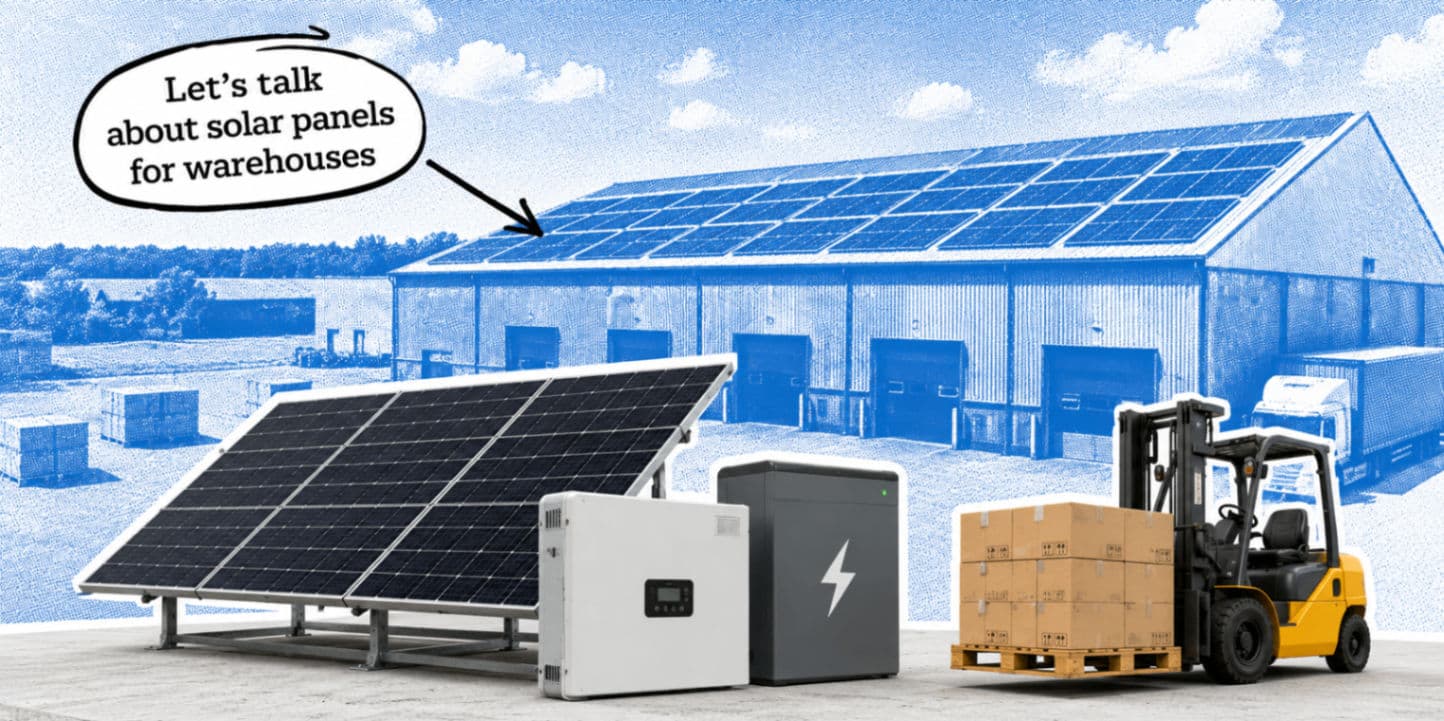

Warehouses are made for solar panels.
- Why warehouses are so well suited to solar panels
- Are solar panels worth it for warehouses?
- What can warehouse solar panels power?
- The big advantage: turning unused roof space into a working asset
- Is your warehouse roof suitable for solar panels?
- How much roof space does a warehouse need for solar panels?
- Solar panels for warehouses and battery storage
- Solar panels and EV charging for warehouses
- Can warehouses sell excess solar power back to the grid?
- How much do solar panels for warehouses cost?
- Planning permission for warehouse solar panels
Not literally, obviously.
But if you were designing the ideal commercial building for solar, you would probably end up with something suspiciously warehouse-shaped: a large roof, high electricity use, open industrial space and plenty of operational demand during the day.
For warehouses, distribution centres, fulfilment hubs and logistics sites, solar panels can turn unused roof space into one of the most useful assets in the business.
The right system can reduce electricity bills, improve energy resilience, support net zero targets and help future-proof sites for EV charging, battery storage and electrified operations.
But warehouse solar is not the same as putting panels on a house.
The roof is bigger. The energy use is more complex. The grid connection matters more. The financial case needs proper modelling. And for larger sites, the decision is less about “how many panels can fit?” and more about “what system actually makes commercial sense?”
This guide explains how solar panels for warehouses work, when they are worth it, what to check before installing them, and why a proper commercial solar consultation is the right place to start.
ℹ️ Get renewable energy consultancy with Heatable
🔑 Key takeaways:
Warehouses are often excellent candidates for solar because they usually have large unused roofs and significant electricity demand.
The best returns usually come when the business can use a high proportion of the solar electricity on site.
Solar panels can help warehouses reduce operating costs, lower carbon emissions and improve protection against long-term energy price volatility.
Battery storage can make sense for some warehouses, especially where there is evening use, peak demand, EV charging or time-of-use pricing.
The roof, grid connection and electricity profile should all be assessed before any system is proposed.
A warehouse solar consultation is more useful than a quick quote, because the best solution depends on site layout, usage patterns, export limits, funding options and long-term business plans.
Why warehouses are so well suited to solar panels
Warehouses tend to have one major advantage - roof space.
A typical warehouse, logistics unit or distribution centre may have thousands of square metres of roof area sitting unused. That roof is often one of the most underused assets on the site.
At the same time, warehouses can use a lot of electricity. Lighting, refrigeration, conveyor systems, packaging equipment, IT infrastructure, security, ventilation, heating controls, offices and EV charging can all add to the load.
Solar works especially well when a site uses electricity during the day. That is because the electricity generated by the panels can be used directly by the business, reducing the amount imported from the grid.
This is where warehouses can have an edge over some other commercial buildings. Many operations are active during daylight hours, which can make the solar generation profile a good match for real business demand.
The UK Warehousing Association has previously highlighted the scale of the opportunity, reporting that UK warehouse rooftops could support up to 15GW of new solar capacity, potentially reducing sector electricity costs and cutting emissions.
Are solar panels worth it for warehouses?
For many warehouses, yes.
The financial case usually depends on four things: how much electricity the site uses, when it uses it, how much roof space is suitable and what the grid connection allows.
A warehouse with high daytime electricity use and a suitable roof can be a very strong candidate for solar.
Every unit of solar electricity used on site is a unit the business does not need to buy from the grid.
That matters because self-consumed solar electricity is usually more valuable than exported electricity.
Exporting surplus power can still be useful, but the strongest commercial solar projects are normally designed around reducing imported electricity first.
Solar panels may be particularly attractive for warehouses with:
High lighting loads
Cold storage or refrigeration
Automated picking and packing systems
Conveyor systems
EV charging requirements
Long operating hours
High daytime electricity demand
Strong ESG or net zero commitments
The key point is that warehouse solar should be modelled around the actual site. The biggest possible system is not always the best system.
What can warehouse solar panels power?
A warehouse solar PV system can support many of the day-to-day electrical loads on site.
That can include lighting, office power, charging equipment, roller doors, security systems, ventilation, refrigeration, automation equipment, packaging machinery, conveyor systems and staff facilities.
For distribution centres, solar can also help support EV charging infrastructure as fleets move towards electric vans, HGVs and workplace charging.
The system does not need to power the entire building to be worthwhile. In many cases, the aim is to reduce grid import, not eliminate it completely.
That is the more sensible commercial framing.
Solar is not magic. It is not a total replacement for the grid unless it is part of a much wider energy system.
But when designed properly, it can take a meaningful chunk out of electricity costs and give the business more control over its energy use.
The big advantage: turning unused roof space into a working asset
Most warehouse roofs do one job: keep the weather out.
Solar lets the roof do a second job: generate electricity.
That is the commercial appeal. The roof is already there. The business is already paying for electricity. Solar connects those two facts.
Instead of treating the roof as a passive surface, the business can use it to produce cheaper, lower-carbon electricity for its own operations.
For owner-occupied warehouses, this can be especially attractive because the business benefits from both the energy savings and the long-term improvement to the building’s infrastructure.
For landlords, solar can also improve the appeal of industrial units, especially as occupiers become more focused on energy costs, ESG reporting and operational resilience.
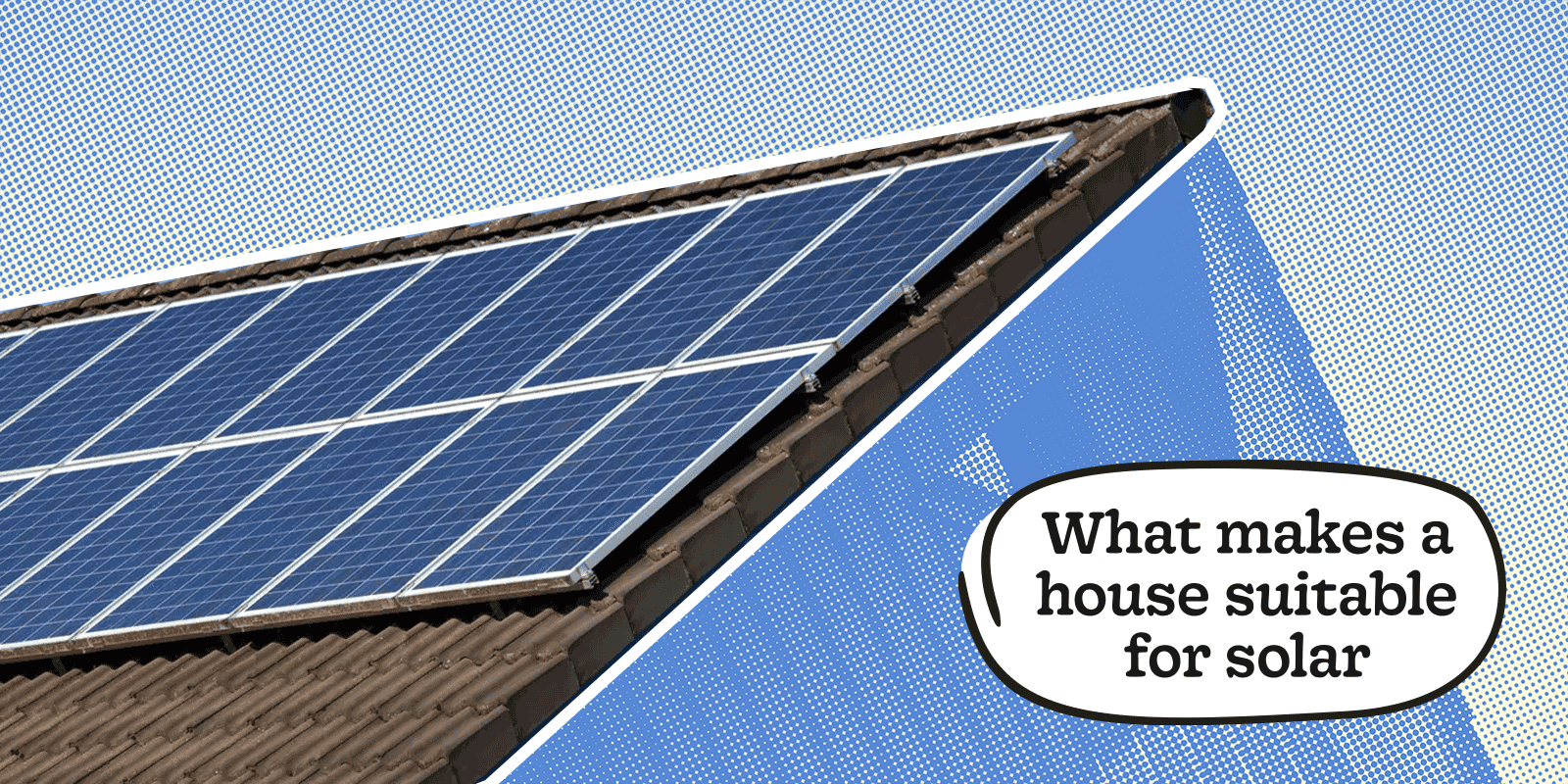
Is your warehouse roof suitable for solar panels?
Not every warehouse roof is suitable, but many are.
The main factors are roof size, orientation, pitch, shading, structure, condition and access.
Flat or gently pitched roofs are common on commercial buildings and can work well for solar, provided the mounting system is designed correctly.
Pitched warehouse roofs can also be suitable, especially where there are large south-facing, east-facing or west-facing roof sections.
The bigger question is often structural condition.
Before installing solar panels on a warehouse, the roof may need to be assessed by a qualified professional.
This is especially important for older buildings, lightweight roofs, asbestos cement roofs, ageing roof sheets or roofs with existing damage.
A proper assessment should also look at access for installation and maintenance, existing roof warranties, drainage, fire safety, insurance requirements and the location of inverters and electrical equipment.
This is why a commercial solar consultation matters. The roof is not just a place to put panels. It is part of the engineering case.
How much roof space does a warehouse need for solar panels?
The answer depends on the size of the system and the type of panels used.
Warehouses often have enough roof area for a much larger solar system than a typical domestic property. But roof area alone should not dictate system size.
A good solar design should consider how much electricity the warehouse actually uses, how much of the solar generation will be used on site and whether there are grid export limits.
For example, a huge warehouse roof may technically be able to hold a very large system. But if the site uses relatively little daytime electricity and has limited export capacity, a smaller system may produce a better return.
Equally, a high-consumption site with refrigeration, automation or EV charging may justify a much larger installation.
The right question is not “how many panels can we fit?”
It is “how large should the system be to deliver the best commercial outcome?”
Solar panels for warehouses and battery storage
Battery storage can be useful for warehouses, but it is not automatically needed.
A battery stores excess solar electricity so it can be used later. That can make sense where the warehouse has evening demand, overnight operations, high peak charges, EV charging or time-of-use tariffs.
Battery storage may also help reduce demand spikes, improve resilience and make better use of solar generation that would otherwise be exported.
However, batteries add cost and complexity. If a warehouse already uses most of its solar electricity during the day, the financial case for a battery may be weaker.
The sensible approach is to model both options.
A proper feasibility assessment should show the expected return with solar only and with solar plus battery storage, so the business can see whether the additional investment is justified.
Solar panels and EV charging for warehouses
EV charging is becoming a major consideration for warehouses and distribution centres.
As more businesses electrify vans, forklifts, company cars and eventually heavier fleet vehicles, electricity demand is likely to rise.
Solar panels can help support that transition by generating electricity on site during the day. This can be especially useful where vehicles are parked or charged during operating hours.
However, EV charging can also create new peak loads. That means it should be planned properly.
For many warehouses, the best long-term strategy may include solar panels, battery storage, smart charging and load management. This can help reduce grid strain and avoid unnecessary connection upgrades where possible.
This is where warehouse solar becomes more than a standalone installation. It becomes part of a broader energy strategy.
Can warehouses sell excess solar power back to the grid?
Yes, many warehouses can export surplus solar electricity back to the grid, subject to the right metering, permissions and export agreement.
But export should usually be treated as secondary to on-site use.
The reason is simple: electricity saved is normally worth more than electricity exported.
If your business is paying a high commercial electricity rate, every unit of solar power used on site avoids that cost. Exported electricity may earn revenue, but typically at a lower rate than the cost of buying electricity from the grid.
That does not mean export is irrelevant. For large roofs and low weekend demand, export income can still help the overall case. But the best system design should prioritise the warehouse’s actual consumption profile.
How much do solar panels for warehouses cost?
The cost of solar panels for a warehouse depends on the system size, roof condition, installation complexity and electrical setup.
A straightforward roof-mounted system on a modern warehouse will usually be simpler than a project that needs roof upgrades, structural reinforcement, complex access equipment or major grid connection works.
Main cost factors include system size, roof type, mounting system, structural surveys, inverter setup, electrical integration, scaffolding or access, battery storage, monitoring, export metering and grid connection requirements.
Larger commercial systems can often achieve better cost efficiency per kWp than smaller systems because fixed costs are spread across more panels.
But cost alone is the wrong metric.
The more important question is payback.
A proper commercial solar proposal should show expected generation, expected on-site usage, estimated savings, export assumptions, battery storage options, maintenance requirements and projected return on investment.
Be cautious with any proposal that only talks about system size or headline savings. Warehouse solar needs proper modelling.
Planning permission for warehouse solar panels
Many rooftop solar installations on commercial buildings may be possible under permitted development rights, provided the system meets the relevant conditions.
However, larger commercial projects can still require checks around planning, building regulations, grid connection, fire safety, structural suitability and local constraints.
Additional considerations may apply if the building is listed, in a conservation area, close to protected sites, visually sensitive or subject to landlord or estate restrictions.
Planning is usually less of a barrier for rooftop warehouse solar than for ground-mounted solar farms, but it should not be ignored.
A proper project plan should confirm the planning route early so the business does not waste time designing a system that later runs into avoidable issues.
Why Heatable for warehouse solar?
Warehouse solar needs more than a panel count and a price.
It needs a joined-up view of the site, the building, the energy profile and the future direction of the business.
Heatable can help assess whether solar panels are suitable for your warehouse, how battery storage could fit into the project and whether the likely savings justify the investment.
That means looking at the practical details before recommending a system: roof suitability, electricity usage, grid connection, export potential, EV charging plans and funding routes.
The aim is not to sell the biggest possible solar system.
The aim is to help you understand what actually makes commercial sense.
Final thoughts: should your warehouse install solar panels?
Solar panels can be an excellent investment for warehouses, distribution centres and logistics sites.
They can reduce electricity costs, lower carbon emissions, support EV charging and turn unused roof space into a long-term energy asset.
But the best warehouse solar projects are designed around real-world usage, not guesswork.
Before committing, the business needs to understand the roof, the grid connection, the electricity profile, the battery storage case and the likely return.
If your warehouse has high energy bills, a large unused roof or plans for EV charging, solar is worth a serious look.