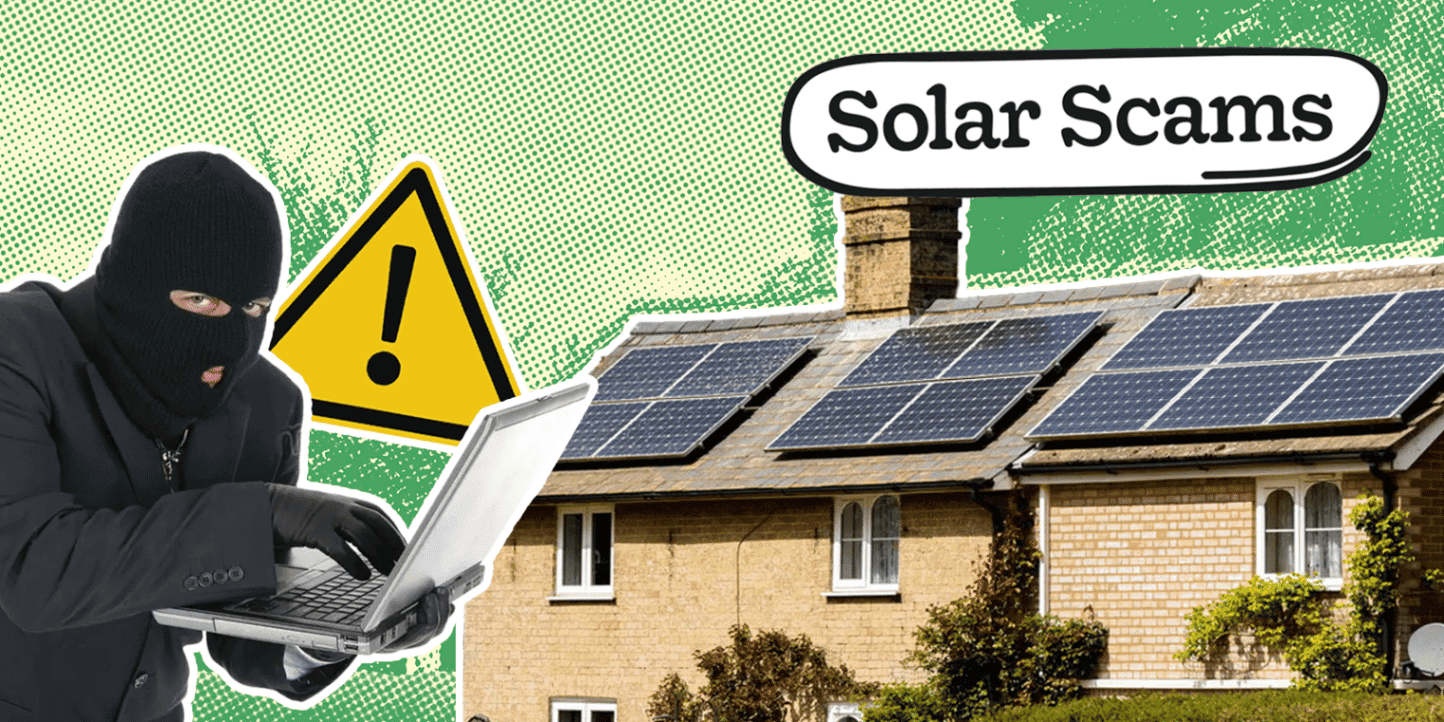

Solar in the UK is booming - and whenever a market takes off, the cowboys aren’t far behind.
Solar itself isn’t the problem. The problem is the sales circus that’s sprung up around it - big-ticket quotes, confusing jargon, and enough grey areas for the wrong people to steer homeowners into terrible deals.
In this guide, we’ll break down the 3-4 most common solar scams we’re seeing right now (the same ones called out in the transcript), show you exactly what they look like in the real world, and give you a dead-simple checklist to avoid getting stitched up.
First: a quick reality check
Solar isn’t the scam. It’s one of the best home upgrades you can make when it’s designed properly, priced fairly, and installed by someone who actually knows what they’re doing.
What is dodgy are the tactics: pressure selling, inflated “savings” projections, proposals built on fantasy assumptions, and fake “official” messages designed to panic you into paying money you don’t need to pay.
The aim here is simple - help you spot the nonsense early, so if you do go solar, you’re buying a system that stacks up in the real world - not on a salesperson’s spreadsheet.
If you’re ready to get your own solar system, we can help. Simply answer a few questions about your home and we’ll give you a fixed installation price for you to consider. It’s totally free and comes with no obligation.
Scam #1: The “sweetened payback” proposal
This one’s the most common because it doesn’t look like a scam. It looks like a “helpful tweak” - and the numbers can seem totally believable.
It usually starts the same way: you like the idea of solar, but you’re fixated on payback. The quote shows (say) a nine-year payback, and you want five or six.
A decent installer will give it to you straight: you might not be able to hit that number without spending more or changing the spec.
A cowboy does the opposite. They “redesign” the system and - magically - the payback drops. And they’ll often blame it on something that sounds technical (“we moved a few panels”, “we’ve switched the battery brand”, “we’ve optimised the layout”). But the real trick is nearly always hidden in the assumptions behind the savings model.
If you’d rather see how this works (and what to look for), watch our YouTube video on solar scams - it covers the same tactics with real examples:
The three main ways they fiddle the maths
1) Inflating the electricity unit rate
Every proposal has to assume what you’ll pay per kWh over time.
If they quietly use a higher import rate than you actually pay today - or pick an “expected” rate that’s conveniently gloomy - your projected savings jump and the payback looks shorter.
2) Cranking up energy price inflation
Solar is long-term. So if they model a higher annual inflation rate, the savings compound harder year after year. The graph looks incredible. The payback shrinks. Reality may not cooperate.
3) Exaggerating export rates
This one’s a classic: “We’ve seen customers get 20–40p/kWh for export.”
Then they bake that into your quote, even if your likely export rate is nowhere near it. Bigger savings on paper. Quicker payback. Higher chance you sign.
There’s often a fourth trick too: inflating your future usage.
“You might get an EV.” “You might get a heat pump.”
So they model you at a much higher annual consumption than your bills show today - not because it’s good planning, but because it makes solar look like it offsets more of your spend.
How to avoid it (without needing an engineering degree)
Ask them to show the assumptions in writing. Specifically:
What import unit rate (p/kWh) are you using?
What energy inflation rate (%) are you using?
What export rate (p/kWh) are you using - and which tariff is that based on?
What annual consumption (kWh) are you using - and is it based on my bills?
If they won’t answer clearly - or they act offended that you asked - you’ve learned everything you need to know.
Scam #2: The “surveyor” who turns up to hard-sell you
This one is less subtle and more… grim.
You enquire about a solar survey, and the person who arrives isn’t there to survey your roof - they’re there to close you.
In the transcript it’s played for laughs, but the behaviour is painfully real: barely looks at the roof, talks fast, creates fake urgency, then hits you with a massive “today only” discount.
The giveaway is the discount itself. If someone can drop £8,000 on the day, that price was padded to begin with.
The discount is designed to make you feel like a “special customer” and panic-sign because you think you’re getting a rare deal.
Then comes the worst part - refusing to leave, guilt-tripping you (“I drove three hours”), and making you feel awkward in your own home.
What to do if this happens
You don’t negotiate. You don’t explain. You end it.
Tell them plainly: “We’re not making a decision today. Please leave.”
If they push back, repeat it. If they still won’t leave, call someone you trust to come round and escalate if needed. You’re not being rude - you’re protecting yourself.
A reputable installer will never trap you into a decision.
Scam #3: Fake “MCS inspection required” letters
This one’s designed to scare you into acting fast - and it’s especially grim when it’s aimed at older homeowners.
It usually lands as a letter or email that looks official and urgent, with wording like:
“MCS inspection required”
“Act now or you’ll lose FIT/export payments”
“System could be void”
“We need to do a meter reading”
But the goal isn’t “compliance”. The goal is access.
They want you to ring the number, book a visit, and let someone into your home for a phoney “inspection” - which then turns into a hard sell for “essential maintenance”: inverter replacements, meter swaps, panel cleaning, call-out fees… whatever they can justify once they’re through the door.
People fall for it because it sounds technical, serious, and time-sensitive - and because nobody wants to risk losing payments they rely on.
The simple rule that protects you
Never call the number on the letter.
If MCS (or any legitimate body) genuinely needs to contact you, you can verify it the safe way:
Go to the official website yourself (don’t click any links in the message).
Find the real contact details from the site.
Ask them directly if the communication is genuine.
If the letter is real, you’ll be able to confirm it independently. If it’s a scam, you’ve just dodged the whole trap - because impersonation is the trick, and the fake phone number is the hook.
Scam #4: “We’ll buy your FIT payments” for a quick lump sum
If you’re on the old Feed-in Tariff (FIT) scheme, you might get offered a one-off lump sum to “buy” the remaining payments on your contract.
It’s pitched like easy money: “Take a couple of grand now and be done with it.”
The reason they’re offering is simple: it’s often a great deal… for them.
They’re trying to purchase a stream of guaranteed(ish) income for a fraction of what it’s worth - and because it feels like “free money”, people say yes without running the numbers.
If you ever get offered this, treat it like any finance deal:
Slow down
Read everything
Get independent advice
And if they push you to sign quickly, that’s not a coincidence - that’s the whole tactic.
How to buy solar safely (the Heatable way)
Solar should feel boring.
No drama. No pressure. No “magic maths”.
Before you sign anything, you want two things:
A quote built on realistic assumptions, and
A company that gives you breathing space to think.
If you want a quick sanity-check framework to compare quotes properly, ask for these in writing:
Total system price (fully installed, including VAT)
System size (kWp)
Battery model (if included)
Assumed import unit rate (p/kWh) + inflation rate (%)
Assumed export rate (p/kWh) (and which tariff it’s based on)
Annual usage (kWh) used in the model (and whether it’s from your bills)
If an installer won’t share those details, you’re not being “fussy” - they’re being slippery.
Final thought
Solar is brilliant. The scams are not.
If your quote relies on pressure, huge “today only” discounts, or payback numbers that feel a bit too perfect, take a step back.
A good installer will still be a good installer tomorrow.
And if you want to go deeper on the scams (including the FIT buyout angle), watch our YouTube video on solar scams - it’s the same subject, just with examples and walkthroughs: [Watch the video: Solar scams explained].
Next Steps For Your Solar Journey:
When planning to install solar panels for your home, there are several important factors to consider. Make sure to refer to the following guides to help you make informed decisions:
To dive deeper into these topics, head over to our advice section, check out our YouTube channel for informative videos, or read a customer case study to see how others have benefited from their solar installation.
Get a Quote for Solar Today
Without boasting you should get your solar installed with us, here's why:
Thousands of Happy Customers: We boast an average score of 4.9 on Trustpilot, outperforming the market leader.
Which? Trusted Trader: Heatable is proudly recognised as a Which? Trusted Trader.
MCS Accredited: Our accreditation by the Microgeneration Certification Scheme (MCS) ensures high-quality standards.
Exclusive Panels: We offer REA Fusion solar panels, available only through Heatable.
Consumer Protection: As members of the HIES consumer code, we provide 2-year deposit protection.
Flexible Payment Options: Choose from multiple payment methods, including finance options.
Fixed Price Guarantee: Enjoy transparency with no hidden costs.
Save Your Quote: You can save your quote and decide later.
Bespoke Design Tool: Draw your own conclusion (literally) on whether solar is worth it for you, here.