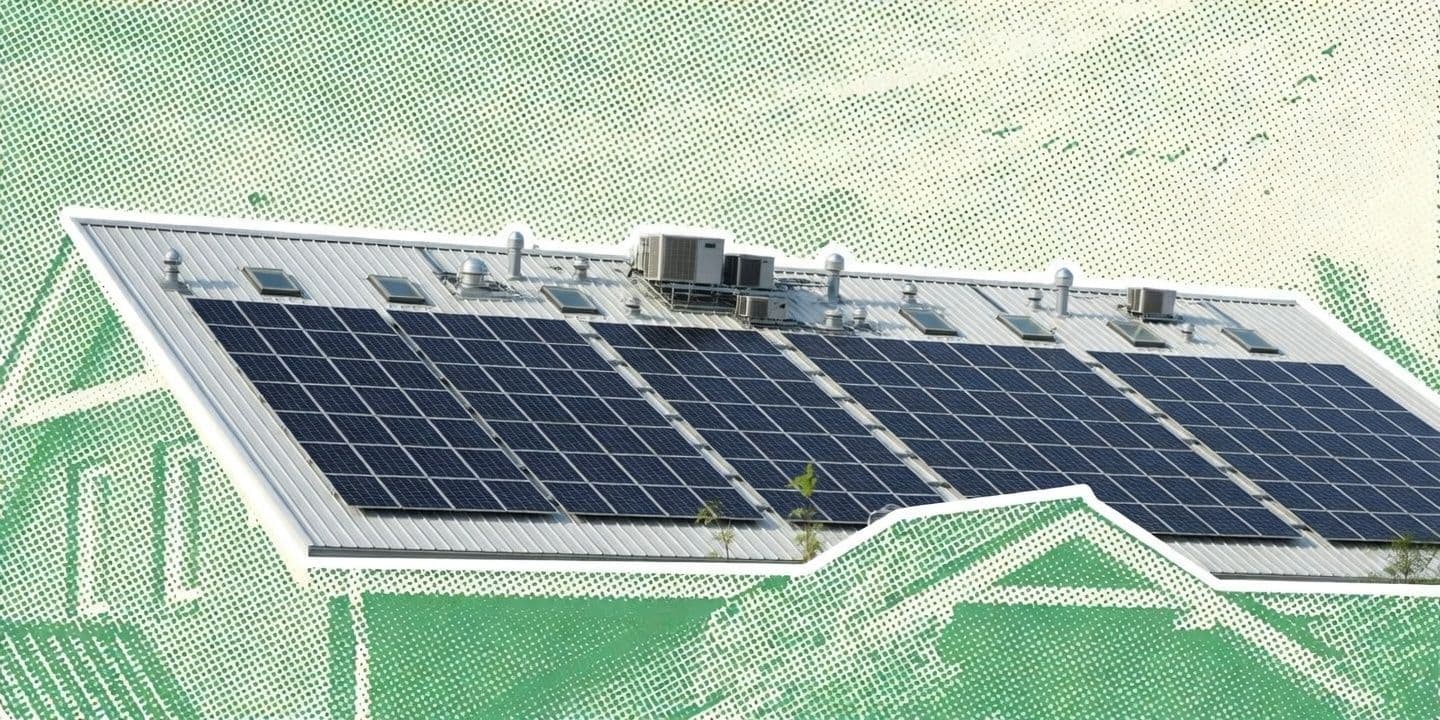

Energy bills still chewing through profits? Carbon reporting breathing down your neck? No wonder solar has jumped from “something to think about” to “why haven’t we done this yet?”
- What Are Commercial Solar Panels?
- Why UK Businesses Are Installing Solar Panels
- How Commercial Solar Panels Save Businesses Money
- Commercial Solar Panels And Battery Storage
- What Types Of Businesses Benefit Most?
- How Much Do Commercial Solar Panels Cost In The UK?
- Commercial Solar Costs, Savings And Payback
- Do Commercial Solar Panels Need Planning Permission?
- What Is Included In A Commercial Solar Installation?
- Choosing A Commercial Solar Installer
- Drawbacks Worth Knowing
- Are Commercial Solar Panels Worth It?
Energy prices remain difficult to predict. Grid connections are becoming a headache for some sites. More businesses are also looking at EV charging, electrification, carbon reduction and ways to take better control of their electricity costs.
Commercial solar panels can help with all of that.
A commercial solar PV system allows your business to generate electricity on site and use it during the working day. For the right site, solar can reduce grid imports, lower bills, improve long-term price certainty and support wider sustainability goals.
But commercial solar should not be treated as a generic roof product.
The right system depends on how your site uses electricity, how much suitable roof or land space you have, how much solar power you can use on site, and whether battery storage would improve the business case.
In this guide, we’ll explain how commercial solar panels work, what they cost, what affects payback, and how to decide whether solar is a good fit for your business.
🔑 Key Takeaways:
Commercial solar panels can help businesses reduce grid electricity imports and improve long-term energy cost certainty.
The strongest projects are designed around real site data, including electricity use, roof suitability, tariff structure and grid connection limits.
Indicative UK commercial solar costs are often around £16,000 to £30,000 for a 20kWp system, £33,000 to £60,000 for a 50kWp system, and £70,000 to £110,000+ for a 100kWp+ system, although complex sites can cost more. Recent UK commercial solar cost guides show similar 2026 ranges.
Payback is usually strongest where a business uses a high proportion of the solar electricity on site, rather than exporting it.
Export payments can help, but they should usually be treated as secondary to avoided grid imports. Ofgem says SEG licensees set their own rates, contract lengths and terms, although tariffs must remain above zero.
Solar PV can work especially well alongside commercial battery storage where the site has surplus generation, evening demand, EV charging plans, demand peaks or export limits.
What Are Commercial Solar Panels?
Commercial solar panels are photovoltaic panels installed on business premises to generate electricity from daylight.
They work in the same basic way as domestic solar panels, but commercial systems are usually larger and more complex.
Instead of being designed around household electricity use, they are designed around commercial loads, operating hours, roof space, grid connection limits and long-term energy plans.
A commercial solar PV system will usually include:
Solar PV panels
Inverters
Mounting equipment
Cabling and isolators
Electrical protection equipment
Generation metering
Monitoring software
Grid connection equipment
Optional battery storage
Optional EV charger integration
The panels generate DC electricity. The inverter converts it into AC electricity your business can use.
That electricity can then be used directly on site, stored in a battery, exported to the grid, or used to support other infrastructure such as EV chargers.
The strongest business case usually comes when your business uses most of the solar electricity itself.
That is why commercial solar design should start with your electricity demand, not just the size of your roof.
Why UK Businesses Are Installing Solar Panels
The obvious reason is cost.
Electricity can be a major operating expense, especially for manufacturers, warehouses, farms, cold storage sites, offices, schools, logistics centres and commercial estates.
Solar PV can reduce the amount of electricity your business buys from the grid. That can lower bills and make long-term energy planning more predictable.
But cost is not the only driver.
Businesses are also looking at solar because it can help with:
Carbon reduction
ESG reporting
Tender requirements
Customer and investor expectations
EV charging plans
Electrification
Energy resilience
Better use of unused roof or land space
For many companies, solar turns an underused roof into a productive energy asset.
It is not right for every site, but where the fundamentals are strong, commercial solar can be one of the more straightforward ways to reduce energy costs and carbon emissions at the same time.
How Commercial Solar Panels Save Businesses Money
Commercial solar creates value mainly by reducing grid imports.
When your panels are generating electricity, your business can use that power directly instead of buying electricity from the grid. This is especially useful for businesses that operate during daylight hours, because solar generation and business electricity demand often overlap.
The higher your self-consumption, the better the business case usually becomes.
For example, a business that uses most of its solar electricity on site will usually see a stronger return than a business that exports a large share of its generation at lower export rates.
Commercial solar can also help by:
Reducing exposure to future energy price rises
Turning unused roof or land space into an energy asset
Supporting carbon reporting and ESG goals
Reducing grid demand during daylight hours
Supporting battery storage and EV charging strategies
The key point is simple:
Solar is usually most valuable when the electricity is used on site.
Export income can help, but avoided grid electricity is normally the bigger prize.
Commercial Solar Panels And Battery Storage
Commercial solar PV and battery storage often work well together.
Solar panels generate electricity during daylight hours. A commercial battery can store surplus electricity and release it later, when the business needs it more.
That can be useful where:
Solar generation exceeds demand at certain times
The business has evening or early-morning electricity use
Export rates are much lower than import rates
The site has export limits
EV charging is planned
The business has demand peaks
Grid capacity is constrained
A battery is not automatically right for every solar project.
Some businesses have enough daytime demand to use most of their solar electricity without one. Others may see a stronger return by storing surplus generation instead of exporting it.
The right answer comes from modelling the site properly.
The goal is not to install the biggest possible battery. It is to design the solar and battery system that gives the strongest commercial result.
What Types Of Businesses Benefit Most?
Commercial solar tends to work best for businesses with suitable roof or land space and meaningful electricity use during daylight hours.
Strong candidates often include:
Manufacturing Businesses
Manufacturers often have high daytime electricity demand from machinery, motors, compressors, lighting, ventilation and production lines.
Solar can reduce grid imports during operating hours and may also work with battery storage to reduce demand peaks.
Warehouses And Logistics Sites
Warehouses and logistics centres often have large roof areas and growing electricity demand from lighting, refrigeration, handling equipment, EV charging and fleet electrification.
Solar can help reduce operating costs and support future electrical demand.
Farms And Rural Businesses
Agricultural businesses may have large roof or land areas, seasonal electricity loads and rural grid constraints.
Solar can be attractive for farms, estates, poultry units, dairies, grain stores and other high-consumption rural sites.
Cold Storage And Food Production
Cold storage and food production sites can have high and consistent electricity demand.
Solar PV can reduce daytime grid imports, while battery storage may help manage demand peaks or improve use of surplus generation.
Offices, Schools And Public Buildings
Offices, schools, councils, healthcare buildings and public facilities often use electricity during daylight hours.
Solar can reduce bills, support decarbonisation targets and improve long-term energy planning.
Retail, Leisure And Hospitality Sites
Retail units, gyms, hotels, leisure centres and hospitality sites may also benefit, depending on opening hours, electricity use, roof space and whether battery storage is needed.
The common thread is not the sector itself.
It is the energy profile.
Solar works best where the site can use a good share of the electricity it generates.
How Much Do Commercial Solar Panels Cost In The UK?
Commercial solar panel costs vary depending on system size, roof type, access, electrical works, grid connection requirements and whether battery storage is included.
As a broad guide, recent UK commercial solar cost estimates suggest the following installed ranges:
System size | Typical site | Indicative installed cost | Typical installed cost per kWp |
20kWp | Medium office, retail unit | £16,000 to £30,000 | £800 to £1,500/kWp |
50kWp | Medium warehouse, factory, school | £33,000 to £60,000 | £660 to £1,200/kWp |
100kWp | Large industrial, logistics site | £70,000 to £110,000+ | £700 to £1,100/kWp |
250kWp | Factory, logistics hub, estate | £175,000 to £275,000+ | Often around £700 to £1,100/kWp |
These are indicative ranges, not fixed prices.
A simple roof with good access and straightforward electrical works may sit towards the lower end of the range. A more complex site may cost more.
The final price can be affected by:
Roof type and condition
Roof access
Scaffolding or lifting equipment
Structural requirements
Panel and inverter specification
Mounting system
Cable runs
Distribution board works
Fire safety requirements
Monitoring equipment
DNO/grid connection requirements
Planning requirements
Battery storage integration
EV charger integration
Larger systems often have a lower cost per kWp because fixed project costs are spread across more panels.
But bigger is not always better.
The best system size is the one that gives the strongest return for the site.
Related: Solar panels for warehouses
Commercial Solar Costs, Savings And Payback
The table below gives broad market ranges only. Actual savings depend heavily on electricity prices, self-consumption, export rates, system performance and site-specific installation costs.
System size | Typical site | Indicative installed cost | Indicative annual savings | Typical payback |
20 kWp | Small office, shop, café | £16,000 to £30,000 | £4,000 to £6,000 | 4 to 6 years |
50 kWp | Warehouse, school, medium office | £33,000 to £60,000 | £10,000 to £15,000 | 3 to 5 years |
100 kWp | Larger warehouse, supermarket, factory | £70,000 to £110,000+ | £18,000 to £28,000 | 3 to 5 years |
250 kWp | Factory, logistics hub, large estate | £175,000 to £275,000+ | £40,000 to £65,000+ | 3 to 6 years |
These figures assume a well-matched system where the business uses a high proportion of the solar electricity on site.
Savings may be lower if the business exports a large share of generation, has low daytime demand, needs significant roof or electrical works, or faces DNO constraints.
Savings may be higher where the site has high daytime demand, high import electricity costs, a straightforward installation, strong self-consumption and a good case for battery storage.
A credible proposal should not just show a headline saving.
It should show the assumptions behind it.
That includes expected generation, self-consumption, export, import tariff, export tariff, maintenance costs and payback.
Example: Why Self-Consumption Matters
Commercial solar savings are usually driven by avoided grid electricity purchases.
For example, a well-positioned 100kWp commercial solar system may generate roughly 90,000 to 100,000kWh per year in the UK, depending on location, roof orientation, shading and system design.
If the business uses most of that electricity on site and avoids buying electricity at around 20p to 28p per kWh, the gross annual benefit could be in the region of £18,000 to £28,000, before maintenance, degradation, finance costs and export assumptions.
But the same system may perform less strongly if the business exports a large share of its generation, because export tariffs are usually lower than import electricity prices.
That is why self-consumption is so important.
For most businesses, the financial case is strongest when solar electricity is used directly on site or stored in a battery for later use.
Smart Export Guarantee Payments
Some businesses may be able to earn money by exporting surplus solar electricity through the Smart Export Guarantee.
However, export income should usually be treated as a secondary benefit.
Ofgem says SEG licensees set their own tariff rates, contract lengths and terms, and that tariff rates must remain above zero. Payments are based on export meter readings.
The practical point is simple:
Using solar electricity on site is usually more valuable than exporting it.
If your business avoids buying electricity at 20p to 30p per kWh, that will usually be worth more than exporting surplus electricity at a lower rate.
This is one of the main reasons commercial solar systems should be designed around site demand.
Where a site is likely to export a lot of electricity, battery storage may improve the business case by storing surplus generation for later use.
Grants, Tax Relief And Incentives
There is no universal “free solar for businesses” grant.
However, several financial mechanisms may improve the business case.
Incentive | What it may mean | Important caveat |
Annual Investment Allowance | Qualifying businesses may be able to deduct eligible plant and machinery expenditure from taxable profits. | Treatment depends on the business, asset and current tax position. Confirm with an accountant. |
Full expensing / capital allowances | Some companies may be able to claim tax relief on qualifying expenditure. | Eligibility depends on current tax rules and business structure. |
Business rates treatment | Eligible onsite renewable energy generation and storage equipment may benefit from business rates support. | The government has stated that eligible rooftop solar panels, wind turbines and battery storage are exempt from business rates from 1 April 2022 until 31 March 2035. |
Smart Export Guarantee | Businesses may be paid for eligible exported electricity. | SEG rates and terms vary by supplier and are usually less valuable than avoided grid imports. |
Local or sector funding | Some businesses may qualify for regional, agricultural, public sector, charity or sector-specific support. | Availability changes and should be checked during feasibility. |
A third party may fund the system and sell electricity to the business under contract. | Reduces upfront cost, but contract terms need careful review. |
Businesses should take tax advice before relying on any tax relief in a financial model.
Carbon Savings From Commercial Solar Panels
Commercial solar panels can help businesses reduce carbon emissions by reducing the amount of grid electricity they import.
However, carbon savings should be calculated using the latest UK Government greenhouse gas conversion factors for company reporting. DESNZ publishes these factors for UK and international organisations to report greenhouse gas emissions.
This matters because the carbon intensity of UK electricity changes over time as the grid decarbonises.
A credible commercial solar proposal should show:
Expected annual solar generation
Estimated grid electricity displaced
The emissions factor used
The reporting year
Whether exported electricity is treated separately
That is more defensible than relying on a generic “tonnes of CO₂ saved” claim.
Do Commercial Solar Panels Need Planning Permission?
Many commercial rooftop solar installations fall under permitted development rights, but not all.
The rules depend on the building, location and system design.
Planning permission may be more likely where:
The building is listed
The site is in a conservation area
The system is ground-mounted
The installation is visually prominent
The equipment exceeds permitted development limits
Even where planning permission is not required, building regulations still apply.
That means the project still needs to consider structural suitability, wind loading, roof integrity, electrical safety, fire safety and grid connection requirements.
A good installer should assess this early, not after the system has already been sold.
ℹ️ Get renewable energy consultancy with Heatable
Grid Connection Requirements
Grid connection is one of the most important parts of a commercial solar project.
The local network may limit how much solar can be connected, how much electricity can be exported, or whether additional equipment is needed.
Depending on the system, the project may require approval from the Distribution Network Operator, usually known as the DNO.
Grid considerations can include:
Existing import capacity
Proposed export capacity
Local network constraints
Export limitation
Protection settings
Metering requirements
Battery storage integration
EV charging plans
Future site expansion
Some sites may be allowed to install solar but limited in how much they can export.
In those cases, the design may need to include export limitation, battery storage or a system size that is better matched to on-site demand.
What Is Included In A Commercial Solar Installation?
A proper commercial solar installation is not just panels on a roof.
It is a full energy system designed to generate, convert, monitor and safely deliver electricity for decades.
A commercial solar PV installation may include:
Site survey
Feasibility assessment
Roof and shading review
Structural checks
System design
Solar PV panels
Inverter or inverters
Mounting system
Cabling and isolators
Electrical protection equipment
Monitoring software
DNO/grid connection support
Scaffolding or access equipment
Commissioning
Handover documentation
Optional battery storage
Optional EV charger integration
Ongoing maintenance recommendations
The important part is the design.
Good design is not just about fitting as many panels as possible.
It is about fitting the right system for the site’s electricity use, tariff, roof space and commercial goals.
Choosing A Commercial Solar Installer
Commercial solar is a long-term infrastructure investment.
The quality of the installer can determine whether the system performs as expected.
When comparing installers, look for:
Commercial solar experience
MCS accreditation where relevant
Clear modelling and assumptions
Site-specific design
Grid connection experience
Structural and electrical competence
Battery storage capability
Monitoring and maintenance support
Strong warranties
Insurance and consumer protection
Relevant case studies
Transparent pricing
Be cautious with any proposal that focuses only on panel count, headline savings or generic payback claims.
A good commercial solar proposal should explain the site, the system, the assumptions, the constraints and the commercial case.
At Heatable, our commercial solar and battery storage service is designed around the business case first.
That means looking at your site, electricity usage, roof, tariff, grid position and future energy plans before recommending a system.
Drawbacks Worth Knowing
Commercial solar can be a strong investment, but it is not right for every site.
The main drawbacks are:
Upfront cost: solar requires capital, finance or a long-term commercial agreement.
Roof suitability: some roofs are too shaded, weak, old, awkward or limited in usable space.
Grid constraints: local network limits may affect system size or export.
Planning and compliance: listed buildings, conservation areas and ground-mounted systems may need extra permissions.
Installation disruption: scaffolding, roof access and short electrical shutdowns may be required.
Design risk: a poorly sized system can underperform if it is not matched to actual demand.
None of these issues are necessarily deal-breakers.
But they should be assessed before the project goes ahead.
Are Commercial Solar Panels Worth It?
For many businesses, yes, but only where the site fundamentals are strong.
Commercial solar panels can reduce electricity costs, improve long-term price certainty, support carbon reduction and turn unused roof or land space into a productive energy asset.
The strongest returns usually come from sites with:
High electricity consumption
Meaningful daytime demand
Suitable roof or land space
Limited shading
Straightforward installation conditions
Strong self-consumption
High import electricity costs
A clear grid connection route
A credible funding structure
Proper maintenance and monitoring
Solar may be less attractive where daytime demand is low, the roof is unsuitable, major electrical upgrades are needed, or a large share of generation would be exported at low rates.
The right question is not simply:
“Are solar panels worth it?”
The better question is:
“What size and structure of solar PV system gives this specific site the strongest commercial return?”
That answer requires proper modelling.
How To Get Started
The first step is to assess whether commercial solar is viable for your site.
That usually means reviewing:
Half-hourly electricity data
Current and future electricity demand
Existing tariff structure
Import and export limits
Roof or land availability
Roof condition
Electrical infrastructure
Planning constraints
EV charging plans
Battery storage potential
Funding preferences
From there, the system can be modelled properly.
The output should not just be a solar panel quote.
It should be a commercial recommendation that explains the expected savings, costs, risks, payback period and best-fit system design.
Financial Disclaimer
The figures in this guide are indicative and for general information only.
They are not a quote, financial advice, tax advice or a guaranteed return.
Actual costs, savings and payback periods depend on site-specific factors, including electricity usage, tariff structure, system size, installation complexity, grid connection requirements, export terms, maintenance costs, finance costs and future energy prices.
Businesses should obtain a site-specific feasibility assessment and seek professional tax or financial advice where required before making an investment decision.
Considering Commercial Solar Panels For Your Business?
Commercial solar panels can reduce energy costs, improve energy resilience, support carbon reduction and help businesses take more control over electricity use.
But the business case depends on the site.
The right next step is a proper feasibility assessment using real energy data, roof information and commercial modelling.
Speak to Heatable about commercial solar panels for your business.