
Thinking about getting solar panels? You’ve probably seen two terms pop up: solar thermal and solar PV.
At first glance, they sound similar. Both use the sun’s energy. Both go on your roof. Both can help lower your energy bills.
But that’s pretty much where the similarities end.
They do completely different things - and for most UK homeowners, one is usually a much smarter investment than the other.
Here’s the no-nonsense breakdown of solar thermal vs solar PV, including the costs, the savings, the pros, the cons, and which one is most likely to make sense for your home.
⚡ If you’re already thinking solar looks like a good shout, you can get a fixed price in 60 seconds with Heatable’s quote tool - no pushy calls, no awkward “just checking in” texts, just a free design and instant price.
What is solar thermal?
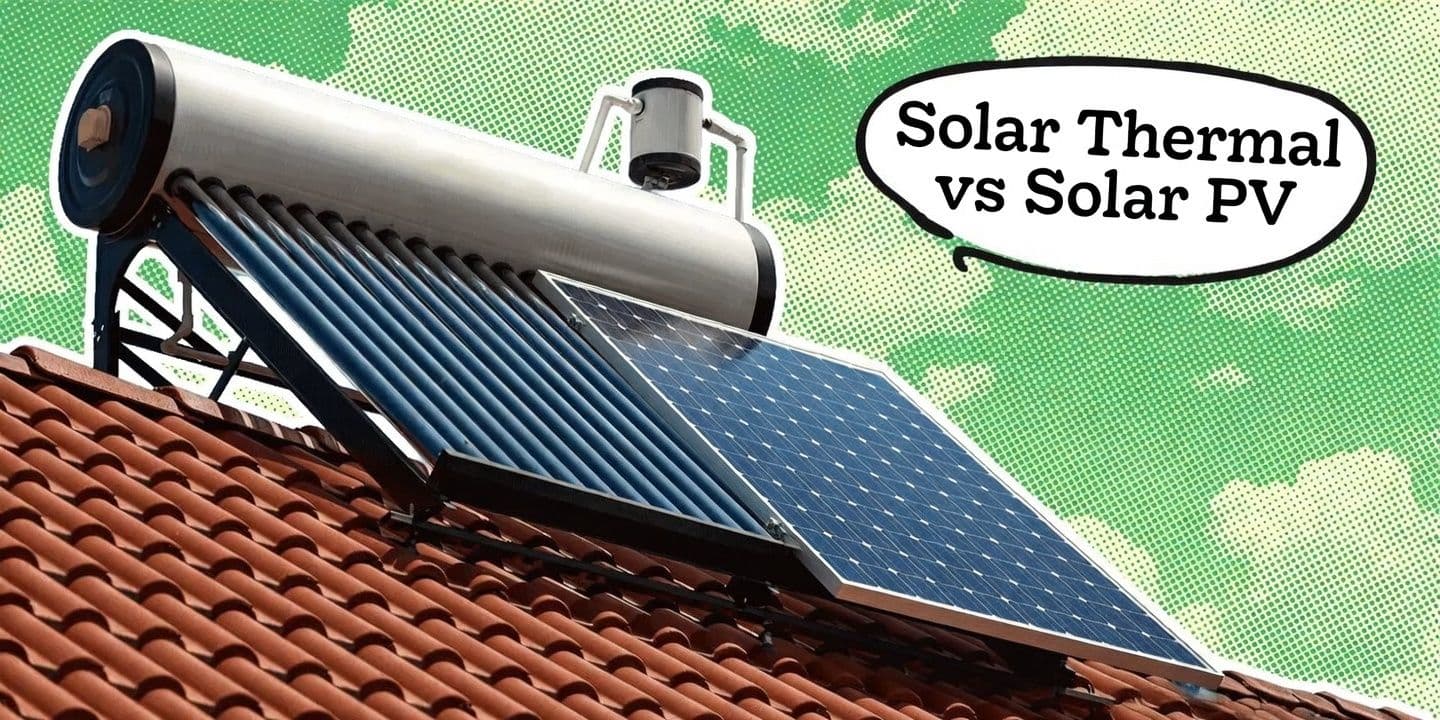
Solar thermal uses the sun’s heat to warm your home’s hot water.
Collectors fitted to your roof absorb heat from sunlight, while a special fluid carries that heat to your hot water cylinder through something called a heat exchanger. From there, the hot water can be used for your taps, showers and baths.
In simple terms, it helps take some of the strain off your boiler when it comes to heating water.
It works best in spring and summer, when there’s more sunshine to play with. In winter, when sunlight drops off, your boiler or immersion heater steps back in to do the heavy lifting.
Most solar thermal systems can cover around 40–60% of a household’s annual hot water demand.
Not bad - but in the UK, it still means you’ll be relying on a backup for a fair chunk of the year.
What is solar PV?
Solar PV, short for photovoltaic, is what most people are talking about when they say solar panels.
Rather than heating water directly, solar PV panels convert sunlight into electricity.
That electricity can then be used to run your lights, fridge, TV, washing machine, chargers and just about everything else in your home.
If your system generates more power than you need, you can usually export the excess to the grid for money or store it in a battery to use later.
So while solar thermal has one main job, solar PV is far more versatile.
And that’s a big reason why it’s become the go-to choice for most UK homeowners.
Solar thermal vs solar PV: what’s the actual difference?
Here’s the simple version:
Solar Thermal | Solar PV | |
What it produces | Hot water | Electricity |
Man use | Showers, baths, taps | Lights, appliances, EV charging, heat pumps |
How it works | Uses heat from the sun | Converts sunlight into electricity |
Best for | Homes with high hot water demand | Homes wanting lower electricity bills |
UK performance | Strong in summer, weak in winter | Useful all year round |
So if you want the one-line answer: Solar thermal heats water. Solar PV powers your home.
That’s the difference.
Which is cheaper to install?
If you’re looking purely at upfront cost, solar thermal usually comes in cheaper.
Typical prices are roughly:
Solar thermal: £4,000 to £6,000
Solar PV: £5,000 to £8,000 for a typical 3.5–4 kWp system
So on paper, solar thermal can look like the cheaper option.
But that doesn’t automatically make it the better deal.
Solar PV usually delivers better overall value because it tends to save more money over time, gives you more flexibility, and currently benefits from 0% VAT on installation. Solar thermal, on the other hand, has less support and is much less commonly installed.
So yes, solar thermal often costs less to buy.
But in many cases, solar PV gives you more back for your money.
Which one saves more money?
This is where the gap starts to open up.
Solar thermal savings
Solar thermal can cut the cost of heating your hot water by around 50% on average.
That sounds solid - and it is - but there’s a catch: hot water is only one part of your overall energy bill.
For a typical household, that usually works out at around £100 to £250 a year in savings, depending on how your water is heated and how much hot water you use.
So yes, it can help.
But it’s unlikely to transform your bills.
In most cases, payback is fairly slow too - often 10 to 15 years or more.
Solar PV savings
Solar PV usually makes a much bigger impact because it helps offset electricity, which is significantly more expensive than gas.
A well-sized system can often save around £300 to £750 a year, depending on:
how much electricity you use during the day
whether you export surplus power to the grid
whether you add a battery
how well the system is matched to your home’s usage
That usually means a quicker payback as well - often around 8 to 12 years.
So for most homeowners, solar PV comes out comfortably ahead on savings.
Which one performs better in the UK?
This is where things can get a bit confusing.
On paper, solar thermal is more efficient than solar PV at turning sunlight into usable energy.
Typical efficiency levels look like this:
Solar thermal: around 60–70%
Solar PV: around 15–22%
So why doesn’t everyone just go for solar thermal?
Because efficiency on paper isn’t the same as value in real life.
Solar thermal is very good at one specific job: heating water. But that’s also its limitation.
It can’t power your appliances, lower your general electricity use or give you the same flexibility as solar PV. And like most solar tech, it performs best in brighter conditions - not exactly a year-round guarantee in the UK.
Solar PV, on the other hand, keeps generating electricity throughout the year, even on grey and cloudy days. And that electricity can be used across your home in all sorts of ways.
So while solar thermal may be more efficient in technical terms, solar PV is usually more useful for everyday life.
And for most homeowners, that matters more.
Solar thermal: pros and cons
Like most home upgrades, solar thermal has its strengths - but it’s not without compromises.
Pros
Great for hot water in spring and summer
Helps reduce boiler use
Usually needs less roof space than solar PV
Well-established technology with a lifespan of around 20–25 years
Cons
Only heats water
Savings tend to be modest
Payback is often slower
Needs more maintenance than solar PV
Less common in the UK, which means fewer installers and fewer support schemes
That doesn’t mean solar thermal is a bad option.
It just means that for the average UK home, it can be a harder sell.
Solar PV: pros and cons
For most homeowners, solar PV is the more attractive all-round package.
Pros
Powers far more than just hot water
Usually delivers bigger overall savings
Low maintenance
Long lifespan, often 25–30+ years
Works well with batteries, EV chargers and heat pumps
Lets you earn money from excess electricity you export to the grid
Cons
Higher upfront cost
Needs enough roof space to make the numbers work
Best savings come when you use electricity during the day - or store it for later
Put simply, solar PV is the more flexible, future-ready option.
And for most UK homes, it fits far better with where energy use is heading.
Can solar PV heat hot water too?
Yes - just not directly.
Solar PV generates electricity, and that electricity can be used to power an immersion heater or support a heat pump, both of which can heat your hot water.
So while solar PV isn’t a dedicated hot water system, it can still play a big part in reducing your water-heating costs.
That’s one of the main reasons many homeowners skip solar thermal and go straight to solar PV.
After all, why install a system that only does one job when another can support almost everything in the home?
Can you have both?
You can - and in some homes, it works well.
A solar thermal system can help with hot water, while solar PV takes care of electricity. If you’ve got plenty of roof space, high overall energy use and the budget to match, combining the two can make sense.
But for most households, it’s probably more than you need.
If you’re deciding where to put your money first, solar PV is usually the smarter investment. It offers wider savings, more flexibility and stronger long-term value.
Then later on, if you’ve still got the roof space and the appetite for it, you can always build on that.
So, which one is better for your home?
Here’s the honest answer: for most UK homes, solar PV is the better buy.
That’s not because solar thermal is pointless - it isn’t. It can still work well in the right property.
But in most cases, solar PV saves more money, gives you more flexibility, and fits better with the way modern homes use energy.
Solar thermal could suit you if:
your main priority is cutting hot water costs
your household uses a lot of hot water every day
you already have a compatible hot water cylinder
you want to reduce your gas use specifically
Solar PV is usually the better choice if:
you want to lower your electricity bills
you want the best overall return
you may want to add a battery later on
you’re thinking about getting an EV or heat pump
you want a system that can do more than one job
For the vast majority of homeowners, solar PV comes out on top.
Not because solar thermal is bad - but because solar PV is simply more useful in more homes.
What else should you think about before choosing?
Before you get too hung up on panel types, efficiency figures or payback periods, start with the basics.
The right system for your home will depend on things like:
how much roof space you’ve got
whether your roof is south-facing, shaded, or somewhere in between
whether you spend more on electricity or hot water
how long you plan to stay in the property
whether your insulation is up to scratch
whether your current boiler setup works well with either option
Because even the best-looking solar system on paper won’t stack up if your roof isn’t suitable or your home is losing heat left, right and centre.
The bottom line
If you’re deciding between solar thermal and solar PV, here’s the blunt version:
For most UK homes, solar PV is the better buy.
It saves more money, gives you more flexibility, works with modern tech like batteries and EV chargers, and helps future-proof your home.
Solar thermal still has a place - especially in homes with high hot water demand - but it’s become a much more niche option.
So unless your main priority is hot water and only hot water, solar PV is probably where your money is best spent.
And before you commit, make sure you get proper advice based on your roof, your energy use and your budget - not a one-size-fits-all sales pitch.
Because the best solar system isn’t the fanciest one.
It’s the one that actually works for your home.
Next Steps for Your Solar Journey:
Check eligibility for ECO4 or other grants via your energy supplier or our funding guide).
Assess your roof using our solar suitability tool.
Get a free quote: Answer a few questions for up to 4 tailored, no-obligation quotes from MCS-certified installers. Start now.
Explore more:
Head to our solar advice hub or YouTube channel for expert tips and real customer stories.