
Octopus cut fixed export payments. Some battery owners found a way around it.
- What happened to solar export payments in 2026?
- How does solar export actually work?
- What is Agile Outgoing Octopus?
- Our real-world test: fixed export vs Agile Outgoing
- Why did Agile Outgoing pay more?
- Can other batteries do the same?
- Can you use Agile Outgoing without a battery?
- Is solar export still worth it?
Solar export payments took a hit in 2026. Octopus Energy reduced its fixed Outgoing export rate from 15p/kWh to 12p/kWh, meaning many solar owners suddenly earned less for sending the exact same electricity back to the grid.
Not ideal.
Especially if you have already invested in solar panels, battery storage, or a full solar and battery system, and your payback figures assumed stronger export rates.
But here’s where it gets interesting.
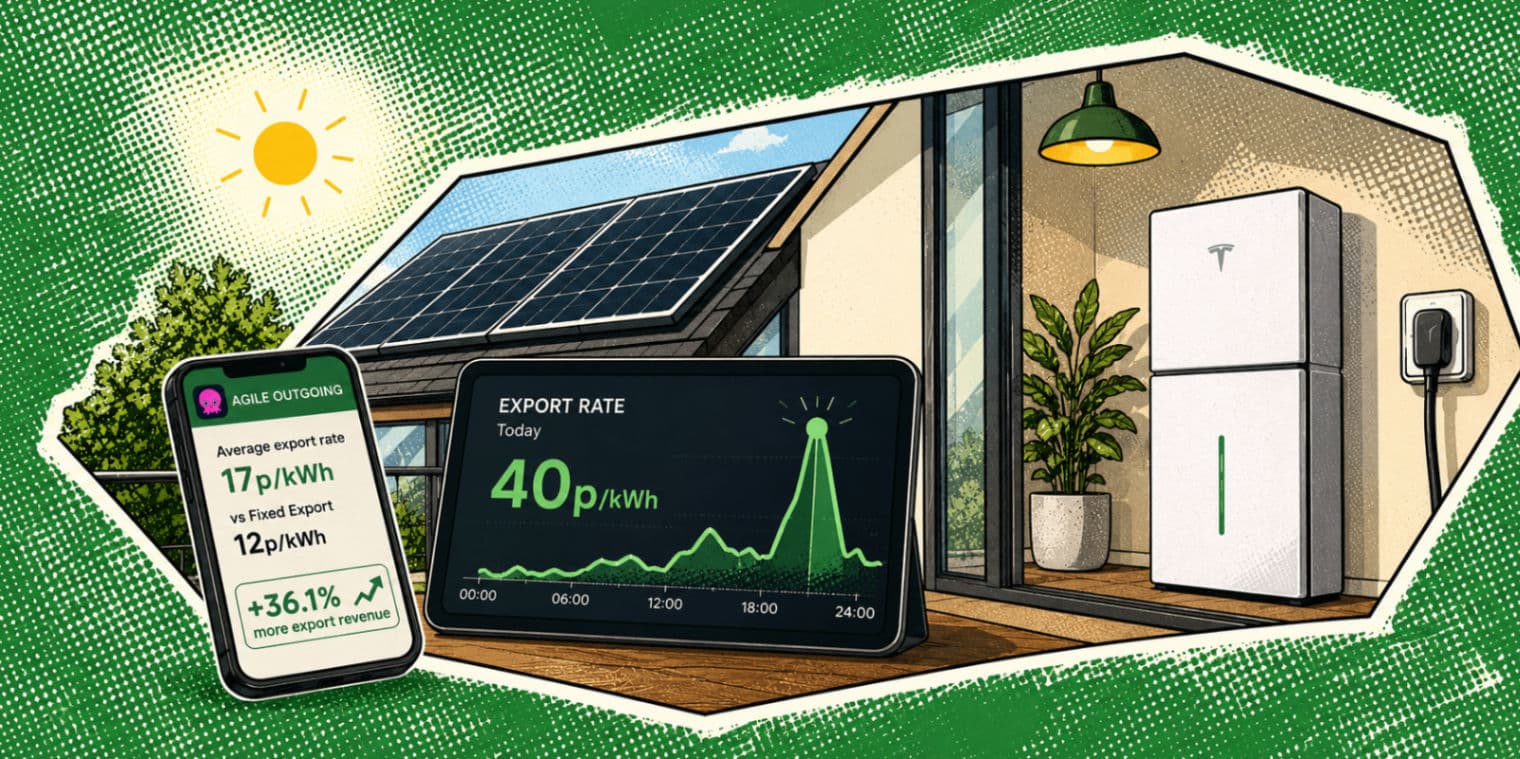
Some battery owners have found a way to beat the new fixed 12p rate by moving to Agile Outgoing Octopus, a tariff that pays different export rates throughout the day.
Instead of getting one flat payment for every exported kilowatt hour, Agile Outgoing follows half-hourly pricing. Export at the wrong time and you may earn less. Export at the right time and you may earn more.
That is where smart battery storage comes in.
We looked at real data from a live Heatable system using 12 solar panels and a Tesla Powerwall 3 to see whether Agile Outgoing could outperform the fixed 12p/kWh export rate.
The result?
The system achieved an average export value of around 17p/kWh, compared with the fixed 12p/kWh rate.
That worked out as a 36.1% uplift in export revenue.
So, is Agile Outgoing Octopus the new solar export cheat code?
Potentially.
But only if your system is smart enough to use it properly.
Check Octopus Energy rates in your area.
Get £50 credit when you switch to Octopus. Existing customer? You may benefit too. T&Cs apply. One switching offer per household.
Referral disclosure: using our Octopus referral link may give you a referral credit, and we may receive a referral reward.
What happened to solar export payments in 2026?
Solar export payments took a hit in 2026.
Octopus Energy, one of the biggest names in the solar export market, reduced its fixed Outgoing Octopus rate from 15p/kWh to 12p/kWh.
That is a 20% cut in the unit rate.
For anyone exporting a meaningful amount of electricity, that matters.
For example:
Export 1,500kWh at 15p/kWh = £225
Export 1,500kWh at 12p/kWh = £180
Difference = £45 lost per year
And if you have a bigger solar and battery setup, the gap gets larger.
The frustrating part is that most customers could not do much about it. You were on the fixed rate, the fixed rate dropped, and that was that.
But some solar battery owners spotted a way around it and they moved away from fixed export pricing altogether.
That is where Agile Outgoing Octopus comes in…
🎥 Watch the full video
Want to see the numbers for yourself?
In the video, we walk through the real Tesla Powerwall 3 export data and show how Agile Outgoing compared with the fixed 12p/kWh export rate.
How does solar export actually work?
When your solar panels generate electricity, that energy usually has three places to go.
First, it goes straight into your home. So if your panels are generating while your kettle, washing machine, dishwasher, oven, heat pump or EV charger is running, your home will use that solar power first.
Second, if you have a battery, any spare solar can charge the battery.
Third, once your home demand is covered and your battery is full, anything left over is exported to the grid.
That exported electricity is usually paid under the Smart Export Guarantee, also known as SEG.
SEG requires certain energy suppliers to pay eligible homes and small generators for low-carbon electricity exported to the grid.
Lovely. Sort of.
Because the rules do not say suppliers have to pay you a great rate. They just have to pay more than zero.
So, technically, 1p/kWh is allowed.
This is why export rates vary so much between suppliers. Some are poor. Some are decent. Some are genuinely competitive.
For a long time, Octopus was one of the stronger options because its fixed export rate was 15p/kWh.
Then it dropped to 12p/kWh and that changed the maths.
Why fixed export tariffs are simple, but not very smart
Most export tariffs are fixed:
If the rate is 12p/kWh, every unit you export is worth 12p.
Morning? 12p.
Afternoon? 12p.
Middle of a sunny, windy day when the grid is drowning in cheap renewable electricity? Still 12p.
Cold evening when demand is higher and electricity is more valuable? Also 12p.
Simple, yes. Smart? Not really…
Because behind the scenes, electricity is not valued at one flat price all day. The UK electricity market works in half-hourly periods. There are 48 of them every day.
The value of electricity changes depending on demand, weather, renewable generation, gas prices and how much energy the grid needs at that exact moment.
A fixed export tariff hides all of that complexity from you.
That is convenient.
But it also means your exported energy is treated the same whether the grid really wants it or not.
What is Agile Outgoing Octopus?
Agile Outgoing Octopus is a variable export tariff.
Instead of paying one fixed rate for every exported kilowatt hour, it pays different rates across the day based on half-hourly wholesale pricing.
So your exported electricity might be worth very little in one half-hour slot, then much more later in the day.
That creates an opportunity.
If you can export electricity when rates are high, you may earn more than you would on a fixed tariff.
The key phrase there is if you can.
Because solar panels on their own are not very controllable. They generate when the sun is shining, and if you are not using the electricity or storing it, the excess goes to the grid.
That might happen when export prices are low.
A battery changes the game.
A smart battery can store energy, hold it back, then discharge or export when it makes more financial sense.
That is the “cheat code”. Not cheating, obviously. Calm down, Ofgem. Just using the tariff properly.
Our real-world test: fixed export vs Agile Outgoing
We looked at data from Dave, who works in Heatable’s technical team.
His setup is:
12 solar panels
Tesla Powerwall 3
Octopus Go for import
Agile Outgoing Octopus for export
Before the 2026 rate drop, Dave was on the fixed Outgoing Octopus tariff earning 15p/kWh.
When Octopus reduced that fixed rate to 12p/kWh, Dave moved his export to Agile Outgoing instead.
He then tracked his export data over roughly 60 days and during that period, his system exported 825kWh.
If he had stayed on the fixed 12p/kWh export tariff, that export would have earned around £100.76.
But on Agile Outgoing, his actual earnings were higher, with the average export value coming out at roughly 17p/kWh.
That is around 5p/kWh more than the fixed 12p/kWh rate. In percentage terms, that is a 42% uplift in the average export rate.
More importantly, it created a 36.1% uplift in actual export revenue. That is the number that matters because that is the money going back into your account.
Why did Agile Outgoing pay more?
Because Dave’s system was not just exporting randomly.
His Tesla Powerwall 3 was helping decide when energy should be stored, used or exported.
This is the important bit.
A battery is not just a big box on the wall. At least, a good one is not.
A smart battery can look at things like:
your home’s normal energy use
tomorrow’s solar forecast
current battery charge
import tariff pricing
export tariff pricing
the best times to charge
the best times to discharge
the best times to export
So instead of simply filling up with solar and dumping the rest to the grid whenever it happens, the system can make better decisions.
For example, if tomorrow is going to be sunny, the battery may leave space for free solar generation.
If tomorrow is going to be dull, it may charge more overnight on a cheaper import rate.
If export prices are expected to spike later in the day, the system can preserve energy and export when that electricity is worth more.
That is how you squeeze more value out of the same solar panels.
Same roof. Same sun. Better timing.
Why Tesla Powerwall 3 matters here
Dave’s result was helped by the fact he has a Tesla Powerwall 3.
The Tesla system is one of the strongest home battery options for this kind of tariff strategy because it can automate much of the decision-making.
That automation is the difference between “this is clever” and “this is a full-time admin job”.
Without automation, you are basically asking a normal person to watch half-hourly rates, weather forecasts, battery levels and household usage patterns every day.
Nobody wants that.
Well, almost nobody. There is probably someone with a spreadsheet and too much coffee who does. But for most households, it needs to be automatic.
The Powerwall 3 helps make that possible.
It can optimise around your usage, generation and tariff structure, which is exactly what you want if you are trying to make Agile Outgoing work properly.
Can other batteries do the same?
Some can get part of the way there.
There are other smart battery brands that can read tariff data, use scheduled charge and discharge windows, or integrate through third-party systems.
Some may simulate a similar strategy, but you need to be careful here.
Not every battery can properly optimise around Agile Outgoing. Some systems are excellent at basic storage but poor at dynamic tariff management.
That does not make them bad batteries.
It just means they may not be the best choice if your goal is to actively maximise export revenue from half-hourly pricing.
So before moving to Agile Outgoing, check whether your battery can actually do anything useful with the tariff data.
If it cannot, you may not get the same benefit.
Can you use Agile Outgoing without a battery?
You can, but it is much less compelling.
Without a battery, your solar export is mostly dictated by the sun and your household demand.
If your panels are generating more than you are using at midday, you export.
If export prices are poor at that time, tough, you do not have much control.
A battery gives you control. It lets you shift energy from one time of day to another, that is the whole point.
So for solar-only homes, Agile Outgoing may still work in some cases, but the argument is weaker.
For solar and battery homes, especially with a smart battery, the argument becomes much more interesting.
Should you switch from fixed export to Agile Outgoing?
Possibly, but not blindly.
Agile Outgoing may be worth considering if:
you have solar panels
you export a decent amount of electricity
you have battery storage
your battery can automate around tariff data
you are currently on a lower fixed export rate
you are comfortable with variable export payments
It may be less suitable if:
you do not have a battery
you want completely predictable payments
your battery cannot optimise charging and export
you barely export any electricity
you do not want to think about tariffs at all
The boring answer is that it depends on your system.
The useful answer is that if you have a Tesla Powerwall 3 and you are currently exporting at 12p/kWh, Agile Outgoing is absolutely worth investigating.
Dave’s system suggests the upside can be meaningful.
Is solar export still worth it?
Yes.
But the market is changing.
The old version of solar export was simple:
Generate electricity, use what you can, export the rest, get a fixed payment.
The newer version is smarter:
Generate electricity, store it, forecast demand, track pricing, and export when the grid values that energy more highly.
That is where solar battery systems are heading and export payments are not becoming worthless, but are becoming more strategic.
And that means the quality of your battery, the tariff you choose and the way your system is configured all matter more than they used to.
What does this mean if you are buying solar now?
If you are looking at solar panels in 2026, export payments should still be part of your payback calculation.
But you should not look at export rates in isolation.
You need to think about the full system:
how much electricity your home uses
when you use it
how much solar your roof can generate
whether you need battery storage
how much battery capacity makes sense
what import tariff you will use
what export tariff you will use
whether the battery can automate around those tariffs
This is where a proper design matters.
A cheap system that cannot adapt to the changing energy market may end up being a false economy.
A better-designed system with the right battery and tariff strategy may produce more usable savings over time.
Heatable can help
If you are considering solar panels, a Tesla Powerwall 3 or a full solar and battery system, Heatable can help you work out what actually makes sense for your home.
You can get an online quote or book a free design call with one of our solar experts.
We can help you understand:
how many solar panels your roof can take
how much electricity your system could generate
whether battery storage is worth it
how much energy you are likely to export
how tariffs affect your payback
whether a Tesla Powerwall 3 is right for you
how Agile Outgoing could work with your setup
We also currently have 0% APR available on the Tesla battery range, subject to eligibility and availability.
That is the sales bit done.
Final verdict
Agile Outgoing Octopus can beat fixed export.
Our real-world test showed a 36.1% uplift in export revenue from a system using 12 solar panels and a Tesla Powerwall 3.
But the real lesson is not just “switch tariff”.
The real lesson is that solar is becoming smarter.
The winners will be the homes that can generate electricity, store it, and export it at the right time.
A fixed export tariff is simple, Agile Outgoing is more advanced.
And with the right battery doing the thinking for you, it can be much more rewarding.
Next Steps For Your Battery Journey:
When planning to install battery storage for your home, there are several important factors to consider. Make sure to refer to the following guides to help you make informed decisions:
To dive deeper into these topics, head over to our advice section, check out our YouTube channel for informative videos, or read a customer case study to see how others have benefited from their battery installation.
Get a Quote for a Battery Today
Without boasting, you should get your battery storage installed with us, here's why:
Thousands of Happy Customers: We boast an average score of 4.9 on Trustpilot, outperforming the market leader.
Which? Trusted Trader: Heatable is proudly recognised as a Which? Trusted Trader.
Tesla Certified Installer: Heatable is proudly certified and approved by Tesla to install the Powerwall.
MCS Accredited: Our accreditation by the Microgeneration Certification Scheme (MCS) ensures high-quality standards.
Consumer Protection: As members of the HIES consumer code, we provide 2-year deposit protection.
Flexible Payment Options: Choose from multiple payment methods, including finance options.
Fixed Price Guarantee: Enjoy transparency with no hidden costs.
Save Your Quote: You can save your quote and decide later.
Bespoke Battery Quote Tool: Find out which battery is ideal for your home, here.

![What size solar battery do I need? [UK, 2026]](/_next/image?url=https%3A%2F%2Fassets.heatable.co.uk%2F1720791617113_Fc5oG64OI.png&w=3840&q=75)