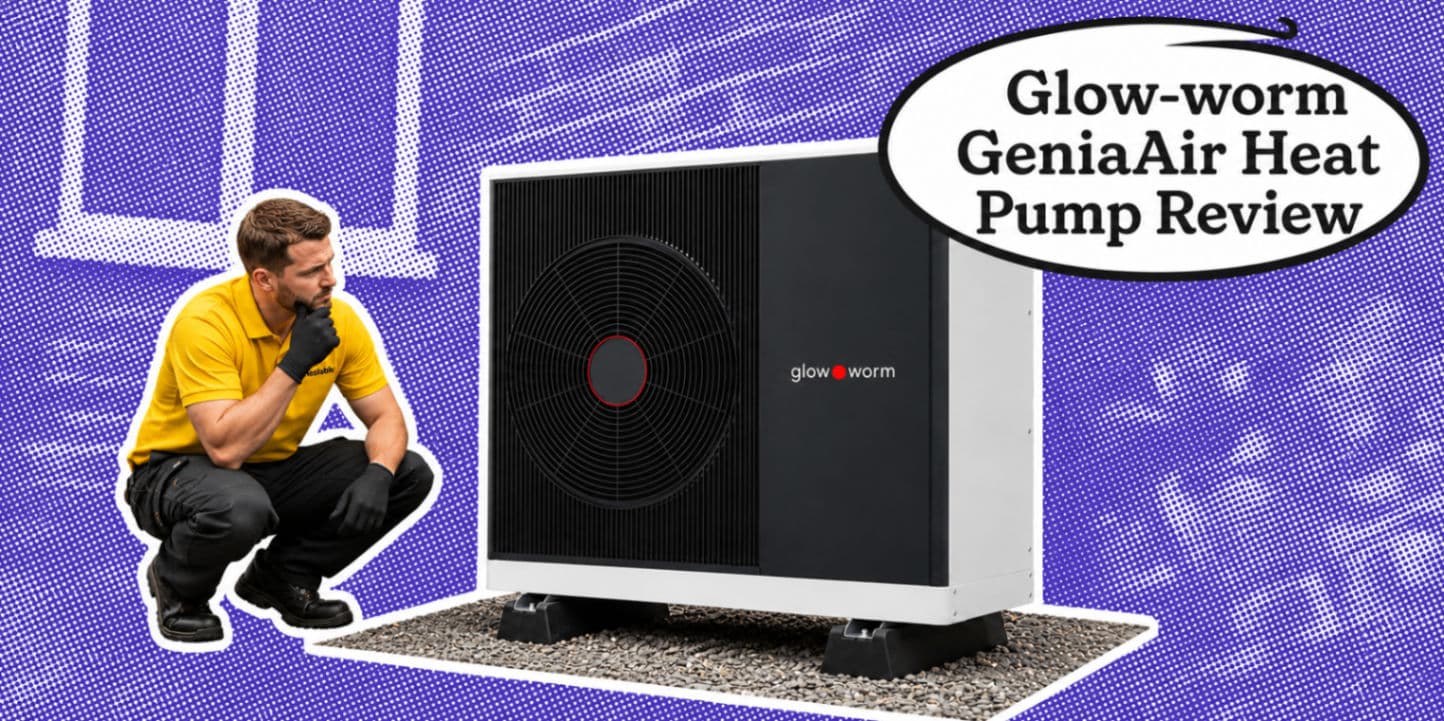

Glow-worm’s new GeniaAir promises quiet operation, high flow temperatures and refreshingly straightforward heat pump tech. We install it ourselves, but is it actually any good?
- What is the Glow-worm GeniaAir?
- Who actually makes Glow-worm heat pumps?
- How efficient is the Glow-worm GeniaAir?
- Does the Glow-worm GeniaAir work in cold weather?
- How noisy is the Glow-worm GeniaAir?
- Is the Glow-worm GeniaAir reliable?
- How much does the Glow-worm GeniaAir cost?
- What about the £7,500 heat pump grant?
- Glow-worm GeniaAir vs Vaillant aroTHERM plus
- Glow-worm GeniaAir pros and cons
- Who should buy a Glow-worm GeniaAir?
Glow-worm has been warming British homes for more than 90 years, although you probably know the name better for boilers than heat pumps.
That changed in 2026 with the arrival of the Glow-worm GeniaAir, a new R290 air source heat pump available in 5kW, 7kW and 11kW models.
On paper, there is quite a bit to like.
You get flow temperatures of up to 70°C, Quiet Mark certification, COP figures approaching 5 under favourable conditions and connectivity through Glow-worm’s MiGo Link app.
It also comes from a company owned by the Vaillant Group, which gives it rather more heating-industry pedigree than your average newcomer.
And yes, full disclosure: Heatable sells and installs the Glow-worm GeniaAir.
That does not automatically make it brilliant.
So, let’s look at where it performs well, where the compromises are and whether we think it deserves a place outside your house.
Ready to make your home more energy-efficient and cut down on your heating bills? Get a heat pump quote today.
Glow-worm GeniaAir review: the quick verdict
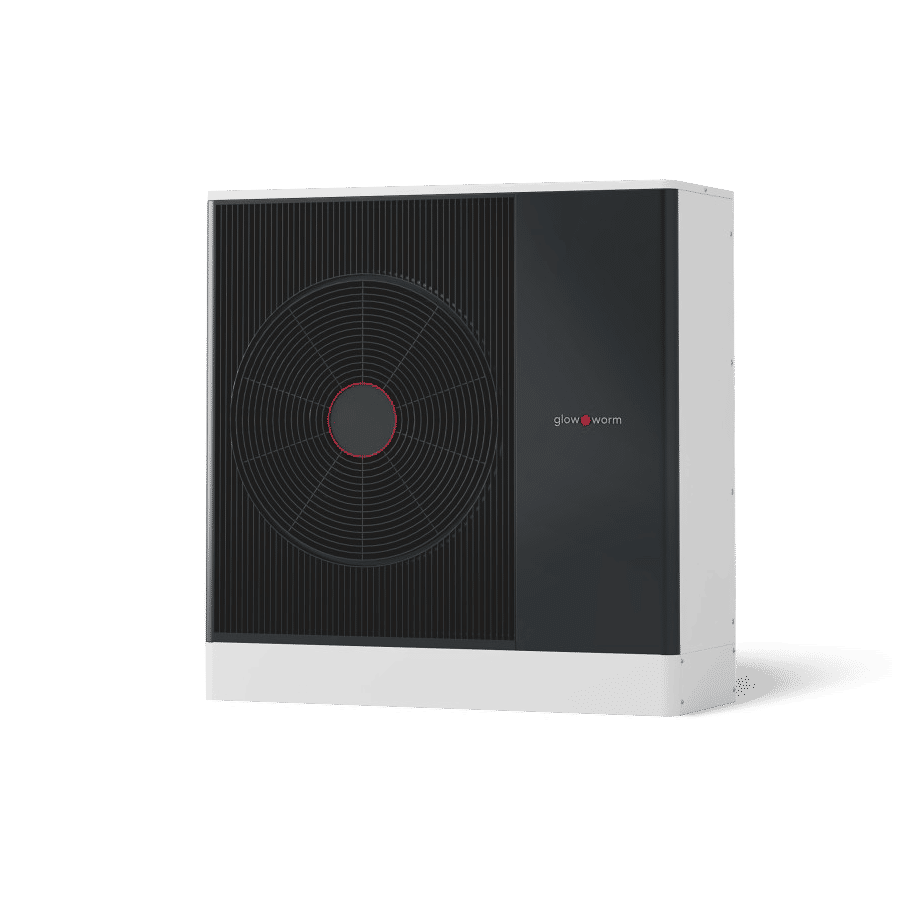
The Glow-worm GeniaAir is a very convincing mid-range air source heat pump, particularly for homeowners who want some of the engineering and support infrastructure associated with the Vaillant Group without necessarily stepping up to a more expensive premium system.
Its biggest strengths are straightforward ones.
It is quiet, compact for its output, uses low-GWP R290 refrigerant and can produce flow temperatures of up to 70°C. That last point gives installers useful flexibility when replacing a boiler in an existing property.
Efficiency is competitive too. Glow-worm quotes a COP of 4.93 for the 5kW model, 4.83 for the 7kW and 5.22 for the 11kW at A7/W35.
Put simply, under those particular test conditions, the units can produce roughly five units of heat for every unit of electricity consumed.
But there are a couple of catches…
The standard guarantee is only two years unless the qualifying conditions for extended cover are met, and the 5kW, 7kW and 11kW line-up is not as broad as some competing ranges.
More importantly, GeniaAir only arrived on the UK market in 2026, so nobody can credibly tell you yet that this particular model has a decade-long reliability record.
Promising? Very.
Proven over the long term? Not yet.
Our scores:
Category | Heatable score |
Performance and efficiency | 4.5/5 |
Reliability | 4/5 |
Noise | 4.5/5 |
Warranty | 3.5/5 |
Price and value | 4.5/5 |
Overall | 4/5 |
In short: the GeniaAir looks like Glow-worm has taken a sensible heat pump, removed most of the unnecessary cleverness and asked it to get on with heating your house.
We approve of this approach.
Glow-worm GeniaAir specifications
Here are the headline numbers:
Specification | 5kW | 7kW | 11kW |
Nominal model size | 5kW | 7kW | 11kW |
Maximum flow temperature | 70°C | 70°C | 70°C |
COP at A7/W35 | 4.93 | 4.83 | 5.22 |
COP at A7/W55 | 2.99 | 2.92 | 3.10 |
Refrigerant | R290 | R290 | R290 |
Refrigerant GWP | 0.02 | 0.02 | 0.02 |
Dimensions (W × H × D) | 1,104 × 750 × 454mm | 1,104 × 750 × 454mm | 1,169 × 1,103 × 454mm |
Operating weight | 84kg | 91kg | 133kg |
Quiet Mark certified | Yes | Yes | Yes |
Standard guarantee | 2 years* | 2 years* | 2 years* |
*Extended cover of up to five years is available subject to Glow-worm's qualifying installation and registration conditions.
Glow-worm states that the GeniaAir has been tested across extreme climatic conditions, including temperatures down to -25°C, although laboratory testing in extreme conditions should not be confused with the output and efficiency you will get from the unit at those temperatures.
Heat pumps do not suddenly stop working because Britain has had the audacity to become cold.
Their output and efficiency simply change with outdoor temperature, flow temperature and system demand.
What is the Glow-worm GeniaAir?
The GeniaAir is a monobloc air-to-water heat pump designed primarily for domestic heating and hot water.
Rather than burning gas, it absorbs heat from the outside air and transfers that energy into the water circulating through your heating system.
As a monobloc unit, the refrigerant circuit is contained within the outdoor heat pump itself. Heated water then travels between the outdoor unit and the rest of the heating system.
The range currently consists of:
GeniaAir 5kW
GeniaAir 7kW
GeniaAir 11kW
That covers a fairly substantial chunk of the UK domestic market.
However, it does mean there is a sizeable jump between 7kW and 11kW.
This isn't necessarily a problem because heat pumps should be selected from a proper room-by-room heat-loss calculation rather than using floor area and a wet finger in the air.
But manufacturers offering more closely spaced outputs can sometimes give system designers greater flexibility.
Who actually makes Glow-worm heat pumps?
Glow-worm is part of the Vaillant Group, having been acquired in 2001.
That is significant.
Although GeniaAir is new to the UK market, Glow-worm isn't a start-up that appeared six months ago with a logo, an Alibaba account and tremendous confidence.
It sits inside one of Europe's largest heating technology groups, alongside brands including Vaillant and Saunier Duval.
That provides access to an established engineering, installer training and aftersales infrastructure.
It is one of the reasons we're considerably more comfortable with a newly introduced Glow-worm heat pump than we would be with an entirely unproven manufacturer.
That said, company history and product reliability aren't the same thing.
The GeniaAir itself still needs time in British homes before its long-term reliability record can be properly judged.
How efficient is the Glow-worm GeniaAir?
Pretty efficient.
At an outside air temperature of 7°C and a 35°C water temperature, Glow-worm publishes the following COP figures:
5kW: 4.93
7kW: 4.83
11kW: 5.22
At a higher 55°C water temperature, those figures fall to:
5kW: 2.99
7kW: 2.92
11kW: 3.10
That difference illustrates something considerably more important than which manufacturer manages to place the largest COP number in its brochure.
Heat pumps prefer lower flow temperatures.
The less work the compressor has to do to raise the water temperature, the more efficiently the system can normally operate.
So while the GeniaAir can reach 70°C, that doesn't mean we'd design every GeniaAir installation to trundle around at 70°C all winter.
Quite the opposite.
A properly designed system should generally use the lowest practical flow temperature capable of keeping the property comfortable.
Higher-temperature capability is useful headroom.
It isn't an instruction manual.
🎥 Watch Our Vaillant aroTHERM Plus Heat Pump Case Study
Want to see a heat pump in action rather than read several thousand words about one?
In our case study, we take a closer look at the Vaillant aroTherm, including its construction, controls, key components and how it performed in a UK home:
Is the Glow-worm GeniaAir suitable for older homes?
Potentially, yes - this is one of its stronger areas.
The GeniaAir can achieve water temperatures of up to 70°C, giving it considerably more flexibility in retrofit installations than early generations of low-temperature heat pumps.
That may help where a property has:
existing radiators
higher heat losses
restricted opportunities to replace emitters
substantial domestic hot water requirements
However, don't interpret "70°C heat pump" as "swap your boiler for this box and change absolutely nothing".
A proper heat pump installation still needs an assessment of your:
heat loss
radiator sizes
pipework
insulation
hot water demand
available outdoor space
Some homes will need larger radiators or other system improvements.
Others won't.
The only sensible way to establish that is through a proper heat-loss survey and system design.
Conveniently, that's what we're supposed to be doing rather than guessing.
Does the Glow-worm GeniaAir work in cold weather?
Yes.
Glow-worm says the GeniaAir has been tested at ambient temperatures as low as -25°C.
That's considerably colder than almost any normal UK winter condition.
But there's an irritating bit of nuance that heat pump marketing sometimes skips.
"Works at -25°C" does not mean "produces exactly the same amount of heat at exactly the same efficiency at -25°C".
As outdoor temperatures fall, the unit has to work harder to extract heat from the air.
Capacity, COP and defrost behaviour therefore need to be considered when sizing the system.
This is another reason why choosing between the 5kW, 7kW and 11kW GeniaAir based purely on the number of bedrooms is a bad idea.
A four-bedroom modern home and a four-bedroom Victorian house can have radically different heat losses.
Bedrooms are for sleeping in.
They are not units of thermal engineering.
How noisy is the Glow-worm GeniaAir?
This is another strong point.
The GeniaAir range has been awarded Quiet Mark certification, which independently assesses products on noise performance.
Glow-worm publishes ErP sound power figures of around 49dB(A) for the smaller unit and up to 54.8dB(A) across the range, depending on model.
There is an important distinction here between sound power and the noise level you actually experience standing several metres away.
Sound pressure falls with distance and is also affected by the unit's position, surrounding walls and reflections.
So don't read 49dB(A) on a specification sheet and assume that is exactly what you'll hear in your bedroom.
Proper siting still matters.
Stick almost any heat pump into a terrible acoustic location surrounded by hard reflective surfaces and it can become considerably more noticeable.
On the whole, though, GeniaAir is a reassuringly quiet system.
GeniaAir's R290 refrigerant
The GeniaAir uses R290, better known outside the HVAC industry as propane.
Before anyone starts picturing a Calor Gas bottle strapped to the side of their house, this is increasingly common in modern heat pumps.
R290 has excellent thermodynamic properties and an exceptionally low global warming potential.
Glow-worm gives its 100-year GWP as just 0.02 under the methodology it cites.
That's a major environmental improvement compared with many older HFC refrigerants.
R290 does, however, come with installation requirements because it is flammable.
That means outdoor-unit placement and the manufacturer's defined safety zones around certain openings need to be respected.
Glow-worm has attempted to make this easier with its Flexible Space Function, which can reduce some siting restrictions when correctly configured.
For homeowners, the important bit is less exciting:
get somebody who knows what they're doing to install it.
GeniaAir controls and app
The GeniaAir can be paired with Glow-worm's MiPro Sense controller, MiGo Internet Gateway and MiGo Link app.
Through the connected system you can monitor and adjust things including:
desired temperatures
heating schedules
hot water
system operation
energy usage data
Glow-worm has deliberately positioned GeniaAir around simplicity rather than trying to turn your central heating system into mission control.
We think that's sensible.
Good heat pump controls should make weather compensation and system optimisation accessible without encouraging homeowners to constantly turn the heating on and off.
Unlike a boiler, a heat pump will generally perform best maintaining temperatures steadily rather than repeatedly sprinting from cold to hot.
The cleverest thing a thermostat can sometimes do is persuade you to leave it alone.
Glow-worm HydraCyl hot water cylinder
Most domestic heat pump installations also require a hot water cylinder.
Glow-worm offers its matching HydraCyl range in sizes from 150 to 250 litres, forming part of its complete GeniaAir system.
Cylinder sizing should depend on household hot-water demand rather than automatically installing the largest cylinder that can be forced through your airing-cupboard door.
A correctly specified cylinder gives the heat pump enough stored hot water while avoiding unnecessary heat losses and wasted space.
And yes, switching from a combi boiler can mean finding room for a cylinder where one didn't previously exist.
Physics remains stubbornly unwilling to download hot water from the cloud.
Glow-worm GeniaAir guarantee
Here's one area where we'd like Glow-worm to be more generous.
The GeniaAir comes with a standard two-year guarantee, although this can be extended to up to five years when qualifying installation and registration requirements are met.
Glow-worm specifically promotes five-year cover when the GeniaAir is installed as part of its qualifying system package, including the HydraCyl cylinder.
Five years is respectable.
Two years as the underlying standard guarantee is less impressive, particularly when some competitors provide longer cover.
It doesn't mean the heat pump is unreliable.
It simply means we'd prefer the warranty to demonstrate a little more confidence without depending on qualification criteria.
Heatable warranty score: 3.5/5
Is the Glow-worm GeniaAir reliable?
This requires a slightly unsatisfying answer:
we don't know yet.
Not properly.
GeniaAir launched in the UK in June 2026.
Anybody currently claiming to have comprehensive ten-year reliability statistics for the model has discovered time travel.
There are nevertheless some encouraging signs.
Glow-worm says the system has undergone more than 300 tests, including long-duration fatigue testing and climatic testing from severe cold to high ambient temperatures.
Glow-worm itself has also been manufacturing heating equipment since 1934 and has belonged to the Vaillant Group since 2001.
That gives us considerably more confidence in parts availability, engineering support and aftersales infrastructure.
But we'd still distinguish between:
Manufacturer confidence: high.
Long-term GeniaAir field evidence: currently limited.
That's why we've resisted giving it five stars for reliability just because we sell it.
Heatable reliability score: 4/5
How much does the Glow-worm GeniaAir cost?
The heat pump itself is only part of the cost of an installation.
At the time of writing, merchant pricing puts the outdoor units roughly around:
5kW: £2,950
7kW: £3,430
11kW: £4,800
including VAT at the cited retail merchant's published prices.
However, those are hardware prices, not installed-system prices.
A complete installation can also require:
hot water cylinder
controls
electrical work
pipework
pumps and valves
radiator upgrades
system flushing
bases or brackets
labour
commissioning
And the amount of work differs enormously between properties.
That's why comparing heat pumps purely by the price of the outdoor unit is roughly equivalent to comparing kitchens by the cost of the oven.
Useful information.
Not remotely the whole bill.
What about the £7,500 heat pump grant?
For eligible homes in England and Wales, the GeniaAir can qualify for the government's £7,500 Boiler Upgrade Scheme grant when installed under the required scheme conditions.
That can dramatically reduce the homeowner's net installation cost.
The actual amount you'll pay depends on the property and the work required, so the useful number is the final surveyed installation price after the grant, rather than an attention-grabbing "from" price attached to the heat pump itself.
Glow-worm GeniaAir vs Vaillant aroTHERM plus
This is an interesting comparison because Glow-worm and Vaillant sit under the same corporate umbrella.
The Vaillant aroTHERM plus is the more established premium option.
It offers a wider range of outputs, can reach flow temperatures of up to 75°C and has an excellent reputation among UK installers.
The GeniaAir counters with a simpler proposition and potentially stronger value.
Broadly speaking:
Glow-worm GeniaAir | Vaillant aroTHERM plus | |
Outputs | 5, 7, 11kW | 3.5, 5, 7, 10, 12kW |
Max flow temperature | 70°C | 75°C |
Refrigerant | R290 | R290 |
Quiet Mark | Yes | Yes on applicable models |
Positioning | Value/mid-range | Premium |
UK track record | New | Established |
App controls | MiGo Link | myVAILLANT |
The aroTHERM plus remains the stronger choice if you want the wider output range, established track record and premium Vaillant ecosystem.
But that doesn't automatically mean it is the better purchase.
Where the heat-loss calculation suits one of the GeniaAir's available outputs, Glow-worm's system can provide a lot of the important functionality without requiring you to pay for the fanciest badge in the Vaillant Group cupboard.
Glow-worm GeniaAir pros and cons
Pros:
Efficient
COP figures approaching five under low-temperature test conditions put the GeniaAir firmly in competitive territory.
70°C maximum flow temperature
Useful for retrofit projects and existing radiator systems where higher water temperatures may occasionally be required.
Quiet
Quiet Mark certification makes it particularly attractive where neighbours or property boundaries are relatively close.
R290 refrigerant
The natural refrigerant offers extremely low global warming potential and strong heat pump performance.
Strong manufacturer backing
Glow-worm is part of Vaillant Group, giving the product access to an established UK heating support and service network.
Simple product range
Three outputs and a matched cylinder/control ecosystem make GeniaAir relatively straightforward to specify.
Good value proposition
It provides many of the characteristics buyers actually want from a modern premium heat pump without necessarily competing at the very top end of the market.
Cons:
Only three output sizes
5kW, 7kW and 11kW covers plenty of houses, but the jump from 7kW to 11kW may make another manufacturer's range a better fit for some heat-loss calculations.
Short standard guarantee
Two years as standard feels stingy. Five-year extended cover is much more respectable, but comes with qualifying conditions.
Very new product
This is the big one.
The GeniaAir hasn't been installed in UK homes for long enough to establish genuine long-term model-specific reliability data.
70°C isn't a magic wand
The higher maximum flow temperature can make retrofits easier, but using high temperatures continuously reduces efficiency.
It doesn't eliminate the need to design the heating system properly.
You'll normally need a cylinder
As with most air-to-water heat pump installations, homeowners replacing a combi boiler need to consider where the hot water cylinder will live.
Who should buy a Glow-worm GeniaAir?
We think the GeniaAir makes particularly good sense if:
you're replacing a gas, oil or LPG heating system with a heat pump
you want an established UK heating brand
your calculated heat loss fits one of the 5kW, 7kW or 11kW models
noise is an important consideration
your property may benefit from higher flow-temperature capability
you're looking for strong value rather than the most premium system available
you want straightforward controls and app connectivity
you're eligible for the Boiler Upgrade Scheme
Who should look elsewhere?
Consider alternatives if:
your heat-loss calculation falls awkwardly between the available outputs
you want the longest standard manufacturer warranty available
you specifically want a product with many years of UK field data
your system requires an output outside the GeniaAir range
you want the broader premium ecosystem offered by something like the Vaillant aroTHERM plus
The Heatable verdict
The Glow-worm GeniaAir is one of the more interesting heat pumps to arrive in the UK market in 2026.
It doesn't try particularly hard to reinvent anything.
That's arguably its greatest strength.
You get an R290 monobloc heat pump from a long-established heating brand, respectable efficiency, 70°C flow capability, low noise, sensible controls and the backing of the Vaillant Group.
There are compromises.
The standard guarantee could be longer, three output sizes won't suit absolutely every property and it is simply too early to give the GeniaAir an unqualified gold star for long-term reliability.
But none of those issues fundamentally undermine the product.
In the right home, properly sized and installed, we think the GeniaAir offers an unusually strong balance between specification, simplicity and price.
Which is also why we've chosen to offer it ourselves.
Not because Glow-worm has discovered a revolutionary new form of thermodynamics.
It hasn't.
It's just built what appears to be a very sensible heat pump.
Our final score: 4 out of 5.
Give it another few years of uneventful service in British homes and that reliability score may well creep higher.
For now, four stars feels fair.
Good specification. Good pedigree. Sensible price positioning.
Just don't confuse "promising new heat pump" with "proven for a decade".
That would require us to review it in 2036.
And frankly, we'd rather not plan the content calendar quite that far ahead.
Next Steps For Your Heat Pump Journey:
When planning to install a heat pump for your home, there are several important factors to consider. Make sure to refer to the following guides to help you make informed decisions:
To dive deeper into these topics, head over to our advice section or check out our YouTube channel to learn more.
Get A Quote From Us Today
Without boasting, get your new heat pump quote and buy from us, here’s why:
Gas Safe installation within 24 hours.
Thousands of satisfied customers with an average score of 4.9 on Trustpilot, surpassing the market leader.
Which? Trusted Trader: Heatable is proudly recognised as a Which? Trusted Trader.
Flexible payment options, including interest-free finance.
Up to 12-year guarantee on selected heat pumps.
Fixed price guarantee: No hidden costs.
Save your quote and decide later.
Get an instant fixed price on a heat pump, here.
Heat Happy.