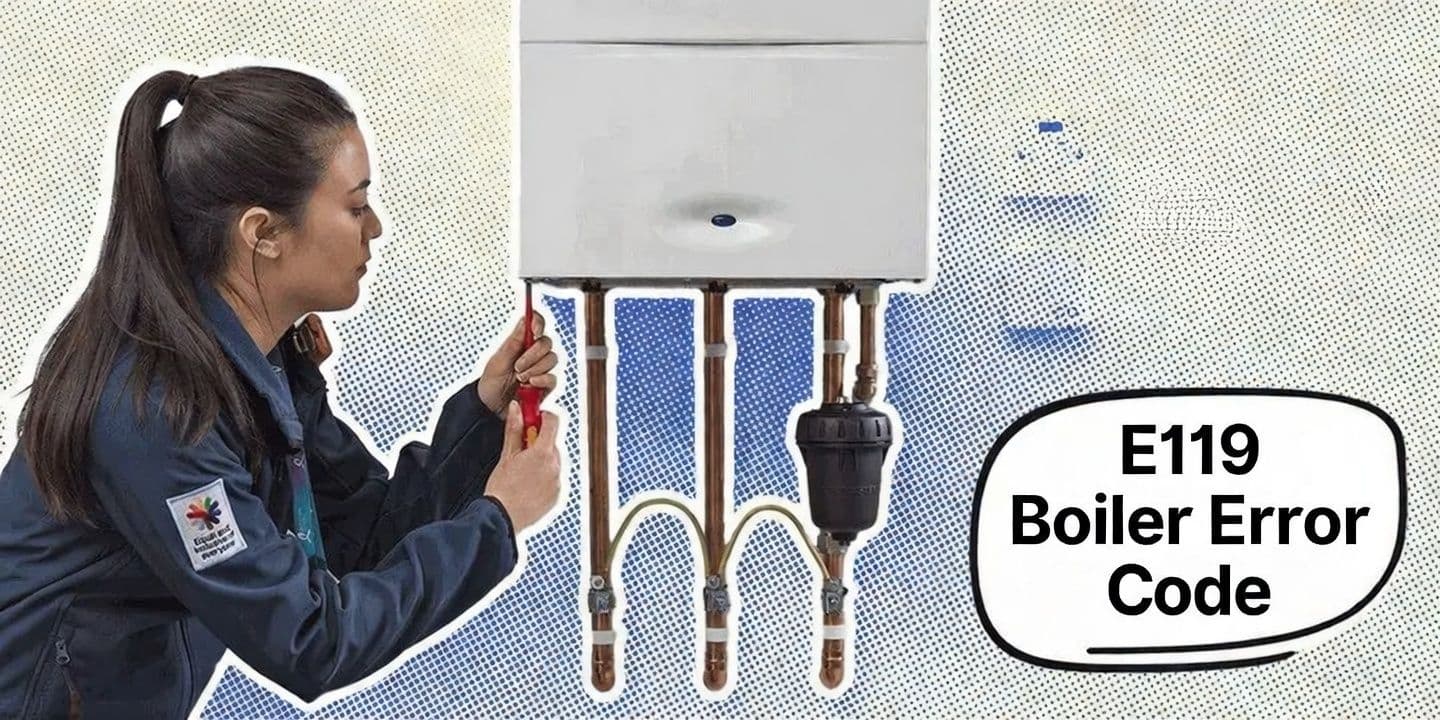

The E119 error code on your boiler usually means the water pressure in your heating system has dropped too low, so the boiler has shut down (locked out) as a safety precaution.
The quickest safe first step is to check the boiler’s pressure gauge. When the system is cold, it’s typically around 1.0–1.5 bar - if it’s below that, you’ll usually need to repressurise the system.
If the pressure is already in range, or it keeps falling again after topping up, it’s a sign something else is going on (like a leak or a faulty component) and you’ll likely need a Gas Safe engineer to take a look.
PS We fit new boilers with gas-safe installation nationwide. Simply answer these questions, get your fixed price and you could get it installed as quickly as tomorrow.
What Does E119 Mean?
Put simply, the E119 usually means your boiler has detected low system pressure - the water pressure in your sealed heating circuit has dropped below a safe level.
When that happens, the boiler will often lock out to protect the pump and heat exchanger from running “dry” and causing damage. It’s essentially a built-in safety cut-off.
Exact meanings can vary a bit by brand and model, but on many UK boilers low pressure is the most common cause behind an E119.
It’s rarely dangerous, and in a lot of cases it’s something you can fix at home by checking the pressure gauge and topping the system back up - just make sure you follow your manufacturer’s instructions.
Common Causes of an E119 Fault
E119 is most often a pressure-related lockout.
Here are the usual reasons it shows up:
System pressure has dropped too low
Your boiler needs enough water in the sealed system to circulate heat properly. If pressure falls below the safe range, it’ll shut down to protect itself.
A small leak in the heating system
Even a slow drip from a radiator valve, pipe joint, or under-floor section can gradually pull pressure down over days or weeks.
You’ve bled radiators but didn’t top the pressure back up
Bleeding releases trapped air, but it can also lower system pressure. If you don’t repressurise afterwards, E119 can appear.
Pressure relief valve (PRV) discharging water
If the PRV has opened (or is stuck slightly open), water can escape through the discharge pipe outside - and the pressure will keep dropping.
Expansion vessel problems
The expansion vessel manages pressure changes as the system heats and cools. If it’s not working properly, you can get big pressure swings (too high when hot, too low when cold).
Faulty pressure sensor or PCB (less common)
Occasionally the boiler is reading the pressure incorrectly due to a sensor fault or a control board issue - especially if the gauge looks normal but the error persists.
Symptoms You Might Notice:
Beyond the E119 code itself, keep an eye out for these telltale signs:
No heating or hot water at all.
Intermittent hot water – it works, then it doesn't.
Gurgling noises from radiators or pipes.
Pressure gauge reading near zero or in the red zone.
Radiators staying cold at the top or bottom.
Boiler cycling on and off more than usual.
[A] Check boiler pressure
1. Find the pressure display
It’ll either be:
• a round dial gauge (often on the front or underside), or
• a digital pressure reading on the screen/menu.

2. Check it when the system is cold
The “normal” range on many UK combis is around 1.0–1.5 bar when cold.
3. What your reading tells you
• Below ~1.0 bar → very likely the reason you’re seeing E119
• In range already → skip ahead to “If E119 comes back” (it may not be a simple top-up)
[B] Repressurise the boiler (if pressure is low)
If the gauge confirms low pressure, you’re usually looking for the filling loop - the bit that lets mains water top your heating system back up.
What it looks like: often a silver braided hose with one or two small taps/valves underneath the boiler (sometimes it’s a keyless/fixed loop, depending on model).
Prefer video? Check out our YouTube video on diagnosing and fixing low boiler pressure below:
Step-by-step:
Turn the boiler off at the wall (and let it cool if it’s been running).
Locate the filling loop under/near the boiler.
Open the valve(s) slowly
Usually anti-clockwise
Go gently - you don’t want a pressure rocket.
Watch the gauge rise and stop at about 1.2–1.5 bar (cold).
Close the valve(s) fully (clockwise). If your loop is detachable, remove it after topping up.
Turn the boiler back on and hit reset if the E119 doesn’t clear automatically (reset method varies - your manual will show where).
If you’re not 100% sure what you’re looking at, or the pressure climbs fast and you panic-close everything - stop and get a Gas Safe engineer. No shame. It’s cheaper than a flood.
Also:
Don’t overfill. Too much pressure can trigger other faults and leaks. Keep it in the 1.2–1.5 bar cold “sweet spot”.
[C] If you recently bled radiators
If you’ve bled radiators recently, a pressure drop is completely normal - you’ve released air and the system may need topping back up.
But if you’re bleeding radiators all the time, that’s usually the boiler equivalent of “this isn’t a one-off.” It can point to:
a small leak,
air getting into the system,
or a component issue.
Have a quick look for damp patches or crusty/white marks around radiator valves and pipe joints.
If E119 comes back (what it usually means)
Use this as your quick triage:
• Pressure drops again within hours or days
→ Most likely a leak, PRV discharge, or expansion vessel issue. Time for an engineer.
• Pressure is fine but E119 won’t clear
→ Could be a pressure sensor, PCB, or another internal fault. Also engineer territory.
• You can see water dripping outside from a copper pipe (usually the PRV discharge pipe)
→ That’s your system dumping pressure. Get it checked sooner rather than later.
When to call a Gas Safe engineer (don’t DIY)
Call in the pros if:
You keep losing pressure after topping up
You’ve got visible leaks, damp patches, or puddles
The PRV discharge pipe is dripping regularly outside
The boiler is making banging, kettling, whistling or other odd noises
The error comes back even with correct pressure
You’re in a rented property (report it to your landlord/agent)
Only a Gas Safe registered engineer should work on boiler internals - both for safety and because it’s the law.
Next Steps For Your New Boiler Journey:
When planning to install a new boiler for your home, there are several important factors to consider. Make sure to refer to the following guides to help you make informed decisions:
To dive deeper into these topics, head over to our advice section or check out our YouTube channel to learn more.
Need a new boiler?
If you’re aiming to get the best deal on a new boiler, consider getting a quote from us, here’s why:
Gas Safe installation within 24 hours.
Thousands of satisfied customers with an average score of 4.9 on Trustpilot, surpassing the market leader.
Which? Trusted Trader: Heatable is proudly recognised as a Which? Trusted Trader.
Price match guarantee: We will match any like-for-like cheaper quote.
Flexible payment options, including interest-free finance.
Up to 12-year guarantee on selected boilers.
Fixed price guarantee: No hidden costs.
Save your quote and decide later.
Get an instant fixed price on a new boiler, here.
To learn more about boilers, visit our advice section, check out our YouTube channel, or read customer testimonials here.
Heat Happy.