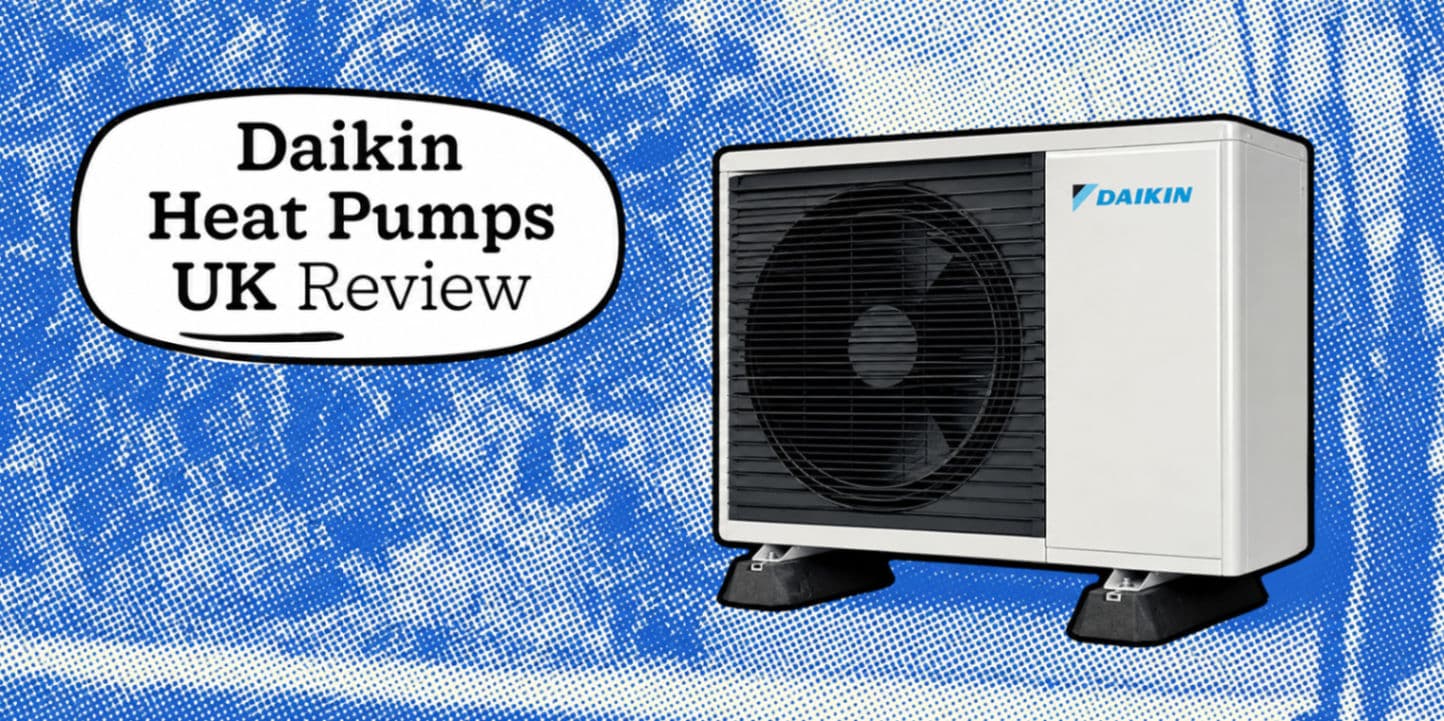

Efficient, Reliable and Impressive, But Are They Worth the Premium Price?
- Which Daikin heat pumps are available in the UK?
- How much do Daikin heat pumps cost?
- Daikin heat pump price after the Boiler Upgrade Scheme
- What warranty do Daikin heat pumps come with?
- Are Daikin heat pumps reliable?
- How efficient are Daikin heat pumps?
- Are Daikin heat pumps noisy?
- Daikin vs Vaillant heat pumps
- Daikin vs Vaillant vs Bosch: which heat pump is best?
- Daikin heat pump pros and cons
Daikin is one of those heat pump brands you’ll encounter almost immediately once you start shopping around.
And for good reason.
The Japanese manufacturer has been building air conditioning and heat pump equipment for decades, offers one of the broadest domestic heat pump ranges in the UK and, unlike some manufacturers, gives you everything from relatively low-temperature systems for new builds to high-temperature models designed to replace a boiler in older homes.
The problem?
Daikin’s range is not exactly straightforward.
You’ve got Altherma 3 R, 3 M, 3 H MT, 3 H HT and now the new Altherma 4 H, before you’ve even started worrying about indoor units, cylinders, outputs and whether somebody has accidentally named your heating system after a broadband router.
So, which Daikin heat pump should you actually buy?
In this guide, we’ll look at the current Daikin heat pump range, how much they cost, warranties, efficiency, reliability and how Daikin compares with two of its biggest rivals: Vaillant and Bosch.
💨 Ready to make your home more energy-efficient and cut down on your heating bills? Get a heat pump quote today.
Daikin heat pumps: our quick verdict
Overall rating: 4.5/5
Daikin makes some of the best air source heat pumps currently available in the UK.
Its strongest point is the sheer breadth of its range.
There are systems designed for low-temperature new builds, systems aimed at boiler replacements and the latest Altherma 4 H, which uses R290 refrigerant and can produce leaving-water temperatures of around 70–75°C even at -15°C outside. Daikin states that it can continue operating down to -28°C.
That makes Daikin particularly interesting for older UK properties where retaining more of the existing radiator system may be desirable.
The downside is that Daikin isn't usually the cheapest choice, and its product range is considerably more complicated than it needs to be from a homeowner's perspective.
Heatable scores:
Category | Score |
Efficiency | 4.5/5 |
Product range | 5/5 |
Noise | 4.5/5 |
Reliability | 4.5/5 |
Warranty | 4/5 |
Controls | 4.5/5 |
Value for money | 4/5 |
Overall | 4.5/5 |
Best for: homeowners wanting a premium heat pump with plenty of choice, particularly retrofit installations.
Which Daikin heat pumps are available in the UK?
Daikin's domestic air-to-water range is sold under the Altherma name.
The important thing isn't remembering every model number.
It's understanding what each system is actually intended to do.
Daikin Altherma 4 H
Best for: older homes and boiler replacement
This is the most interesting Daikin heat pump in the current range.
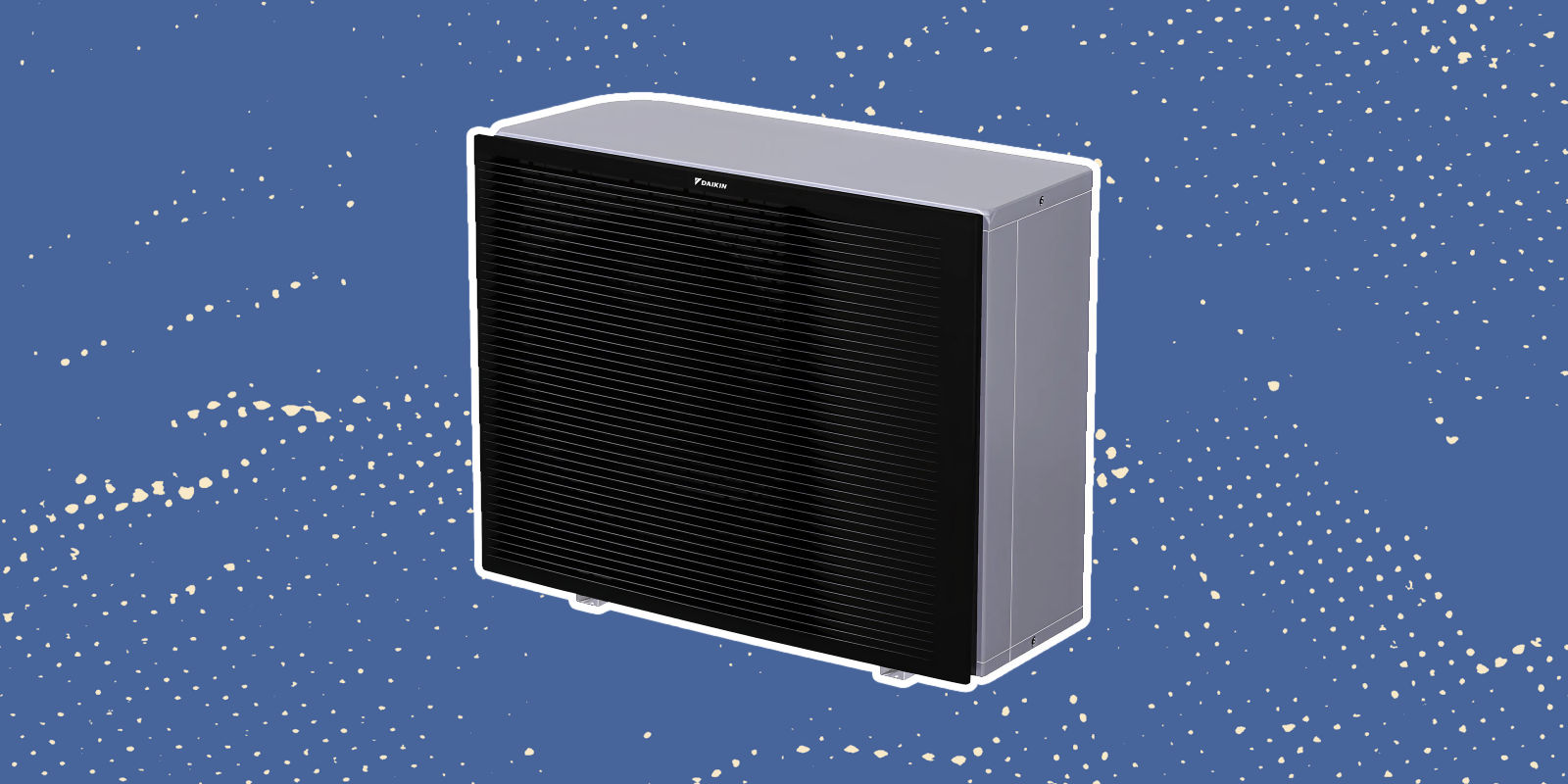
The Altherma 4 H is Daikin's newer high-temperature R290 heat pump and is designed squarely with retrofit installations in mind.
Depending on model and configuration, Daikin says it can:
produce leaving-water temperatures of 70–75°C at -15°C
operate in outdoor temperatures down to -28°C
run at sound-power levels around 50–54dB(A)
use the natural refrigerant R290
provide heating, hot water and, with appropriate configurations, cooling
integrate with the Daikin Onecta app.
The integrated floor-standing version can also incorporate a 180L or 230L hot-water cylinder, which helps create a relatively neat complete system.
🎥 Watch Our Vaillant aroTHERM Plus Heat Pump Case Study
Want to see a heat pump in action rather than read several thousand words about one?
In our case study, we take a closer look at the Vaillant aroTherm, including its construction, controls, key components and how it performed in a UK home:
Our view:
This is the Daikin we'd be most interested in for a typical UK boiler-replacement project.
High flow-temperature capability gives the installer more flexibility with existing radiators, while R290 brings Daikin in line with the direction competitors such as Vaillant and Bosch are already heading.
One important qualification, though:
Just because a heat pump can produce 75°C water doesn't mean you should run it at 75°C all winter.
Heat pumps become more efficient as flow temperatures come down.
The higher temperature is useful headroom, not the target setting.
Daikin Altherma 3 H HT
Best for: high-temperature retrofit
The Altherma 3 H HT is the established predecessor/alternative within Daikin's high-temperature range.
It uses R32 rather than R290 and can produce 70°C leaving water at -15°C, while Daikin states that it can continue operating down to -28°C.
This makes it particularly suitable for replacing boilers in older properties where higher radiator temperatures may still be required.
Our view:
Still an excellent heat pump.
But if we were choosing a new Daikin system today and the Altherma 4 H fitted the property and budget, we'd generally lean towards the newer R290 platform.
Daikin Altherma 3 H MT
Best for: moderate-temperature retrofit
The Altherma 3 H MT sits between low-temperature and high-temperature systems.
It can produce leaving-water temperatures of 65°C at -15°C, operates down to -28°C and carries an efficiency rating of up to A+++.
That makes it useful for homes where you don't necessarily need a full 70–75°C high-temperature system but still want more flexibility than a traditional low-temperature heat pump.
Our view:
Probably the sensible middle child of the Daikin family.
Less headline-grabbing than the Altherma 4 H, but potentially a better fit where the heating system has already been reasonably well optimised.
How much do Daikin heat pumps cost?
This is where heat pump pricing becomes slightly irritating.
You'll see wildly different figures online because one website is quoting the outdoor unit, another is quoting a system pack, while somebody else is quoting the entire installation.
Those are three completely different things.
For most homeowners, the only figure that really matters is:
What will the complete installed system cost after any available grant?
Typical Daikin heat pump installation cost
As a realistic UK guide, we'd generally expect a complete Daikin air source heat pump installation to land somewhere around:
£10,000–£18,000 before grants
depending on the property and specification.
More complicated installations can go beyond this.
A relatively simple installation in a well-prepared house may come in lower.
The final price depends on things such as:
heat pump output
model selected
hot-water cylinder
radiator upgrades
pipework
electrical work
system controls
hydraulic components
location of the outdoor unit
installation complexity
heat-loss requirements
A Daikin Altherma 4 H system will generally sit towards the premium end compared with cheaper mass-market heat pumps.
But comparing hardware price alone is rarely useful.
A £4,000 heat pump requiring £8,000 of additional system work isn't cheaper than a £5,000 heat pump requiring £5,000 of system work.
The house ultimately decides the bill.
Daikin heat pump price after the Boiler Upgrade Scheme
Eligible households in England and Wales can currently receive £7,500 towards the cost of an air source heat pump under the Boiler Upgrade Scheme.
That can turn, for example:
£13,500 installation
into roughly:
£6,000 payable by the homeowner
assuming the installation qualifies.
The precise price still depends heavily on the property.
This is why we dislike adverts promising a heat pump for some implausibly precise bargain price before anybody has calculated the heat loss.
Your house hasn't even met the installer yet.
Are Daikin heat pumps expensive?
Compared with the cheapest manufacturers?
Yes.
Compared with Vaillant and Bosch?
Not dramatically.
Daikin sits firmly in the premium mainstream part of the market alongside:
Vaillant
Bosch
Mitsubishi Electric
Viessmann
You are generally paying for:
a mature manufacturer
extensive product choice
established UK support
sophisticated controls
strong cold-weather performance
high-temperature options
a substantial installer network
Whether that's worth paying for depends on the installation.
We would rather spend slightly more on the correctly sized heat pump and heating design than save £1,000 on the outdoor unit and spend the next ten years wondering why the upstairs bedroom is cold.
What warranty do Daikin heat pumps come with?
Daikin's current UK residential warranty arrangement is slightly more complicated than we'd like.
Daikin advertises:
2 years as standard
extension to 5 years free of charge once the qualifying air-to-water system is registered through Daikin's Stand By Me platform
the possibility of extending to 7 years in qualifying installations, with additional conditions/cost applying.
Annual maintenance is also required to preserve warranty eligibility.
Our warranty score: 4/5
Five years free once properly registered is respectable.
But we'd prefer manufacturers to make their longest warranty simpler and more automatic.
Nobody wants to discover in year four that their expensive heat pump technically has the wrong kind of paperwork.
Are Daikin heat pumps reliable?
Broadly, yes.
Daikin has far more history in heat pumps and refrigeration than many brands now entering the UK market.
That matters because a heat pump isn't just a white box containing a fan.
The compressor, refrigerant circuit, controls and system integration all matter.
Daikin's long HVAC pedigree gives us good confidence in the underlying engineering and support ecosystem.
However, we'd make a distinction with the latest Altherma 4 H:
Daikin as a manufacturer is proven.
The Altherma 4 H itself is comparatively new.
So we'd be comfortable giving Daikin a high reliability score, but we wouldn't pretend the newest model has ten years of UK field data when it obviously doesn't.
Reliability score: 4.5/5
How efficient are Daikin heat pumps?
Potentially very efficient.
But there isn't one meaningful "Daikin efficiency number".
Heat pump performance depends on:
outdoor temperature
flow temperature
domestic hot-water demand
system design
emitter sizing
weather compensation
installation quality
Daikin itself describes typical seasonal performance broadly around:
SCOP 3.5–4.5 for lower-temperature air-to-water systems
SCOP 3–4 for high-temperature systems.
And that illustrates an important point.
A high-temperature heat pump provides more retrofit flexibility, but lower-temperature operation is generally more efficient.
The aim isn't to buy the heat pump with the hottest water.
The aim is to keep your house warm using the least electricity.
Are Daikin heat pumps noisy?
Generally, no.
The newer Altherma 4 H models quote sound-power levels around 50–54dB(A) depending on model.
The Altherma 3 H MT range lists outdoor sound-pressure figures of approximately 41–47.1dB(A) depending on the system.
Those aren't directly interchangeable measurements, so don't simply compare the numbers and conclude one machine is "10dB quieter".
Sound power and sound pressure are different measures.
In practice, placement matters almost as much as the machine itself.
A quiet heat pump wedged between two reflective brick walls can become considerably less quiet.
Daikin heat pump controls
Daikin heat pumps can integrate with the Onecta app, giving homeowners remote control of compatible heating and hot-water systems.
Depending on the installation, systems can also work with Amazon Alexa and Google Assistant.
The newer Altherma 4 H also incorporates an updated 5-inch touchscreen interface on compatible indoor units.
Controls are one area where Daikin feels properly mature rather than bolted together.
That said, the best heat pump control strategy often involves doing considerably less than homeowners expect.
Once weather compensation has been configured properly, the system should largely get on with maintaining the house.
Constantly switching it on and off like a gas boiler rather defeats the point.
Daikin vs Vaillant heat pumps
This is probably the comparison most UK homeowners should make.
The obvious pairing is:
Daikin Altherma 4 H vs Vaillant aroTHERM plus
Both are premium heat pumps designed to work particularly well in retrofit installations.
Daikin vs Vaillant comparison
Feature | Daikin Altherma 4 H | Vaillant aroTHERM plus |
Refrigerant | R290 | R290 |
Max flow temperature | Up to ~75°C | High-temperature capable |
Cold operation | Down to -28°C | Strong UK cold-weather performance |
App | Onecta | myVaillant |
Standard warranty | 2 years | 2 years |
Extended warranty | Up to 5 years free / 7 years qualifying | Up to 7 years qualifying |
Product positioning | Premium | Premium |
Best suited to | Retrofit / older homes | Retrofit and new build |
Daikin's Altherma 4 H can deliver around 70–75°C leaving water at -15°C, while Vaillant's current aroTHERM plus is positioned as an A+++ R290 system for retrofit and new-build applications.
Vaillant offers up to a seven-year extended guarantee under qualifying installation conditions, although the standard guarantee is two years.
Which is better?
Very close.
We'd choose Daikin if:
you want the broadest overall product ecosystem
the Altherma 4 H is particularly well matched to your heat loss
very high-temperature capability matters
you prefer Daikin's control ecosystem
We'd choose Vaillant if:
you want an exceptionally established UK retrofit choice
you value the aroTHERM plus installer ecosystem
you can obtain the seven-year extended guarantee
you want a particularly quiet premium monobloc solution
Our verdict
Daikin: 4.5/5
Vaillant: 4.5/5
This isn't a boxing match where one has to be knocked unconscious.
The correct system design matters more than the badge.
Daikin vs Bosch heat pumps
Bosch's main rival here is the Compress 5800i AW.
The Bosch is another modern R290 heat pump aimed at both renovation and new-build properties.
Bosch has put considerable emphasis on compact design, quiet operation and ease of siting, and the Compress platform has won both Red Dot and iF design recognition.
Daikin vs Bosch comparison
Feature | Daikin Altherma 4 H | Bosch Compress 5800i AW |
Refrigerant | R290 | R290 |
Positioning | Premium/high-temperature retrofit | Compact premium retrofit/new build |
Range | Very broad Daikin family | More streamlined |
Controls | Onecta | Bosch controls/app ecosystem |
Warranty | 2 years, extendable | Extended cover available subject to conditions |
Strongest feature | Flexibility and high-temperature operation | Compactness and quiet operation |
Which would we choose?
Daikin wins for:
Range and retrofit flexibility.
There are simply more Daikin configurations available, and the Altherma 4 H's 70–75°C capability is useful in more difficult retrofit situations.
Bosch wins for:
Packaging and simplicity.
The Compress 5800i AW is particularly attractive where outdoor space, appearance and noise are major concerns.
Overall
If the property requires a high-temperature retrofit solution, we'd probably lean Daikin.
If the installation is relatively straightforward and compactness/noise are the dominant concerns, we'd look very seriously at Bosch.
Again, this is precisely why we'd rather see the property's heat-loss calculation than simply tell everybody to buy our favourite brand.
Daikin vs Vaillant vs Bosch: which heat pump is best?
Brand | Our score | Best for |
Daikin | 4.5/5 | Overall range and retrofit flexibility |
Vaillant | 4.5/5 | Premium all-rounder |
Bosch | 4.5/5 | Compact, quiet installations |
That's deliberately boring.
All three are genuinely strong manufacturers.
The interesting question is which one best suits your house.
A properly sized Bosch will outperform an oversized Daikin.
A properly designed Daikin will outperform a badly commissioned Vaillant.
And a beautifully installed Vaillant will make considerably more sense than either if its output happens to fit the property's heat loss better.
Heat pumps are annoyingly resistant to Premier League-style brand tables.
Daikin heat pump pros and cons
Pros:
Excellent product range
Few manufacturers cover quite as many domestic scenarios.
Strong retrofit options
The Altherma 4 H and Altherma 3 H HT are particularly useful for replacing traditional boilers.
High flow temperatures
The Altherma 4 H can deliver around 70–75°C water even at -15°C outdoor temperature.
R290 on the latest generation
Daikin has finally moved its flagship high-temperature platform onto the low-GWP refrigerant increasingly becoming standard among premium manufacturers.
Good cold-weather capability
Selected systems remain operational down to -28°C.
Good controls
Onecta and the newer touchscreen interface provide a polished control ecosystem.
Cons:
Daikin's range is confusing
The engineering department apparently won the naming meeting.
Premium pricing
There are cheaper heat pumps available.
Warranty could be simpler
The full five- or seven-year proposition depends on registration and eligibility rather than simply coming automatically with every unit.
High-temperature capability can be misunderstood
A 75°C heat pump is not an excuse to avoid proper heat-loss calculations and radiator design.
Who should buy a Daikin heat pump?
Daikin should be high on your shortlist if:
you're replacing an existing boiler
you have an older property
you want to retain as much of the existing heating system as practical
you want a premium manufacturer
you're willing to pay slightly more for a broader product ecosystem
the heat-loss calculation fits one of Daikin's systems particularly well
Who should consider something else?
Look at Vaillant, Bosch or another manufacturer if:
another system matches your heat loss more closely
a longer included warranty is important
you want the simplest possible product range
the Daikin quote is materially more expensive for no clear technical benefit
outdoor space or installation constraints favour another design
The Heatable verdict
Daikin deserves its reputation as one of the strongest heat pump manufacturers in the UK.
The biggest reason isn't one spectacular efficiency figure or some revolutionary compressor.
It's that Daikin offers a heat pump for almost every sensible domestic application.
The latest Altherma 4 H strengthens that position considerably, bringing R290 refrigerant, up to around 75°C flow temperatures and strong cold-weather capability to Daikin's retrofit range.
It isn't perfect.
Daikin's naming convention needs a map, prices sit towards the premium end of the market and we'd prefer a simpler warranty proposition.
But those are relatively minor complaints.
Against Vaillant and Bosch, we'd place Daikin firmly in the same top tier.
Our rating: 4.5/5.
If you want the broadest range and particularly strong retrofit flexibility, Daikin may even have the edge.
Just don't buy one because somebody on the internet says Daikin is "the best heat pump".
Buy one because the specific Daikin model is the best fit for your property.
That's a rather less exciting sentence.
It's also the correct one.
Next Steps For Your Heat Pump Journey:
When planning to install a heat pump for your home, there are several important factors to consider. Make sure to refer to the following guides to help you make informed decisions:
To dive deeper into these topics, head over to our advice section or check out our YouTube channel to learn more.
Get A Quote From Us Today
Without boasting, get your new heat pump quote and buy from us, here’s why:
Gas Safe installation within 24 hours.
Thousands of satisfied customers with an average score of 4.9 on Trustpilot, surpassing the market leader.
Which? Trusted Trader: Heatable is proudly recognised as a Which? Trusted Trader.
Flexible payment options, including interest-free finance.
Up to 12-year guarantee on selected heat pumps.
Fixed price guarantee: No hidden costs.
Save your quote and decide later.
Get an instant fixed price on a heat pump, here.
Heat Happy.