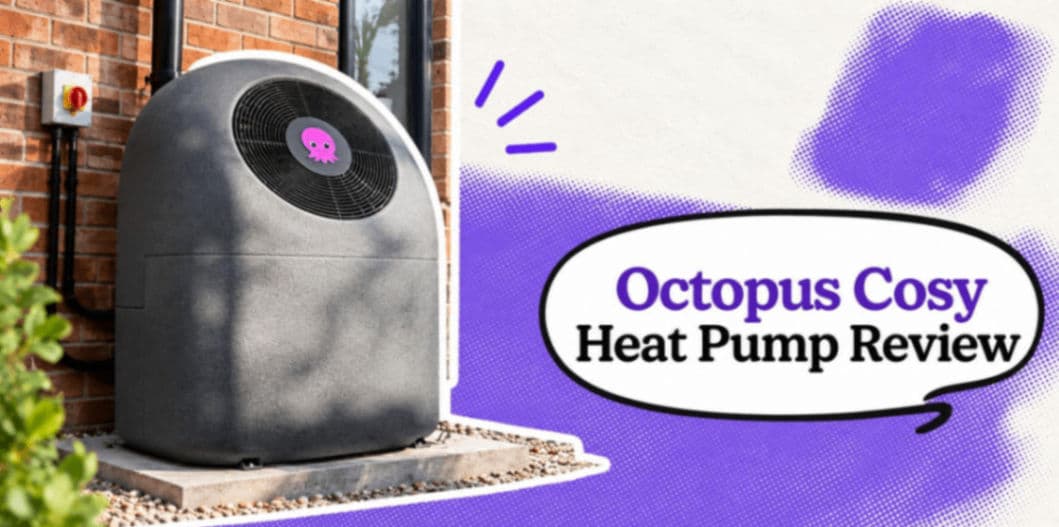

Octopus Energy’s Cosy combines a heat pump, smart controls, remote monitoring and an electricity tariff under one very purple umbrella. Is that genuinely useful, or simply an unusually coordinated collection of tentacles?
Most heat pumps follow a familiar formula.
There is a grey box outside, a collection of pipes inside and a control panel seemingly designed by somebody who considers “user-friendly” a personal insult.
The Octopus Cosy takes a more joined-up approach.
Octopus designs the heat pump, installs it, connects it to its app, monitors its performance and offers a tariff designed around the way heat pumps consume electricity.
On paper, it is one of the neatest all-in-one heat pump packages available in the UK.
But neat does not automatically mean perfect.
So, how efficient is the Cosy in the real world, what does it cost and are there any catches hiding beneath those eight friendly arms?
Ready to make your home more energy-efficient and cut down on your heating bills? Get a heat pump quote today.
Octopus Cosy heat pump review: the quick verdict
The Octopus Cosy is a very strong choice for homeowners who want their heat pump, installation, controls, support and electricity tariff managed by one company.
Its biggest advantage is not one spectacular technical specification. It is how well the complete system fits together.
There are now three models covering a useful range of UK homes, all using R290 refrigerant and capable of producing water at up to 70°C.
The app and Cosy Pods are genuinely useful, while Octopus’s fleet data provides more evidence of real-world performance than many manufacturers publish.
The limitations are worth noting.
Cosy is still a relatively young product range, so it does not have the decade-spanning reliability record of established systems from manufacturers such as Vaillant, Mitsubishi Electric or Daikin. Its best financial case also relies partly on using Octopus’s ecosystem effectively.
Standard workmanship cover is shorter than the eight-year product warranty unless additional cover is taken, and no headline price or running-cost saving will apply to every property.
Our verdict: an impressively complete and competitively priced heat pump system, particularly for homeowners who value smart controls and one-company accountability.
Our scores:
Category | Heatable score |
Reliability and support | 4/5 |
Performance and efficiency | 4.5/5 |
Controls and smart features | 5/5 |
Warranty | 4/5 |
Price and value | 4.5/5 |
Overall | 4.5/5 |
In short, it is the heat-pump equivalent of buying the phone, network and technical support from the same place.
Convenient, clever and considerably less likely to result in three companies blaming one another while you sit in a jumper.
Octopus Cosy specifications
The Cosy range currently includes three models.
Specification | Cosy 6 | Cosy 9 | Cosy 12 |
Heating capacity at -5°C outside/50°C flow | 5.6kW | 8.7kW | 11.2kW |
Heating capacity at -5°C outside/65°C flow | 5.2kW | 8.1kW | 10kW |
Published SCOP at 50°C | 3.4 | 3.6 | 3.9 |
Published SCOP at 65°C | 2.8 | 3.0 | 3.3 |
Maximum flow temperature | 70°C | 70°C | 70°C |
Sound power at 55°C operation | 58dB(A) | 56dB(A) | 61dB(A) |
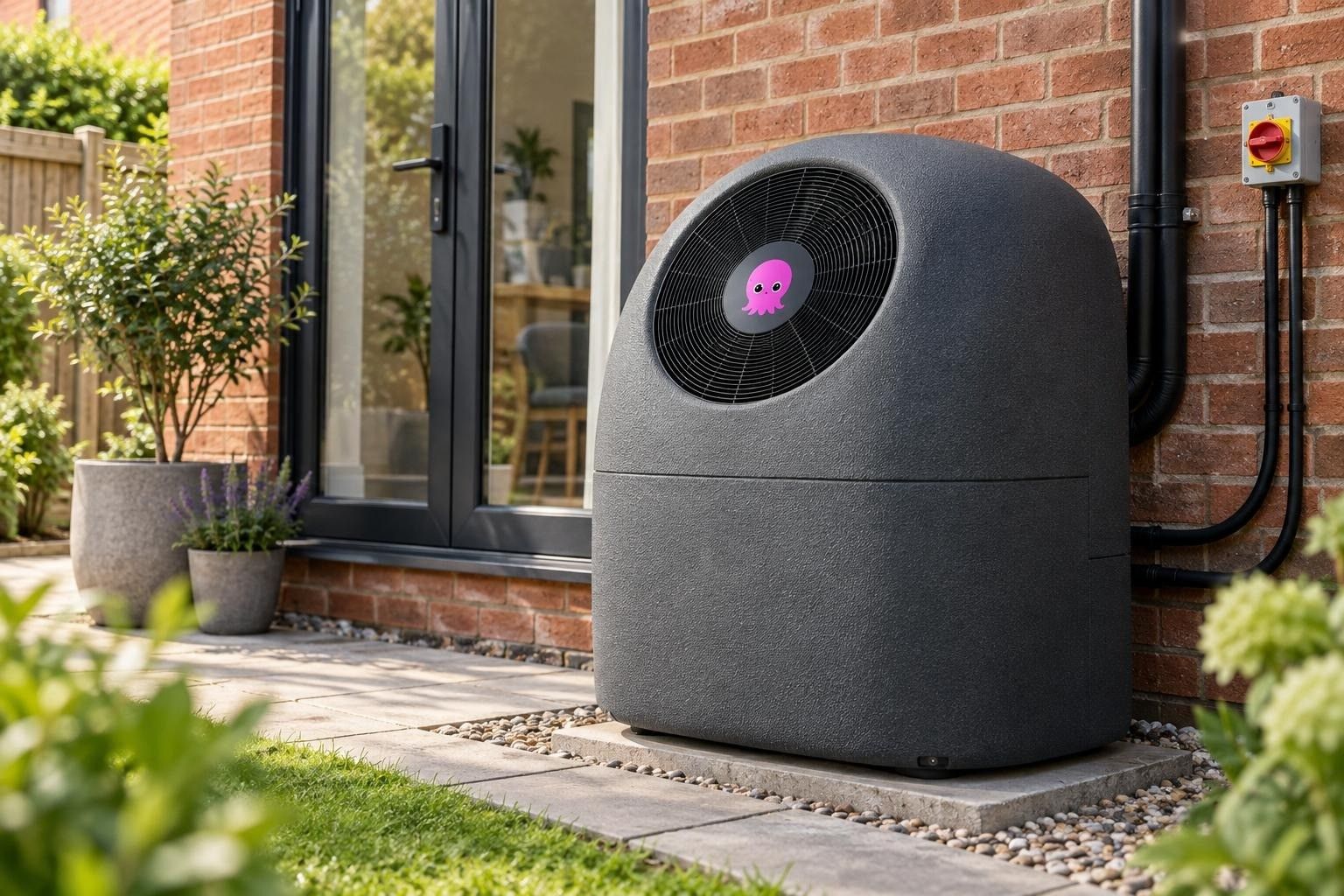
Dimensions, W × H × D | 855 × 1,125 × 595mm | 855 × 1,375 × 595mm | 855 × 1,375 × 595mm |
Refrigerant | R290 | R290 | R290 |
Product warranty | 8 years | 8 years | 8 years |
These capacities should not be used to select a heat pump by themselves.
A Cosy should be sized using a room-by-room heat-loss calculation. The number of bedrooms is useful for estate agents, but considerably less useful for heating engineers.
What is the Octopus Cosy?
The Cosy is an air-to-water monobloc heat pump.
It absorbs heat from the outside air, raises its temperature using a compressor and transfers that heat into the water circulating through your radiators, underfloor heating and hot-water cylinder.
The refrigerant circuit is contained within the outdoor unit, while water pipes connect it to the heating system inside the property.
The complete Cosy system can include:
The outdoor heat-pump unit
A suitably sized hot-water cylinder
The Cosy Hub
The Octopus Energy app
Up to four Cosy Pods
Required radiator upgrades
Associated plumbing and electrical work
The Cosy Pods monitor temperature and humidity in different parts of the home.
This gives the system a better idea of what is actually happening around the property, rather than relying on one thermostat sitting in the warmest hallway in Britain.
Cosy 6, Cosy 9 or Cosy 12?
The three models allow Octopus to serve a broader range of properties than the original Cosy 6 could manage alone.
Cosy 6
The Cosy 6 is intended for smaller and medium-sized homes with a design heat loss below approximately 5.6kW at a 50°C flow temperature.
It could suit a well-insulated one- to four-bedroom property, but the heat-loss survey ultimately decides.
Cosy 9
The Cosy 9 raises the available output to approximately 8.7kW under the same published design conditions.
That makes it suitable for many medium-sized family homes and less-efficient properties that sit beyond the Cosy 6’s comfortable operating range.
Interestingly, its published sound-power figure is slightly lower than the Cosy 6’s under the stated test conditions.
Cosy 12
The Cosy 12 extends the range to larger or higher-heat-loss homes, producing up to 11.2kW at the published -5°C/50°C condition.
It is physically taller and has the highest sound-power figure of the range, so location and noise assessment become especially important.
As ever, do not simply buy the biggest model because more kilowatts look reassuring.
An oversized heat pump can cycle unnecessarily, operate less efficiently and age its components faster.
It may also loom outside the kitchen like a very expensive public information kiosk.
Performance and efficiency: 4.5/5
Octopus publishes SCOP figures of between 3.4 and 3.9 when the Cosy models are designed around a 50°C flow temperature.
In simple terms, a SCOP of 3.9 represents approximately 3.9 units of heat produced for every unit of electricity consumed across the relevant test cycle.
At a higher 65°C design temperature, the published figures fall to between 2.8 and 3.3.
This is normal.
Heat pumps become less efficient when asked to produce hotter water. Although the Cosy can reach 70°C, that does not mean it should spend every winter charging around at maximum temperature.
A good installation will use the lowest practical flow temperature while still keeping every room comfortable.
What does the real-world data say?
Octopus publishes a fleet-performance dashboard using data from Cosy systems installed in British homes.
For the year to June 2026, it reported an average seasonal performance factor of 3.77 across heating and hot water. Its shorter-term average coefficient of performance was slightly above four when checked.
That is encouraging because it represents installed systems rather than one heat pump behaving impeccably in a laboratory.
However, this remains data published and interpreted by Octopus itself. It should not be treated as a guarantee that every Cosy will achieve the same result.
Performance will still depend on:
Heat-loss calculations
Radiator and underfloor-heating design
Flow temperature
Insulation
Hot-water demand
Weather compensation
Installation and commissioning
How the occupants use the system
A clever heat pump cannot repeal thermodynamics because somebody forgot to insulate the loft.
Running costs
According to Octopus’s fleet data, customers using a Cosy heat pump with the Cosy Octopus tariff saved an average of approximately £224 over the measured year compared with producing the same heat using an 85%-efficient gas boiler on Octopus’s standard variable tariff.
Octopus also reported that 94% of the measured Cosy systems would have been cheaper to run than the modelled gas-boiler alternative at the tariff rates used for its April 2026 comparison.
Those are useful figures, but the assumptions matter.
The calculation compares Octopus tariffs, assumes an 85%-efficient gas boiler and only includes avoided gas standing charges for customers who had completely removed their gas supply.
Your savings could therefore be higher, lower or entirely eaten by a teenager who has discovered hour-long showers.
The sensible conclusion is that a well-designed Cosy can compete with gas on running costs, particularly when paired with an appropriate smart tariff.
It is not a contractual promise that every household will save £224.
Controls and smart features: 5/5
This is where the Cosy is at its strongest.
The Octopus app allows users to:
Control heating and hot water remotely
Set schedules
View temperatures
Monitor system performance
Use Hush Mode
Receive software and performance updates
The Cosy Hub connects the heat pump to Octopus’s platform, while the room Pods provide temperature and humidity information from around the home.
Octopus can also monitor systems remotely and may be able to identify or resolve certain issues without an engineer visiting the property.
Software updates can refine performance and introduce new features over time.
That is still relatively unusual in domestic heating, where the traditional software-update process involves staring at the boiler until the error code disappears.
The trade-off is greater dependence on the Octopus platform, an internet connection and app-based controls.
You do not have to buy your household energy from Octopus to have one of its heat pumps installed. However, the system’s most joined-up experience - and potentially its strongest running-cost case - comes from using the wider Octopus ecosystem.
How noisy is the Octopus Cosy?
Octopus publishes sound-power figures between 56dB(A) and 61dB(A), depending on the model and operating temperature.
These are sound-power ratings, not necessarily the level somebody will hear at a nearby patio, pavement or bedroom window.
Real-world noise depends on:
Distance from the unit
Fan and compressor speed
Nearby walls and reflective surfaces
Mounting and vibration isolation
The required operating temperature
The specific model
Hush Mode can reduce the Cosy’s maximum output during quieter periods, which is useful where the unit is close to neighbours.
The Cosy is not unusually noisy for a modern air-source heat pump, but neither should the word “quiet” replace a proper MCS noise assessment.
This is particularly relevant for the larger Cosy 12.
Installation experience
Octopus manages the full process, including system design, installation and Boiler Upgrade Scheme paperwork.
After the initial quote, Octopus currently takes a £200 deposit to arrange the home survey. This remains refundable until the installation agreement is signed.
The survey checks:
Room-by-room heat loss
Required heat-pump size
Radiator output
Pipework
Outdoor-unit location
Cylinder location
Electrical requirements
Potential planning issues
Any additional work
Octopus says its standard installation quotes include required radiator upgrades, a compatible cylinder, normal plumbing and electrical work, delivery, labour and help with the grant application.
Extra costs can still arise for work such as scaffolding, planning applications, asbestos removal, structural surveys or unusual ground preparation.
Some properties requiring extensive replacement pipework may sit outside Octopus’s standard installation scope.
That is not necessarily a criticism. Recognising an unsuitable installation is considerably better than forcing a heat pump into a property and hoping nobody checks the electricity bill.
If a Cosy is not the right match following the survey, Octopus says it may recommend an alternative Daikin system at the same quoted price.
How much does an Octopus Cosy cost?
Octopus currently states that its typical heat-pump price is £4,459 after the standard £7,500 Boiler Upgrade Scheme grant.
That figure is the median post-survey price across Octopus heat-pump quotes issued during a specified six-month period. It is not a guaranteed Cosy price and should not be treated as one.
The final amount will depend on the property, required model, radiators, cylinder, electrical work and installation complexity.
As of July 2026, eligible properties in England and Wales can receive:
£7,500 towards an air-to-water heat pump
£9,000 for certain off-gas-grid homes replacing oil or LPG heating, available until March 2027
The installer applies for the Boiler Upgrade Scheme funding and deducts it from the price.
Scotland and Northern Ireland operate different support schemes.
For value, the Cosy looks highly competitive. Just wait for the surveyed, final quotation before deciding that your installation will cost exactly £4,459 and spending the remainder on an unnecessarily large television.
Warranty and aftercare: 4/5
The Cosy hardware comes with an eight-year manufacturer warranty.
According to Octopus’s current Cosy Care comparison, its free standard cover includes:
Eight-year Cosy product warranty
Two-year workmanship warranty
Remote smart monitoring
The optional Cosy Care plan starts from £12 per month and extends workmanship cover to eight years while adding annual servicing, covered call-outs and priority support.
Some warranty descriptions across Octopus’s online heat-pump pages currently use slightly different wording, particularly around labour and workmanship.
Customers should therefore confirm exactly what is included in the final installation agreement, which takes precedence over general website copy.
Eight years of product cover is strong. The shorter standard workmanship period and additional cost of matching that cover prevent a perfect score.
Reliability and customer support: 4/5
Cosy benefits from Octopus’s scale, remote monitoring and ability to manage both installation and ongoing support.
Octopus Energy as a whole was rated approximately 4.8/5 from more than 800,000 reviews on Trustpilot when checked in July 2026.
That is an impressive overall result, but it covers the complete energy business - not just Cosy heat-pump installations.
The bigger unknown is long-term hardware durability.
The Cosy range launched in 2024, so there is not yet enough evidence to judge how the units will perform after ten or fifteen British winters.
Remote monitoring and an eight-year warranty reduce the risk, but they do not magically create a long-term track record.
Established heat-pump manufacturers still have an advantage here.
Octopus Cosy pros and cons
Pros:
Three models now cover a useful range of property sizes
Strong real-world fleet-performance data
Up to 70°C flow temperature
Lower-impact R290 refrigerant
Excellent app and smart-control integration
Room temperature and humidity monitoring
Remote diagnostics and software updates
Eight-year product warranty
Competitive typical post-grant pricing
Installation, controls, support and tariffs available from one provider
Cons:
Shorter product history than established heat-pump brands
Standard workmanship cover is shorter than the product warranty
Best experience is closely tied to the Octopus ecosystem
Headline price will not apply to every installation
Running-cost claims depend on tariffs and modelling assumptions
Requires space for an outdoor unit and hot-water cylinder
Larger models need careful noise and location assessment
Some complex properties may fall outside the standard installation scope
Who should buy an Octopus Cosy?
The Cosy is particularly well suited to homeowners who:
Want one company responsible for design, installation and support
Like app-based controls and home-energy technology
Are interested in smart electricity tariffs
Want access to remote monitoring
Prefer an inclusive installation quote
Have suitable space for the unit and cylinder
Value an eight-year product warranty
It could also appeal to anyone who has previously attempted to resolve a heating problem involving an installer, manufacturer and energy supplier simultaneously.
Who should consider something else?
A different heat pump may make more sense if:
You want a manufacturer with a much longer UK track record
You prefer using a trusted independent local installer
You want maximum freedom to choose third-party controls
Your home requires extensive or highly bespoke plumbing work
Your heat loss exceeds the available Cosy range
You do not want heating controls dependent on an app or internet connection
Another manufacturer offers a demonstrably better fit for your property design
The correct heat pump is the one that suits the building - not the one with the friendliest brand mascot.
Final verdict
The Octopus Cosy is one of the most convincing all-in-one heat pump propositions in the UK.
Its hardware specifications are competitive, the controls are excellent and Octopus publishes unusually useful fleet-performance data.
The expanded Cosy 6, 9 and 12 range also means the system can now serve far more homes.
It is not automatically the most efficient heat pump on the market, nor does it have the longest reliability record.
Its pricing and running-cost claims also require context, while customers should check the precise workmanship cover included in their agreement.
Nevertheless, the complete package is difficult to ignore.
For homeowners who want a well-integrated heat pump with smart controls, remote monitoring, good product cover and one company responsible for most of the process, the Octopus Cosy is very easy to recommend.
Heatable score: 4.5/5
A very good heat pump system with an excellent supporting ecosystem - provided your home, tariff and fondness for tentacles all fit the brief.
Next Steps For Your Heat Pump Journey:
When planning to install a heat pump for your home, there are several important factors to consider. Make sure to refer to the following guides to help you make informed decisions:
To dive deeper into these topics, head over to our advice section or check out our YouTube channel to learn more.
Get A Quote From Us Today
Without boasting, get your new heat pump quote and buy from us, here’s why:
Gas Safe installation within 24 hours.
Thousands of satisfied customers with an average score of 4.9 on Trustpilot, surpassing the market leader.
Which? Trusted Trader: Heatable is proudly recognised as a Which? Trusted Trader.
Flexible payment options, including interest-free finance.
Up to 12-year guarantee on selected heat pumps.
Fixed price guarantee: No hidden costs.
Save your quote and decide later.
Get an instant fixed price on a heat pump, here.
Heat Happy.