
The Octopus Cosy 6 is one of the more unusual heat pumps to arrive on the UK market in recent years.
Unlike established heat pump manufacturers such as Vaillant and Samsung, Octopus Energy has approached the market from the other direction, developing its own heat pump alongside the tariff, software and installation service needed to run it.
The result is the Cosy 6, a 6kW R290 air source heat pump designed primarily for smaller and medium-sized UK homes.
On paper, there's plenty to like. It can produce flow temperatures of up to 70°C, comes with an eight-year product warranty and integrates closely with the Octopus Energy app and Cosy tariff. Octopus currently publishes outputs of 5.2kW at -5°C/65°C and 5.6kW at -5°C/50°C.
It is also one of the most visually distinctive heat pumps on the market. That may sound trivial, but when you're installing a fairly large appliance permanently outside your house, appearance is worth considering. The Cosy has attracted some fairly polarised reactions online, which we'll come to later.
But how does it actually stack up against established alternatives?
In this Cosy 6 review, we'll look beyond the marketing and examine its specifications, efficiency, noise, running costs, warranty, design, and potential drawbacks.
Ready to make your home more energy-efficient and cut down on your heating bills? Get a heat pump quote today.
Cosy 6: At a Glance
Specification | Octopus Cosy 6 |
Nominal capacity | 6kW |
Refrigerant | R290 propane |
Maximum flow temperature | 70°C |
SCOP at 50°C design temperature | 3.4 |
SCOP at 65°C design temperature | 2.8 |
Heat output at -5°C / 50°C flow | 5.6kW |
Sound power at 55°C | 58dB(A) |
Dimensions | 855 x 1,125 x 595mm |
Product warranty | 8 years |
Smart controls | Octopus Energy app |
These are Octopus's currently published figures.
Cosy 6 Pros and Cons
Pros:
Uses low-GWP R290 refrigerant
Maximum flow temperature of 70°C
Eight-year product warranty
Integrated app controls and remote monitoring
Compatible with Octopus's heat-pump-specific tariff
Software can be updated remotely
Designed, installed and supported within one Octopus ecosystem
Potentially competitive installation pricing after the Boiler Upgrade Scheme
More distinctive exterior design than a conventional white heat pump box
Cons:
Smaller choice of installers than manufacturer-led brands
Closely tied to the Octopus hardware and software ecosystem
Not especially compact at 1,125mm high
Published efficiency figures aren't obviously class-leading against some direct rivals
Efficiency falls significantly when very high flow temperatures are used
Less long-term product history than established manufacturers such as Vaillant and Samsung
Styling is divisive, particularly the rounded casing and prominent Octopus branding
Samsung and Vaillant both offer arguably more restrained designs if the outdoor unit will be highly visible
What Is the Octopus Cosy 6?
The Cosy 6 is an air-to-water monobloc heat pump developed by Octopus Energy.
It takes heat from the outside air and transfers it into water circulating through your radiators or underfloor heating, as well as providing heat for a compatible hot water cylinder.
Despite the name, 6kW shouldn't automatically be interpreted as the amount of heating the machine delivers under every condition.
Heat pump output varies according to outdoor temperature and required water temperature.
At -5°C outside, Octopus publishes a heating capacity of approximately 5.6kW at a 50°C flow temperature and 5.2kW at 65°C.
That's why heat pump sizing should be based on a proper room-by-room heat-loss calculation rather than simply replacing a 24kW gas boiler with a similarly rated heat pump.
Octopus also offers Cosy 9 and Cosy 12 models where the calculated heating demand requires greater output.
How Efficient Is the Cosy 6?
This is where heat pump comparisons can become misleading surprisingly quickly.
Efficiency depends heavily on the outside temperature and, crucially, the temperature of the water the heat pump is being asked to produce.
Octopus currently quotes the Cosy 6 at:
SCOP 3.4 when designed around a 50°C flow temperature
SCOP 2.8 when designed around a 65°C flow temperature
That difference matters.
The harder any heat pump has to work to raise water temperature, the more electricity it generally consumes for each unit of heat delivered.
So don't assume that because the Cosy can produce 70°C water, running it near 70°C continuously is desirable.
A well-designed installation should normally aim for the lowest practical flow temperature while still keeping the property comfortable.
The 70°C Flow Temperature Explained
One of the Cosy 6's headline specifications is its 70°C maximum flow temperature.
That's much closer to traditional boiler operating temperatures than older generations of heat pump.
The use of R290 propane refrigerant helps modern heat pumps reach these higher temperatures, which can make them more suitable for retrofit properties.
However, maximum temperature shouldn't be confused with optimum temperature.
The Cosy's own SCOP figures show how much performance can change when a system is designed at higher temperatures.
If your house requires extremely high radiator temperatures throughout winter just to remain comfortable, it may be worth investigating larger radiators, heat loss or insulation before simply designing the heat pump around 65-70°C operation.
Cosy 6 Noise Levels
Octopus publishes a sound power level of 58dB(A) when operating at a 55°C water temperature and 59dB(A) at 65°C.
It's important not to confuse sound power with the sound pressure level you might actually experience several metres away.
Distance, walls, fences and the installation environment all affect perceived noise.
The system also includes Hush Mode, which can be enabled through the Octopus app.
Nevertheless, siting remains important.
A heat pump positioned away from bedrooms and neighbouring boundaries will generally be less intrusive than exactly the same machine installed in an acoustically awkward location.
What Does the Cosy 6 Look Like?
This deserves its own section because the Cosy is anything but anonymous.
Most heat pumps are unapologetically utilitarian: a rectangular white, grey or black metal enclosure with a large fan on the front.
The Cosy takes a different approach.
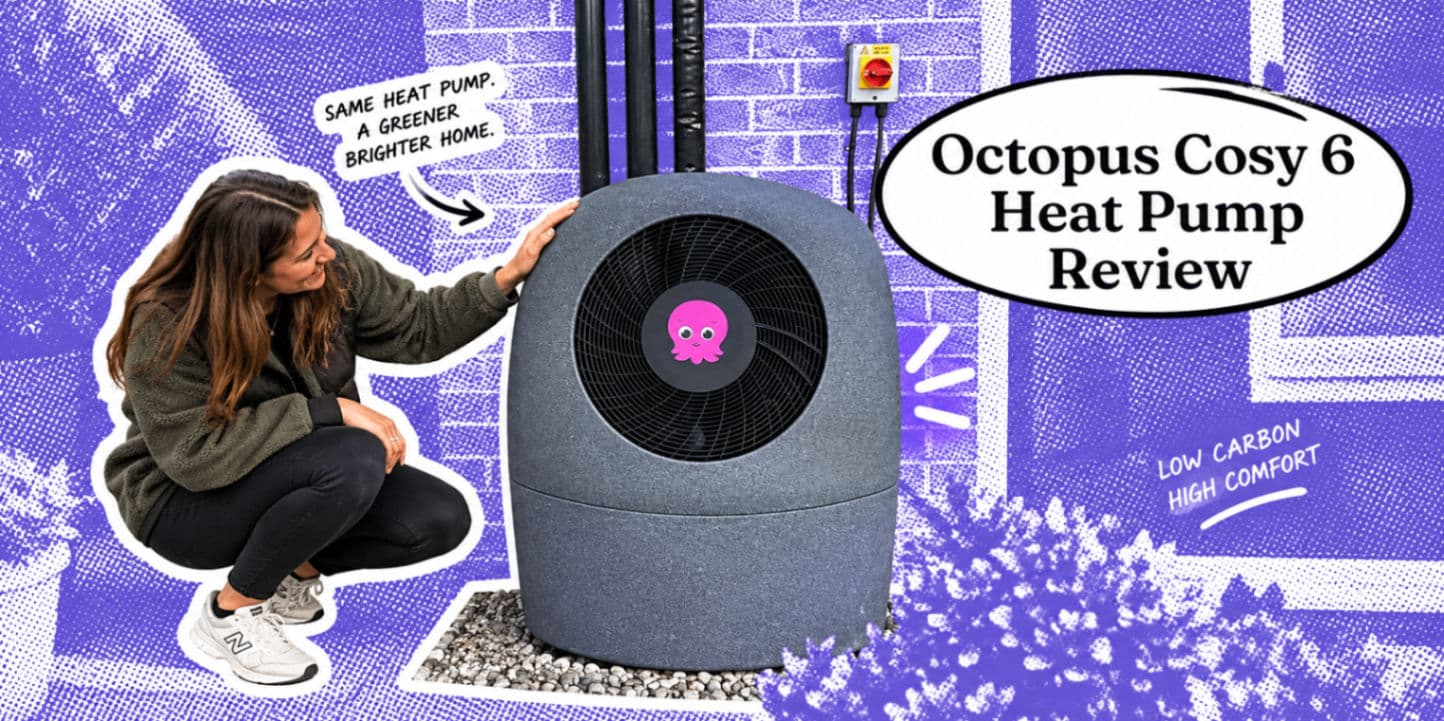
The production Cosy uses a dark graphite-style casing with rounded corners, a textured outer surface and prominent Octopus branding.
Earlier promotional versions attracted attention for their much brighter purple finish, although production units moved to the considerably more restrained dark colour.
That still hasn't made the design universally popular.
Some owners and prospective buyers have criticised the rounded shape and branding, while others specifically say they prefer it to conventional boxy heat pumps.
In one Octopus Energy community discussion, reactions ranged from criticism that the design looked overly toy-like to owners saying they liked it more than traditional units.
That's worth presenting for what it is: subjective feedback, not a product defect.
Personally, we'd put it this way.
The Cosy looks deliberately designed rather than purely engineered. Whether that's a success will depend entirely on your taste.
If the unit will be hidden down the side of your house, this probably doesn't matter.
If it's going beside a patio, on the front elevation or somewhere permanently in view, we'd absolutely look at the physical units before choosing.
Cosy vs Samsung vs Vaillant on looks
Samsung arguably takes the most conventional contemporary-design approach of the three.
Its EHS Mono R290 uses a fairly minimalist dark-grey enclosure with straight, architectural lines. Samsung explicitly markets the casing as being designed to complement modern building exteriors, rather than merely concealing the engineering inside.
Vaillant sits somewhere between Samsung and Octopus.
The aroTHERM plus is cleaner and more conventional than the Cosy, with an understated light-coloured enclosure, but it remains recognisably an HVAC appliance.
The Cosy is easily the most visually distinctive.
That's either an advantage or a disadvantage depending on whether you want the heat pump to blend into the background or look like a deliberately designed consumer product.
R290 Refrigerant
The Cosy 6 uses R290 propane refrigerant.
R290 has an extremely low global warming potential compared with many older fluorinated refrigerants and has become increasingly common in the latest generation of high-temperature heat pumps.
Significantly, both of the major competitors we're comparing here also use R290.
The Samsung EHS Mono R290 uses propane and can produce leaving-water temperatures of up to 75°C.
Vaillant's aroTHERM plus also uses R290 and reaches flow temperatures of up to 75°C.
So R290 is a strength of the Cosy, but no longer a unique advantage.
Cosy 6 Controls and Octopus App
Software is probably where the Cosy proposition differs most from a conventional heat pump manufacturer.
The system integrates with the Octopus Energy app, allowing owners to control heating and hot water, adjust schedules, monitor temperatures and activate Hush Mode.
Octopus can also remotely update the heat pump's software. citeturn483291search1
That makes the Cosy less like buying an isolated heating appliance and more like entering an energy ecosystem.
Octopus supplies the heat pump, installs it, supplies the electricity, offers a dedicated tariff and controls much of the software layer.
There is a genuine advantage to that integration.
There's also a trade-off.
Some homeowners will prefer hardware supported by a broader independent installer base rather than something so closely linked to one energy company.
Cosy 6 vs Samsung EHS Mono R290
The Samsung EHS Mono R290 is probably the most interesting contemporary competitor to the Cosy.
Like the Cosy, it's a modern monobloc system using R290.
Samsung offers the EHS Mono R290 in 5kW, 8kW, 12kW and 16kW capacities, so the 5kW version is the closest nominal comparison with the Cosy 6. citeturn596130search0
Samsung quotes leaving-water temperatures of up to 75°C, compared with the Cosy's 70°C.
Samsung also says the 5kW R290 model achieves a SCOP of 5.10 at 35°C under EN14825 test conditions.
That number shouldn't be directly compared with the Cosy's published 3.4 figure at a 50°C design temperature, because the operating temperatures differ substantially.
The important point is that Samsung's published low-temperature efficiency specification is very strong, while the Cosy provides unusually transparent figures for operation at much higher 50°C and 65°C design temperatures.
Samsung advantages
The Samsung has several notable strengths:
maximum flow temperature up to 75°C
R290 refrigerant
5kW model close to the Cosy 6's output class
SmartThings integration
remote monitoring through Samsung's ecosystem
broad range extending to 16kW
compact 850mm height for its 5kW and 8kW models
comparatively restrained dark-grey exterior styling
Samsung also uses a four-stage Quiet Mode and advertises sound-pressure levels as low as 35dB(A) under its specified test conditions.
Care is required here because this isn't the same measurement as the Cosy's 58dB(A) sound-power figure, so the two numbers shouldn't be directly ranked.
Where the Cosy fights back
The Octopus system offers something Samsung doesn't replicate in quite the same way: vertical integration.
Your installer, electricity supplier, heat pump software, app, monitoring and heat-pump-specific tariff can all come from the same company.
That's arguably the Cosy's strongest selling point.
Cosy 6 vs Vaillant aroTHERM plus
The Vaillant aroTHERM plus is probably the benchmark established competitor.
Like both Samsung and Octopus, it uses R290.
Vaillant offers the aroTHERM plus in 3.5kW, 5kW, 7kW, 10kW and 12kW outputs, giving installers more opportunities to match the unit closely to calculated property heat loss.
The 5kW and 7kW versions are the most obvious comparisons with the Cosy 6.
Maximum temperature
The Vaillant can provide flow temperatures of up to 75°C, compared with 70°C from the Cosy.
Again, we'd caution against choosing a heat pump based primarily on maximum temperature.
The goal should normally be to run at a substantially lower temperature whenever possible.
Efficiency
Vaillant advertises SCOP figures of up to 5.03, depending on the model and operating conditions.
As with Samsung, this shouldn't simply be placed beside the Cosy's 50°C or 65°C SCOP and treated as an apples-to-apples comparison.
Test conditions matter.
Noise
This is one area where Vaillant's published technical data deserves attention.
The current 5kW aroTHERM plus specification gives a sound-power figure of 48dB(A) at A7/W35, while the 7kW model is listed at 49dB(A) under comparable EN test conditions.
The Cosy's published figure is 58dB(A) at a higher 55°C water temperature, meaning this again isn't a perfect like-for-like comparison.
Nevertheless, Vaillant has invested heavily in acoustics and the aroTHERM plus carries Quiet Mark recognition.
Controls
Vaillant uses its sensoCOMFORT controller alongside the myVAILLANT app and internet gateway.
It's a more traditional manufacturer-led controls ecosystem than Octopus's approach.
The Cosy arguably feels more consumer-tech-focused because its controls are integrated directly into the same Octopus app customers may already use for their energy account.
Aesthetics
The aroTHERM plus is far less adventurous visually than the Cosy.
For some people that's exactly the point.
It has a clean, neutral enclosure designed to disappear reasonably unobtrusively against a property rather than attract attention.
If you want your heat pump to visually disappear, the Vaillant probably has an advantage. If you prefer something with more personality, the Cosy is considerably more distinctive.
Cosy 6 vs Samsung vs Vaillant: Key Differences
Feature | Octopus Cosy 6 | Samsung EHS Mono R290 | Vaillant aroTherm plus |
Closest ouput | 6kW | 5kW | 5kW / 7kW |
Refrigerant | R290 | R290 | R290 |
Max flow temperature | 70°C | Up to 75°C | Up to 75°C |
Smart platform | Octopus app | SmartThings | myVAILLANT |
Product range | 6, 9, 12kW | 5, 8, 12, 16kW | 3.5, 5, 7, 10, 12kW |
Design | Rounded graphite casing | Minimalist dark grey | Conventional light enclosure |
Main proposition | Integrated energy ecosystem | Technology + design + broad range | Established heating platform |
Standout advantage | Octopus integration | Compact modern design / SmartThings | Installer ecosystem / established platform |
We deliberately haven't put a single “winner” beside those specifications.
The figures aren't all published under identical test conditions, and heat-pump performance in an actual house depends heavily on installation design.
Is the Cosy 6 Suitable for Older Homes?
Potentially, yes.
The idea that heat pumps only work in new builds is outdated.
But neither the Cosy nor Samsung nor Vaillant can escape basic thermodynamics.
An older property needs an accurate heat-loss calculation to establish:
how much heat it loses on a cold day
what size radiators are required
what flow temperature is necessary
whether insulation improvements make economic sense
what size heat pump should be installed
The Cosy 6's 70°C capability gives installers additional flexibility, but regularly running any heat pump at high temperatures is likely to sacrifice efficiency.
How Does the Cosy 6 Compare With a Gas Boiler?
Don't compare the 6kW number with the 24kW or 30kW printed on a combi boiler.
They're doing different jobs.
A combi requires high instantaneous output partly because it heats mains water on demand.
A heat pump generally heats a hot water cylinder progressively and is sized much closer to the building's actual space-heating requirement.
The Cosy 6 therefore isn't “four times less powerful” than a 24kW boiler in any meaningful sense.
What matters is whether its available output under design conditions matches the calculated heat loss.
Our View of the Octopus Cosy 6
The Cosy 6 is a credible modern heat pump with several genuinely interesting features.
R290 refrigerant, 70°C operation, an eight-year warranty, remote diagnostics and tight integration with Octopus's software and tariffs give it a compelling proposition.
However, judged purely as a piece of heat-pump hardware, it faces extremely serious competition.
Samsung's EHS Mono R290 offers 75°C operation, a wider output range, SmartThings connectivity and a noticeably more compact and conventional-looking 5kW outdoor unit.
Vaillant's aroTHERM plus offers 75°C capability, a broad range of outputs and an established platform with particularly strong published acoustic performance.
And then there's the appearance.
The Cosy's rounded graphite casing and prominent branding are unmistakable. Some homeowners genuinely like that. Others have criticised it quite strongly online.
Neither reaction tells us anything about how well it heats a house.
But heat pumps are large outdoor appliances that can remain in place for well over a decade, so aesthetics aren't completely frivolous either.
If your heat pump is going somewhere highly visible, we'd compare the physical appearance and dimensions of the Cosy, Samsung and Vaillant before signing a contract.
Ultimately, though, the Cosy's biggest differentiator isn't its casing, refrigerant or maximum temperature.
It's Octopus itself.
The same business can install your system, supply your electricity, provide a tariff designed around it, monitor the hardware and update its software.
For some households, that joined-up approach may be more valuable than winning an individual specification battle.
For others, a Samsung or Vaillant installed by an experienced independent heat-pump specialist may offer greater flexibility.
Most importantly, a well-designed heating system matters more than the logo on the outdoor unit.
Correct heat-loss calculations, radiator sizing, weather compensation and low flow temperatures will usually have a much bigger effect on comfort and running costs than choosing a heat pump because one headline figure happens to be slightly higher than another.
Next Steps For Your Heat Pump Journey:
When planning to install a heat pump for your home, there are several important factors to consider. Make sure to refer to the following guides to help you make informed decisions:
To dive deeper into these topics, head over to our advice section or check out our YouTube channel to learn more.
Get A Quote From Us Today
Without boasting, get your new heat pump quote and buy from us, here’s why:
Gas Safe installation within 24 hours.
Thousands of satisfied customers with an average score of 4.9 on Trustpilot, surpassing the market leader.
Which? Trusted Trader: Heatable is proudly recognised as a Which? Trusted Trader.
Flexible payment options, including interest-free finance.
Up to 12-year guarantee on selected heat pumps.
Fixed price guarantee: No hidden costs.
Save your quote and decide later.
Get an instant fixed price on a heat pump, here.
Heat happy.