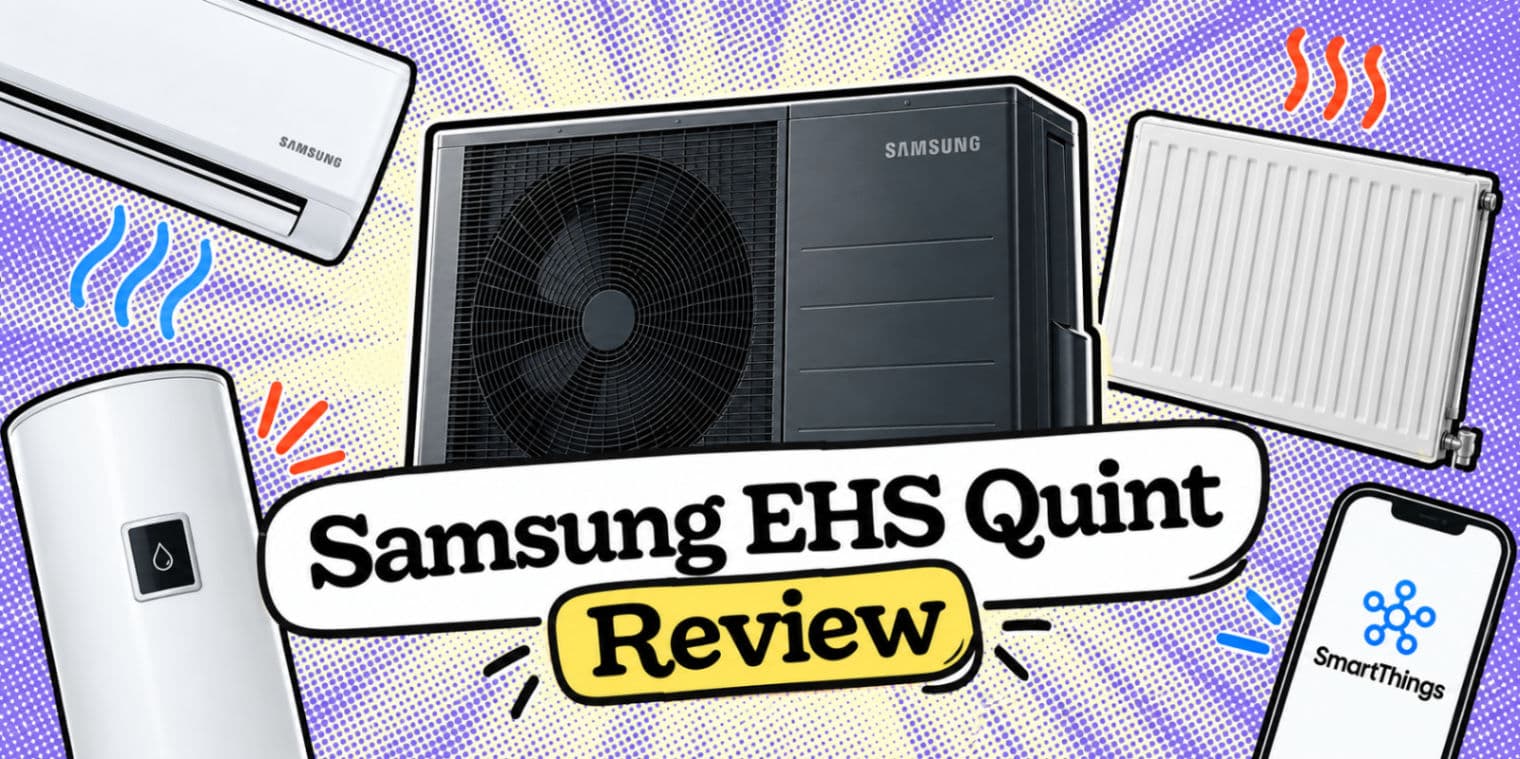

The Samsung EHS Quint heats your home, heats your hot water and provides proper air conditioning. All from one outdoor unit. Clever stuff, but is it actually any good?
- What Is the Samsung EHS Quint?
- How Does the Samsung EHS Quint Work?
- How Hot Can the Samsung EHS Quint Run?
- Why Does the Samsung Quint Use R32?
- Is the Samsung EHS Quint Quiet?
- Who Is the Samsung EHS Quint Actually For?
- Does the Samsung EHS Quint Qualify for the Boiler Upgrade Scheme?
- Samsung EHS Quint Pros and Cons
Heat pumps and air conditioners are more closely related than most people realise. Both use refrigerant to move heat from one place to another; the main difference is what they're designed to do with it.
That raises an obvious question. If the technology is so similar, why do homeowners normally need one outdoor unit for their heat pump and another for their air conditioning?
Samsung has come up with an answer: the EHS Quint.
The Quint combines air-to-water heating, domestic hot water and air-to-air cooling into one system.
It can heat your radiators or underfloor heating, warm your hot-water cylinder and run proper air-conditioning units around the home, all from one outdoor unit.
It can even recover some of the heat removed by the air conditioning and use it elsewhere in the system.
Very clever.
There is one fairly major catch, though. The smallest Quint currently available is 12.5kW, which immediately makes it too large for plenty of ordinary UK homes.
So, who is it actually for, and is combining all this tech into one unit genuinely a good idea?
Let's take a look…
💨 Ready to make your home more energy-efficient and cut down on your heating bills? Get a heat pump quote today.
Samsung EHS Quint: At a Glance
The easiest way to understand the Quint is to think of it as an air source heat pump and air-conditioning system rolled into one.
Depending on the system design, it can:
Heat radiators
Run underfloor heating
Produce domestic hot water
Provide proper air conditioning
Heat and cool different parts of the home at the same time
Recover heat from the cooling system
Connect to Samsung SmartThings
Samsung currently offers the Quint in 12.5kW and 16kW models.
The 12.5kW version has a published heating COP of 4.66, can provide flow temperatures up to 65°C and maintains its full heating capacity down to -15°C.
On paper, there's plenty to like.
The bigger question is whether your home actually needs one.
What Is the Samsung EHS Quint?
With a conventional setup, anyone wanting both an air source heat pump and proper air conditioning would normally end up with two separate systems.
The air-to-water heat pump would supply hot water to your radiators, underfloor heating and hot-water cylinder.
Your air-conditioning system would then have another outdoor unit connected to the indoor AC units around the property.
That setup works perfectly well, but it means more outdoor equipment, more pipework and potentially two different systems to maintain and control.
The Quint combines both jobs.
You could, for example, have underfloor heating downstairs, radiators elsewhere in the property, air conditioning in the bedrooms and hot water stored in a cylinder, all connected back to the same outdoor system.
That is what makes the Quint interesting. Samsung hasn't invented a completely new way of heating or cooling a house.
Instead, it has found a much neater way of combining technologies that would normally operate separately.
Prefer to watch instead?
If you’d rather see the Samsung EHS Quint in action, we’ve broken down how it works, the key specs, heat recovery, grant questions and who it’s actually suited to in our full video review below.
Watch the full Samsung EHS Quint review below:
How Does the Samsung EHS Quint Work?
When the Quint is heating your home, it works much like any other air source heat pump.
The outdoor unit absorbs thermal energy from the surrounding air. Refrigerant carries that energy through the system, where the compressor increases its temperature before the heat is transferred into the water running through your central-heating system.
That heated water can then be sent around your radiators or underfloor heating, or used to heat the water stored inside your hot-water cylinder.
The air-conditioning side works on the same basic refrigeration principle, but instead removes heat from the room.
The indoor AC unit absorbs warm air, transfers that heat into the refrigerant and blows cooler air back into the room.
Normally, that collected heat is simply dumped outside.
The Quint can do something much more useful with it.
Heat Recovery Is Probably the Cleverest Part
This is one of the standout features of the Quint.
Imagine it's the middle of summer and your bedroom air conditioning is running. The system is removing heat from the room to cool it down.
With a normal AC system, that heat would usually be discharged outside.
The Quint can instead redirect some of that energy into your hot-water system.
So while you're cooling your bedroom, the system can use heat that would otherwise be wasted to help warm the water in your cylinder.
That doesn't mean your hot water suddenly becomes free every summer. The benefit will depend on how much cooling you're using, your hot-water demand and how the overall system is configured.
But from an efficiency point of view, it makes a lot of sense. If you've already collected that heat, you might as well put it somewhere useful.
The Quint can also use recovered heat elsewhere in the system, including during defrost operation.
It Can Heat and Cool at the Same Time
Another unusual feature is the ability to provide heating and cooling at the same time.
At first, that sounds slightly excessive. Why would you ever want the heating and air conditioning running together?
In a larger property, it can actually make plenty of sense.
A top-floor bedroom exposed to direct sunlight could be uncomfortably hot while a shaded room downstairs still needs heating.
Rather than forcing the entire house into one operating mode, the Quint can manage different areas separately.
That means the air-to-air side could cool one part of the property while the wet heating system continues to warm another.
It can also produce domestic hot water while cooling.
For a typical small house, that level of flexibility might be unnecessary. For a larger or multi-storey property with very different temperature zones, it's a genuinely useful feature.
Samsung EHS Quint Efficiency
The headline efficiency figures are strong.
The 12.5kW model has a published:
Heating COP: 4.66
Cooling EER: 4.01
A heating COP of 4.66 means that, under the stated test conditions, the heat pump delivers 4.66 units of heat for every unit of electricity it uses.
That does not mean you're going to achieve a COP of 4.66 throughout the year.
Real-world efficiency depends on plenty of variables, including:
Outdoor temperature
Heating flow temperature
Radiator and emitter sizing
Insulation
Hot-water demand
Controls
System design
Installation quality
Still, a COP of 4.66 is a very respectable figure on paper.
How Hot Can the Samsung EHS Quint Run?
The Quint can produce heating water at up to 65°C.
That gives it a decent amount of flexibility when replacing a boiler, particularly in homes where existing radiators are being retained.
Some of the newest R290 heat pumps can run hotter, with certain models capable of producing water at around 70–75°C. Samsung's own EHS Mono R290 is one example.
But maximum flow temperature isn't the number you should obsess over when choosing a heat pump.
Heat pumps generally become more efficient as the required water temperature falls. A well-designed system will therefore aim to heat the property using the lowest practical flow temperature, often with larger radiators or underfloor heating.
So the Quint's 65°C maximum is useful extra headroom, rather than the temperature you should expect it to run at every day.
Why Does the Samsung Quint Use R32?
This is one of the more interesting technical choices.
A lot of newer air-to-water heat pumps now use R290, otherwise known as propane. R290 has an extremely low global-warming potential and also allows manufacturers to achieve very high flow temperatures.
The Quint uses R32 instead.
At first glance, that might look like a step backwards, but the design of the Quint makes things more complicated.
This isn't simply a monobloc heat pump with all of the refrigerant sealed inside the outdoor unit. The refrigerant circuit also needs to supply the indoor air-conditioning units around the property.
R290 is highly flammable, which creates much stricter limits around refrigerant charge, pipework and how the system can be installed indoors.
R32 is classed as mildly flammable, making it much better suited to this kind of combined air-to-water and air-to-air setup.
In other words, R32 isn't being used because Samsung forgot newer refrigerants exist. It's part of what allows the Quint to work in the way it does.
Is the Samsung EHS Quint Quiet?
Samsung quotes an operating sound-pressure level of around 49dB(A), with a Night Mode capable of reducing this to around 35dB(A) under the right conditions.
That's fairly respectable considering the size of the unit.
And it is big.
The outdoor unit weighs around 126kg, which gives you some idea of the amount of equipment Samsung has squeezed into it.
You'll therefore need a suitable position outside the property, and this isn't something you're casually relocating once it's installed.
The Biggest Problem: 12.5kW Is a Lot of Heat Pump
This is where the Quint becomes much less suitable for the average UK home.
The smallest model is 12.5kW.
For comparison, plenty of ordinary UK properties need something closer to 5kW, 7kW or 8kW. At Heatable, 7kW is one of the most common heat-pump sizes we install.
And when it comes to heat pumps, bigger isn't necessarily better.
A significantly oversized heat pump can cycle on and off more frequently instead of running steadily, potentially reducing efficiency and increasing wear on the system.
That's why heat pumps should be selected using a proper heat-loss calculation rather than simply choosing the largest unit available.
If your house only requires a 6kW heat pump, buying a 12.5kW Quint because you fancy air conditioning probably isn't going to be the most sensible solution.
This is easily the biggest limitation of the product at the moment.
If Samsung eventually launches something around 5–8kW, the Quint suddenly becomes relevant to a much larger chunk of the UK housing market.
Who Is the Samsung EHS Quint Actually For?
The Quint makes much more sense once you start looking at larger properties.
Imagine you're renovating a large detached home or planning a substantial extension. You want an air source heat pump, underfloor heating downstairs, radiators elsewhere, air conditioning in several bedrooms and proper smart controls.
Traditionally, you could easily end up specifying separate heating and cooling systems with multiple outdoor units.
The Quint can potentially bring all of that together.
We therefore see it making the most sense for:
Larger detached properties
Major home renovations
Large extensions
Self-build projects
Homes already planning extensive air conditioning
Properties with higher calculated heat losses
For your average three-bedroom semi, there are likely to be much more sensible heat-pump options.
For a big house where both heating and cooling are already part of the plan, the Quint gets much more interesting.
Does the Samsung EHS Quint Qualify for the Boiler Upgrade Scheme?
This is where things become slightly messy.
The Boiler Upgrade Scheme supports eligible heat-pump installations in England and Wales, including both air-to-water and, more recently, certain air-to-air systems.
The Quint crosses both categories.
That doesn't mean you can simply claim an air-to-water grant and an air-to-air grant for the same property. Current BUS rules only allow one grant per property.
The more important question is exactly how the Quint and its particular installation configuration are classified.
Because this is a relatively unusual hybrid system, we'd want the eligibility of the exact installation confirmed before assuming any BUS funding will apply.
In other words, don't base your buying decision on a grant until somebody has confirmed you're actually getting it.
You'll Still Need a Hot-Water Cylinder
One other thing worth knowing is that the Quint doesn't work like a combi boiler.
It won't produce domestic hot water instantaneously every time you open a tap.
Like most air-to-water heat pumps, it heats water that is stored inside a cylinder ready for your showers, baths and taps.
Samsung offers its own ClimateHub equipment, although the exact indoor setup will depend on how your system is designed.
If you're currently replacing a combi boiler and don't have a hot-water cylinder, you'll therefore need to find space for one.
That's not specific to the Quint, but it is something homeowners often overlook when comparing heat pumps with combi boilers.
Samsung SmartThings Integration
The Quint also integrates with Samsung SmartThings, allowing the heating and cooling system to be controlled through Samsung's smart-home platform.
On a basic heating system, app integration can sometimes feel more like a nice extra than something genuinely useful.
On the Quint, it makes considerably more sense.
You could potentially have multiple heating zones, several air-conditioning units and your hot water all operating as part of the same wider system. Bringing those controls together in one place is much neater than having different thermostats, remotes and apps for every part of the house.
Just check exactly what's included in the installation quotation, as compatible equipment isn't always included as standard.
Samsung EHS Quint Pros and Cons
What We Like:
Heating and cooling from one outdoor system: If you're already planning both, combining them is a much neater solution.
Heat recovery: Reusing heat removed by the air conditioning instead of simply dumping it outside is genuinely clever.
Simultaneous heating and cooling: Particularly useful in larger properties with different temperature requirements between rooms or floors.
Strong efficiency figures: A published heating COP of 4.66 is impressive.
SmartThings integration: Useful when you're controlling several different parts of the home's heating and cooling system.
Less outdoor equipment: One integrated unit is much cleaner than separate outdoor heat-pump and AC systems.
What We Don't Like:
12.5kW minimum size: The biggest issue. It's simply too large for plenty of normal UK homes.
It's a substantial unit: At around 126kg, you'll need to think carefully about where it's going.
65°C maximum flow temperature: Perfectly workable, although some newer R290 heat pumps can go higher.
Grant eligibility needs checking: Don't assume your installation will qualify until it's been confirmed.
Greater system complexity: Combining heating, cooling and hot water inevitably creates a more involved installation.
Limited long-term UK data: It's still a relatively new product, so we don't yet have years of UK installations to judge it against.
Samsung EHS Quint Review: Our Verdict
The Samsung EHS Quint is one of the more interesting heat pumps we've looked at recently.
Not because Samsung has invented a new type of heating technology, but because it has found a clever way of combining two systems that are normally installed separately.
For years, air conditioning has been relatively unusual in UK homes. That's beginning to change. Hotter summers and increasingly well-insulated modern properties mean more homeowners are starting to think about cooling as well as heating.
If you want both, having one outdoor system capable of handling your heating, hot water and air conditioning is an attractive proposition.
The heat-recovery feature makes the whole thing even more interesting. Taking energy that would normally be thrown outside by the AC system and using it elsewhere in the home is exactly the sort of joined-up engineering we'd like to see more of.
The main issue is size.
At 12.5kW minimum, the Quint is simply too powerful for a lot of homes. That immediately narrows the market to larger properties, major renovations and projects where substantial heating and cooling loads genuinely exist.
For those homes, though, this could be a brilliant bit of kit.
If Samsung eventually gives us a smaller 5kW, 7kW or 8kW version, that's when the Quint could become seriously interesting for the wider UK market.
For now, we'd describe it as a very clever product for a fairly specific type of home.
Next Steps For Your Heat Pump Journey:
When planning to install a heat pump for your home, there are several important factors to consider. Make sure to refer to the following guides to help you make informed decisions:
To dive deeper into these topics, head over to our advice section or check out our YouTube channel to learn more.
Get A Quote From Us Today
Without boasting, get your new heat pump quote and buy from us, here’s why:
Gas Safe installation within 24 hours.
Thousands of satisfied customers with an average score of 4.9 on Trustpilot, surpassing the market leader.
Which? Trusted Trader: Heatable is proudly recognised as a Which? Trusted Trader.
Flexible payment options, including interest-free finance.
Up to 12-year guarantee on selected heat pumps.
Fixed price guarantee: No hidden costs.
Save your quote and decide later.
Get an instant fixed price on a heat pump, here.
Heat Happy.