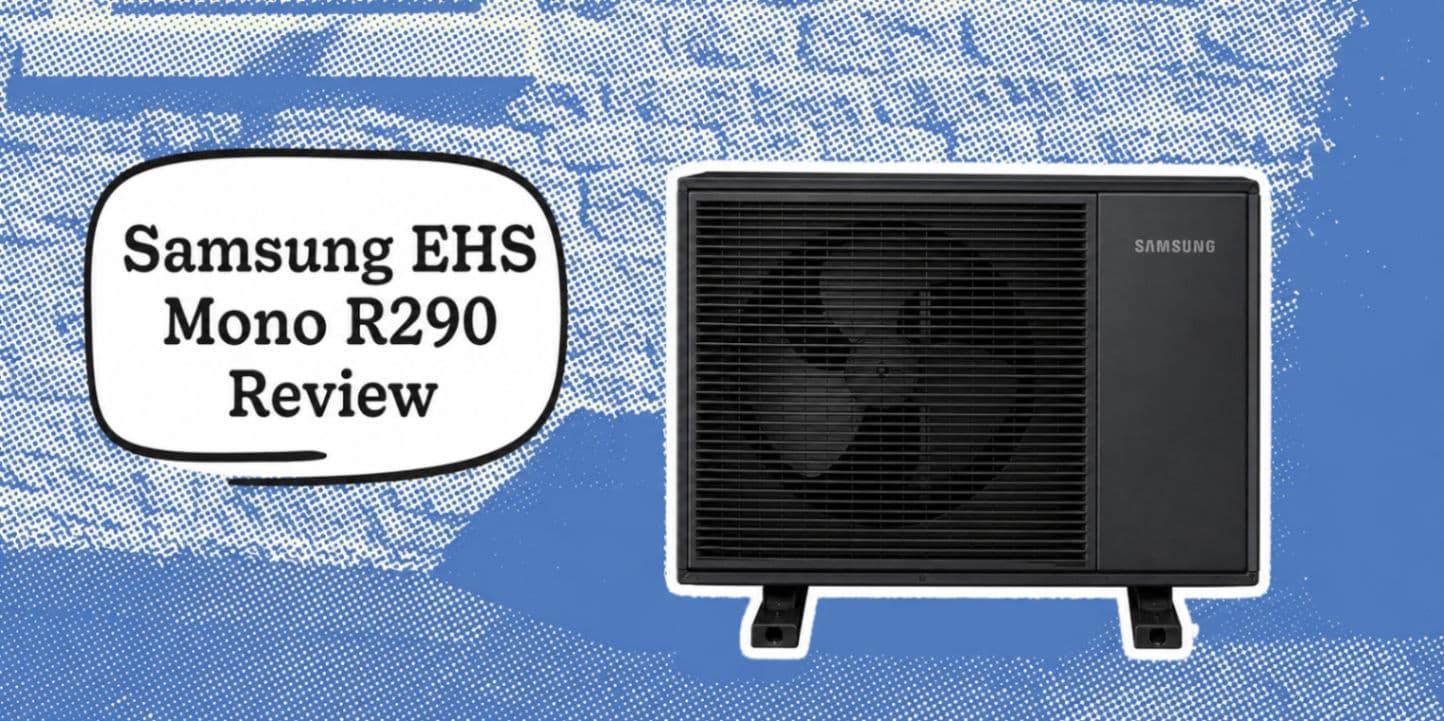

Samsung’s EHS Mono R290 combines high-temperature heating, a broad range of outputs and some genuinely useful smart-home technology. But is it the right heat pump for your home?
Samsung is probably better known for televisions large enough to affect local tides and phones capable of photographing individual craters on the moon.
It also makes heat pumps.
The Samsung EHS Mono R290 is the company’s latest high-temperature air source heat pump for UK homes.
It is available in 5kW, 8kW, 12kW and 16kW outputs, can produce water at up to 75°C and uses low-global-warming-potential R290 refrigerant.
There is even SmartThings connectivity, allowing your heating to join the same app as your television, washing machine and the fridge that keeps sending notifications because somebody has left the door open.
Lovely.
However, a heat pump is not automatically brilliant because it has an app and an impressive collection of numbers. It still needs to be correctly sized, properly installed and paired with suitable radiators, pipework and controls.
So, is the Samsung EHS Mono R290 a smart choice for UK homes?
Let’s investigate…
💨 Ready to make your home more energy-efficient and cut down on your heating bills? Get a heat pump quote today.
Samsung EHS Mono R290 review: the quick verdict
The Samsung EHS Mono R290 is a competitively priced, well-equipped heat pump with one of the broadest output ranges available from a single domestic product family.
Its maximum 75°C flow temperature gives installers useful flexibility in older homes, while the 12kW and 16kW models provide options for larger properties that smaller heat-pump ranges simply cannot cover.
Samsung’s SmartThings ecosystem is another genuine advantage, particularly for households already using Samsung smart-home products.
However, the required connectivity equipment is not necessarily included as standard. The warranty also depends heavily on correct installation, registration and ongoing servicing.
The EHS Mono R290 is a relatively recent product, meaning it does not yet have the same long-term UK track record as systems such as the Mitsubishi Ecodan. Installer knowledge and aftercare are therefore especially important.
Overall, it is a strong all-rounder offering premium features without automatically demanding a premium-brand price.
Our scores:
Category | Heatable score |
Reliability | 4/5 |
Performance and efficiency | 4.5/5 |
Warranty | 4/5 |
Price and value | 4.5/5 |
Overall | 4.5/5 |
In short: it is the Galaxy phone of heat pumps. Clever, stylish and packed with settings, although somebody still needs to explain where everything is in the menu.
Key Samsung EHS Mono R290 specifications
Feature | Samsung EHS Mono R290 |
Heat pump type | Air-to-water monobloc |
Available outputs | 5kW, 8kW, 12kW and 16kW |
Maximum flow temperature | Up to 75°C under specified conditions |
Energy rating | Up to A+++ at 35°C and A++ at 55°C |
Heating operating range | Down to -25°C |
Refrigerant | R290 |
Refrigerant GWP | 3 |
Sound pressure | 41–51dB(A) in normal operation, depending on model |
Quiet Mode | As low as 35dB(A) at three metres under Samsung test conditions |
Controls | Wired controller; SmartThings connectivity with compatible equipment |
Hot-water cylinder options | Samsung ClimateHub or compatible third-party cylinder |
Standard warranty | 24 months |
Extended warranty | Up to seven years, subject to installer, registration and servicing conditions |
Typical fitted price | Approximately £9,000–£15,000 before grants |
Government grant | £7,500 for eligible installations, or £9,000 for qualifying off-gas-grid properties until March 2027 |
What is the Samsung EHS Mono R290?
The EHS Mono R290 is an air-to-water heat pump.
It absorbs energy from the outdoor air, increases its temperature using a compressor and transfers that heat into the water circulating around your home.
That water can then supply:
Radiators
Underfloor heating
A domestic hot-water cylinder
Yes, it can still extract heat when the weather is cold. The air outside does not need to feel warm to your face; it simply needs to contain some thermal energy.
The EHS Mono R290 is a monobloc heat pump, meaning the entire refrigerant circuit is contained within the outdoor unit. Water pipes connect it to the heating equipment inside the property.
This can simplify installation because refrigerant pipework does not normally need to run through the home.
It does not mean the outdoor unit is the only equipment required.
A typical system may also need:
A hot-water cylinder
A control kit or ClimateHub
Pumps, valves and safety equipment
A buffer vessel or volumiser
Suitable heating controls
Upgraded radiators or pipework
Additional Wi-Fi hardware for SmartThings connectivity
If you currently have a combi boiler, pay particular attention to the cylinder.
Heat pumps generally produce hot water gradually and store it for later use.
You will therefore need to find room indoors for a suitable tank, even if the estate agent previously described your airing cupboard as a “compact home office”.
Samsung EHS Mono R290 sizes
The EHS Mono R290 is available in four nominal outputs:
Model | Likely application |
5kW | Small, efficient homes and low-energy new builds |
8kW | Small and medium-sized family homes |
12kW | Larger properties or homes with greater heat loss |
16kW | Large or particularly demanding properties |
These examples are only a rough guide.
A heat pump must be selected using a room-by-room heat-loss calculation. The number of bedrooms, the output of your existing boiler and the installer’s ability to stare thoughtfully at your brickwork are not acceptable substitutes.
A well-insulated four-bedroom home could need a smaller heat pump than a draughty three-bedroom property.
The 12kW and 16kW models are particularly noteworthy. Several competing domestic ranges stop at around 7kW or 12kW, so Samsung offers more flexibility for larger homes.
More output is not automatically better, though.
An oversized heat pump may switch on and off too frequently, known as cycling. This can reduce efficiency, increase wear and leave you paying extra for capacity the property did not need.
Reliability: 4/5
Samsung is one of the world’s largest technology manufacturers and has supplied heating and cooling equipment for many years.
The EHS Mono R290 itself arrived in the UK in late 2023, making it considerably newer than long-established products such as the Mitsubishi Ecodan.
That does not make it unreliable. It simply means there is less long-term field data from British homes.
The monobloc design is a positive. Its refrigerant circuit is assembled and sealed at the factory, reducing the amount of refrigerant work required during a standard installation.
Internal components can also be accessed through a removable side panel, which should make servicing and maintenance less theatrical.
The greater variable is likely to be the installer.
Samsung systems offer plenty of control and configuration options, but those options need to be set up properly.
Poor weather-compensation settings, unsuitable controls or unnecessary buffers and zones can quickly undermine an otherwise capable heat pump.
The product is also supported through Samsung’s trained installer and technical-support network, although support experience may depend more heavily on the individual installer than it does with some traditional UK heating brands.
A brilliant heat pump fitted badly remains a badly fitted heat pump. It just has a nicer logo.
Performance and efficiency: 4.5/5
The Samsung EHS Mono R290 carries an energy rating of up to A+++ when supplying water at 35°C and A++ at 55°C.
Samsung publishes a coefficient of performance of 5.10 for the 5kW model and 4.91 for the 8kW model under defined A7/W35 test conditions.
In normal-person language, the 5kW model can produce approximately 5.1 units of heat for every unit of electricity consumed during that specific laboratory test.
That does not mean it will achieve a COP of 5.1 throughout every British winter.
Real-world efficiency depends on:
Outdoor temperature
Required flow temperature
Radiator or underfloor-heating design
Hot-water use
Defrost cycles
Weather-compensation settings
System volume and zoning
Installation and commissioning quality
The lower the required water temperature, the more efficiently a heat pump will generally operate.
A correctly designed system running at 35°C to 45°C could produce excellent seasonal performance.
A system constantly being asked to provide 70°C water will use considerably more electricity.
How does the Samsung perform in cold weather?
Samsung states that the EHS Mono R290 can continue operating in heating mode at outdoor temperatures as low as -25°C.
The company also says the range can maintain its rated heating output at temperatures down to -10°C under its specified test conditions.
That is comfortably beyond the temperatures experienced by most UK homes, excluding particularly cold locations and whichever railway platform you happen to be standing on.
Cold-weather operation and cold-weather efficiency are not the same thing, however.
Like every air source heat pump, the Samsung has to work harder as the outdoor temperature falls. It will also occasionally enter a defrost cycle to remove ice from the outdoor heat exchanger.
The important question is whether the proposed model can meet your property’s calculated heat loss at the local design temperature without relying excessively on backup electric heating.
Your installer should be able to show you this calculation.
If they cannot, ask them to stop discussing kilowatts until they can.
The 75°C flow temperature
The EHS Mono R290 can provide a leaving-water temperature of up to 75°C under Samsung’s specified operating conditions.
This is useful for older properties.
Traditional gas boilers commonly operate at higher flow temperatures than heat pumps, and older radiators may have been sized around those temperatures.
A heat pump capable of reaching 75°C gives the system designer more options during especially cold weather.
However, 75°C is extra capability rather than an ideal everyday setting.
It is like the maximum brightness on your phone. Occasionally useful, but operating there permanently is going to affect the battery.
The heating system should still be designed to run at the lowest practical temperature. Some radiators may need to be replaced or upsized to achieve this.
High-temperature capability can reduce the number of upgrades required in certain homes, but it does not repeal the laws of thermodynamics or transform unsuitable radiators through positive thinking.
What does the Samsung EHS Mono R290 cost to run?
Using the average July–September 2026 Direct Debit energy price-cap rates:
Electricity costs approximately 26.11p per kWh.
Gas costs approximately 7.33p per kWh.
A heat pump achieving a seasonal COP of 3.5 produces useful heat for approximately 7.5p per kWh.
At a seasonal COP of 4, the cost falls to approximately 6.5p per kWh.
A 90%-efficient gas boiler produces useful heat for approximately 8.1p per kWh.
For a home requiring 12,000kWh of useful space-heating and hot-water energy each year, the simplified comparison looks like this:
Heating system | Assumed efficiency | Approximate annual energy cost |
Samsung heat pump | SCOP 3.5 | £895 |
Samsung heat pump | SCOP 4.0 | £783 |
Gas boiler | 90% efficiency | £977 |
These examples exclude standing charges and should not be treated as a personal bill prediction.
Actual costs depend on the property, household behaviour, local weather, tariff and system design.
A specialist heat-pump tariff, solar panels or time-of-use electricity pricing could improve the numbers further. An inefficient installation running at unnecessarily high temperatures could push them firmly in the opposite direction.
The Samsung has the hardware required for strong performance.
Whether it achieves that performance will depend on what happens between the survey and the installer leaving your driveway.
How quiet is the Samsung EHS Mono R290?
The EHS Mono R290 is reasonably quiet, although there is an important difference between its smaller and larger models.
Samsung publishes normal sound-pressure figures of:
41dB(A) for the 5kW model
45dB(A) for the 8kW model
47dB(A) for the 12kW model
51dB(A) for the 16kW model
Its four-step Quiet Mode can reduce sound levels to as little as 35dB(A) at a distance of three metres under Samsung’s test conditions.
The outdoor unit uses a double-layered sound-insulation system and Samsung’s splendidly named Groove Grid Felt to absorb compressor noise and vibration.
It sounds like something used to carpet a 1970s discotheque, but it serves a useful purpose.
In real life, noise will vary with:
Outdoor temperature
Fan and compressor speed
Whether the unit is heating rooms or hot water
Distance from the unit
Nearby walls and reflective surfaces
Installation quality
Anti-vibration measures
The selected Quiet Mode setting
The 5kW and 8kW models should be relatively neighbour-friendly when correctly positioned.
The 16kW unit is noticeably larger and louder in normal operation, so its acoustic assessment deserves particular attention.
Do not position any heat pump solely according to which part of the garden currently contains the least attractive plant pot. Airflow, drainage, servicing access, planning rules and neighbourly relations all matter.
SmartThings and heating controls
Smart connectivity is one of Samsung’s clearest advantages.
With compatible indoor equipment and the required Wi-Fi kit, the EHS Mono R290 can connect to Samsung SmartThings Energy.
This can allow homeowners to:
Adjust temperatures
Set heating and hot-water schedules
Monitor energy consumption
Create smart-home routines
Control the system remotely
Use compatible energy-saving functions
The system can also work with Samsung’s ClimateHub, which combines hydraulic equipment, controls and a 200-litre or 260-litre hot-water cylinder.
Alternatively, it can be connected to a compatible third-party cylinder using Samsung’s Mono Control Kit.
There is one substantial caveat: SmartThings connectivity is not necessarily built into every EHS Mono R290 quotation.
Samsung states that compatible equipment, a Samsung account, internet access and an optional Wi-Fi kit may be required.
Certain energy-saving features also require a compatible Wi-Fi-enabled ClimateHub.
Before accepting a quote, check whether it includes:
The wired controller
The correct Samsung control kit
Wi-Fi connectivity
SmartThings compatibility
Weather compensation
Energy monitoring
Any required subscriptions or cloud services
“SmartThings ready” and “everything required for SmartThings is included” are not identical sentences.
One of them can cost extra.
R290 refrigerant: why it matters
The clue is in the name.
The Samsung EHS Mono R290 uses R290 refrigerant, better known as propane.
Before you imagine Samsung lowering a patio-gas cylinder into the outdoor unit, the refrigerant is factory-sealed inside a purpose-designed circuit.
R290 has a global warming potential of just three. That is dramatically lower than the GWP of refrigerants such as R32 and R410A.
It also has thermodynamic properties that work well in high-temperature heat pumps, helping the Samsung produce water at up to 75°C.
The trade-off is that R290 is flammable.
The amount sealed inside a domestic heat pump is relatively small, but the unit still needs to be installed in accordance with Samsung’s siting and safety instructions.
Required clearances and exclusion zones may affect its position near doors, windows, vents, drains and ignition sources.
This is a design consideration for the installer, not an invitation to approach the outdoor unit with a cigarette lighter and a spirit of scientific enquiry.
Warranty: 4/5
Samsung’s standard EHS warranty period is 24 months.
That is adequate, although two years feels slightly ungenerous for a machine expected to sit outdoors confronting February for considerably longer.
Eligible systems can receive up to seven years of cover when Samsung’s extended-warranty conditions are satisfied.
These conditions include:
Installation and commissioning by an appropriately trained Samsung engineer
Registration with Samsung within the required period
Submission of the relevant commissioning documents
An annual maintenance agreement
Servicing in accordance with Samsung’s requirements
Always ask the installer to confirm:
The precise warranty period included in the quote
Whether both parts and labour are covered
Which system components are included
Whether the cylinder and controls have separate warranties
Who will register the system
The annual servicing requirements
What happens if you sell the property
Who handles a warranty claim
“Seven-year warranty available” is not the same as receiving documentary proof that your particular installation has been registered for seven years.
Keep the confirmation somewhere safer than the drawer containing thirteen obsolete charging cables.
Samsung EHS Mono R290 cost: 4.5/5
Samsung does not publish a universal fitted price because a complete installation must be designed around the property.
As a broad guide, expect a Samsung EHS Mono R290 installation to cost approximately £9,000–£15,000 before grants.
The final price may include:
The outdoor heat pump
A ClimateHub or separate hot-water cylinder
Samsung control equipment
Upgraded radiators
Larger pipework
Electrical work
Pumps, valves and system components
A base or wall-mounting equipment
Condensate drainage
System cleaning
Heat-loss calculations
MCS certification
Commissioning and warranty registration
A smaller, heat-pump-ready property may sit near the lower end.
A large house requiring a 12kW or 16kW system, new pipework and numerous radiator upgrades could exceed the upper figure.
Samsung equipment is generally positioned below premium systems from brands such as Vaillant and NIBE, making it attractive to buyers who want high-temperature performance and smart controls without immediately selecting the most expensive option.
Still, compare complete system quotations rather than the price of the outdoor unit.
A cheap grey box surrounded by £9,000 of essential extras is not a cheap heating system.
Boiler Upgrade Scheme grants
Eligible homeowners in England and Wales can receive £7,500 towards an air-to-water heat pump through the Boiler Upgrade Scheme.
Until 31 March 2027, qualifying properties can receive £9,000 when:
The property is not connected to the mains-gas grid.
The existing heating system uses oil or LPG.
The scheme is installer-led. An MCS-certified installer applies for the grant and deducts it from the installation price.
You do not receive £7,500 to wander around the heat-pump aisle with. Partly because there is no heat-pump aisle, and partly because that is not how the scheme works.
Hybrid systems combining a heat pump with a fossil-fuel boiler are not currently eligible.
Always check the latest eligibility rules before relying on the grant in your budget.
Installation and space requirements
The 5kW and 8kW EHS Mono R290 units measure approximately:
998mm wide
850mm high
500mm deep
The 12kW and 16kW models are substantially larger:
1,270mm wide
1,018mm high
530mm deep
The outdoor unit also requires adequate clearance for airflow, drainage and servicing. Its location must comply with planning, noise and R290 safety requirements.
Indoors, you will normally need a hot-water cylinder.
Samsung offers 200-litre and 260-litre ClimateHub options, although the correct cylinder size should reflect the household’s hot-water demand.
Installation commonly takes between two and five days, depending on the work required.
A proper installation process should include:
A room-by-room heat-loss calculation
Radiator and pipework assessment
Outdoor-unit siting and noise calculations
Hot-water-cylinder sizing
Electrical assessment
R290 safety checks
System cleaning and installation
Weather-compensation setup
Commissioning and homeowner demonstration
MCS, grant and warranty paperwork
If the survey consists entirely of asking how many bedrooms you have and whether the side gate opens, it is not yet a heat-pump survey.
Samsung EHS Mono R290 pros and cons
Pros:
Broad 5kW to 16kW output range
Up to 75°C flow temperature
A+++ energy rating at 35°C
Capable of operating at outdoor temperatures down to -25°C
Samsung states that rated heating output can be maintained down to -10°C under specified conditions
Low-GWP R290 refrigerant
Four-step Quiet Mode
SmartThings connectivity with compatible equipment
ClimateHub and third-party cylinder options
Suitable for radiators and underfloor heating
Potentially better value than several premium European brands
Up to seven years of warranty cover when the conditions are met
Eligible installations can access the Boiler Upgrade Scheme
Cons:
Only a two-year standard warranty
Extended warranty requires trained installation, registration and ongoing maintenance
SmartThings equipment may not be included as standard
Product-specific long-term UK reliability data is still limited
Support quality can depend heavily on the installer
The 12kW and 16kW outdoor units require more space
The 16kW model is noticeably louder in normal operation
A hot-water cylinder will usually be required
Some properties will still need radiator and pipework upgrades
Efficiency falls when high flow temperatures are used regularly
Samsung’s range of compatible controllers, kits and indoor options can make quotations difficult to compare
Samsung EHS Mono R290 vs the competition
Heat pump | Main advantage | Potential drawback | Best suited to |
Samsung EHS Mono R290 | Broad output range, SmartThings and competitive pricing | Connectivity and warranty depend on the installation package | Smart homes, larger properties and value-conscious retrofits |
Bosch Compress 5800i AW | Exceptionally quiet and compact | Range currently stops at 7kW | Small and medium-sized homes prioritising low noise |
Vaillant aroTHERM plus | Premium controls and established UK support | Higher price and conditional extended guarantee | Premium retrofits and existing radiator systems |
There is no universal best heat pump.
Samsung’s special talent is combining high-temperature performance and serious output options with a more consumer-friendly smart-home ecosystem.
The 16kW model gives it an advantage for larger properties, while the 5kW and 8kW units compete strongly on price and features.
Bosch and Vaillant arguably offer more polished traditional heating ecosystems. Mitsubishi has a longer UK heat-pump track record.
Samsung fights back with flexibility, connectivity and value.
The correct choice will ultimately be determined by the property’s heat loss, required flow temperature and the quality of the available installer.
The Heatable verdict
The Samsung EHS Mono R290 is one of the strongest value-focused heat pumps currently available for UK homes.
It offers a useful combination of high-temperature performance, low-GWP refrigerant, intelligent controls and an unusually broad 5kW to 16kW output range.
Its smaller models should suit many ordinary UK properties, while the 12kW and 16kW versions give Samsung credible options for larger homes.
SmartThings is a meaningful point of difference rather than a decorative app icon, particularly if the correct monitoring and connectivity equipment is included.
The main reservations concern the surrounding package.
The standard warranty is short, the extended cover carries conditions and the quality of design, controls and aftercare may depend heavily on the installer. Smart functionality also needs to be specified correctly rather than assumed.
But with a detailed heat-loss calculation, a Samsung-trained installer and sensible flow temperatures?
It is an impressive bit of kit.
The EHS Mono R290 will not make every Victorian terrace instantly cheap to heat, and setting it to 75°C all winter will not cause the electricity meter to applaud.
Properly designed, though, it can deliver efficient, comfortable heating with enough output and flexibility to suit a wide range of UK homes.
Our final score: 4.5 out of 5
Samsung has successfully made a heat pump that feels like a Samsung product: capable, connected and slightly more interested in software settings than your previous boiler ever was.
Fortunately, it also appears rather good at heating houses.
Next Steps For Your Heat Pump Journey:
When planning to install a heat pump for your home, there are several important factors to consider. Make sure to refer to the following guides to help you make informed decisions:
To dive deeper into these topics, head over to our advice section or check out our YouTube channel to learn more.
Get A Quote From Us Today
Without boasting, get your new heat pump quote and buy from us, here’s why:
Gas Safe installation within 24 hours.
Thousands of satisfied customers with an average score of 4.9 on Trustpilot, surpassing the market leader.
Which? Trusted Trader: Heatable is proudly recognised as a Which? Trusted Trader.
Flexible payment options, including interest-free finance.
Up to 12-year guarantee on selected heat pumps.
Fixed price guarantee: No hidden costs.
Save your quote and decide later.
Get an instant fixed price on a heat pump, here.
Heat Happy.