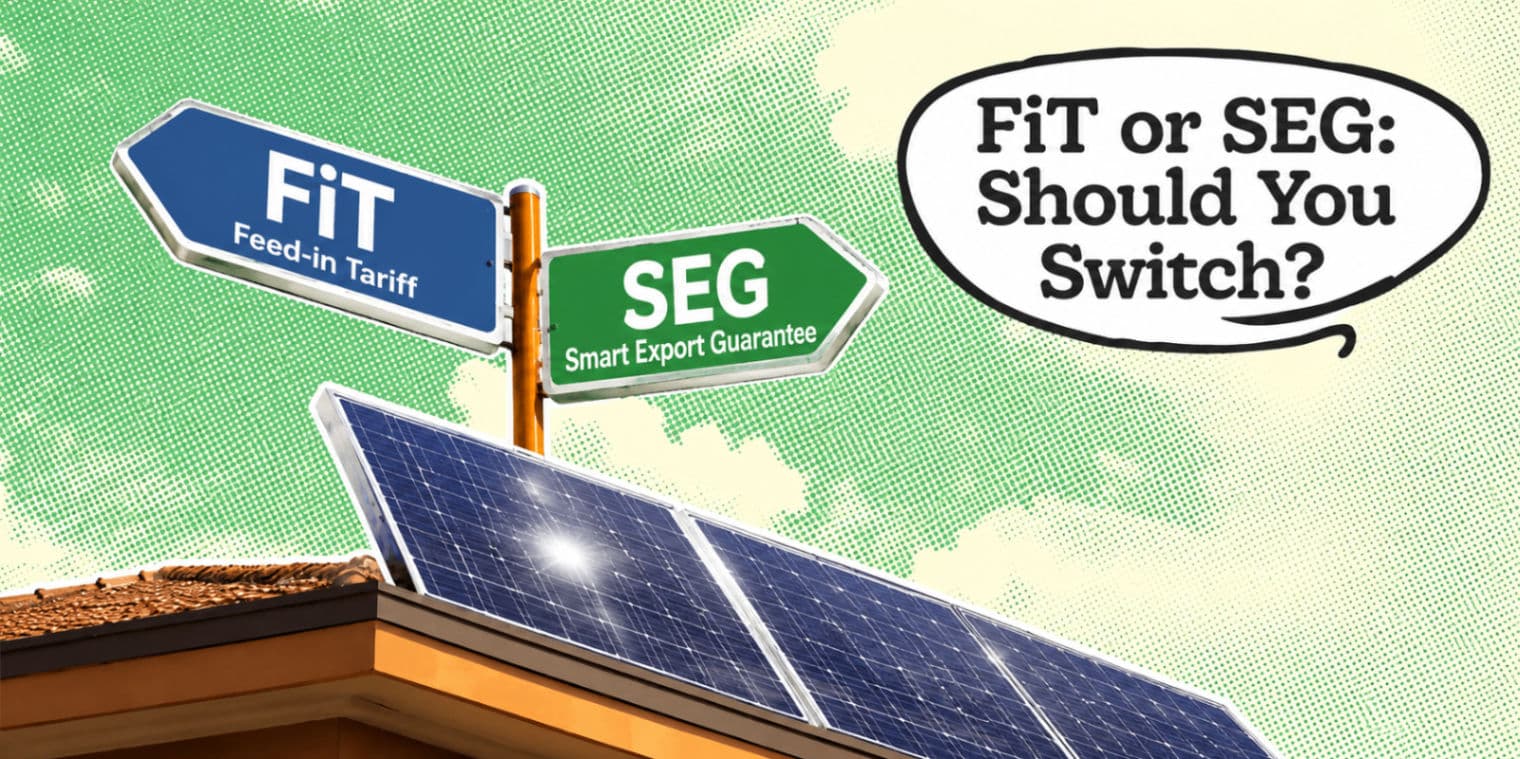

If you had solar panels installed before 2019, there’s a good chance you’re still receiving payments through the old Feed-in Tariff scheme.
But with some Smart Export Guarantee tariffs now offering attractive rates for exported solar electricity, you might be wondering:
Should I stay on FiT, switch to SEG, or do something in between?
The important answer is this:
Most homeowners should not give up their FiT generation payments. However, some may be able to switch only their export payments to a SEG tariff while keeping their FiT generation payments.
That distinction matters.
The Feed-in Tariff can pay you for generating electricity and exporting electricity. SEG only pays for electricity exported to the grid.
So, if you’re on FiT, the real question usually isn’t should I switch to SEG? It’s - can I move my export payments to a better SEG tariff without losing my FiT generation payments?
Let’s break it down…
Find out how much you can expect to pay with Octopus and sign up via this link to receive £50 credit.
FiT vs SEG: the quick answer
If you are still receiving Feed-in Tariff payments, don’t rush to leave the scheme.
Your FiT generation payments may still be valuable, and giving them up just to access a higher SEG export rate could leave you worse off.
However, it may be worth switching your export payments from FiT to SEG if:
Your current FiT export rate is low.
A SEG tariff would pay more for exported electricity.
You export a meaningful amount of solar electricity.
You can keep your FiT generation payments.
Your chosen SEG supplier accepts your system.
You have a suitable meter for export readings.
In simple terms:
Keeping FiT generation payments is usually the priority. Switching the export element may be worth exploring. Leaving FiT entirely usually is not.
What was the Feed-in Tariff?
The Feed-in Tariff, usually called FiT, was a government-backed scheme that paid homeowners and businesses for generating renewable electricity.
For solar panel owners, it was one of the main incentives available before the scheme closed to new applicants in 2019.
If your solar panels were accredited under FiT before the scheme closed, you may still receive payments for the rest of your eligibility period.
FiT payments usually have two parts.
1. FiT generation payments
The generation tariff pays you for every unit of electricity your solar panels generate.
This is usually the most valuable part of the Feed-in Tariff.
You receive this payment based on the electricity your panels produce, not just the electricity you export.
So, even if you use your solar electricity at home, your generation payment can still apply.
This is the part you should be very careful about giving up.
2. FiT export payments
The export tariff pays you for electricity sent back to the grid.
With many older FiT systems, export was not measured directly. Instead, it was often “deemed”, meaning your supplier estimated how much electricity you exported.
For example, your supplier might assume that a fixed percentage of your solar generation was exported, even if your actual export was different.
This can work in your favour or against you.
If you use most of your solar electricity at home, deemed export may be generous. If you export a lot of electricity, a modern metered export tariff could pay more.
What is the Smart Export Guarantee?
The Smart Export Guarantee, or SEG, is the current way many solar panel owners earn money from electricity they export to the grid.
It replaced the export-payment route for new solar installations after FiT closed to new applicants.
SEG does not pay you for generating solar electricity. It only pays you for electricity exported to the grid.
That means if your solar panels generate electricity and you use it in your home, SEG will not pay you for that unit.
Instead, you benefit because you avoid buying that electricity from your supplier.
SEG tariffs are offered by energy suppliers, and the rates vary.
Some are simple fixed export tariffs. Others are linked to:
Smart meters
Battery storage
Electric vehicles
Time-of-use tariffs
Import tariffs
Existing customer status
This is why the highest headline SEG rate is not always the best deal for every home.
FiT vs SEG: what’s the difference?
Here’s the simple comparison.
Feature | Feed-in Tariff | Smart Export Guarantee |
Open to new applicants? | No | Yes, for eligible systems |
Pays for solar generation? | Yes, for accredited systems | No |
Pays for exported electricity? | Yes | Yes |
Export often estimated? | Often, depending on the setup | Usually measured |
Usually needs export metering? | Not always | Yes, usually |
Rates | Set under FiT rules | Set by suppliers |
Best for | Existing FiT customers | New solar owners and FiT customers seeking better export rates |
The biggest difference is simple:
FiT can pay for generation and export. SEG only pays for export.
That is why existing FiT customers need to treat switching carefully.
Can you switch from FiT to SEG?
Yes, but you need to be precise about what you are switching.
There are three possible situations.
Option 1: stay on FiT for both generation and export
This means you keep your current FiT arrangement exactly as it is.
You continue receiving:
FiT generation payments
FiT export payments
This may be the right option if your current export rate is reasonable, your export is deemed, your export volume is low, or the admin of switching is not worth the likely gain.
It may also suit households without a suitable smart meter or export meter.
There is nothing wrong with staying put if the numbers still work.
Option 2: keep FiT generation payments and switch export to SEG
This is the option many FiT customers should investigate.
In some cases, you may be able to opt out of FiT export payments while keeping your FiT generation payments.
This means you still receive your generation tariff, but you receive export payments through a SEG tariff instead.
This can make sense if your FiT export rate is lower than the SEG rates available to you.
For example, if your FiT export rate is 7p/kWh and you can move to a SEG tariff paying 15p/kWh, your export income could increase.
But the key condition is this:
You must keep your FiT generation payments.
Before switching, ask your FiT provider whether you can opt out of export payments only. Then ask your chosen SEG supplier whether they will accept your system while you remain on FiT generation payments.
Get confirmation before making changes.
Option 3: leave FiT completely and move to SEG
This is usually a bad idea.
If leaving FiT means giving up your generation tariff, you could lose a valuable income stream.
SEG pays only for exported electricity. It does not pay for every unit your panels generate.
So, even if the SEG export rate looks better than your FiT export rate, that does not mean it is better than your overall FiT income.
In most cases, you should not give up FiT generation payments unless there is a very specific reason and you have done the maths properly.
Example | Exported electricity | Export rate | Annual export income |
Current FiT export | 1,500 kWh | 7p/kWh | £105 |
SEG export tariff | 1,500 kWh | 15p/kWh | £225 |
In this example, switching export payments from FiT to SEG would increase export income by £120 per year.
That sounds good.
But it only works if you keep your FiT generation payments.
If switching caused you to lose hundreds of pounds in generation payments, the higher export rate would not be worth it.
When switching export payments may be worth it
Switching from FiT export to SEG may make sense if:
Your FiT export rate is low.
You export a decent amount of electricity.
Your export is measured rather than deemed.
You have a smart meter or export-capable meter.
Your chosen SEG supplier accepts FiT customers.
Your FiT provider allows you to opt out of export only.
The SEG tariff does not force you onto an unsuitable import tariff.
The extra annual income is worth the admin.
The more electricity you export, the more important the export rate becomes.
For example, improving your export rate by 8p/kWh is worth around £40 per year if you export 500 kWh. But it is worth around £160 per year if you export 2,000 kWh.
When switching probably is not worth it
Switching probably does not make sense if:
You would lose your FiT generation payments.
You export very little electricity.
You use most of your solar electricity at home.
Your battery stores most of your excess solar.
Your deemed export arrangement works in your favour.
Your current export rate is already competitive.
You cannot get suitable export metering.
The best SEG tariff requires an import tariff you do not want.
The annual gain is too small to justify the hassle.
A higher export rate is only useful if you actually export enough electricity to benefit from it.
Do you need a smart meter for SEG?
Usually, yes, or at least a meter capable of measuring exported electricity.
SEG payments are normally based on actual export readings. This means your supplier needs a reliable way to measure how much electricity you send to the grid.
For many households, that means having a smart meter that can record export.
However, suppliers can have different requirements, so check before applying.
You should ask:
Is my current meter suitable?
Do I need a smart meter?
Do I need an export MPAN?
How will export readings be submitted?
How often will I be paid?
What about solar batteries?
A solar battery can change the calculation.
Without a battery, unused solar electricity is usually exported to the grid.
With a battery, some of that excess electricity can be stored and used later.
This can be financially useful because avoiding grid electricity is often worth more than exporting electricity.
For example, if your import rate is around 25p/kWh and your export rate is 10p/kWh, using stored solar electricity at home may be more valuable than exporting it.
But this is not always the case.
Some time-of-use export tariffs pay higher rates at certain times. Some battery owners may also choose to export electricity strategically when rates are high.
So the best setup depends on:
Your solar generation
Your household usage
Your battery size
Your import tariff
Your export tariff
Your daily routine
If you are installing solar panels now, adding a battery can help you use more of your own solar electricity and reduce your reliance on the grid. Heatable can quote for solar panels with or without battery storage.
How to check whether switching is worth it
Before changing anything, work through these steps.
1. Find your latest FiT statement
You need to know what you are currently receiving.
Look for:
Your generation tariff
Your export tariff
Your annual generation
Your annual export payment
Whether export is deemed or metered
Do not compare your SEG export rate with your FiT generation rate. They are different payments.
2. Work out your current export income
Find out how much you currently earn from the FiT export tariff.
If your export is deemed, check how the deemed amount is calculated.
If your export is metered, look at your annual exported kWh.
3. Compare current SEG tariffs
Look at current SEG tariffs and check the details, not just the headline rate.
Check whether the tariff:
Is fixed or variable
Requires you to be an import customer
Requires a specific import tariff
Requires a battery or EV
Accepts existing solar systems
Accepts FiT generation customers
Requires a smart meter
Has any exit terms
4. Ask your FiT provider the key question
Ask this clearly:
Can I opt out of FiT export payments only while keeping my FiT generation payments?
If the answer is unclear, do not switch.
You want written confirmation before making any change.
5. Ask the SEG supplier the other key question
Ask your chosen SEG supplier:
Can I receive SEG export payments while keeping my existing FiT generation payments?
Also ask what documents they need.
They may ask for information such as:
MCS certificate
Proof of ownership
Meter details
Export MPAN
FiT details
Installation size
6. Calculate the likely annual gain
Use this formula:
Annual export gain = exported kWh × difference between your SEG rate and FiT export rate
For example:
Exported electricity: 1,500 kWh per year
FiT export rate: 7p/kWh
SEG export rate: 15p/kWh
Difference: 8p/kWh
Annual gain: £120
Then decide whether the extra income is worth the effort.
7. Check you are not giving up FiT generation payments
This is the final and most important check.
If switching means losing FiT generation payments, stop.
For most FiT customers, the generation tariff is too valuable to give up casually.
Will I lose my FiT payments if I switch to SEG?
Not necessarily.
The risk is cancelling the wrong part.
If you can opt out of FiT export payments only, you may be able to keep your FiT generation payments and receive export payments through SEG.
But do not assume this is automatic.
Always check before switching.
Final answer: FiT or SEG?
If you are already on the Feed-in Tariff, do not rush to leave it.
Your FiT generation payments may still be valuable, and giving them up just to access a higher export rate is usually a mistake.
However, your FiT export payments are a different matter.
If your current export rate is low, and you can access a better SEG tariff, it may be worth switching only the export element while keeping your FiT generation payments.
So the best answer is:
Keep FiT generation payments if you can. Compare your FiT export rate with SEG tariffs. Only switch the export element if the numbers work and both suppliers confirm it is allowed.
Related reading:
Get a Quote for Solar Today
Without boasting you should get your solar installed with us, here's why:
Thousands of Happy Customers: We boast an average score of 4.9 on Trustpilot, outperforming the market leader.
Which? Trusted Trader: Heatable is proudly recognised as a Which? Trusted Trader.
MCS Accredited: Our accreditation by the Microgeneration Certification Scheme (MCS) ensures high-quality standards.
Exclusive Panels: We offer REA Fusion solar panels, available only through Heatable.
Consumer Protection: As members of the HIES consumer code, we provide 2-year deposit protection.
Flexible Payment Options: Choose from multiple payment methods, including finance options.
Fixed Price Guarantee: Enjoy transparency with no hidden costs.
Save Your Quote: You can save your quote and decide later.
Bespoke Design Tool: Draw your own conclusion (literally) on whether solar is worth it for you, here.