
What happens when you combine solar panels, battery storage and an air source heat pump in one home? We visited Heatable customer Roger to find out.
There are people who check their energy bill once a month.
Then there’s Roger.
Roger has spreadsheets. Lots of spreadsheets.
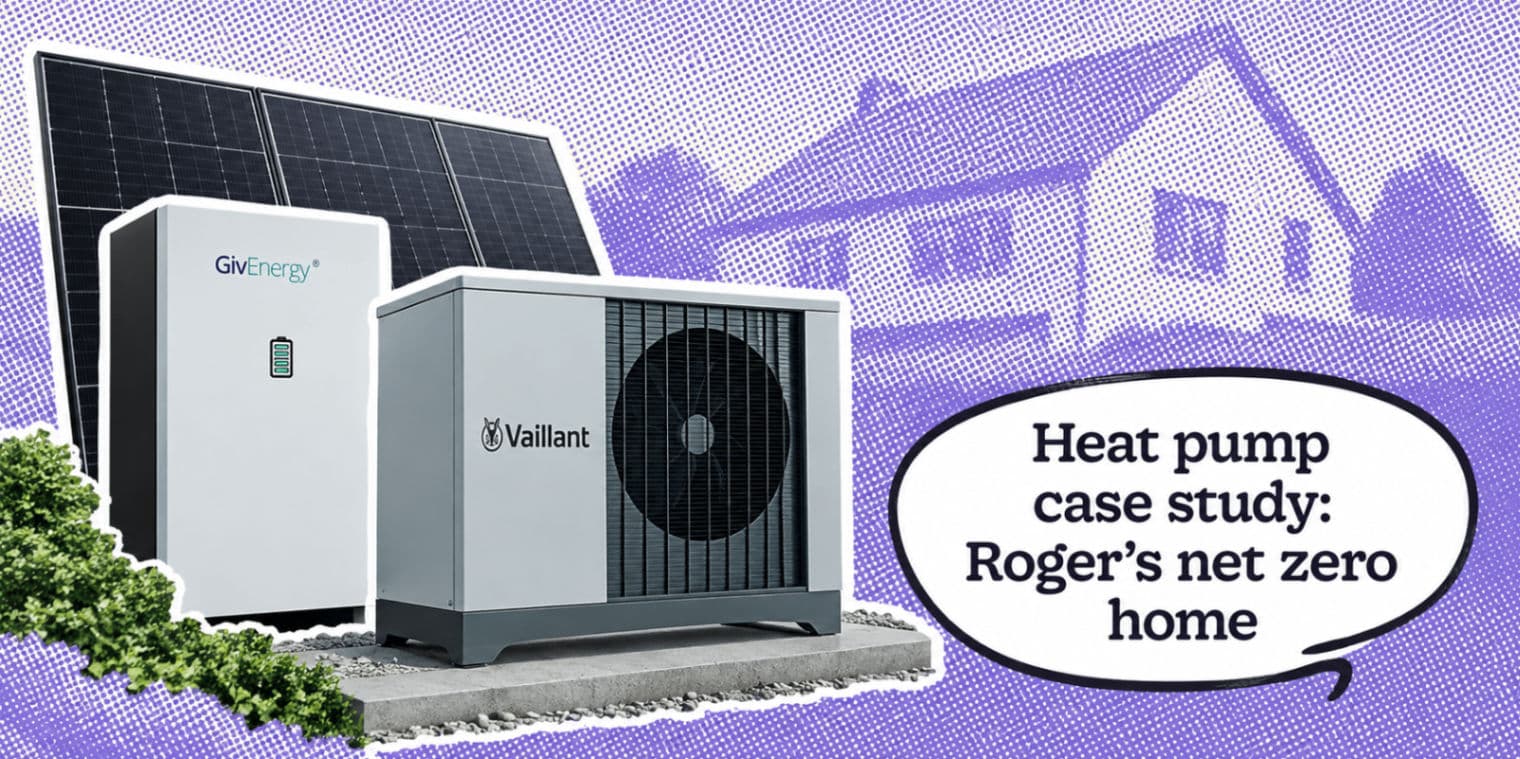
After already installing solar panels and battery storage, his next objective was to remove gas from the equation entirely, replacing his boiler with a Vaillant aroTHERM plus 7kW air source heat pump.
So, naturally, we went along for the ride.
Want the full tour?
Watch the video below to see Roger’s heat pump installation, his solar and battery setup, and exactly how he’s trying to get his home as close to net zero as possible.
Roger's home energy setup
Roger was already a repeat Heatable customer before the heat pump installation.
His home included:
Enphase solar PV
GivEnergy All in One battery storage
GivEnergy Gateway
EV charging
And now a Vaillant aroTHERM plus 7kW heat pump
The idea was fairly simple: generate electricity using solar, store as much of it as practical in the battery, use electricity intelligently around the home and remove the remaining dependence on gas by installing a heat pump.
Simple in theory, anyway.
Roger being Roger, there were also several extraordinarily detailed spreadsheets involved.
Why add a heat pump?
Solar panels and batteries can dramatically reduce the amount of electricity you need to buy from the grid.
They don't, however, make your gas boiler disappear.
For Roger, that was the missing piece.
Installing an air source heat pump meant he could move his heating and hot water away from gas and onto electricity, allowing more of his home's energy demand to potentially be supplied by his solar panels, battery and appropriately chosen electricity tariff.
It also created something increasingly interesting for UK homeowners: an integrated home-energy system rather than several unrelated products bolted onto a house.
The heat pump installation
For Roger's property, we installed a 7kW Vaillant aroTHERM plus.
As with any heat pump, correct specification matters considerably more than simply choosing the biggest unit available.
Roger's home benefits from good insulation, modern windows and an existing solar installation, making it particularly well suited to the project.
Inside the property, the installation included the associated hot-water cylinder, buffer tank and insulated pipework.
Outside sits the aroTHERM plus itself.
One thing Roger noticed almost immediately was the noise, or rather the lack of it.
The system was so quiet inside the house that he told us the main thing he could hear was the water moving through the pipework.
How efficient is it?
When we returned roughly four weeks after installation, Roger's system had been achieving an eSCOP of around 6.
That's an impressive early figure, but it needs some context.
The installation had been operating during warmer weather, when a heat pump generally has an easier job extracting heat from the outside air and supplying a home.
Winter will be the more meaningful test.
As outside temperatures fall and heating demand increases, efficiency will naturally change.
That's why we're planning to keep an eye on Roger's system rather than declaring victory based on a few sunny weeks in Britain. That would be brave.
Can a heat pump actually work with solar panels?
Very well, providing you understand what each part of the system is doing.
Solar panels generate electricity.
A battery allows some of that electricity to be stored rather than immediately exported.
A heat pump then gives the home another productive use for electricity by replacing a gas boiler.
In Roger's case, excess solar generation can therefore help supply household electricity, charge the battery, contribute towards heating demand or be exported back to the grid.
That doesn't mean a heat pump will run entirely from solar throughout winter.
UK solar generation is lowest precisely when heating demand is highest.
But viewed across the entire year, solar, batteries and heat pumps can complement one another extremely well.
Do you need solar panels with a heat pump?
No.
This is an important distinction.
You do not need solar panels or battery storage to install a heat pump.
A correctly designed heat pump can operate perfectly well using electricity supplied by the grid.
However, if your objective is to reduce your dependence on imported energy as much as possible, adding solar and battery storage gives you considerably more control over where that electricity comes from and when you use it.
You can also combine a heat pump with an electricity tariff offering cheaper rates at particular times of day.
The right combination depends on:
Your property's heat demand
Heat pump efficiency
Solar generation
Battery capacity
Electricity tariff
Export tariff
When your household actually uses energy
This is exactly why simply copying somebody else's setup rarely works.
Roger knows his household's energy behaviour in extraordinary detail.
You probably don't need quite as many spreadsheets as Roger, but understanding your own consumption is still extremely useful.
How much did Roger's setup cost?
Across the wider project, Roger estimated that his solar, battery, Gateway and associated grid work came to roughly £17,000.
His heat pump installation was approximately £4,500 after the Boiler Upgrade Scheme grant, bringing his total investment across the system to a little over £20,000.
Those figures are specific to Roger's property and installation rather than a universal price.
Heat pump costs vary depending on the property, system design and any additional work required.
The current Boiler Upgrade Scheme can also substantially reduce the upfront cost of an eligible heat pump installation.
Is Roger actually net zero?
This is where terminology gets slightly slippery.
Roger's personal objective is essentially "net zero from the pocket".
In other words, he wants the electricity generated and exported by his home, combined with reduced purchased energy, to offset his remaining household energy costs over the year.
That's different from claiming that the property has literally zero emissions or never imports electricity from the grid.
It is better thought of as trying to reach an annual financial energy balance.
And Roger believes he's getting remarkably close.
His ambition is that, across the year, his home could eventually have no net fuel bill at all, or potentially even leave him slightly in credit.
We'll need a full winter and preferably a complete year of data before judging whether he's achieved it.
The important lesson from Roger's setup
The most interesting part of this installation isn't actually the heat pump.
It's the system around it.
A heat pump should never be treated as an isolated box attached to the side of a house.
The best results come from considering the entire property:
How much heat does it need?
When does the household use energy?
Can some electricity be generated on-site?
Would battery storage help?
Which electricity tariff makes sense?
How should the heat pump itself be configured?
Get those decisions right and technologies such as solar PV, batteries, EV charging and heat pumps stop behaving like separate purchases.
They start behaving like one home-energy system.
Should you install solar, a battery and a heat pump together?
Not necessarily.
Roger's setup works because it was designed around his property, energy usage and objectives.
Some homeowners may benefit most from installing a heat pump first.
Others may get greater immediate value from solar.
Some properties could justify solar plus battery storage.
And plenty of homeowners won't have either the roof space or budget to install everything at once.
The important thing is designing the system around the home rather than designing the home around whatever technology happens to be fashionable that month.
Roger's installation is at the more enthusiastic end of the spectrum.
But it demonstrates what becomes possible when several increasingly common home-energy technologies are designed to work together.
And yes, apparently what becomes possible also includes an absolutely heroic quantity of Excel.
Thinking about installing a heat pump?
Heatable installs air source heat pumps from leading manufacturers including Vaillant, with the system designed specifically around your property and heating requirements.
You can get an online heat pump quote from Heatable and see whether an air source heat pump could make sense for your home.
And we'll be checking back in with Roger once his aroTHERM plus has experienced something rather more challenging than a British summer.
Winter is coming, Roger. Get the spreadsheet ready.
Next Steps For Your Heat Pump Journey:
When planning to install a heat pump for your home, there are several important factors to consider. Make sure to refer to the following guides to help you make informed decisions:
To dive deeper into these topics, head over to our advice section or check out our YouTube channel to learn more.
Get A Quote From Us Today
Without boasting, get your new heat pump quote and buy from us, here’s why:
Gas Safe installation within 24 hours.
Thousands of satisfied customers with an average score of 4.9 on Trustpilot, surpassing the market leader.
Which? Trusted Trader: Heatable is proudly recognised as a Which? Trusted Trader.
Flexible payment options, including interest-free finance.
Up to 12-year guarantee on selected heat pumps.
Fixed price guarantee: No hidden costs.
Save your quote and decide later.
Get an instant fixed price on a heat pump, here.
Heat Happy.