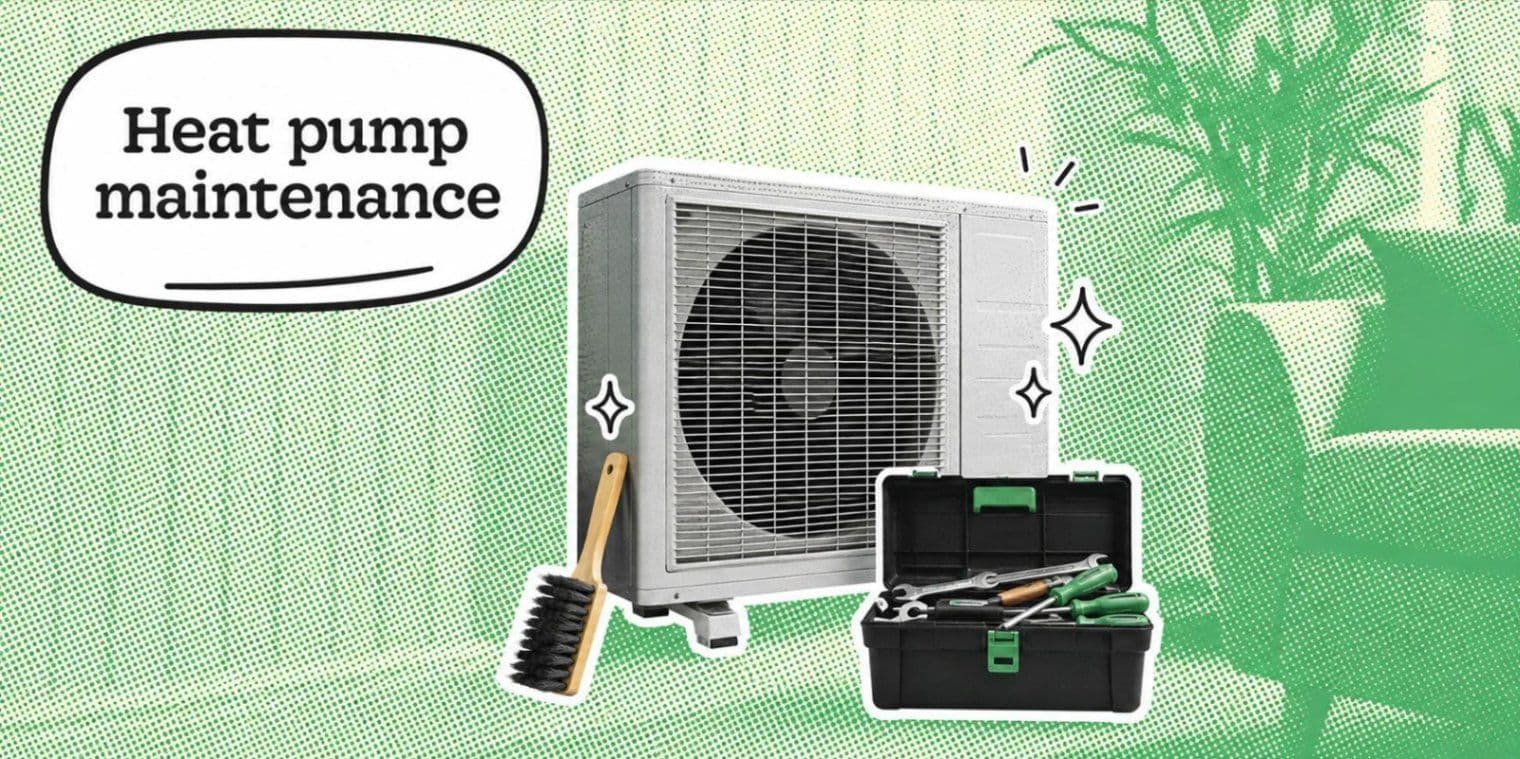

Heat pumps are pretty low-maintenance. But low-maintenance doesn't mean no-maintenance.
- Do heat pumps need maintenance?
- Heat pump maintenance you can do yourself
- Heat pump maintenance you should leave to a professional
- How often should a heat pump be serviced?
- How much does heat pump maintenance cost?
- Do heat pumps need more maintenance than boilers?
- What happens if you don't maintain a heat pump?
- Signs your heat pump needs an engineer
- Heat pump maintenance checklist
- Can you service a heat pump yourself?
A bit of basic upkeep can help your heat pump run efficiently, avoid unnecessary strain and reduce the chances of something expensive going wrong later.
The important bit is knowing where DIY maintenance stops and professional servicing starts.
Some jobs are perfectly safe to do yourself. Others involve refrigerant, electrics or pressurised heating components and should be left well alone unless you know exactly what you're doing.
Here's what you need to know.
Ready to make your home more energy-efficient and cut down on your heating bills? Get a heat pump quote today.
Do heat pumps need maintenance?
Yes.
Your heat pump doesn't have a burner or flue like a gas boiler, so there are fewer combustion-related parts to worry about.
But it still relies on several components working properly, including the:
Outdoor heat exchanger
Fan
Compressor
Refrigerant circuit
Pumps and valves
Heating controls
Filters and strainers
Hot water cylinder, if you have one
Fortunately, you don't need an engineer every time a leaf lands near the outdoor unit.
There are several useful checks you can do yourself throughout the year.
Heat pump maintenance you can do yourself
Think of DIY heat pump maintenance as keeping things clean, clear and behaving normally.
If you're reaching for tools and removing covers, you've probably gone too far.
[1] Keep the outdoor unit clear
Your outdoor unit needs plenty of airflow to extract heat from the outside air.
So if it's slowly disappearing behind leaves, weeds, bins and an aggressively ambitious shrub, give it some breathing room.
Regularly check around the unit and:
Remove leaves and loose debris
Cut back vegetation growing too close
Keep the air inlet and outlet unobstructed
Avoid storing garden furniture, bins or other objects directly around it
You don't need to make the surrounding area completely barren. Just don't let anything restrict airflow.
[2] Check the outdoor coil
The heat exchanger on the outdoor unit can accumulate dirt, dust, pollen and other debris.
A light coating isn't usually something to panic about. A heavily clogged coil is another matter, as restricted airflow can reduce performance.
Give it a visual check every so often.
If your manufacturer's instructions allow homeowner cleaning, follow them carefully.
Don't attack the coil with a pressure washer or stiff brush. The fins can be surprisingly easy to damage.
If it looks seriously dirty, call an engineer.
[3] Give it a once-over after bad weather
British weather is rarely kind enough to leave anything outside alone forever.
After particularly heavy rain, strong winds or snow, check that:
Debris isn't blocking the unit
Nothing has fallen onto it
The unit hasn't obviously shifted or become damaged
Water can drain away properly
And if you see frost during cold weather, don't immediately assume the heat pump is broken.
Air source heat pumps naturally accumulate some frost and automatically run defrost cycles to clear it.
A unit that remains heavily iced up, however, deserves professional attention.
[4] Clean any user-serviceable filters
Depending on your heat pump system, there may be filters that you're expected to clean periodically.
The key phrase there is expected to.
Check your manufacturer's instructions before removing anything. If the manual doesn't specifically identify a filter as homeowner-serviceable, don't start dismantling the system in search of one.
[5] Keep an eye on the system pressure
If your heat pump supplies a wet central heating system, you'll usually be able to see its pressure on a gauge or controller.
There's no universal 'correct' pressure for every installation, so use the range specified by your installer or manufacturer.
A small adjustment occasionally isn't necessarily a concern.
Having to repeatedly repressurise the system is.
If the pressure keeps dropping, get it investigated. There could be a leak or another underlying issue.
[6] Notice when something changes
You don't need diagnostic equipment to spot that your heating suddenly isn't behaving like it used to.
Keep an eye out for:
Rooms taking longer to warm up
Radiators staying unexpectedly cold
Hot water problems
Strange noises
Recurring warning messages
Falling system pressure
Electricity consumption rising sharply for no obvious reason
A gradual performance problem is usually cheaper to investigate before it becomes a complete breakdown.
[7] Stop fiddling with the thermostat every five minutes
Heat pumps generally work best when providing steady, low-temperature heat over longer periods.
That's quite different from the traditional 'boiler off, house freezing, boiler on full blast' approach many UK households are used to.
Constantly making large temperature changes can make the system work harder than necessary.
If your home is consistently too hot or too cold, the problem may be the heating curve, weather compensation or flow temperature settings, rather than the thermostat itself.
Those can usually be optimised.
Heat pump maintenance you should leave to a professional
This is where we draw a fairly hard line.
Once you're dealing with the refrigerant circuit, electrical internals or pressurised components, heat pump maintenance stops being a Sunday DIY job.
Refrigerant checks
The refrigerant circuit is central to how your heat pump works.
It isn't something homeowners should open, adjust or attempt to refill.
A suitably qualified engineer can check the system for signs of leakage or abnormal refrigerant performance and carry out any work required under the relevant regulations.
Electrical inspections
Heat pumps contain compressors, fans, pumps, control boards and high-voltage electrical equipment.
During a service, an engineer can check electrical connections and components for signs of wear, overheating or failure.
Removing the casing and poking around inside is firmly in the don't column.
Compressor and fan checks
The compressor is effectively the heart of the heat pump and one of its most valuable components.
Professional servicing can identify abnormal noise, vibration or operating behaviour before it develops into a larger problem.
The outdoor fan should also be checked for correct operation.
Water flow and circulation checks
A heat pump can be perfectly healthy but still perform badly if water isn't circulating around your heating system properly.
An engineer may check:
Flow rates
Circulation pumps
Valves
Filters and strainers
Expansion vessels
System pressure
Air trapped within the system
This matters because heat pumps are particularly dependent on maintaining the correct flow through the heating circuit.
Heating controls and weather compensation
This is one of the most overlooked areas of heat pump maintenance.
A badly configured heat pump can consume more electricity than necessary without technically being 'broken'.
An engineer can review settings including:
Flow temperature
Heating curves
Weather compensation
Timers and schedules
Hot water settings
Immersion or backup heater operation
For many households, getting these settings right can matter just as much as mechanically servicing the unit.
Hot water cylinder checks
If your heat pump feeds a hot water cylinder, that may also need servicing.
This is particularly important with unvented cylinders, which include safety components that should be checked by someone appropriately qualified.
How often should a heat pump be serviced?
For most domestic heat pumps, once a year is a sensible rule of thumb.
But check the manufacturer's requirements for your specific model.
Some warranties also require regular servicing to remain valid, so ignoring the service schedule could prove expensive if you later need to make a claim.
How much does heat pump maintenance cost?
There's no single UK-wide servicing price because it depends on:
Your heat pump manufacturer
The type of system
Where you live
How complicated the installation is
Whether the cylinder is included
Whether any repairs or replacement parts are needed
The main thing we'd recommend is comparing what's actually included in the service rather than simply going for the cheapest quote.
There's a big difference between someone giving the unit a quick once-over and properly checking system performance, controls and key components.
Do heat pumps need more maintenance than boilers?
Not really. They just need different maintenance.
A heat pump doesn't have the burner, combustion chamber or flue associated with a gas boiler.
But it does have a refrigeration circuit, outdoor heat exchanger and more dependence on correct water flow and control settings.
So we'd describe heat pumps as relatively low-maintenance rather than maintenance-free.
What happens if you don't maintain a heat pump?
In the short term, possibly nothing.
That's partly why maintenance gets ignored.
Over time, though, poorly maintained systems can suffer from:
Lower efficiency
Higher electricity bills
Poor heating performance
Increased wear
More breakdowns
Shorter component life
Warranty issues
Even something as simple as restricted airflow can make the heat pump work harder than necessary.
Signs your heat pump needs an engineer
Don't wait until the annual service if something is clearly wrong.
Book an engineer if you notice:
Persistent fault codes
Grinding, rattling or other unusual noises
Regular electrical trips
Little or no heating
Loss of hot water
Heavy icing that isn't clearing
Water or refrigerant leaks
Pressure repeatedly falling
A sudden unexplained rise in electricity usage
Occasionally restarting a system to clear a one-off error is one thing.
Resetting the same fault every Tuesday and pretending everything is fine is not a maintenance strategy.
Heat pump maintenance checklist
Jobs you can do yourself:
Remove leaves and debris around the outdoor unit
Keep plants and objects away from the airflow
Visually check the outdoor coil
Check the unit after severe weather
Clean approved user-serviceable filters
Monitor system pressure
Look out for fault messages
Pay attention to unusual changes in heating performance
Jobs for a professional:
Refrigerant system checks
Electrical inspections
Compressor and fan checks
Flow rate and circulation checks
Strainer and filter servicing
Expansion vessel checks
Heating control optimisation
Hot water cylinder checks
Fault diagnosis
Overall system performance testing
Can you service a heat pump yourself?
Not properly, no.
You can absolutely maintain one.
Keeping the outdoor unit clear, checking its condition and carrying out manufacturer-approved cleaning are all sensible DIY jobs.
A full service is different.
A useful rule is:
If you're cleaning or looking at something designed to be homeowner-accessible, you're probably fine. If you're removing the casing, disconnecting anything or interfering with refrigerant, electrics or pressurised components, stop.
That's engineer territory.
The bottom line
Heat pump maintenance isn't particularly complicated.
Keep the outdoor unit clear, pay attention to how the system is performing and don't ignore warning signs.
Then have the technical stuff checked professionally at the intervals recommended by the manufacturer.
Do that and you'll give your heat pump the best chance of running efficiently, reliably and for as long as possible.
Next Steps For Your Heat Pump Journey:
When planning to install a heat pump for your home, there are several important factors to consider. Make sure to refer to the following guides to help you make informed decisions:
To dive deeper into these topics, head over to our advice section or check out our YouTube channel to learn more.
Get A Quote From Us Today
Without boasting, get your new heat pump quote and buy from us, here’s why:
Gas Safe installation within 24 hours.
Thousands of satisfied customers with an average score of 4.9 on Trustpilot, surpassing the market leader.
Which? Trusted Trader: Heatable is proudly recognised as a Which? Trusted Trader.
Flexible payment options, including interest-free finance.
Up to 12-year guarantee on selected heat pumps.
Fixed price guarantee: No hidden costs.
Save your quote and decide later.
Get an instant fixed price on a heat pump, here.
Heat Happy.