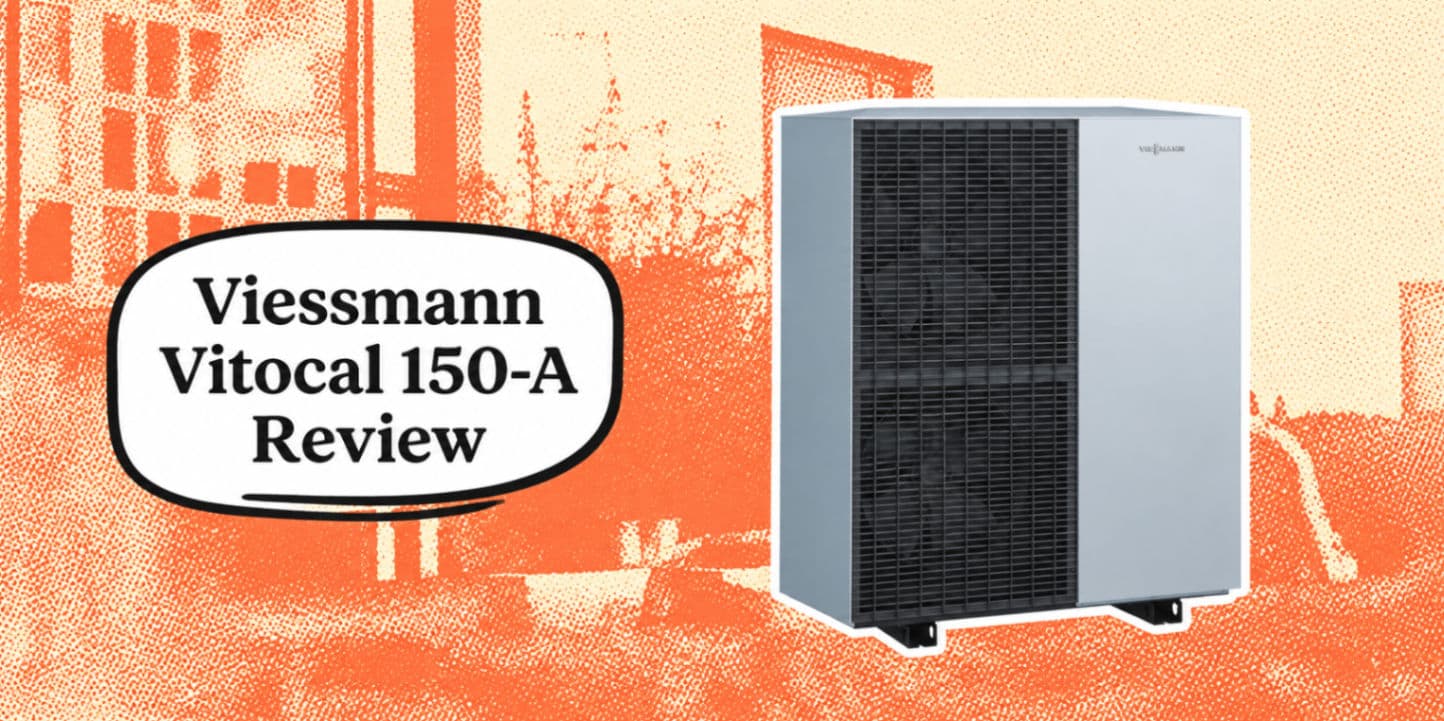

The Viessmann Vitocal 150-A is a high-temperature air source heat pump designed with one particularly difficult job in mind: replacing boilers in existing UK homes.
- What is the Viessmann Vitocal 150-A?
- The Big Selling Point: 70°C Flow Temperatures
- How Efficient is the Viessmann Vitocal 150-A?
- How Big is the Vitocal 150-A?
- Vitocal 150-A Running Costs
- How Much Does the Viessmann Vitocal 150-A Cost?
- Viessmann Vitocal 150-A Warranty
- Viessmann Vitocal 150-A vs Vaillant aroTHERM plus
- Advantages of the Viessmann Vitocal 150-A
- Is the Viessmann Vitocal 150-A Good for Older Homes?
- Should You Buy a Viessmann Vitocal 150-A?
That immediately makes it interesting.
Older properties are generally harder to convert to heat pumps than new builds because they tend to have higher heat losses, existing radiators and heating systems originally designed around much higher water temperatures.
The Vitocal 150-A tackles this with flow temperatures of up to 70°C, even when the outside temperature drops to -10°C, while using the increasingly popular R290 propane refrigerant.
But does that make it one of the best air source heat pumps available in the UK?
In this Viessmann Vitocal 150-A review, we'll look at its efficiency, noise levels, controls, warranty and real-world performance, as well as how it compares with alternatives from Vaillant and Samsung.
💨 Ready to make your home more energy-efficient and cut down on your heating bills? Get a heat pump quote today.
Viessmann Vitocal 150-A: Our Verdict
The Viessmann Vitocal 150-A is a technically impressive air source heat pump and one of the stronger options for existing UK homes, particularly where relatively high flow temperatures are required.
Its standout features are:
Up to 70°C flow temperature
R290 natural refrigerant
Heating outputs from 2.1kW to 14.9kW
COP of up to 5.2
Heating and cooling capability
ViCare app control
Integrated energy monitoring
Viessmann's Hydro AutoControl hydraulic system
Viessmann has also put considerable effort into making the system easier to install and commission, which is more important than it sounds.
Heat pump performance depends heavily on the quality of the complete installation. A superb compressor attached to a badly designed heating system is still going to perform badly.
Our main reservation is the warranty.
Viessmann currently lists the Vitocal 150-A with a two-year standard warranty, with a seven-year extension available. That's acceptable, but isn't especially generous for a premium heating system.
Overall, though, this is a very capable heat pump.
Viessmann Vitocal 150-A Specifications
Specification | Viessmann Vitocal 150-A |
Heat pump type | Air-to-water monobloc |
Heating output | 2.1 to 14.9kW |
Maximum flow temperature | 70°C |
Performance at low temperature | 70°C flow down to -10°C outside |
Refrigerant | R290 propane |
Refrigerant GWP100 | 0.02 |
Maximum COP | Up to 5.2 at A7/W35 |
Sound power | 51 to 56dB(A), depending on model |
Heating & cooling | Yes |
Smart controls | ViCare |
Standard warranty | 2 years |
Extended warranty | Up to 7 years |
Suitable for | New builds and retrofit properties |
Viessmann currently quotes a maximum COP of 5.2 at A7/W35, although performance varies depending upon the exact model and operating conditions.
What is the Viessmann Vitocal 150-A?
The Vitocal 150-A is an air-to-water monobloc heat pump.
Put simply, it absorbs heat energy from the outside air and transfers that energy into the water circulating through your central heating system.
Because it's a monobloc system, the refrigerant circuit is contained within the outdoor unit. Water then connects the outdoor unit to the heating system inside the property.
The Vitocal 150-A is available across a relatively broad output range, covering 2.1kW to 14.9kW.
That makes it suitable for everything from reasonably efficient smaller homes to considerably larger properties, subject to an accurate heat-loss calculation.
And that last part matters.
You shouldn't choose a heat pump simply because your existing boiler says "24kW" on the front.
Boilers are commonly massively oversized compared with the actual heat loss of the property, whereas heat pumps need to be sized much more carefully.
The Big Selling Point: 70°C Flow Temperatures
One of the Vitocal 150-A's biggest selling points is its ability to produce a 70°C flow temperature at outdoor temperatures as low as -10°C.
That's significant because traditional boilers often run radiators at much higher temperatures than heat pumps.
Older heat pumps were commonly associated with flow temperatures around 35°C to 55°C. That could mean replacing several radiators when converting an existing property.
The Vitocal 150-A gives installers considerably more flexibility.
But there's an important caveat.
70°C doesn't mean you should run it at 70°C
A heat pump becomes less efficient as the difference between the outdoor air temperature and the required water temperature increases.
So while the Vitocal 150-A can reach 70°C, that doesn't mean operating continuously at 70°C is desirable.
A properly designed installation should still attempt to run the system at the lowest practical flow temperature.
For example, if your property can maintain its required indoor temperature using 45°C water, there's little sense forcing the heat pump to produce 65°C instead.
Think of the 70°C capability as additional headroom rather than the target operating temperature.
It's particularly useful in retrofit situations where completely replacing the existing radiator network would otherwise be impractical.
How Efficient is the Viessmann Vitocal 150-A?
Very efficient, at least on paper.
Viessmann currently quotes a COP of up to 5.2 at A7/W35.
A COP of 5.2 means that under those particular test conditions, the heat pump can supply approximately 5.2kWh of heat for every 1kWh of electricity consumed.
However, COP shouldn't be confused with the efficiency you'll experience throughout an entire winter.
Outside temperature, flow temperature, domestic hot water production, defrost cycles and system design all affect performance.
Seasonal performance is therefore considerably more useful.
What about real-world performance?
This is where the Vitocal 150-A becomes particularly interesting.
In January 2026, Viessmann published results from seven UK Vitocal 150-A installations selected for a year-long efficiency competition.
Those systems achieved an average measured seasonal efficiency of 4.1.
That's encouraging.
It would mean roughly 4.1 units of useful heat being delivered for every unit of electricity consumed over the measured period.
There is, however, an obvious limitation to the data.
These weren't seven randomly selected Vitocal installations. Viessmann says the systems were pre-selected for their energy-efficient system designs.
So 4.1 shouldn't be treated as the efficiency every homeowner will automatically achieve.
What it does demonstrate is that the hardware is capable of very strong seasonal performance when installed as part of a well-designed system.
And that's arguably the more useful takeaway.
R290 Refrigerant
The Vitocal 150-A uses R290 refrigerant, otherwise known as propane.
R290 is rapidly becoming the refrigerant of choice for premium domestic heat pumps.
Its major advantage is its exceptionally low environmental impact.
Viessmann quotes a GWP100 of just 0.02 for the refrigerant used in the Vitocal 150-A.
R290 also performs well at the higher refrigerant temperatures required to produce hot heating water, which helps explain why manufacturers including Viessmann and Vaillant have adopted it for high-temperature heat pumps.
The trade-off is that propane is flammable, so installation and positioning requirements must be followed carefully.
For homeowners, that should simply be part of the system design undertaken by a competent installer.
Is the Viessmann Vitocal 150-A Quiet?
Noise is understandably one of the biggest concerns homeowners have before installing an air source heat pump.
The Vitocal 150-A performs reasonably well here.
Viessmann's technical data lists sound power levels of:
51dB(A) for the smaller 4kW, 6kW and 8kW versions, and 56dB(A) for the larger units, measured in night mode.
It's worth being careful when comparing heat pump noise figures because manufacturers don't always quote the same measurement.
Sound power and sound pressure at a certain distance are not interchangeable.
That makes apparently simple "Model A is 44dB while Model B is 51dB" comparisons potentially misleading.
In practice, correct positioning is often just as important as the underlying machine.
Placing any heat pump directly beneath a bedroom window, inside a narrow alleyway or next to reflective walls can make noise considerably more noticeable.
Hydro AutoControl: More Important Than the Name Suggests
One of the more interesting features of the Vitocal 150-A is Viessmann's Hydro AutoControl system.
It's essentially designed to simplify the hydraulic side of a heat pump installation.
Viessmann says the system can reduce the number of components required and make installation faster, while helping the heat pump maintain appropriate operating conditions.
That's useful because heat pump hydraulics can become surprisingly complicated.
Poorly designed systems may end up with unnecessary:
buffer tanks
pumps
bypasses
valves
hydraulic separation
Every additional component adds cost and complexity and, if designed badly, can reduce efficiency.
We wouldn't choose a heat pump purely because it contains Hydro AutoControl.
But anything that makes good system design easier and reduces unnecessary components is a genuine advantage.
ViCare App and Smart Controls
The Vitocal 150-A also fits into Viessmann's wider One Base ecosystem.
Homeowners can use the ViCare app to control their heating and view system information, while Viessmann's Energy Management system can display energy consumption and performance information.
For installers, ViGuide allows remote system monitoring and diagnostics.
Again, this sounds like a secondary feature until something goes wrong.
Remote diagnostics can allow an installer to identify certain faults or incorrect settings without immediately visiting the property.
Given that heat pump performance can be heavily influenced by control settings and commissioning, good monitoring software is increasingly important.
How Big is the Vitocal 150-A?
There are effectively two outdoor-unit sizes.
Viessmann's technical data lists the smaller models at approximately:
600 × 1,144 × 841mm
while the larger twin-fan versions are approximately:
600 × 1,144 × 1,382mm.
The corresponding outdoor-unit weights are approximately 162kg and 191kg respectively.
So although the smaller models are relatively compact, this is still substantial heating equipment.
Installation location therefore needs to be considered properly, rather than choosing a space based purely on where the old boiler happened to be.
Vitocal 150-A Running Costs
There isn't a meaningful universal running-cost figure for any heat pump.
Anyone claiming otherwise is oversimplifying it.
Your annual costs depend on:
The property's heat loss
Desired indoor temperature
Electricity tariff
Required flow temperature
Domestic hot water demand
Weather compensation settings
Heat pump seasonal efficiency
Whether solar panels or battery storage are installed
For example, suppose a property requires 12,000kWh of heat annually.
At an SPF of 4.0:
12,000 ÷ 4 = 3,000kWh of electricity
At 25p/kWh, that would cost around:
£750 per year
But if the same installation only achieved an SPF of 3.0:
12,000 ÷ 3 = 4,000kWh
which would cost around:
£1,000 per year
Same property. Same heat demand. Very different bill.
That's why installation quality matters so much.
How Much Does the Viessmann Vitocal 150-A Cost?
The heat pump itself is only one component of the total installation.
Current equipment listings put smaller Vitocal 150-A packages at around the £6,000 mark before considering the complete installation, cylinder, controls, radiator alterations, labour and other materials.
The final installed price can therefore be substantially higher.
Fortunately, eligible homeowners in England and Wales can currently receive £7,500 towards an air-to-water heat pump through the Boiler Upgrade Scheme.
Since July 2026, certain off-gas-grid homes replacing oil or LPG heating can qualify for an increased £9,000 grant, currently available until 31 March 2027.
The installer applies for the BUS grant and deducts it from the price paid by the homeowner.
Viessmann Vitocal 150-A Warranty
Here's one area where we'd like to see Viessmann become more competitive.
The Vitocal 150-A currently comes with a two-year standard manufacturer's warranty.
Viessmann's current warranty information lists an extension to seven years, subject to registration and the applicable conditions.
Annual servicing is also required to maintain the warranty.
Seven years is respectable.
Two years as standard feels less impressive for a premium product that's expected to heat your home for many years.
We'd therefore pay close attention to exactly what warranty the installer is providing as part of their quote.
Viessmann Vitocal 150-A vs Vaillant aroTHERM plus
The Vaillant aroTHERM plus is probably one of the Vitocal 150-A's most obvious competitors.
Both:
use R290
are designed for UK heating systems
can produce high flow temperatures
offer app-based controls
are available across multiple output sizes
target both new-build and retrofit installations
Vaillant's aroTHERM plus can achieve a flow temperature of up to 75°C, compared with 70°C for the Vitocal 150-A.
But we wouldn't choose between them based on that five-degree difference.
If your heat pump genuinely needs to spend its life producing 70-75°C water, the more important question is whether improvements elsewhere in the heating system could reduce that requirement.
The new aroTHERM plus is also available with an extended guarantee of up to seven years under qualifying installations.
The better choice between the two is therefore likely to depend on:
system design, installer expertise, price and local aftercare, rather than one headline specification.
Viessmann Vitocal 150-A vs Samsung EHS
Samsung is another major competitor in this part of the market.
Its high-temperature heat pump range can also achieve approximately 70°C leaving-water temperatures, while Samsung has increasingly moved towards R290 technology.
Samsung can be particularly attractive where installed price is the priority.
Viessmann's proposition feels slightly different.
The Vitocal 150-A is built around a more tightly integrated heating ecosystem, including Hydro AutoControl, ViCare, ViGuide and Viessmann's wider energy-management platform.
Whether that's worth paying more for depends heavily on the quotation and, again, the installer.
Advantages of the Viessmann Vitocal 150-A
The main positives are:
Excellent high-temperature capability for retrofit properties
R290 refrigerant
Broad 2.1-14.9kW output range
Strong efficiency figures
Promising measured seasonal performance
Relatively quiet operation
Heating and cooling capability
Good smart controls and monitoring
Particularly well suited to existing radiator systems
Strong engineering and hydraulic integration
Disadvantages of the Viessmann Vitocal 150-A
There are some drawbacks:
Two-year standard warranty is fairly short
Seven-year extension may involve additional cost
Premium equipment isn't necessarily the cheapest route into a heat pump
Larger models require substantial outdoor space
70°C marketing could encourage poorly designed installations if interpreted as "just replace the boiler"
Actual efficiency depends heavily on system design and flow temperature
That final point isn't really a Viessmann-specific weakness.
It's true of practically every heat pump.
But it's worth repeating because the quality of the installer is arguably more important with heat pumps than the badge on the outdoor unit.
Is the Viessmann Vitocal 150-A Good for Older Homes?
Potentially, yes.
In fact, this is arguably where the Vitocal 150-A makes the most sense.
The ability to maintain relatively high flow temperatures gives installers more options when dealing with:
older radiators
higher heat-loss properties
limited space for larger emitters
retrofit heating systems
However, we'd still be wary of any installer whose sales pitch is simply:
"It reaches 70°C, so nothing else needs changing."
A proper heat-loss calculation should come first.
Radiators should then be assessed room by room against the intended design temperature.
If a few inexpensive radiator upgrades allow the entire system to operate at 45°C instead of 60°C, that may significantly improve long-term efficiency.
Should You Buy a Viessmann Vitocal 150-A?
The Vitocal 150-A deserves a place on the shortlist if you're replacing a boiler with an air source heat pump, particularly in an existing property.
The combination of R290 refrigerant, high flow temperatures, good modulation, sophisticated controls and strong efficiency makes it technically competitive with the best mainstream heat pumps currently available.
What we wouldn't do is choose it purely because the brochure says 70°C.
The best heat pump installation isn't the one that can produce the hottest water.
It's the one that can keep your house comfortable while producing the coolest water possible.
Get that part of the design right and the Vitocal 150-A has the hardware to deliver very good performance.
Next Steps For Your Heat Pump Journey:
When planning to install a heat pump for your home, there are several important factors to consider. Make sure to refer to the following guides to help you make informed decisions:
To dive deeper into these topics, head over to our advice section or check out our YouTube channel to learn more.
Get A Quote From Us Today
Without boasting, get your new heat pump quote and buy from us, here’s why:
Gas Safe installation within 24 hours.
Thousands of satisfied customers with an average score of 4.9 on Trustpilot, surpassing the market leader.
Which? Trusted Trader: Heatable is proudly recognised as a Which? Trusted Trader.
Flexible payment options, including interest-free finance.
Up to 12-year guarantee on selected heat pumps.
Fixed price guarantee: No hidden costs.
Save your quote and decide later.
Get an instant fixed price on a heat pump, here.
Heat Happy.