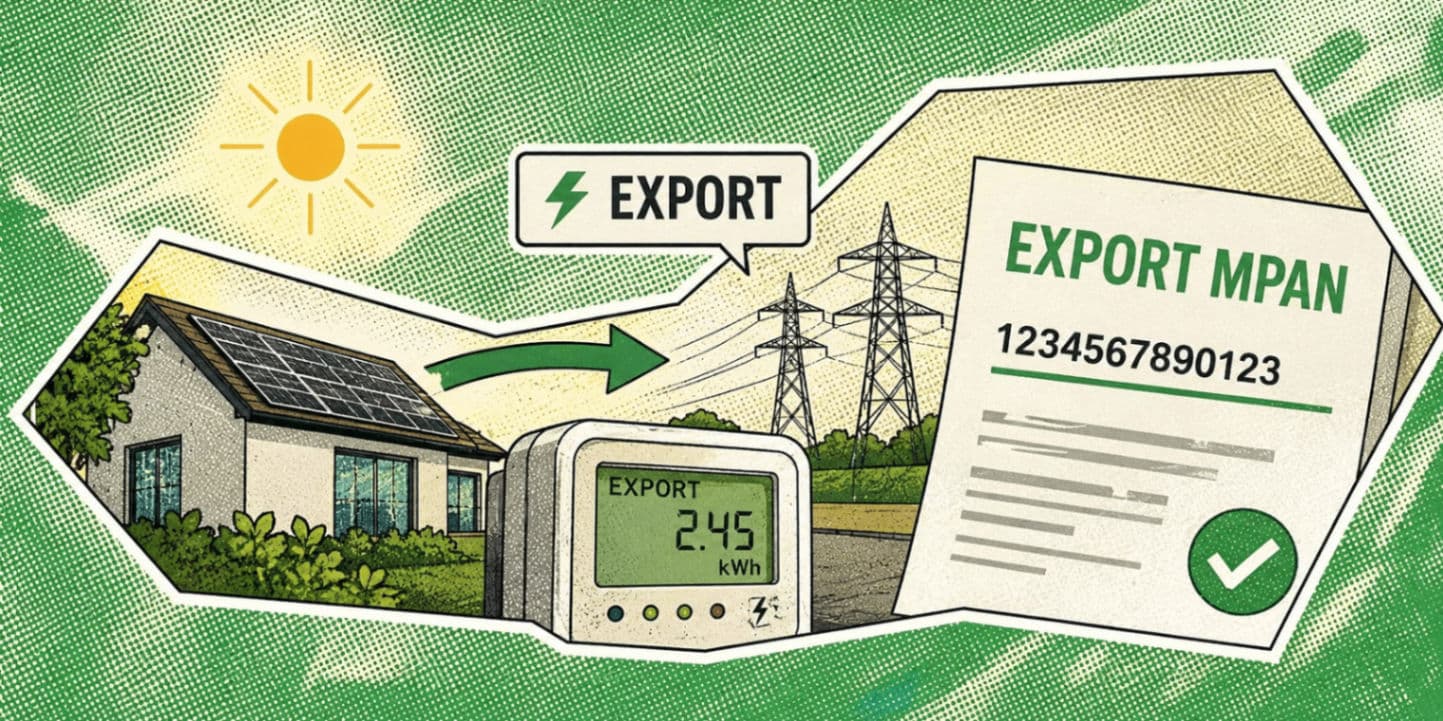

Solar panels are great when they’re quietly knocking chunks off your electricity bill. Less great when you discover there’s another piece of energy admin to deal with, complete with yet another acronym.
- Why does an export MPAN matter?
- Export MPAN vs import MPAN
- Is an export MPAN the same as a smart meter?
- Who creates the export MPAN?
- Where does the DNO fit into all this?
- How do you find your export MPAN?
- Common export MPAN problems
- Do all solar panel systems need an export MPAN?
- How much can you earn from exporting electricity?
Enter the export MPAN.
It sounds like something invented in a beige meeting room by people who enjoy saying “process alignment”. And, to be fair, it probably was. But if you want to get paid for the electricity your solar panels send back to the grid, it matters.
Your export MPAN is one of the key bits of paperwork that allows your supplier to register your exported electricity and pay you for it. Without one, your solar panels may still be sending excess electricity to the grid, but you might not actually be getting paid for it.
Not ideal.
So, let’s unpack what an export MPAN is, how it works, who sorts it, how long it usually takes, and what to do if yours gets stuck somewhere in the great British energy admin swamp.
PS We offer MCS-certified solar panel installation nationwide. Simply answer these questions, get your fixed price and arrange your free design.
Quick answer: what is an export MPAN?
An export MPAN is a unique reference number used to identify electricity exported from your property to the grid.
MPAN stands for Meter Point Administration Number. Most homes already have an import MPAN, which identifies the electricity they buy from the grid.
An export MPAN does the opposite job: it identifies the electricity your home sends back to the grid.
In simple terms, your import MPAN helps your supplier bill you, while your export MPAN helps your supplier pay you.
So yes, it’s admin. But it’s admin with actual money attached.
Why does an export MPAN matter?
When your solar panels generate electricity, your home uses that power first. If your home doesn’t need all of it at that moment, the spare electricity can be sent back to the grid.
That exported electricity can be paid for through an export tariff, usually under the Smart Export Guarantee, often shortened to SEG.
This is the scheme that allows eligible homes and businesses to be paid for low-carbon electricity they export.
Lovely.
But your supplier needs a way to know which property exported the electricity, which meter recorded it, which customer should be paid, and which export tariff applies. That’s where the export MPAN comes in.
It acts as the official reference for your home’s exported electricity. Without it, your supplier may not be able to connect your exported units to your account. And as you may have noticed, energy companies are not famous for freestyle generosity. If the paperwork isn’t right, payments can stall.
Export MPAN vs import MPAN
This is where people get understandably confused, because your home can have two MPANs linked to the same property.
Your import MPAN identifies the electricity you take from the grid. This is usually the number shown on your electricity bill, often in a box labelled “Supply Number”.
Your export MPAN identifies the electricity you send back to the grid.
This may appear on your export tariff documents, export statements, online account or supplier app once everything is set up.
MPAN type | What it tracks | Why it exists |
Import MPAN | Electricity you take from the grid | So your supplier can bill you |
Export MPAN | Electricity you send to the grid | So your supplier can pay you |
Same property. Different direction of electricity flow. Different record.
Is an export MPAN the same as a smart meter?
No. An export MPAN is not the same as a smart meter.
A smart meter measures electricity usage and, when correctly configured, exported electricity too. An export MPAN is the administrative reference attached to that exported electricity.
So the smart meter does the measuring, while the export MPAN does the identifying. Your supplier then uses both to calculate what you’re owed.
For most Smart Export Guarantee tariffs, you’ll need a meter capable of taking half-hourly export readings. In practice, that usually means having a smart meter that can record export properly.
No reliable export readings, no reliable export payments.
Who creates the export MPAN?
Your export MPAN is created by your Distribution Network Operator, usually called a DNO.
That is not the same as your energy supplier.
Your supplier is the company you pay for electricity. Your DNO is the company responsible for the local electricity network in your area. They look after the cables, substations and local grid infrastructure.
They also need to know when homes start generating and exporting electricity, because solar panels are not just another appliance.
They’re a small power station on your roof. A tiny, polite, roof-mounted power station, yes, but still a power station.
The DNO creates the export MPAN because it relates to electricity being exported onto the local network. Your export supplier then uses that MPAN to register your export tariff.
Do you have to apply for an export MPAN yourself?
Usually, no.
In most cases, your installer and export supplier do most of the heavy lifting. Your installer deals with the relevant DNO paperwork after, or sometimes before, your solar panel system is installed.
Your export supplier then uses the required information to request or register your export MPAN when you apply for an export tariff.
A typical process looks like this:
Your solar panel system is installed.
Your installer submits the relevant paperwork to the DNO.
You receive your installation documents, including your MCS certificate.
You apply for an export tariff with your chosen supplier.
The supplier requests or registers the export MPAN.
Your export account goes live.
You start getting paid for eligible exported electricity.
That is how it should work. Of course, this is the UK energy industry, so “should” is doing some lifting there. Delays can happen. Documents go missing. Supplier portals sulk. Smart meters occasionally forget they’re meant to be smart.
But in general, you should not need to personally create an export MPAN from scratch.
What do you need before getting paid for exported solar electricity?
To get paid for solar export, you’ll normally need a few things lined up: a solar panel system, an MCS certificate or equivalent certification, DNO notification or approval, a smart meter capable of recording export, an export MPAN, an export tariff, and bank details for payment.
The exact requirements vary by supplier, but the big three are usually a certified installation, DNO paperwork and export-capable metering.
This is why solar isn’t just about what happens on the roof. The paperwork matters too. A cheap-looking quote can get a lot less charming if the post-install admin is a mess.
What is the Smart Export Guarantee?
The Smart Export Guarantee, or SEG, is the scheme that allows eligible homes and businesses to be paid for low-carbon electricity exported to the grid.
For most domestic customers, that means solar panel owners getting paid for spare electricity they don’t use at home.
Energy suppliers with enough customers must offer an SEG tariff, but the government does not set one fixed export rate.
Suppliers set their own rates, terms and payment structures, which means export tariffs vary a lot.
Some pay a simple fixed amount per kWh exported. Some offer better rates if you also buy your electricity from them.
Some are designed around solar and battery storage. Some look excellent in the headline rate, then become less impressive once you read the small print.
Classic.
Can your export supplier be different from your import supplier?
Yes, often. You can usually buy electricity from one supplier and sell exported electricity to another.
For example, you might import from Supplier A and export to Supplier B.
However, there’s a catch. Some of the more attractive export tariffs are only available if you also take the supplier’s import tariff, or if you have certain technology installed.
So don’t just chase the biggest export rate on a comparison table. Look at the whole deal, including the export rate, import rate, standing charge, battery rules, payment frequency, whether the pricing is fixed or variable, and whether you must also be an import customer.
The best solar setup is not always the one with the highest export rate. It’s the one that gives you the best overall saving.
Using your own solar electricity is often more valuable than exporting it, because grid electricity usually costs more to buy than export electricity pays to sell. In other words, saving a kWh can be worth more than selling a kWh.
Where does the DNO fit into all this?
Your DNO needs to know about your solar system because it connects to the local electricity network.
For smaller domestic solar installations, your installer may be able to notify the DNO after installation under G98 rules.
For larger systems, or systems that export more power, your installer may need to apply in advance under G99 rules.
There’s also G100, which relates to export limitation. That sounds grim, but it’s straightforward enough.
If your system can generate more electricity than the local network is comfortable accepting, the DNO may require an export limit.
This means your system can still generate power for your home, but the amount it sends back to the grid is capped.
This is common with larger solar and battery systems. It’s not necessarily a dealbreaker, but it needs to be designed properly. A good installer should explain this before the system goes in, not after.
What documents might your supplier ask for?
When applying for an export tariff, your supplier may ask for your MCS certificate, DNO notification or approval letter, import MPAN, meter serial number, smart meter details, installation date, system size, installer details and bank details.
They may also ask for photos of your meter or inverter, depending on their process.
Annoying? Yes. Understandable? Also yes. They need to confirm that your system is eligible, properly installed and capable of recording export accurately.
How long does it take to get an export MPAN?
There isn’t one universal timescale. In a smooth case, it can be sorted in a few weeks. In a less smooth case, it can take longer.
A rough expectation would be one to four weeks once your export tariff application is underway and your supplier has the documents they need.
Delays can happen if your MCS certificate hasn’t been issued, the DNO notification hasn’t been processed, your supplier hasn’t requested the export MPAN, your smart meter isn’t sending export readings, your address doesn’t match across industry records, or your system needs G99 approval.
Sometimes the supplier is just being painfully slow. This is where you need to be mildly annoying in a productive way. Chase, ask specific questions, and get reference numbers. Don’t just accept “it’s with the relevant team” as an answer for six weeks.
Can you export electricity before the export MPAN is active?
Yes, your system may physically export surplus electricity before your export tariff is fully live. But you may not be paid for that electricity until the export account is properly registered.
That’s the irritating bit: the electricity can flow, but the money may not.
So it’s worth starting the export tariff process promptly once your installer gives you the documents you need.
If your system is already installed and you’re still not being paid, check whether your export MPAN and export tariff are actually active.
Don’t assume.
How do you find your export MPAN?
Once it exists, your export MPAN may appear on your export tariff welcome email, export statement, online supplier account, supplier app or export payment documents.
If you can’t find it, ask your export supplier directly. You can also contact your DNO, but your supplier is usually the better first stop because they’re the one registering and paying your export tariff.
A useful message to send is:
Please can you confirm whether my export MPAN has been created and registered for my export tariff?
Nice and specific. Harder to dodge.
What if your export MPAN is delayed?
If your export MPAN is delayed, first check that you have the basics: your MCS certificate, DNO confirmation, smart meter details, export readings, import MPAN, meter serial number and export tariff application reference.
Then ask your supplier whether the export MPAN has been requested, whether the DNO has created it, whether anything is missing from your application, whether your smart meter is sending half-hourly export readings, and whether the export account has been registered.
If they say the DNO is holding things up, ask for the date the request was made and any reference number. If needed, contact the DNO yourself and ask:
I have a solar PV system installed at my property and I’m applying for an export tariff. Please can you confirm whether an export MPAN has been created for this address?
Include your address, import MPAN, installer name, MCS certificate number and any DNO reference you have.
Boring? Deeply. Worth doing? Absolutely.
Common export MPAN problems
The usual problems are not dramatic. They’re just tedious.
Common issues include the installer not submitting the DNO paperwork, the MCS certificate being missing or incorrect, the DNO not creating the export MPAN yet, the supplier being unable to locate the export MPAN, the smart meter not being configured for export, the property address not matching across systems, the meter serial number being wrong, the system size requiring extra approval, or the export tariff application being incomplete.
The fastest fix is usually to identify exactly which link in the chain has failed. Is it the installer, the DNO, the supplier, the meter or the documents?
Once you know that, you can stop being passed around like a parcel no one ordered.
Do you need an export MPAN for battery storage?
If your battery can export electricity to the grid, then yes, export metering and tariff rules become important.
Battery export can be more complicated than solar export, because some tariffs pay for electricity exported from solar panels, some allow battery export, some restrict payments if the battery has been charged from the grid, and some actively encourage battery export at certain times.
This matters because a battery can change the economics of solar quite a lot. You might use it to store spare solar electricity for the evening, charge cheaply overnight to reduce peak-time grid usage, or export at higher-value times if your tariff allows it.
So before picking an export tariff, check the rules properly, especially if you have, or plan to add, a battery.
Can you switch export tariffs later?
Yes, usually. Once your export MPAN exists, switching export supplier should generally be easier than setting it up from scratch.
But don’t assume it’ll be instant. Before switching, check whether there are exit fees, whether your current tariff is fixed-term, whether the new supplier accepts your installation, whether the new tariff allows battery export, whether you need to be an import customer, whether your smart meter will work with the new supplier, and how often you’ll be paid.
Also, be careful if you’re on the old Feed-in Tariff scheme. You can’t usually be paid twice for the same exported electricity, so don’t change anything until you understand how it affects your existing payments.
Do all solar panel systems need an export MPAN?
If your solar system is grid-connected and you want to be paid for exported electricity, then yes, you’ll usually need an export MPAN.
If your system is genuinely set up not to export anything, the situation may be different. But for a normal domestic solar installation where surplus electricity can go back to the grid, the export MPAN is part of the setup.
It’s not the exciting bit. Nobody is showing their friends the export MPAN. But it is one of the small details that makes the money side work.
How much can you earn from exporting electricity?
That depends on how much electricity your solar panels generate, how much you use at home, how much surplus you export, your export tariff rate, whether you have battery storage, and your general usage pattern.
A household that’s home during the day may use more of its solar electricity directly and export less.
A household that’s out all day may export more, unless it has a battery. A larger system may export more, but only if the DNO allows it and your home doesn’t use the electricity first.
The crucial point is this: export payments are nice, but they’re usually only one part of the solar calculation.
The biggest benefit often comes from avoiding expensive grid electricity in the first place. That’s where solar becomes properly interesting.
Not because your roof becomes a tiny energy business, but because your home buys less electricity from everyone else’s.
Does Heatable help with export MPANs?
Heatable helps with the bits that matter before you apply for export payments: proper solar design, certified installation and the documentation needed for the next steps.
Your export tariff is normally arranged with an energy supplier, not your installer. But a clean installation process makes the export side much less painful.
Because when solar is done properly, it’s not just panels on a roof. It’s the roof survey, system design, inverter, battery options, DNO process, certification, warranties, monitoring and paperwork.
Less cowboy. More “actually works”.
Which, call us old-fashioned, is the general idea.
Final answer: what is an export MPAN?
An export MPAN is the unique number used to identify the electricity your solar panels export to the grid.
Your import MPAN is for electricity you buy. Your export MPAN is for electricity you sell. Your DNO creates it, your export supplier uses it, and your smart meter provides the readings.
If you want to get paid through a Smart Export Guarantee tariff, your export MPAN is one of the key bits of admin that needs to be in place.
Dull? Yes. Important? Also yes. Potentially worth chasing if it goes missing? Very much yes.
Next Steps For Your Solar Journey:
When planning to install solar panels for your home, there are several important factors to consider. Make sure to refer to the following guides to help you make informed decisions:
To dive deeper into these topics, head over to our advice section, check out our YouTube channel for informative videos, or read a customer case study to see how others have benefited from their solar installation.
Get a Quote for Solar Today
Without boasting you should get your solar installed with us, here's why:
Thousands of Happy Customers: We boast an average score of 4.9 on Trustpilot, outperforming the market leader.
Which? Trusted Trader: Heatable is proudly recognised as a Which? Trusted Trader.
MCS Accredited: Our accreditation by the Microgeneration Certification Scheme (MCS) ensures high-quality standards.
Exclusive Panels: We offer REA Fusion solar panels, available only through Heatable.
Consumer Protection: As members of the HIES consumer code, we provide 2-year deposit protection.
Flexible Payment Options: Choose from multiple payment methods, including finance options.
Fixed Price Guarantee: Enjoy transparency with no hidden costs.
Save Your Quote: You can save your quote and decide later.
Bespoke Design Tool: Draw your own conclusion (literally) on whether solar is worth it for you, here.