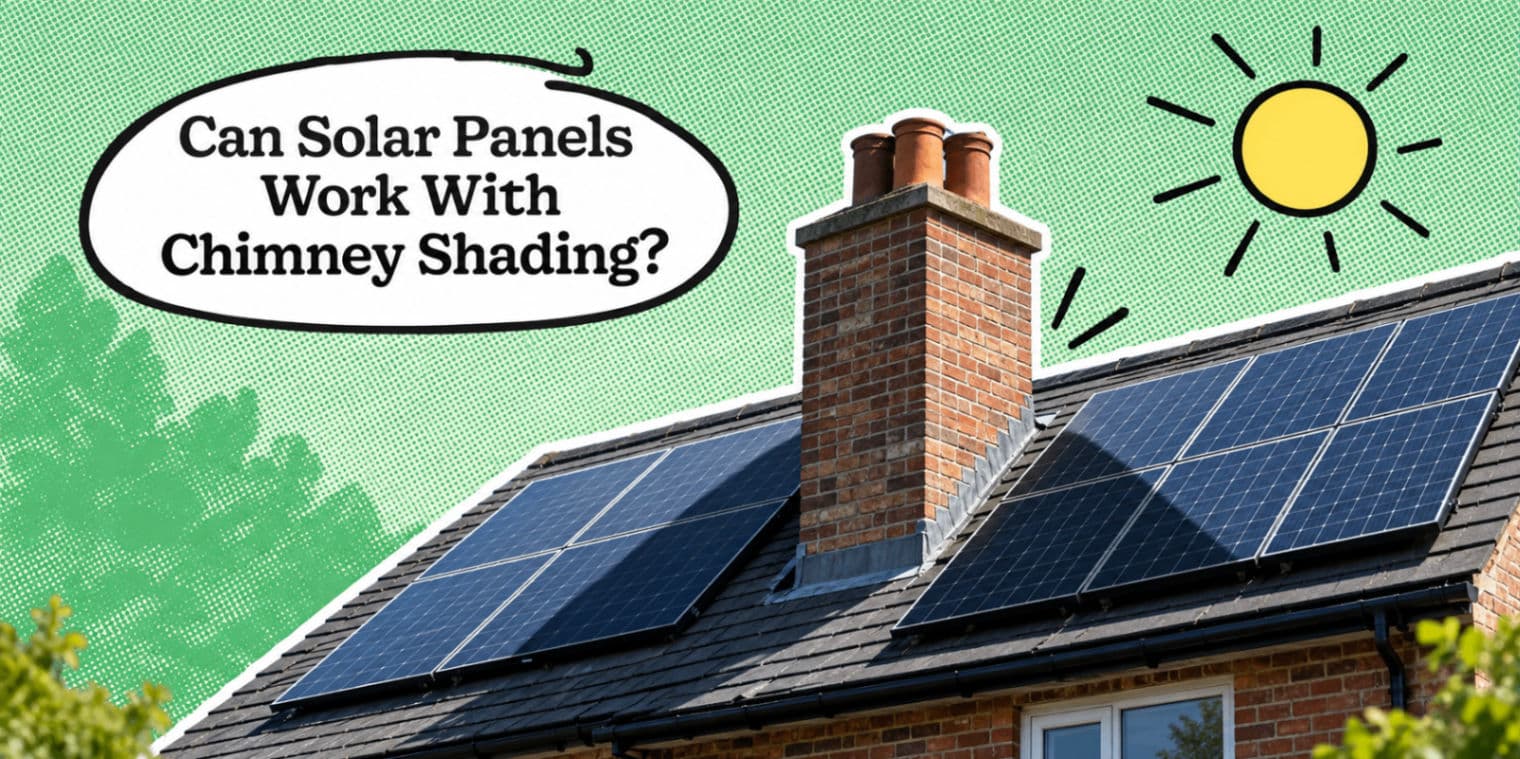

A big chimney in the middle of your roof isn't exactly ideal when you're planning a solar installation.
- Why battery-first solar installations are becoming more interesting
- Adding solar should push the savings even further
- The problem: chimney shading
- What is a microinverter?
- But what about microinverter clipping?
- How much generation did the chimney actually cost?
- Microinverters vs optimisers
- Does chimney shading mean you can't have solar panels?
- Is a solar battery worth installing before solar panels?
In fact, with a conventional solar setup, heavy chimney shading can significantly reduce the output of more than just the panel sitting in the shade.
That was exactly the problem we faced at Nick's home.
Six months earlier, we'd installed a Sigenergy battery system that had already cut his electricity spending roughly in half, from around £100–£110 per month to approximately £50.
The next step was solar.
There was just one problem: the best section of roof had a massive chimney sitting right in the middle of it.
Rather than giving up valuable roof space, we decided to test another approach: Atmos microinverters, allowing each solar panel to operate independently.
After around a month of monitoring, we've now got the data.
And it makes a pretty convincing case for microinverters on awkward, partially shaded roofs.
PS We offer MCS-certified solar panel installation nationwide. Simply answer these questions, get your fixed price and arrange your free design.
The project at a glance:
Here's what we installed:
10 LONGi solar panels
4.85kWp total solar capacity
Around 3,500kWh estimated annual generation
Atmos microinverters
Existing 6kW Sigenergy inverter
Two 9.1kWh Sigenergy battery modules
Seven panels were installed on the main roof, with another three positioned on the rear extension.
Most importantly, the new solar array could work alongside the battery Nick already had.
Nick was already saving money without solar
Solar panels weren't actually Nick's first step towards reducing his electricity bills.
He started with battery storage.
The idea is fairly simple.
Nick is on a smart EV tariff that gives him access to electricity at around 7p/kWh during off-peak periods.
Instead of buying most of his electricity during the day, when it can cost considerably more, the battery charges overnight when electricity is cheap.
During the day, the battery discharges and powers the house.
This is sometimes called energy arbitrage: buying electricity when it's cheap and using it when grid electricity is more expensive.
Before the battery was installed, Nick told us he was spending roughly £100–£110 per month on electricity.
Afterwards:
“We have a net spend now of £50, whereas previously I'd say we were around about £100 to £110.”
That's before adding a single solar panel.
Why battery-first solar installations are becoming more interesting
Nick's installation also highlights something we're seeing increasingly often: homeowners building their energy systems in stages.
You don't necessarily have to install solar panels and a battery together.
Since 1 February 2024, qualifying standalone residential battery installations have been eligible for 0% VAT, removing one of the previous financial advantages of installing the battery alongside solar.
That zero rate is currently scheduled to apply until 31 March 2027.
So you can install battery storage first, add solar later and build the system around your circumstances rather than doing everything in one go.
That's exactly what Nick did.
Want to see it in action? Watch the full Heatable video for the install and real panel-by-panel performance data.
Adding solar should push the savings even further
The new 4.85kWp solar system is estimated to generate around 3,500kWh per year.
Instead of relying entirely on cheap overnight electricity to fill the battery, Nick can now generate electricity during the day too.
Solar power can:
supply the house directly
recharge the battery
reduce electricity imported from the grid
export surplus electricity back to the grid
Under the Smart Export Guarantee (SEG), eligible households can receive payments from electricity suppliers for renewable electricity they export.
That creates an interesting optimisation problem.
If your off-peak import rate is lower than your export tariff, it can sometimes still make financial sense to charge the battery cheaply overnight and export surplus solar electricity during the day.
The objective isn't simply “use as little grid electricity as possible”.
It's to use the combination of solar, battery storage and smart tariffs as efficiently as possible.
The problem: chimney shading
Unfortunately, Nick's roof wasn't particularly solar-friendly.
The main roof had limited usable space and a large chimney right in the middle of the proposed array.
That matters because shading can seriously affect solar generation.
A chimney may only physically shade one or two panels at any particular moment, but depending on how the system is designed, its impact can spread much further.
Why shading causes problems for traditional string systems
Most conventional solar arrays use what's known as a string inverter.
Solar panels generate DC electricity and are connected together in series to create a string.
That string then feeds electricity back to an inverter, which converts the DC electricity produced by the panels into AC electricity your home can use.
It's simple and effective.
But panels connected within the same string also affect one another.
If one panel is heavily shaded and its output falls, the performance of the string can also be constrained.
Modern solar equipment includes ways of reducing these losses, including bypass diodes, multiple MPPT inputs and power optimisers.
But where substantial or constantly changing shading is unavoidable, panel-level electronics become particularly useful.
And that's where microinverters come in.
What is a microinverter?
Instead of connecting a group of solar panels to one central inverter, a microinverter is installed at panel level.
Each panel effectively becomes its own independent AC generator.
So if one panel gets shaded by Nick's chimney, the neighbouring panels aren't forced to operate at exactly the same level.
The shaded panel loses generation.
The others keep producing.
For this particular roof, that was exactly what we wanted.
Why we used Atmos microinverters
Atmos supplied its microinverter equipment for us to trial on this installation.
There were several reasons the system suited Nick's roof.
Independent panel performance
This was the big one.
Each panel could produce independently, meaning the chimney could reduce the output from the panels it actually shaded without unnecessarily dragging down the clearer parts of the array.
Panel-level monitoring
Another benefit became particularly useful for this test.
Because each panel has its own microinverter, we can see how much electricity each individual panel generates.
That makes it possible to quantify exactly what the chimney is doing.
With a conventional system, you would normally see combined generation from the array or string rather than such straightforward panel-by-panel data.
Lower DC voltage across the roof
In a conventional string array, several panels are connected together to create a much higher DC string voltage.
With the Atmos setup, the DC side is handled at individual-panel level.
Atmos says the maximum voltage on the roof is therefore below 60V DC.
Flexible installation
The units attach directly to the solar mounting rails and use a pre-terminated cable system to connect the equipment together.
From an installer perspective, that simplifies the physical installation and avoids needing a different mounting arrangement for every rail system.
But what about microinverter clipping?
One criticism you'll often hear about microinverters is clipping.
This happens when a solar panel is capable of producing more DC power than the inverter can convert at that moment.
For example, pairing a 485W panel with a substantially smaller microinverter could mean some of the panel's peak output is clipped during ideal conditions.
Atmos currently offers residential microinverters including 425W, 450W and 500W options, allowing the inverter specification to be more closely matched to modern high-output solar panels.
It's also worth remembering that solar panels only reach their headline rated output under specific test conditions.
In the real world, roof angle, temperature, orientation, clouds, shading and the time of day all affect production.
The system therefore needs to be designed around expected real-world generation rather than comparing two headline wattage numbers in isolation.
So, did the microinverters actually work?
This is where things get interesting.
We left Nick's system running for roughly four weeks and then compared generation across the individual panels.
The best-performing panel, B6, generated:
46.75kWh
The worst-performing panel, B5, generated:
27.43kWh
B5 is positioned directly around the chimney shading.
That's a big difference.
It generated only 59.1% of the electricity produced by the best-performing panel.
Other panels close to the chimney were also noticeably affected.
But here's the important bit:
They were still generating electricity independently.
The chimney hadn't dragged the clear panels down with them.
How much generation did the chimney actually cost?
When we grouped the panels together, the difference became even clearer.
Panels with relatively unobstructed exposure averaged around:
2.06kWh per day
Panels affected by the chimney averaged around:
1.51kWh per day
That represents an average shading loss of approximately:
26.9%
The worst-affected panel lost approximately:
37.8%
At first glance, losing nearly 38% sounds terrible.
But it's actually why this installation is interesting.
We're containing that loss to the panels that are being shaded rather than allowing a badly affected panel to compromise the output of the wider array.
And crucially, we were able to put solar panels onto sections of roof that might otherwise have been difficult to justify.
Microinverters vs optimisers
Power optimisers provide another potential solution to partial shading.
They're installed alongside individual panels while retaining a central inverter.
Optimisers can improve panel-level control and reduce the impact that an underperforming panel has on the wider string.
Microinverters take a different approach by performing the DC-to-AC conversion at panel level instead.
Neither technology is automatically “better” for every house.
On a large, simple, unshaded roof, a conventional string inverter can remain an extremely sensible and cost-effective solution.
But microinverters become particularly interesting where you've got:
chimney shading
roof vents or other obstructions
panels facing several directions
complex roof geometry
limited usable roof space
different shading conditions across an array
Nick's roof ticked several of those boxes.
Has Nick actually got his electricity bill to zero?
So far, yes.
After combining the new solar system with his existing battery and smart tariff, Nick hasn't simply reduced his electricity spending to zero during the initial monitoring period.
During August and September, he was actually building credit on his electricity account.
That's important because solar generation is highly seasonal.
Producing enough electricity during a sunny summer month doesn't mean you'll do the same in December.
Nick's strategy is therefore to build credit when solar generation is strong and use that credit to help offset higher winter electricity costs.
Meanwhile, he can continue using the strategy that worked before the panels were installed:
charge the battery cheaply off-peak, power the home from stored electricity and intelligently manage any surplus solar generation.
Whether that results in a genuinely zero electricity bill across an entire year will depend on actual generation, consumption, tariff rates and export payments.
But the early results are encouraging.
Does chimney shading mean you can't have solar panels?
Absolutely not.
It means the system needs to be designed properly.
Shading should form part of any decent solar assessment because even relatively small obstructions can affect generation.
But automatically ruling out a roof because it has a chimney can mean leaving useful generation potential on the table.
Depending on the property, options can include:
changing the panel layout
separating panels across different strings or MPPTs
using power optimisers
using microinverters
installing panels across multiple roof sections
For Nick's house, microinverters meant we could make use of more of the available roof without allowing one heavily shaded panel to dictate the performance of the rest.
Is a solar battery worth installing before solar panels?
Nick's installation also proves something else.
A home battery isn't useless without solar.
With the right smart tariff, a standalone battery can charge when electricity is inexpensive and power the house when electricity is more expensive.
Nick had already roughly halved his monthly electricity spending before the panels arrived.
Adding solar simply gave the system another source of cheap electricity.
That's why we expect modular installations like this to become increasingly common.
Start with a battery.
Add solar later.
Add an EV.
Potentially add a heat pump.
Then manage the lot intelligently around your electricity tariff.
Rather than thinking of each technology independently, the house starts functioning as one integrated energy system.
The verdict
Nick had one of those roofs that doesn't look particularly promising for solar.
Limited space.
Multiple roof sections.
And a huge chimney casting shade straight across the main array.
But the first month of data shows exactly why system design matters.
The chimney is hurting generation. On the worst-affected panel, output was almost 38% lower than the best-performing panel.
The technology hasn't magically eliminated shading.
What the microinverters have done is isolate its impact.
Clear panels can continue generating properly while the shaded panels contribute whatever electricity they can.
The result is a larger usable solar array and significantly more generation from the available roof space.
Combined with Nick's existing Sigenergy battery and cheap off-peak charging strategy, it's already pushed his net electricity costs to zero during the initial summer monitoring period.
The next test?
Winter.
Because that's when we'll find out just how far the combination of solar, battery storage and smart energy tariffs can really take him.
Next Steps For Your Solar Journey:
When planning to install solar panels for your home, there are several important factors to consider. Make sure to refer to the following guides to help you make informed decisions:
To dive deeper into these topics, head over to our advice section, check out our YouTube channel for informative videos, or read a customer case study to see how others have benefited from their solar installation.
Get a Quote for Solar Today
Without boasting you should get your solar installed with us, here's why:
Thousands of Happy Customers: We boast an average score of 4.9 on Trustpilot, outperforming the market leader.
Which? Trusted Trader: Heatable is proudly recognised as a Which? Trusted Trader.
MCS Accredited: Our accreditation by the Microgeneration Certification Scheme (MCS) ensures high-quality standards.
Exclusive Panels: We offer REA Fusion solar panels, available only through Heatable.
Consumer Protection: As members of the HIES consumer code, we provide 2-year deposit protection.
Flexible Payment Options: Choose from multiple payment methods, including finance options.
Fixed Price Guarantee: Enjoy transparency with no hidden costs.
Save Your Quote: You can save your quote and decide later.
Bespoke Design Tool: Draw your own conclusion (literally) on whether solar is worth it for you, here.