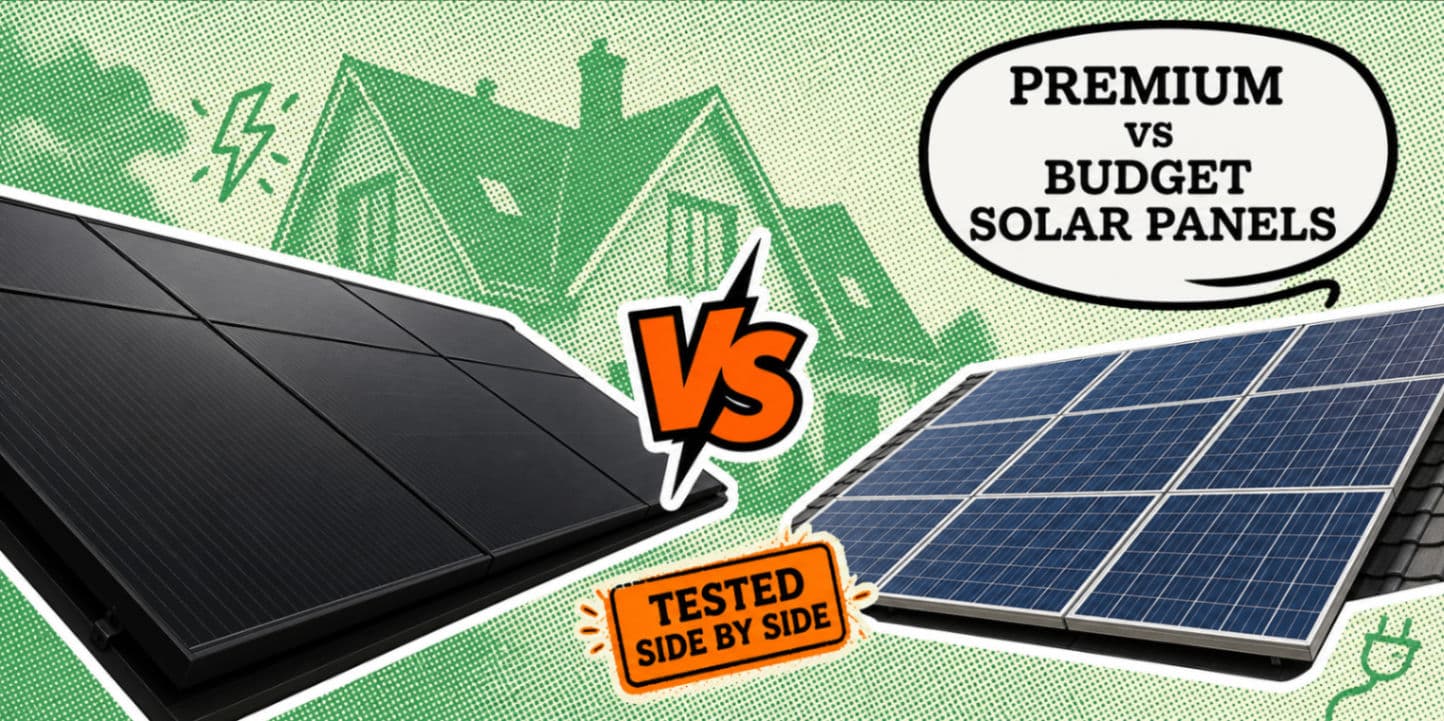

Are Premium Solar Panels Worth It? We Tested Two 480W Panels...
A 480W solar panel is a 480W solar panel. Right?
Not necessarily.
The power rating printed on a panel’s specification sheet tells you how it performs under standardised test conditions.
It doesn’t tell you quite as much about what will happen on a hot roof in Cheshire, during a downpour or after several years of British weather.
That leaves homeowners with a fairly important question: is it worth paying more for premium solar panels, or are you better off choosing the cheapest panel with the same headline wattage?
We decided to find out.
PS We offer MCS-certified solar panel installation nationwide. Simply answer these questions, get your fixed price and arrange your free design.
The short answer:
Yes, based on our test, the premium panel was worth the extra cost.
Across 65 complete days of testing, a 480W LONGi Hi-MO X10 produced 132.35kWh, compared with 127.98kWh from a 480W UKSOL panel.
That gave the LONGi a 3.4% real-world energy advantage, despite both panels carrying exactly the same power rating.
The difference became more pronounced in sunny and hot conditions, suggesting the LONGi’s lower temperature coefficient and HPBC 2.0 cell design were making a measurable difference.
For a typical 12-panel system, our admittedly cautious long-term calculation suggested that roughly £168 of additional panel cost could return around £1,060 in extra electricity value over 30 years.
This was a limited real-world comparison, not a controlled laboratory test, so those numbers shouldn’t be treated as a guaranteed return. They do, however, show why comparing panels by wattage alone can be misleading.
What did we test?
We installed two panels side by side in the grounds of Heatable HQ:
A LONGi Hi-MO X10 480W panel using HPBC 2.0 back-contact technology
A UKSOL 480W N-type TOPCon panel
Both panels faced south and were installed at the same angle on an identical ballasted flat-roof mounting system.
Each panel was connected to an identical 450W microinverter and fed into the same property.
Neither panel was shaded, and both experienced the same temperature, rainfall and sunshine.
In other words, we made the setup as fair as a real-world garden experiment could reasonably be.
The only meaningful variable was the panel.
🎥 Prefer video? Check out our Youtube video comparing the panels below:
How much did the panels cost?
At the time of our test, the prices before VAT and delivery were approximately:
Panel | Approximate price |
LONGi Hi-MO X10 480W | £87 |
UKSOL 480W | £72.91 |
Difference per panel | Around £14 |
Difference across 12 panels | Around £168 |
That makes the LONGi roughly 19% more expensive at panel level.
However, the panel price is only one part of a solar installation. Scaffolding, roof fixings, mounting rails, electrical equipment and labour are required whichever module you choose.
Consequently, paying around £14 more for a panel does not make the complete installation 19% more expensive. The effect on the overall system price is considerably smaller.
The LONGi also uses less roof space
Although both panels were rated at 480W, they weren’t the same size.
The UKSOL panel measured approximately 1,909mm by 1,134mm. The LONGi delivered the same rated power from a footprint around 6% smaller.
That distinction matters on domestic roofs.
If roof space is limited, a more efficient panel may allow an installer to fit more generating capacity into the usable area.
A cheaper but larger panel might save money per module while limiting the total capacity of the system.
Wattage tells you how much power a panel is rated to produce. Efficiency tells you how much roof area it needs to do it.
The results after 65 complete days
The experiment ran for 83 days, beginning on 23 April.
Unfortunately, our groundskeeper cut through the monitoring cable. Then, having established that this was possible, managed to do it again.
Days affected by those interruptions were removed, leaving us with 65 full days of comparable production data.
Here are the headline results:
Result | LONGi Hi-MO X10 | UKSOL |
Total generation | 132.35kWh | 127.98kWh |
Average recorded peak output | 382.5W | 375.7W |
Overall difference | +4.37kWh | - |
Percentage advantage | +3.4% | - |
The 4.37kWh difference may look modest, but remember that this came from one panel over a little more than two months.
It also represents a genuine 3.4% uplift from two products carrying the same 480W rating.
Was the microinverter limiting either panel?
Both 480W panels were connected to 450W microinverters, which raises an obvious question: could inverter clipping have affected the result?
Clipping occurs when a solar panel produces more power than its inverter can process. Any production above the inverter’s limit is effectively cut off.
In this test, the average recorded peaks were 382.5W for the LONGi and 375.7W for the UKSOL. Both remained comfortably below the 450W inverter ceiling.
There was no evidence that either panel was being meaningfully capped, so the observed difference appears to have come from the panels rather than the downstream equipment.
What happened in sunny and cloudy weather?
We matched the generation data against sunshine, rainfall and temperature readings from a nearby weather station.
The pattern was revealing:
Across 39 sunnier days, the LONGi’s average lead was 3.76%
Across 26 cloudier days, its average lead fell to 1.95%
The premium panel’s advantage was therefore almost twice as large during sunnier conditions.
That doesn’t mean the LONGi won every individual day. On the wettest and cloudiest day in the test, the UKSOL generated 0.47kWh while the LONGi produced 0.45kWh.
That was a tiny amount of energy and only one day, but it is a useful reminder that solar performance is variable. A single sunny or rainy day cannot tell you which panel is better.
The overall pattern matters far more.
Heat appears to be where the LONGi pulled ahead
Solar panels like sunlight, but they don’t particularly like heat.
As the cells become hotter, their output typically falls.
The amount lost is represented by the panel’s temperature coefficient: the less negative the figure, the better the panel should retain its output as temperatures rise.
LONGi publishes a power temperature coefficient of -0.26% per °C for the Hi-MO X10. The company positions this as one of the advantages of its HPBC 2.0 cell technology.
Our results appeared to support that claim.
On 26 June, when the local weather station recorded a temperature approaching 33°C, the panels produced:
LONGi: 2.55kWh
UKSOL: 2.42kWh
That gave the LONGi a 5.37% lead.
We then grouped the ten hottest days rather than relying on one isolated result:
Ten hottest days | Electricity generated |
LONGi | 26.56kWh |
UKSOL | 25.53kWh |
LONGi advantage | 1.03kWh, or around 4% |
The LONGi’s average daily advantage during those hot days was about 50% larger than its average absolute daily lead across the complete test.
That doesn’t prove how every LONGi panel will perform on every roof, but it is consistent with the manufacturer’s published claims about high-temperature performance.
What could the extra generation be worth?
Over the 65 complete days, the LONGi produced an additional 4.37kWh.
That works out at approximately:
4.37kWh ÷ 65 days = 0.067kWh extra per panel, per day
If that rate continued for a year:
0.067kWh × 365 = approximately 24.5kWh extra per panel
Across a 12-panel system:
24.5kWh × 12 = approximately 294kWh extra per year
At an illustrative electricity price of 27p per kWh, using every additional unit in the home would make that electricity worth around £79 per year.
However, simply multiplying that figure by 30 years would be far too optimistic.
Our test took place during relatively productive months, electricity prices will change, panels degrade and most households won’t use every extra unit themselves.
So, we deliberately made the calculation more pessimistic.
We halved the projected energy advantage to approximately 147kWh per year for a 12-panel array. At 27p per kWh, that would be worth about £39.70 annually.
Over 30 years, and after applying a further broad reduction for degradation, the additional electricity would have an illustrative value of around £1,060.
Compared with an initial panel premium of approximately £168, that leaves roughly £893 of additional value.
This is an illustration, not a financial forecast. It doesn’t account for discount rates, changing tariffs, export payments, maintenance, panel-to-panel variation or the precise amount of solar electricity used in the home.
What it demonstrates is that a small improvement in annual generation can compound over the working life of a solar system.
Other reasons to consider a premium panel
Energy yield is not the only factor separating solar panels.
More power from a smaller roof area
The LONGi produced the same rated wattage from a smaller footprint. On a constrained roof, that could allow more total capacity to be installed.
Better performance in hot conditions
Our data showed a larger advantage on the hottest days. LONGi’s published specification gives the Hi-MO X10 a -0.26% per °C power temperature coefficient.
Partial-shading technology
LONGi says its Shading Optimizer design allows current to bypass affected cells rather than sacrificing a much larger section of the panel.
The aim is to reduce power loss and localised overheating when part of a module is shaded.
Our experiment did not test partial shading, so we cannot verify that feature from our own results.
Long-term warranty cover
Panel warranties can include separate product and performance guarantees, and the terms can differ by model and installer.
The Hi-MO X10 carries a 30-year published power warranty, but homeowners should check the exact product warranty included in their installation quote.
Manufacturer stability
A long warranty is only useful if there is a credible company standing behind it.
Manufacturing scale, financial stability, UK support and an established supply chain should all form part of a panel comparison.
Limitations of our test
We want to be clear about what this experiment can and cannot establish.
It compared one example of each panel, in one location, during 65 complete days between spring and summer. It was a real-world observational test rather than an independent laboratory study.
The results could be influenced by normal manufacturing tolerances, and they do not include a complete British winter. We also did not test degradation, partial shading, snow loading or long-term reliability.
A longer experiment involving multiple panels of each type would produce stronger evidence.
Still, the setup was consistent, neither inverter was clipping and the overall results aligned with the expected difference in high-temperature performance.
That makes the findings useful, provided they are treated as evidence from one practical comparison rather than a universal guarantee.
So, are premium solar panels worth it?
In this test, yes.
The LONGi cost around £14 more per panel but:
Generated 3.4% more electricity overall
Produced the same rated wattage from a smaller area
Extended its lead during hot and sunny conditions
Offers technology intended to reduce partial-shading losses
Comes with long-term performance cover
The cheaper UKSOL panel still performed perfectly respectably. It generated only 4.37kWh less across the test and even edged ahead on one extremely gloomy day.
But solar panels are expected to remain on a roof for decades.
When scaffolding, mounting equipment and labour already form a significant part of the installation cost, saving a relatively small amount on the component responsible for generating the electricity may be a false economy.
Our conclusion is simple: don’t choose a solar panel by headline wattage alone.
Look at its efficiency, physical size, temperature coefficient, degradation rate, warranty and expected lifetime output.
A premium panel doesn’t need to produce dramatically more electricity each day to justify its price. It only needs to produce a little more, consistently, for a very long time.
Next Steps For Your Solar Journey:
When planning to install solar panels for your home, there are several important factors to consider. Make sure to refer to the following guides to help you make informed decisions:
To dive deeper into these topics, head over to our advice section, check out our YouTube channel for informative videos, or read a customer case study to see how others have benefited from their solar installation.
Get a Quote for Solar Today
Without boasting you should get your solar installed with us, here's why:
Thousands of Happy Customers: We boast an average score of 4.9 on Trustpilot, outperforming the market leader.
Which? Trusted Trader: Heatable is proudly recognised as a Which? Trusted Trader.
MCS Accredited: Our accreditation by the Microgeneration Certification Scheme (MCS) ensures high-quality standards.
Exclusive Panels: We offer REA Fusion solar panels, available only through Heatable.
Consumer Protection: As members of the HIES consumer code, we provide 2-year deposit protection.
Flexible Payment Options: Choose from multiple payment methods, including finance options.
Fixed Price Guarantee: Enjoy transparency with no hidden costs.
Save Your Quote: You can save your quote and decide later.
Bespoke Design Tool: Draw your own conclusion (literally) on whether solar is worth it for you, here.